Class 9 Social Science Chapter 4 Important Questions and Answers on Governance and Public Policy
The Class 9 Chapter 4 Governance and Public Policy Important Questions PDF covers government and governance, public welfare, policy-making stages, stakeholders and digital public services.
Students can use this Class 9 Social Science Part 2 Chapter 4 question-answer collection on Governance and Public Policy to understand key concepts and practise MCQs, short answers and case-based questions. The chapter PDF also helps students revise important definitions, policy-making stages and the roles of citizens.
Class 9 Chapter 4 Social Science Important Questions MCQs
1. Which term refers to the process of decision-making and implementation?
A) Government
B) Governance
C) Legislature
D) Judiciary
Answer: B) Governance
2. Which feature of good governance means that public resources are used wisely?
A) Transparency
B) Responsiveness
C) Effectiveness
D) Inclusiveness
Answer: C) Effectiveness
3. Which of these is an example of a public policy?
A) A school’s policy on the use of mobile phones
B) A company’s work-from-home policy
C) A housing society’s rules for parking vehicles
D) The government’s introduction of free vaccination for children
Answer: D) The government’s introduction of free vaccination for children
4. In which stage of the policy cycle does the government frame the legislation and regulations?
A) Policy Formulation
B) Policy Adoption
C) Policy Implementation
D) Policy Evaluation
Answer: B) Policy Adoption
5. Who chaired the expert committee, set up in 2017, that drafted the National Education Policy (NEP) 2020?
A) Dr K. Kasturirangan
B) Dr A. P. J. Abdul Kalam
C) Dr S. Radhakrishnan
D) Dr M. S. Swaminathan
Answer: A) Dr K. Kasturirangan
6. In the Khelo Bharat Niti 2025, what does the Union Government mainly provide?
A) Coaching and training for athletes
B) Sports events and camps at block level
C) The policy framework and funding
D) Sponsorship for sports teams
Answer: C) The policy framework and funding
Class 9 Social Science Chapter 4 Very Short Answer Questions
7. What is Rājadharma?
Answer: Rājadharma was the foremost duty of an ideal king. The king had to protect the people by upholding Dharma (righteous duty) and promoting society's welfare.
8. Name any four features of good governance.
Answer: Responsiveness, transparency, participation, the rule of law, accountability, effectiveness and inclusiveness. (Any four.)
9. What does the word ‘public’ mean in public policy?
Answer: The word ‘public’ refers to all the people living in a society or community. A policy becomes a public policy when the government makes it for the public benefit, public institutions implement it, and public money collected through taxes often pays for it.
10. Why does the government monitor and evaluate a public policy?
Answer: The government monitors and evaluates a policy to check whether it is achieving its objectives. It uses the feedback from citizens and other stakeholders to improve the policy over time.
Class 9 Social Science Part 2 Chapter 4 Short Answer Questions
11. How do Indian institutions use traditional ideas and values of governance? Give examples.
Answer: Since Independence, Indian institutions have drawn on traditional ideas and values and adapted them to a modern democracy.
The British ‘Order of the Star of India’ used the phrase ‘Heaven’s Light, Our Guide’. After Independence, India adopted ‘Satyamev Jayate’ (Truth alone triumphs) from the Muṇḍaka Upaniṣhad as the national motto.
The Supreme Court of India has the motto ‘Yato Dharmastato Jayaḥ’ from the Mahābhārata. It means ‘Where there is Dharma (righteous duty), there is victory’.
The Sengol, a cultural marker of rulership and good governance, comes from the Chola tradition. Jawaharlal Nehru received it at midnight on 15 August 1947, and in 2023 it was placed in India’s new Parliament building.
Mahatma Gandhi imagined an ideal model of governance as Rām Rājya, based on probity, transparency, compassion, welfare and a people-centric approach.
12. How is a public policy different from the policy of a school or a company? Why do people play an important role in shaping public policy?
Answer:
Schools, companies, hospitals, sports clubs and families often have their own policies. These policies apply only to a particular organisation or a limited group of people. For example, a school may have a policy on mobile phone use.
Governments make public policies to address issues that affect society on a larger scale. A public policy applies to everyone, uses public resources, promotes public welfare, and involves people in shaping it.
Public policy responds to people's needs and aspirations. People identify issues, express their concerns, take part in consultations, give suggestions, and share feedback after the policy is implemented. Governments use this feedback to improve policies.
13. What is the difference between a policy, a programme and a scheme? Explain with the example of the National Health Policy 2017.
Answer:
A policy is a broad goal or direction that the government adopts to address an important public issue. It tells us what the government wants to achieve and why.
A programme explains the plan or approach for achieving that goal.
A scheme is a specific action through which the programme is implemented, so that its benefits reach the people.
In simple terms, policy provides direction, programmes provide the plan, and schemes put the plan into action.
Example: The National Health Policy 2017 sets goals such as universal access to good quality healthcare. A programme like ‘Universal access to comprehensive healthcare’ turns this goal into an action area. Schemes like Ayushman Bharat Pradhan Mantri Jan Arogya Yojana (AB-PMJAY) and Janani Suraksha Yojana give concrete benefits to specific groups.
14. Name any four contributors to policy-making and implementation. Explain the role of each with an example.
Answer:
Citizens: They identify problems, vote, participate, give suggestions and provide feedback. For example, residents request a zebra crossing near a school.
Elected representatives: They represent people, raise public issues, take part in law-making and approve budgets. For example, an MLA raises the issue of drinking water shortage in the Assembly.
Government officials, departments and ministries: They prepare and implement policies and programmes, coordinate departments, deliver public services and monitor progress. For example, a district collector coordinates the implementation of a government scheme in the district.
Civil society organisations, NGOs, experts, researchers, and the media: They study problems, suggest solutions, raise awareness, monitor programmes, and provide feedback. For example, an NGO conducts a water-conservation campaign.
The private sector (for example, a company installing solar panels in government schools through a public-private partnership) and international organisations (for example, the World Health Organisation helping countries control infectious diseases) also contribute.
Class 9 Social Science Chapter 4 Long Answer Questions
15. What is good governance? Explain its features and the challenges to it. How does e-governance help?
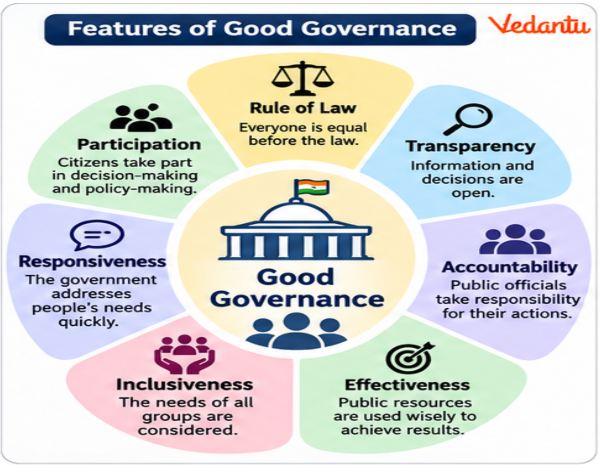
Answer:
Good governance helps maintain law and order, protects citizens' rights and freedoms, and helps people access public services such as education, healthcare, and transport. It promotes justice and fairness, ensures that people are treated equally before the law, and builds trust between citizens and the government.
Features of good governance include responsiveness, transparency, participation, the rule of law, accountability, effectiveness, and inclusiveness.
Good governance is the government’s responsibility, but it also depends on other groups. Citizens elect their representatives, follow the law and take part in public life. The media helps people understand public issues. Civil society organisations raise awareness about social concerns. The private sector contributes through economic activity and innovation.
Challenges: Weak coordination between institutions and departments hinders programme implementation. Unequal access to public services leaves some groups behind. Malpractices and misuse of public office prevent benefits from reaching people. Misinformation and fake news also pose a serious challenge.
E-governance means governments use information and communication technology to provide public services, share information, communicate with citizens, receive feedback, and improve administrative processes. It makes governance more transparent, accessible, convenient, and quick; reduces paperwork; and lets people access services without visiting government offices. It works well only when people have digital devices, reliable internet and the skills to use them, so the government must keep digital services inclusive.
16. Explain the stages of the policy cycle. Use the hospital ramp case study as an example.
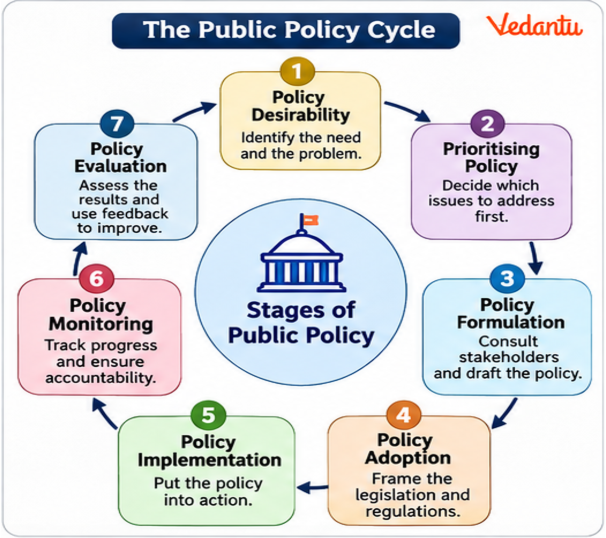
Answer: A public policy develops through a systematic process, not a single decision. The key stages are:
Policy desirability: Decide what needs and problems the policy must address.
Prioritising policy: Decide which issues the government must address first.
Policy formulation: Consult stakeholders, draft the policy and assess its financial feasibility.
Policy adoption: Frame the legislation (laws governing the policy) and regulations (rules and guidelines).
Policy implementation: Put the policy into action through government officials, local bodies, civil society organisations, private organisations and citizens.
Policy monitoring: Measure the policy’s progress, ensure accountability and identify shortcomings.
Policy evaluation: Assess the policy's results and impact, and generate feedback. The government uses this feedback to improve the policy.
Example: In the hospital ramp case study, patients and their families realise that the hospital is not accessible to everyone and raise the issue with the hospital authorities and representatives. A disability rights organisation highlights the problem through newspapers and social media. The district administration asks the Public Works Department (PWD) and the Health Department to inspect the hospital. After consulting doctors, hospital staff, architectural experts, organisations of persons with disabilities, senior citizens and residents, the government prepares a plan and approves the funds needed to construct ramps, lifts, handrails, tactile pathways, accessible toilets and clear signboards.
17. Explain how different stakeholders coordinate in the Khelo Bharat Niti 2025. What role do citizens play in good governance?
Answer: The Government of India launched the Khelo Bharat Niti in 2025 to transform India’s sports landscape. Its success depends on the coordination of many stakeholders:
Union Government: It provides the broader policy framework and funding, and identifies funding sources for agencies at the state, district, and block levels.
State governments: They strengthen sporting ecosystems through initiatives like the ‘Model Sports State’, host major national games and tournaments, and attract private investment through the public-private partnership (PPP) model to build sports infrastructure.
Districts and blocks: Districts work to become ‘Model Sports Districts’ by improving their sports capabilities. Blocks organise sporting programmes regularly to attract mass participation and find talent.
Sports promotion institutions: They provide coaching, training, equipment and facilities.
Private organisations: They sponsor sportspersons and sports teams and invest in research on better nutrition, equipment and medical facilities.
Citizens and families: They encourage children, especially girls, to take up sports, and they give feedback and support local talent.
In good governance, citizens vote, follow laws, raise concerns, take part in public affairs and give feedback on government services. In this way, they help improve the way public institutions work.
Key Concepts for Class 9 Social Science Chapter 4 Important Questions and Answers
The Class 9 Social Science Chapter 4 Important Questions and Answers cover the meaning of governance, the role of public institutions and the steps involved in making public policies. Students should understand these concepts before writing their answers.
Understand Governance and Public Policy Through Everyday Examples
The government's work does not stop after making a decision. Government departments and public institutions must put the decision into action, check whether it is working and address people's problems. The examples below show how this happens in everyday life.
These examples show why public participation, coordination and feedback are important parts of good governance.
How to Practise Governance and Public Policy Class 9 Important Questions
To prepare for Class 9 Chapter 4 Governance and Public Policy Important Questions and Answers, focus on key terms, differences between concepts, the policy cycle and textbook examples using the steps below.
Learn important terms: Write short definitions of governance, public policy, accountability, transparency and policy implementation.
Understand the differences: Compare government and governance, and distinguish a policy from a programme and scheme.
Study the policy cycle: Learn the order of the stages and explain the purpose of each stage.
Use textbook examples: Refer to the hospital ramp case study, NEP 2020 and Khelo Bharat Niti 2025 when answering detailed questions.
Practise case-based questions: Identify the public problem, the people involved, the action taken and the feedback required.
Check your answers: Attempt the Class 9 Social Science Chapter 4 Important Questions and Answers without looking at the solutions first.
How Vedantu Helps Students Practise Class 9 Social Science Questions
Vedantu's Class 9 Social Science Chapter 4 Important Questions and Answers help students practise definitions, examples and explanations from the textbook.
Students can use the questions in the following ways:
MCQs: Check their understanding of governance, public policy and policy-making.
Very short answers: Practise direct explanations of important terms and principles.
Short answers: Explain differences, give examples and describe the roles of stakeholders.
Long answers: Organise responses with clear points on governance, challenges and policy implementation.
Chapter PDF: Use the Class 9 Chapter 4 Governance and Public Policy Important Questions PDF to read and practise questions.
Additional resources: Use revision notes and NCERT Solutions to understand difficult concepts before attempting the questions.
Important Study Material Links for Class 9 Social Science Part 2 Chapter 4 Governance and Public Policy
Students can use the following resources along with the Class 9 Social Science Part 2 Chapter 4 question answers on Governance and Public Policy.
Class 9 Social Science Chapter-Wise Important Questions
Students can practise important questions from other chapters of Understanding Society: India and Beyond.
Important Study Materials for CBSE Class 9 Social Science
FAQs on Important Questions for Class 9 Social Science (Understanding Society: India and Beyond – Part II) Chapter 4 Governance and Public Policy | 2026-27
1. When is National Good Governance Day celebrated in India?
India observes National Good Governance Day on 25 December every year to mark the birth anniversary of former Prime Minister Atal Bihari Vajpayee. The day highlights the importance of transparent, accountable and effective governance.
2. What is the difference between transparency and accountability in good governance?
Transparency means that government decisions and information are open and accessible to the public. Accountability means that public officials must take responsibility for their actions and decisions. Both help citizens understand how public institutions work.
3. What is CPGRAMS, and how does it help citizens?
CPGRAMS stands for Centralised Public Grievance Redressal and Monitoring System. It is an online platform where citizens can submit complaints about public services and track their status. It helps government departments address grievances and improve service delivery.
4. What is the role of Government e-Marketplace (GeM) in e-governance?
Government e-Marketplace (GeM) is an online platform where government departments and public organisations can purchase goods and services. It makes government purchasing more transparent, efficient and accessible to sellers.
5. How many marks does Governance and Public Policy carry in Class 9 Social Science exams?
CBSE does not prescribe a separate fixed mark allocation for Governance and Public Policy in Class 9 school examinations. The number of questions and marks may vary according to the school's question paper. Students should prepare MCQs, short answers, long answers and case-based questions.
6. Where can students download Class 9 Chapter 4 Governance and Public Policy important questions PDF?
Students can access the Class 9 Chapter 4 Governance and Public Policy important questions PDF on Vedantu. It includes solved MCQs, very short answers, short answers and long answers based on important chapter topics. Students can also use Vedantu's NCERT Solutions and revision notes to prepare for exams.