Explore the Chola Empire and the Battles of Tarain in Class 7 Social Science Chapter 4
Use the Turning Tides: 11th and 12th Centuries PDF for offline practice. Work through the extra questions to compare the reigns of Rajaraja Chola I and Rajendra Chola I, explain the impact of Mahmud of Ghazni’s campaigns and trace how the outcome at Tarain changed between 1191 and 1192.
Class 7 Social Science Part 2 Chapter 4 Important MCQs with Answers
Q1. Which dynasty ruled much of Bengal from its capital at Nadiya?
A. Cholas
B. Senas
C. Chahamanas
D. Western Chalukyas
Answer: B. Senas.
Q2. Which dynasty began the construction of the Jagannatha Temple at Puri?
A. Eastern Gangas
B. Rashtrakutas
C. Pallavas
D. Chahamanas
Answer: A. Eastern Gangas.
Q3. Which work by Bhaskaracharya teaches mathematics through problems and riddles?
A. Gitagovindam
B. Kitab al-Hind
C. Lilavati
D. Harshacharita
Answer: C. Lilavati.
Q4. Which ruler made Ajayameru, now called Ajmer, his dynastic capital?
A. Rajendra Chola I
B. Mahmud of Ghazni
C. Muhammad Ghuri
D. Prithviraj Chauhan’s dynasty, the Chahamanas
Answer: D. The Chahamanas.
Class 7 Social Science Part 2 Chapter 4 Very Short Answer Questions
Q5. Who was al-Biruni, and what did he study in India?
Answer
Al-Biruni was a Persian scholar who studied Indian languages, beliefs, customs, mathematics and astronomy. He recorded his observations in Kitab al-Hind.
Q6. What does the title ‘Gangaikondachola’ mean, and who adopted it?
Answer
It means “the Chola who conquered the Ganga”. Rajendra Chola I adopted the title to commemorate his victories in northern India.
Q7. Who wrote the Gitagovindam, and whom is it about?
Answer
Jayadeva wrote the Gitagovindam. It tells the story of Krishna and Radha.
Q8. Which Chola ruler built the Brihadishvara Temple, and where is it located?
Answer
Rajaraja Chola I built the Brihadishvara Temple at Thanjavur in present-day Tamil Nadu.
Class 7 Social Science Part 2 Chapter 4 Short Answer Questions
Q9. How did Mahmud of Ghazni’s campaigns differ from those of Muhammad Ghuri?
Answer
Q10. What does Rajaraja Chola I’s support for a Buddhist monastery at Nagapattinam reveal about his rule?
Answer
Rajaraja Chola I was a devotee of Shiva and built the Brihadishvara Temple. He also helped a Srivijaya ruler establish a Buddhist monastery at Nagapattinam. This shows that his support extended to a different religious tradition and that the Cholas had ties with rulers across the Bay of Bengal.
Q11. A historian wants to understand both what a king claimed and how a visiting scholar saw Indian society. Which sources from the chapter could help?
Answer
Royal inscriptions record the titles, conquests and achievements that rulers wanted to make known.
Al-Biruni’s account describes Indian learning, beliefs and customs from a visiting scholar’s perspective.
Reading them together helps the historian compare what rulers emphasised with what a traveller chose to observe and record.
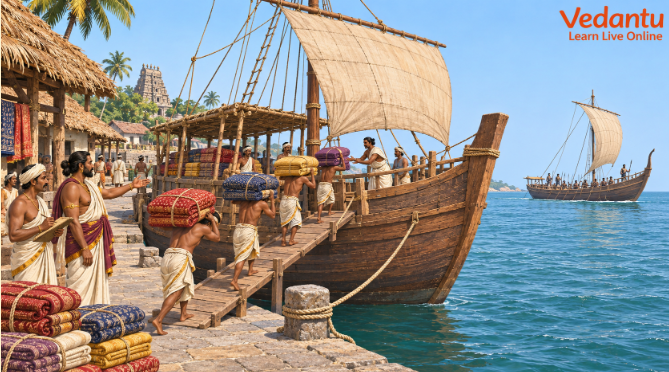
Q12. Look at the illustration of a port in the Chola period. How could a powerful navy help merchants who depended on overseas trade?
Answer
Merchants relied on sea routes to reach overseas markets and carry goods.
A strong navy allowed the Cholas to respond when access to an important trade route was threatened.
Rajendra Chola I’s expedition against Srivijaya shows how naval power and the interests of merchant groups could be linked.
Class 7 Social Science Part 2 Chapter 4 Long Answer Questions
Q13. Explain how Rajaraja Chola I and Rajendra Chola I expanded Chola power on land and at sea.
Answer
Rajaraja expanded Chola rule in southern India. He conquered parts of present-day Karnataka and Andhra Pradesh.
He extended Chola power across the sea. He conquered northern Sri Lanka, including the kingdom of Anuradhapura.
Rajendra led a campaign towards the Ganga. He adopted the title Gangaikondachola and built a new capital at Gangaikondacholapuram.
He sent a fleet against Srivijaya. The expedition challenged a power that controlled important sea passages used by merchants.
The expedition had a different outcome from territorial conquest. Rajendra defeated Srivijaya’s forces but did not establish permanent rule over its empire.
Q14. Compare the two Battles of Tarain and explain how the second battle changed the balance of power in northern India.
Answer
After his victory in 1192, Ghuri captured Delhi. He left commanders such as Qutb-ud-din Aibak to strengthen and expand his control. This helped lay the foundation for the Delhi Sultanate.
Q15. Explain how learning, literature and architecture continued to develop during the political changes of the 11th and 12th centuries. Give examples from the chapter.
Answer
Mathematics and astronomy — Bhaskaracharya wrote works such as Lilavati and Bijaganita. He used examples, problems and explanations to teach mathematical ideas.
Literature — The Senas supported scholars and poets in Bengal. Jayadeva’s Gitagovindam is an example of devotional literature from this period.
Temple architecture — Rajaraja Chola I built the Brihadishvara Temple at Thanjavur, while the Eastern Gangas began building the Jagannatha Temple at Puri.
Exchange across the sea — A Srivijaya ruler supported a Buddhist monastery at Nagapattinam with help from Rajaraja. This shows that religious ties accompanied trade across the Bay of Bengal.
These examples show how scholars, poets, builders and rulers contributed to cultural life across different regions during a period of political change.
Understand What Changed in Turning Tides: 11th and 12th Centuries
In Turning Tides, power changed in different ways across India. The Cholas expanded their influence on land and at sea, while the Battles of Tarain changed who held power in parts of northern India. Use these Class 7 Social Science Part 2 Chapter 4 important questions to understand what happened and why each event mattered.
How to Use Vedantu’s Turning Tides Extra Questions for Class 7
Vedantu’s Turning Tides: 11th and 12th Centuries extra questions give you 15 solved questions to practise after reading Chapter 4. Use the set to check what you remember and practise explaining why events mattered.
Find the questions you need. Go to the questions section above. Start with MCQs to check names and dates, or jump to the short and long answers to practise explaining events in your own words.
Try an answer before you read the solution. For the Battles of Tarain question, write who won each battle and what changed after the second one. Then use the answer table to check whether you explained the outcome as well as naming the winners.
Save the questions for offline practice. Download the Class 7 Social Science Chapter 4 questions and answers PDF from the download section above. Mark the questions you found difficult and try them again later with the answers covered.
Class 7 Social Science Part 2 Chapter 4 Turning Tides: 11th and 12th Centuries Study Materials
Class 7 Social Science Chapter-wise Important Questions
Important Study Materials for CBSE Class 7 Social Science
FAQs on Important Questions for Class 7 Social Science (Exploring Society: India and Beyond Part 2) Chapter 4 Turning Tides: 11th and 12th Centuries | 2026-27
1. What do Vedantu’s Turning Tides: 11th and 12th Centuries extra questions cover?
The set includes 15 solved questions on topics such as Chola expansion, the Battles of Tarain, and the period’s literature, architecture and cultural connections. It includes MCQs, very short answers, short answers and long answers.
2. Where can I download the Class 7 Social Science Chapter 4 questions and answers PDF?
Use the PDF download section above the questions on this Vedantu page. You can save the PDF and attempt the questions offline before checking the answers.
3. How can I remember the difference between the two Battles of Tarain?
Remember the order of the winners. Prithviraj Chauhan won the first battle in 1191, and Muhammad Ghuri won the second in 1192. If a question asks why the second battle mattered, add that Ghuri’s victory helped expand his control in northern India.
4. What should I write if a question asks how the Cholas expanded by land and sea?
Give one point for each. Explain how military campaigns extended Chola control on land, then describe how their navy allowed them to carry out campaigns across the sea.
5. How can I answer the Chola port picture question in Chapter 4?
Pick out a visible clue, such as cargo being loaded onto a ship. Explain what it shows about trade, then connect it to why naval power mattered for a kingdom with overseas links.
6. How much detail should I give in a short answer on Turning Tides?
Follow the wording of the question. If it asks for two reasons, give two distinct points and explain each briefly. If it asks you to name a ruler or give a date, a direct answer is enough.
7. How can I organise a long answer on learning and culture in the 11th and 12th centuries?
Group your points under ideas such as literature, architecture and cultural exchange. Give a specific example from the chapter for each point you include and explain what it shows.
8. Can I use these extra questions after completing the textbook exercises?
Yes. Choose a topic you found difficult in the textbook exercises and attempt a related question from this set. Compare your response with the solved answer to see whether you missed a fact, a reason or an example.