

CBSE Class 4 Maths Chapter 11 Important Questions and Answers – Fun with Symmetry
The following questions cover the chapter's main concepts and hands-on activities. Use a mirror, paper cutouts or a dot grid wherever needed to check your answers.
Multiple Choice Questions (MCQs) for Class 4 Maths Chapter 11
Q1. Which of these shapes has exactly four lines of symmetry?
A. Rectangle that is not a square
B. Square
C. Equilateral triangle
D. Scalene triangle
Answer: B. Square
Explanation: A square has four lines of symmetry: one vertical, one horizontal and two diagonal.
Q2. A sheet of paper is folded in half, and colour is pressed between the two halves. What will happen when the paper is opened?
A. Both halves will have unrelated patterns.
B. The colours will disappear.
C. The design can form matching patterns on both sides of the fold.
D. Only one half will have colour.
Answer: C. The design can form matching patterns on both sides of the fold.
Q3. Which of these shapes has no line of symmetry?
A. Square
B. Circle
C. Rectangle
D. Scalene triangle
Answer: D. Scalene triangle
Explanation: A scalene triangle has sides of different lengths and no line that divides it into matching mirror halves.
Q4. Which word looks the same in a vertical mirror when written in suitable capital block letters?
A. CAT
B. MOM
C. PEN
D. DOG
Answer: B. MOM
Explanation: M and O have vertical symmetry, and MOM reads the same when reflected across its centre line in suitable block lettering.
Q5. Which action changes the direction of a tile without changing its shape or size?
A. Cutting
B. Stretching
C. Rotating
D. Tearing
Answer: C. Rotating
Very Short Answer Questions for Class 4 Maths Chapter 11
Q6. What is a line of symmetry?
Answer: A line of symmetry divides a shape into two matching halves that fit exactly when folded along the line.
Q7. How many lines of symmetry does a rectangle that is not a square have?
Answer: Two lines of symmetry: one vertical and one horizontal.
Q8. How many lines of symmetry does an equilateral triangle have?
Answer: Three lines of symmetry.
Q9. A square piece of paper is folded along its vertical centre line. How many equal halves are formed?
Answer: Two halves.
Q10. What is the name of a pattern made by repeating shapes to cover a surface without gaps or overlaps?
Answer: A tessellation, also called a tiling pattern.
Short Answer Questions for Class 4 Maths Chapter 11
Q11. Look at the following shapes. Write the number of lines of symmetry for each.
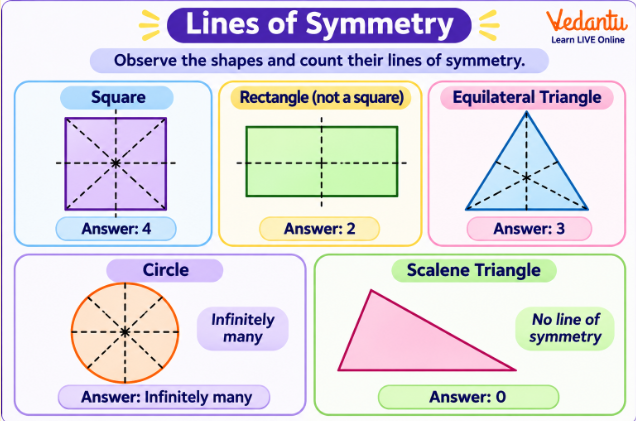
a) Square
b) Rectangle that is not a square
c) Equilateral triangle
d) Circle
e) Scalene triangle
Solution:
Q12. A paper aeroplane is folded so that its left and right wings match.
a) Where is its line of symmetry?
b) How can you check whether the wings are symmetrical?
c) What happens if one wing is folded differently?
Solution:
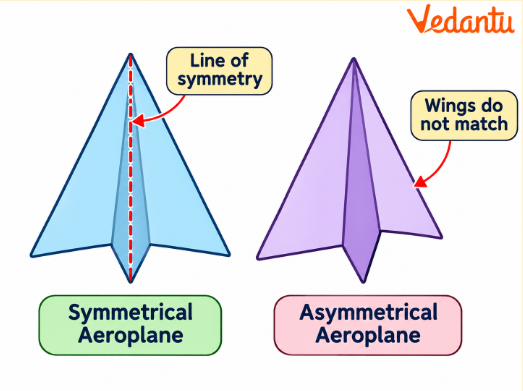
a) The line of symmetry runs along the centre fold from the nose to the back of the aeroplane.
b) Fold the aeroplane along the centre line. The wings should overlap.
c) The wings will no longer match exactly, so the aeroplane becomes asymmetrical. Its flight may also change.
Answer: A symmetrical paper aeroplane has matching wings on either side of its centre fold.
Q13. A square piece of paper is folded once along the middle. A small triangular piece is cut from the folded edge. What happens when the paper is opened?
Solution:
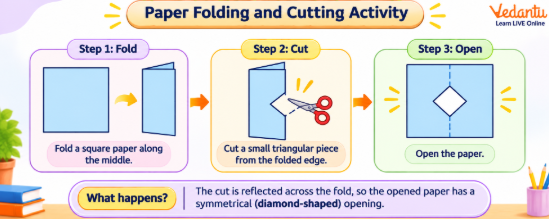
The cut is reflected across the fold. When the paper opens, the two matching halves of the cut form a symmetrical opening.
For example, if a triangular notch is cut from the folded edge, opening the paper can produce a diamond-shaped hole.
Answer: The opening is symmetrical about the fold line.
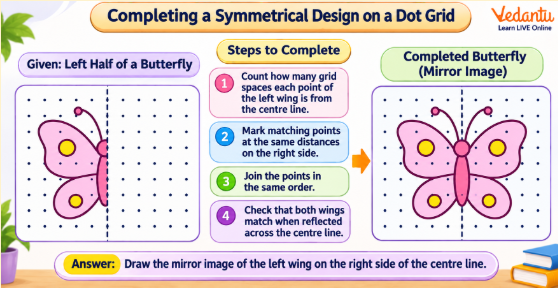
Q14. A dot-grid design shows the left half of a butterfly and a vertical line through its centre. How will you complete the right half?
Solution:
Count how many grid spaces each point of the left wing is from the centre line.
Mark matching points at the same distances on the right side.
Join the points in the same order.
Check that both wings match when reflected across the centre line.
Answer: Draw the mirror image of the left wing on the right side of the centre line.
Q15. Why is the word AMBULANCE written in reverse on the front of many ambulances? Explain using mirror reflection.
Solution:
A rear-view mirror reverses the left and right appearance of writing. Writing AMBULANCE in reverse on the vehicle allows drivers in front to read the word correctly in their rear-view mirrors.
Answer: The reversed lettering helps drivers recognise an ambulance quickly in their rear-view mirrors.
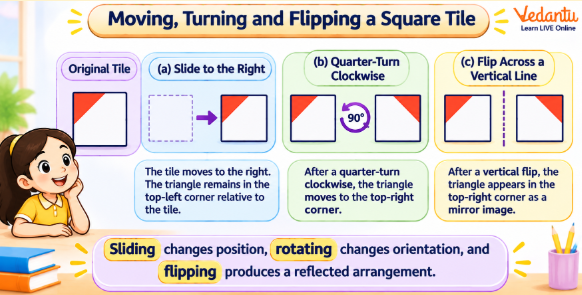
Q16. A square tile has a coloured triangle in its top-left corner. Describe what happens when the tile is:
a) Slid to the right
b) Turned through a quarter-turn clockwise
c) Flipped across a vertical line
Solution:
a) The tile moves to the right. The triangle remains in the top-left corner relative to the tile.
b) After a quarter-turn clockwise, the triangle moves to the top-right corner.
c) After a vertical flip, the triangle appears in the top-right corner as a mirror image.
Answer: Sliding changes position, rotating changes orientation, and flipping produces a reflected arrangement.
Long Answer and Activity-Based Questions for Class 4 Maths Chapter 11
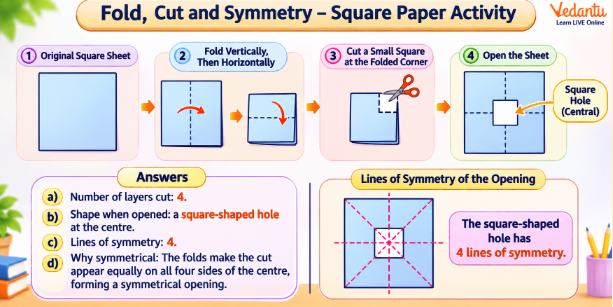
Q17. A student folds a square sheet of paper twice, once vertically and once horizontally. The student then cuts a small square from the corner where the two fold lines meet.
a) How many layers of paper are cut?
b) What shape appears when the paper is completely opened?
c) How many lines of symmetry does the opening have?
d) Explain why the design is symmetrical.
Solution:
a) The folded paper has four layers.
b) When the paper is opened, the cut produces a square-shaped hole at the centre.
c) The square-shaped hole has four lines of symmetry.
d) The folds make the cut appear equally on all four sides of the centre. The matching parts form a symmetrical opening.
Answer: Four layers are cut, and the opened sheet has a central square hole with four lines of symmetry.
Q18. A mirror is placed vertically along the centre of a design made from coloured square tiles. The left half contains three tiles arranged like an L.
a) How many tiles will appear in the completed symmetrical design?
b) How should the tiles on the right side be arranged?
c) How can you check the design using a mirror?
d) Will the completed design remain symmetrical if one tile on the right is moved?
Solution:
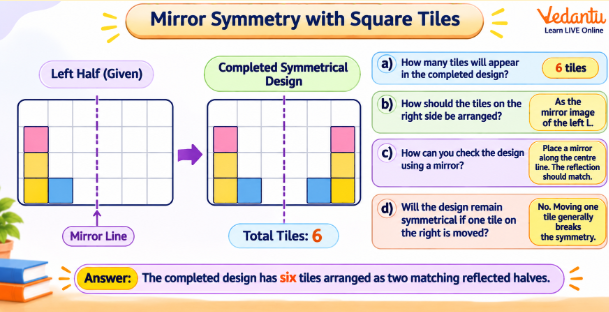
a) The left half has three tiles. Its reflection adds three more tiles, making six tiles.
b) Arrange the three tiles on the right as the mirror image of the left-side L.
c) Place a mirror along the centre line. The reflected image should match the completed right half.
d) Moving one tile away from its matching position generally breaks the symmetry.
Answer: The completed design has six tiles arranged as two matching reflected halves.
Q19. Bablu Chacha wants to cover a rectangular floor with square tiles. The floor is 6 tiles long and 4 tiles wide.
a) How many square tiles are needed?
b) Explain how the tiles can cover the floor without gaps or overlaps.
c) If each tile has a diagonal coloured stripe, how can the tiles be arranged to make a repeating pattern?
d) What will happen if the tiles overlap?
Solution:
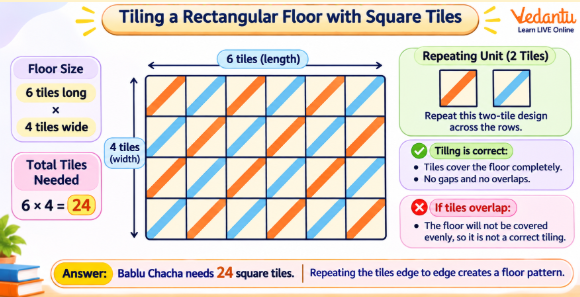
a) Number of tiles = 6 × 4 = 24.
b) Arrange the square tiles in 6 columns and 4 rows, keeping their edges together.
c) Alternate the direction of the diagonal stripes or repeat a two-tile design across the rows.
d) Overlapping tiles will not cover the floor evenly. A correct tiling pattern should have no gaps or overlaps.
Answer: Bablu Chacha needs 24 square tiles. Repeating the tiles edge to edge creates a floor pattern.
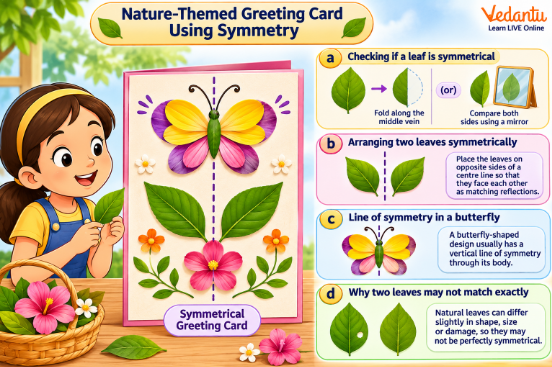
Q20. Mini makes a nature-themed greeting card using leaves and flowers collected during a nature walk.
a) How can Mini check whether a leaf is symmetrical?
b) How can she arrange two similar leaves to create a symmetrical design?
c) What line of symmetry might a butterfly-shaped design have?
d) Why might two leaves of the same type not match exactly?
Solution:
a) Mini can fold the leaf gently along its middle vein or compare both sides using a mirror.
b) She can place the leaves on opposite sides of a centre line so that they face each other as matching reflections.
c) A butterfly-shaped design usually has a vertical line of symmetry through its body.
d) Natural leaves can differ slightly in shape, size or damage, so they may not be perfectly symmetrical.
Answer: Mini can use folding, reflection and matching arrangements to create a symmetrical greeting card while observing that natural objects may have small differences.
Important Topics and Preparation Tips for Class 4 Maths Chapter 11
Chapter 11 uses drawing, folding, mirrors and tiles to help students understand symmetry. The following topics are useful for practising the chapter's picture-based and activity-based questions.
Exam Tip: When completing a symmetrical design, check that every point on one side has a matching point at the same distance from the line of symmetry.
Download Class 4 Maths Chapter 11 Important Questions PDF
Vedantu provides the Class 4 Maths Chapter 11 important questions PDF for Fun with Symmetry. It includes practice questions on lines of symmetry, mirror images, paper folding, completing designs and tile patterns.
For the Class 4 Maths Chapter 11 important questions PDF download, use the PDF download option available on this page. Students can practise the questions and check the solved answers while preparing for school assessments.
CBSE Class 4 Maths Chapter 11 Study Materials
Explore the following study materials to understand Fun with Symmetry and practise its drawing and observation activities.
CBSE Class 4 Maths Chapter-wise Important Questions
Related Study Materials for CBSE Class 4 Maths
FAQs on Important Questions and Answers for Class 4 Maths Chapter 11 Fun with Symmetry 2026–27
1. What are the important topics in Class 4 Maths Chapter 11 Fun with Symmetry?
The chapter covers lines of symmetry, mirror reflections, paper folding, holes and cuts, symmetrical drawings, tile patterns and symmetry in nature. Students also practise sliding, flipping and rotating shapes.
2. Where can I find Class 4 Maths Chapter 11 important questions and answers?
Vedantu provides Class 4 Maths Chapter 11 important questions and answers based on Fun with Symmetry. Students can practise MCQs, drawing activities, mirror-image problems and questions on repeating tile patterns.
3. What types of Class 4 Maths Chapter 11 important questions MCQ should students practise?
Students should practise MCQs on identifying symmetrical shapes, counting lines of symmetry, recognising mirror images and understanding sliding, flipping and rotating tiles. Picture-based questions are especially useful for this chapter.
4. How can I solve Class 4 Maths Chapter 11 important questions with solutions on mirror images?
First, identify the position of the mirror line. Then check that each point or part of the shape has a matching reflected point at the same distance on the other side. A small mirror or folded paper can help verify the answer.
5. How can I answer Class 4 Maths Chapter 11 question-answer problems involving paper folding?
Observe how many times the paper is folded and where the cut is made. Imagine opening one fold at a time to see how the cut is reflected. Drawing each stage can help you predict the final shape.
6. Why does a square have four lines of symmetry but a rectangle has only two?
A square has equal sides and matching halves along its vertical, horizontal and two diagonal lines. A rectangle that is not a square has matching halves only along its vertical and horizontal centre lines.
7. What is the difference between flipping and rotating a shape?
Flipping produces a mirror image of a shape across a line. Rotating turns a shape around a point without changing its size or shape. Both actions are used in the chapter's tile-pattern activities.
8. Where can I access the Class 4 Maths Chapter 11 important questions PDF?
The Class 4 Maths Chapter 11 important questions PDF is available through the download option on Vedantu's chapter page. Students can use it to practise symmetry questions and review their answers.
9. How can students make a symmetrical tile pattern without gaps or overlaps?
Students can choose a tile shape and repeat it by sliding, flipping or rotating it. Each tile should fit against neighbouring tiles without leaving empty spaces or covering another tile.
10. How can students identify symmetry in leaves and butterflies?
Students can look for a central line that divides the object into matching halves. A butterfly often shows approximate symmetry across its body, while many leaves have a middle vein that helps students compare both sides.