

Class 4 Maths Chapter 6 Measuring Length Important Questions and Answers
These questions cover the major activities in Measuring Length, from using metre ropes and centimetre scales to solving garden fencing and dot-grid problems.
Multiple Choice Questions (MCQs) for Class 4 Maths Chapter 6 Measuring Length
Q1. Which unit is more suitable for measuring the length of a classroom?
A) Centimetre
B) Metre
C) Kilogram
D) Litre
Answer: B) Metre
Explanation: A classroom is several metres long. Metres are suitable for measuring longer distances.
Q2. How many centimetres make one metre?
A) 10 cm
B) 50 cm
C) 100 cm
D) 1000 cm
Answer: C) 100 cm
Explanation: One metre contains 100 centimetres.
Q3. Which combination of ropes makes exactly one metre?
A) Two quarter-metre ropes
B) One half-metre rope and one quarter-metre rope
C) Two half-metre ropes
D) Three quarter-metre ropes
Answer: C) Two half-metre ropes
Explanation: Half a metre is 50 cm. Two such ropes make 100 cm, or 1 metre.
Q4. A blue whale is about 30 metres long. A crocodile is about 6 metres long. How many crocodiles placed end to end would match the whale's length?
A) 3
B) 4
C) 5
D) 6
Answer: C) 5
Explanation: 30 ÷ 6 = 5. Five crocodiles of 6 m each would measure 30 m.
Q5. Ramu measures his height as 120 cm. Shamu says the same height is 1 m 20 cm. Who is correct?
A) Only Ramu
B) Only Shamu
C) Both are correct
D) Neither is correct
Answer: C) Both are correct
Explanation: 1 m 20 cm = 100 cm + 20 cm = 120 cm.
Q6. A ribbon starts at the 3 cm mark and ends at the 11 cm mark of a ruler. What is its length?
A) 8 cm
B) 11 cm
C) 14 cm
D) 3 cm
Answer: A) 8 cm
Explanation: Subtract the starting reading from the ending reading: 11 − 3 = 8 cm.
Q7. Which of the following describes the perimeter of a garden?
A) The space inside the garden
B) The distance around its boundary
C) The height of the plants
D) The number of plants
Answer: B) The distance around its boundary
Explanation: Perimeter is the total length of the boundary of a closed shape.
Q8. A square has four sides of 5 cm each. What is its perimeter?
A) 10 cm
B) 15 cm
C) 20 cm
D) 25 cm
Answer: C) 20 cm
Explanation: 5 + 5 + 5 + 5 = 20 cm.
Very Short Answer Questions for Class 4 Maths Chapter 6
Q9. Write the length of half a metre in centimetres.
Answer: 50 cm.
Half of 100 cm is 50 cm.
Q10. How many centimetres are there in a quarter metre?
Answer: 25 cm.
One-quarter of 100 cm is 25 cm.
Q11. Convert 4 metres into centimetres.
Answer: 400 cm.
4 × 100 = 400 cm.
Q12. Write 350 cm in metres and centimetres.
Answer: 3 m 50 cm.
300 cm = 3 m, with 50 cm remaining.
Q13. A toy car travels 75 cm. Another travels 90 cm. Which car travels farther, and by how much?
Answer: The second car travels 15 cm farther.
90 − 75 = 15 cm.
Q14. Which unit would you use to measure the length of an eraser: metres or centimetres?
Answer: Centimetres, because an eraser is a small object.
Q15. A rope is 1 metre long. How many quarter-metre pieces can be cut from it?
Answer: Four pieces.
Each quarter-metre piece is 25 cm long.
Short Answer Questions for Class 4 Maths Chapter 6 Measuring Length
Q16. A student wants to make a 5 m line using a 1 m rope. How can the student measure the line?
Answer:
The student can place the 1 m rope along the ground and mark its endpoint.
Then, move the rope forward so that its starting point touches the previous mark.
Repeat this five times.
Total length = 1 + 1 + 1 + 1 + 1 = 5 m.
Q17. Three students take part in a long jump competition. Their jump lengths are given below. Arrange them from longest to shortest.
Answer:
Convert all measurements into centimetres.
Asha: 140 cm
Kabir: 95 cm
Meera: 165 cm
Therefore, the order is:
Meera > Asha > Kabir
Meera jumped the farthest, and Kabir jumped the shortest distance.
Q18. A blue whale is approximately 30 m long. A bus is approximately 10 m long. How many buses placed end to end would match the whale's length?
Answer:
Length of whale = 30 m
Length of one bus = 10 m
30 ÷ 10 = 3
Therefore, 3 buses would match the whale's approximate length.
Q19. A student measures a pencil using a ruler. The pencil starts at the 2 cm mark and ends at the 16 cm mark. Find its length.
Answer:
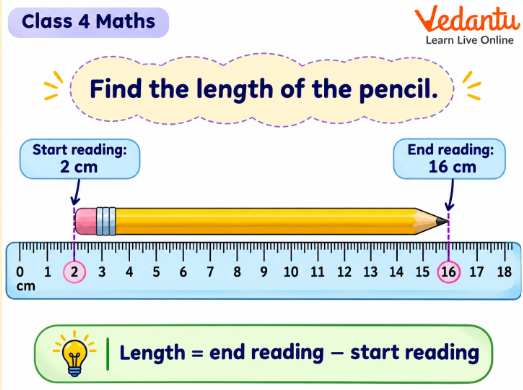
Length = Ending reading − Starting reading
16 − 2 = 14 cm
The pencil is 14 cm long.
Q20. Three toy cars travel different distances from a ramp. Find their ranks.
Answer:
Arrange the distances from greatest to smallest:
120 cm > 105 cm > 85 cm
The blue car travels the farthest.
Q21. Sonu wants to cover the length of a 2 m board using decorative stickers. Each sticker is 20 cm long. How many stickers will he need?
Answer:
Length of board = 2 m = 200 cm
Length of each sticker = 20 cm
Number of stickers = 200 ÷ 20 = 10
Therefore, Sonu needs 10 stickers to cover the board's length without gaps or overlaps.
Q22. Match the measurements that represent the same length.
Answer:
A → 3: 1 m 40 cm = 140 cm
B → 4: 4 m 60 cm = 460 cm
C → 2: 2 m 30 cm = 230 cm
D → 1: 5 m 50 cm = 550 cm
Q23. Complete the missing measurements on a number line marked from 0 cm to 100 cm at intervals of 10 cm. What is the measurement halfway between 40 cm and 60 cm?
Answer:
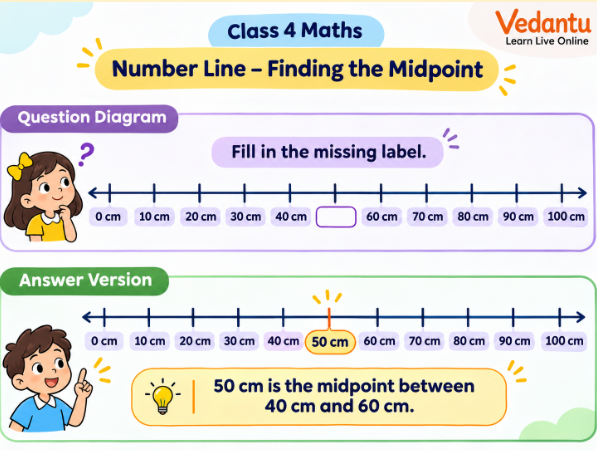
The number line reads:
0, 10, 20, 30, 40, 50, 60, 70, 80, 90, 100 cm.
The halfway point between 40 cm and 60 cm is 50 cm.
Long Answer and Application-Based Questions for Class 4 Maths Chapter 6
Q24. Ashwin has a broken ruler. A ribbon begins at the 6 cm mark and ends at the 15 cm mark. How can he find its correct length?
Answer:
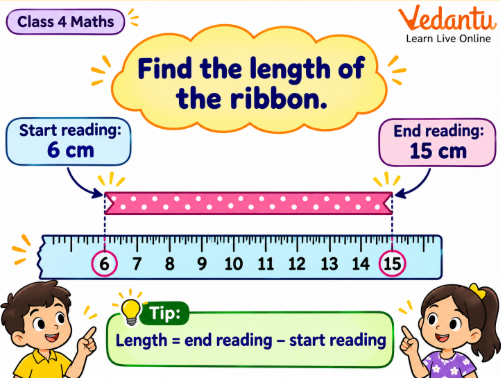
Even if the ruler's zero end is broken, Ashwin can measure the ribbon using two visible marks.
Starting reading = 6 cm
Ending reading = 15 cm
Length = 15 − 6 = 9 cm
The ribbon is 9 cm long.
Ashwin should not write 15 cm because the ribbon does not begin at zero.
Q25. A rectangular vegetable garden is 8 m long and 5 m wide. Bhola wants to put fencing around it. How much fencing does he need?
Answer:
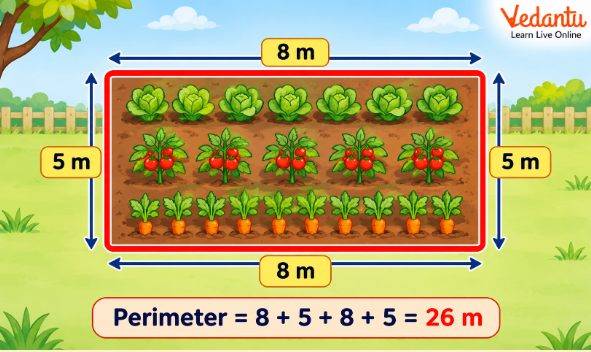
The garden has four sides.
Two sides measure 8 m each, and the other two measure 5 m each.
Total boundary length:
8 + 5 + 8 + 5 = 26 m
Therefore, Bhola needs 26 m of fencing to cover the garden's boundary once.
Q26. Three children draw different rectangles on a dot grid. Each gap between neighbouring dots measures 1 cm. Find the perimeter of each rectangle.
Answer:
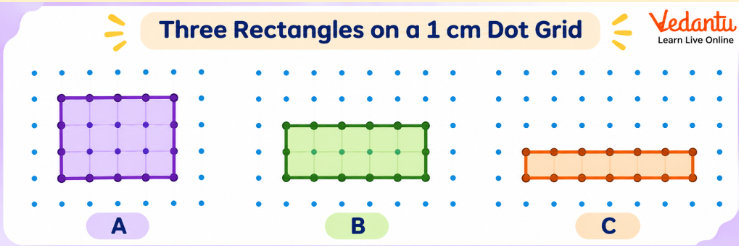
For Rectangle A:
4 + 3 + 4 + 3 = 14 cm
For Rectangle B:
5 + 2 + 5 + 2 = 14 cm
For Rectangle C:
6 + 1 + 6 + 1 = 14 cm
All three rectangles have the same perimeter of 14 cm, even though their shapes are different.
Q27. A treasure-hunt route has four straight sections measuring 8 cm, 5 cm, 7 cm and 4 cm. Find the total distance walked. If another allowed route is 21 cm long, which is shorter?
Answer:
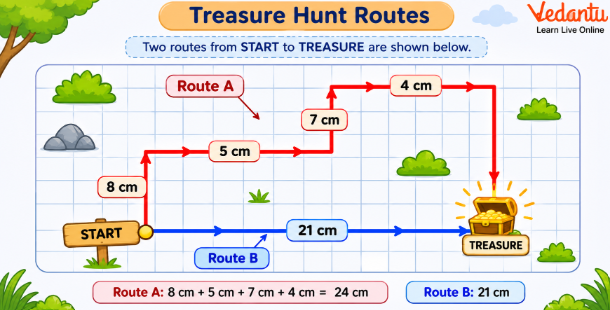
Total distance along the first route:
8 + 5 + 7 + 4 = 24 cm
Second route = 21 cm
Difference = 24 − 21 = 3 cm
Therefore, the second route is shorter by 3 cm.
Q28. A school measures the heights of four students. Use the table to answer the questions.
Find:
a) Who is the tallest?
b) Who is the shortest?
c) How many students are taller than 1 m 30 cm?
d) What is the difference between the tallest and shortest students?
Answer:
Convert the heights into centimetres.
Riya = 125 cm
Arjun = 132 cm
Neha = 118 cm
Dev = 140 cm
a) Dev is the tallest.
b) Neha is the shortest.
c) 2 students, Arjun and Dev, are taller than 130 cm.
d) Difference = 140 − 118 = 22 cm.
Q29. Draw three different rectangles, each having a perimeter of 20 cm. Write their side lengths.
Answer:
Three possible rectangles are:
Checking:
A: 6 + 4 + 6 + 4 = 20 cm
B: 7 + 3 + 7 + 3 = 20 cm
C: 8 + 2 + 8 + 2 = 20 cm
All three rectangles have the same perimeter but different lengths and breadths.
Q30. Two gardens have different shapes. Garden A is a rectangle measuring 9 m by 4 m. Garden B is a square with each side measuring 7 m. Which garden needs less fencing?
Answer:
Garden A:
9 + 4 + 9 + 4 = 26 m
Garden B:
7 + 7 + 7 + 7 = 28 m
Difference:
28 − 26 = 2 m
Therefore, Garden A needs 2 m less fencing than Garden B.
Important Topics in Class 4 Maths Chapter 6 Measuring Length
How to Prepare for Class 4 Maths Chapter 6 Important Questions
Practise measuring objects using a ruler or measuring tape.
Convert lengths between metres and centimetres.
Solve broken-ruler and number-line questions.
Find the perimeter by adding all boundary lengths.
Use the chapter PDF to practise different measurement problems.
Practise Class 4 Maths Chapter 6 with Vedantu
Vedantu's Class 4 Maths Chapter 6 important questions with answers include MCQs, measurement activities, conversions and perimeter problems. Students can use the chapter-wise PDF to practise questions, check answers and prepare for school assessments.
Chapter 6 Measuring Length Study Materials
Students can explore these chapter-specific resources to practise length measurement and related activities.
Class 4 Maths Chapter-wise Important Questions for 2026–27
Explore important questions from other Maths Mela chapters to strengthen different mathematical skills.
Additional Study Materials for Class 4 Maths
Students can also use these resources for broader Class 4 Maths practice.
FAQs on Important Questions and Answers for Class 4 Maths Chapter 6 Measuring Length | 2026–27
1. How can students solve Class 4 Maths Chapter 6 Measuring Length question answer problems using a broken ruler?
Subtract the starting reading from the ending reading. For example, if an object starts at 4 cm and ends at 13 cm, its length is 9 cm. The ruler does not need to start at zero.
2. Why are centimetres used for small objects and metres for larger objects?
Centimetres help measure small lengths such as pencils, erasers and seeds. Metres are more suitable for measuring classroom lengths, long jumps and larger distances. Choosing the right unit makes measurements easier to understand.
3. How do I convert 2 m 35 cm into centimetres?
First, convert 2 metres into 200 centimetres. Then add the remaining 35 centimetres. The total is 235 cm.
4. How can I make a 10 m line using only a 1 m rope?
Place the rope along the ground and mark its endpoint. Move it forward from that mark and repeat the process ten times. The completed line measures 10 metres.
5. How can students find the perimeter of an irregular shape on a dot grid?
Count the 1 cm intervals along every outer edge of the shape. Add those lengths to find the perimeter. Do not count lines inside the shape.
6. Can two different shapes have the same perimeter?
Yes. A rectangle measuring 6 cm by 4 cm and another measuring 7 cm by 3 cm both have a perimeter of 20 cm. Their shapes are different, but their boundary lengths are equal.
7. What types of Class 4 Maths Chapter 6 important questions MCQ exercises should students practise?
Students should practise questions on choosing measurement units, metre-centimetre conversions, reading rulers, comparing lengths and identifying perimeter. Some MCQs also use ropes, toy cars and real-life measurements.
8. Where can I get Class 4 Maths Chapter 6 important questions PDF?
Students can access the Class 4 Maths Chapter 6 important questions PDF on Vedantu. It contains solved questions on measuring length, converting units, reading scales and finding perimeter.
9. How can a Class 4 Maths Chapter 6 worksheet with answers PDF help with practice?
A worksheet can help students practise measuring objects, completing number lines, comparing lengths and solving perimeter problems. Students should attempt each question before checking the answers.
10. What is the best way to practise Class 4 Maths Chapter 6 question answer exercises before a school test?
Start with centimetre and metre measurements, then solve conversion and comparison problems. Practise broken-ruler questions, then finish with garden-fencing and dot-grid perimeter activities.