Class 12 History Chapter 11 Mahatma Gandhi and the Nationalist Movement Important Questions with Answers PDF
This collection of Chapter 11 History Class 12 Important Questions includes 24 solved questions: six MCQs, five very short answers, seven short answers and six long answers. The questions focus on Gandhi's ideas, the participation of different social groups, specific historical incidents, negotiations with the British, and the use of letters, newspapers, photographs and government records to study the national movement.
Class 12 History Chapter 11 Important Questions MCQ Practice
Q1. In which month and year did Mahatma Gandhi return to India from South Africa?
(a) January 1915
(b) February 1916
(c) April 1917
(d) March 1919
Answer: (a) January 1915.
Explanation: Gandhi returned to India in January 1915 after spending about two decades abroad, largely in South Africa. There he developed his methods of satyagraha and gained experience in organising non-violent resistance.
Q2. At which event did Gandhi make his first major public appearance in India after his return?
(a) Lahore Congress Session
(b) Opening of Banaras Hindu University
(c) Second Round Table Conference
(d) Dandi Salt March
Answer: (b) Opening of Banaras Hindu University.
Explanation: Gandhi spoke at the opening of Banaras Hindu University in February 1916. He criticised the wealthy elite for being distant from ordinary peasants and workers, making clear that the national movement needed broader public participation.
Q3. Which issue brought Gandhi to Champaran in Bihar in 1917?
(a) Salt taxation
(b) Harsh treatment of indigo cultivators
(c) Closure of textile mills
(d) Forest restrictions in Andhra
Answer: (b) Harsh treatment of indigo cultivators.
Explanation: Gandhi travelled to Champaran after learning about the difficulties peasants faced under European indigo planters. This became an important early example of his satyagraha in India.
Q4. What was the main resolution adopted at the Lahore Congress Session in December 1929?
(a) Separate electorates
(b) Purna Swaraj
(c) Permanent Settlement
(d) Partition of Bengal
Answer: (b) Purna Swaraj.
Explanation: Under Jawaharlal Nehru's presidency, the Congress declared complete independence as its goal. Subsequently, 2the Congress observed 6 January 1930 as Independence Day.
Q5. Who encouraged Gandhi to ensure that women could participate in the Salt Satyagraha?
(a) Annie Besant
(b) Sarojini Naidu
(c) Kamaladevi Chattopadhyay
(d) Aruna Asaf Ali
Answer: (c) Kamaladevi Chattopadhyay.
Explanation: Kamaladevi Chattopadhyay opposed restricting the salt protests to men. She and many other women participated in civil disobedience, including breaking the salt and liquor laws.
Q6. Which source was prepared by the colonial Home Department to report political developments during the Salt March?
(a) Ain-i Akbari
(b) Fortnightly Reports
(c) Arthashastra
(d) Harijan Sevak Sangh records
Answer: (b) Fortnightly Reports.
Explanation: The colonial Home Department prepared confidential Fortnightly Reports on political activities, public reactions, arrests and protests. These reports help historians understand how the British administration monitored the national movement.
Class 12 History Chapter 11 Very Short Answer Questions
Q7. What did Gandhi mean by satyagraha?
Answer: Satyagraha was Gandhi's method of resisting injustice through truth, non-violence and moral courage. It involved refusing to cooperate with unjust authority without using physical violence against opponents.
Q8. Who was Gopal Krishna Gokhale in relation to Gandhi's early political career?
Answer: Gopal Krishna Gokhale was a senior nationalist leader and Gandhi's political mentor. He advised Gandhi to travel across India and understand its people and conditions before becoming deeply involved in Indian politics.
Q9. Why was the charkha important to Gandhi's idea of swaraj?
Answer: The charkha, or spinning wheel, symbolised self-reliance, productive labour and economic independence. Gandhi encouraged Indians to spin yarn and wear khadi to reduce dependence on imported cloth and connect the national movement with everyday work.
Q10. What was the Gandhi-Irwin Pact of March 1931?
Answer: It was an agreement between Gandhi and Viceroy Lord Irwin under which the Civil Disobedience Movement was suspended. The British agreed to concessions, including releasing prisoners covered by the agreement and allowing coastal salt manufacture.
Q11. What was the main demand of the Quit India Movement launched in August 1942?
Answer: The Quit India Movement demanded an immediate end to British rule in India. Gandhi called upon Indians to continue the struggle for freedom with determination, using the slogan Do or Die.
Class 12 History Chapter 11 Short Answer Questions
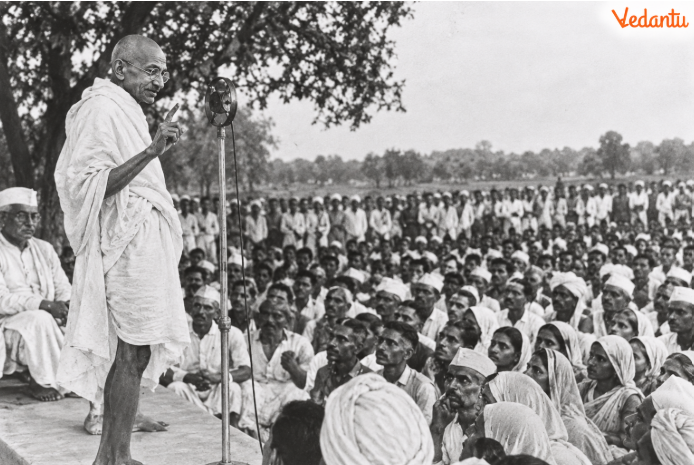
Q12. Why did Gandhi criticise the wealthy Indian elite during his speech at Banaras Hindu University in February 1916?
Answer: Gandhi used the opening of Banaras Hindu University to highlight the distance between educated nationalists and ordinary Indians.
Contrast Between Wealth and Poverty: Gandhi observed that wealthy princes and dignitaries attended the ceremony in expensive clothes and jewellery, while poor Indians were absent.
Importance of Peasants: He argued that India's future depended on farmers, who produced much of the country's wealth.
Criticism of Privilege: Gandhi believed that privileged Indians should use their wealth and influence to serve the public.
Limits of Elite Nationalism: He questioned a freedom movement dominated by lawyers, doctors and landlords.
Need for Mass Participation: Gandhi wanted peasants and workers to participate in the struggle for self-rule actively.
Conclusion: The speech was an early statement of Gandhi's intention to make nationalism a movement involving ordinary Indians rather than only the educated elite.
Q13. How did Gandhi's early movements in Champaran, Ahmedabad and Kheda reflect his approach to local problems?
Answer: Gandhi's early activities in India connected the national movement with the everyday difficulties of peasants and workers.
Why these movements mattered:
They brought Gandhi into direct contact with rural and working communities.
They showed that political action could focus on specific local grievances.
They helped establish satyagraha as a method of public protest.
They strengthened Gandhi's reputation among people beyond the educated political leadership.
Conclusion: These struggles laid the foundation for Gandhi's later mass movements by connecting the demand for freedom with economic and social problems.
Q14. How did the Non-Cooperation and Khilafat movements bring different sections of Indian society into nationalist politics?
Answer: Gandhi linked the Non-Cooperation Movement with the Khilafat cause to broaden opposition to British rule and encourage Hindu–Muslim cooperation.
1. Participation of Students: Many students left government-controlled schools and colleges.
2. Role of Lawyers: Some lawyers stopped attending British courts as part of the boycott.
3. Working-Class Participation: Industrial workers organised strikes. Historical records document 396 strikes during 1921, involving about 600,000 workers.
4. Peasant Resistance: Peasants in Awadh resisted taxation, while communities in Kumaun refused to carry loads for colonial officials.
5. Tribal Protests: Hill communities in northern Andhra challenged colonial forest laws.
6. Wider Religious Cooperation: Support for the Khilafat Movement helped Gandhi bring sections of Hindu and Muslim society into a shared political campaign.
7. Different Local Interpretations: Not everyone followed the movement exactly as national leaders intended. Many communities adapted Non-Cooperation to address their own grievances.
Conclusion: Non-Cooperation transformed nationalism into a much wider movement because people from different backgrounds found ways to challenge colonial authority.
Q15. Why did Gandhi withdraw the Non-Cooperation Movement in 1922, and how did he continue working towards freedom?
Answer: Gandhi withdrew the movement after the violent incident at Chauri Chaura in February 1922.
1. Incident at Chauri Chaura: Protesters clashed with the police, and a police station was set on fire, killing police officers.
2. Commitment to Non-Violence: Gandhi believed that a movement based on satyagraha could not succeed if its participants used violence.
3. Withdrawal of Non-Cooperation: He stopped the campaign because he felt that the public needed greater discipline and preparation.
4. Continued Constructive Work: Gandhi promoted khadi, village industries and social reform.
5. Campaign Against Untouchability: He urged Indians to end discriminatory practices within society.
6. Communal Harmony: Gandhi continued encouraging peaceful relations between religious communities.
Conclusion: The withdrawal did not mean that Gandhi abandoned independence. He believed that building a just and disciplined society was also necessary for achieving swaraj.
Q16. Why did Gandhi describe the British salt monopoly as a serious economic injustice? Explain with reference to the chapter's historical source.
Answer: Gandhi considered the salt monopoly unjust because it affected a basic necessity used by every household.
1. Essential Commodity: Rich and poor Indians alike required salt in their daily lives.
2. Restriction on Production: People were not allowed to produce salt for their own use freely.
3. Heavy Taxation: The colonial government imposed a tax that increased the cost of salt.
4. Destruction of Natural Salt: Officials sometimes destroyed naturally available salt to prevent people from collecting it without paying tax.
5. Loss of Village Employment: The monopoly restricted a simple village industry that could have supported local livelihoods.
6. Unnecessary Government Expenditure: Public funds were used to enforce the salt laws and destroy salt.
7. Symbol of Colonial Control: Gandhi used salt to demonstrate how British laws interfered with even the simplest needs of Indians.
Conclusion: The Salt Satyagraha was effective because it linked the demand for independence to a hardship ordinary people could understand.
Q17. How did women contribute to the Salt Satyagraha of 1930, and why was their participation historically important?
Answer: The Salt Satyagraha marked an important stage in women's wider participation in India's freedom struggle.
1. Kamaladevi Chattopadhyay's Role: She urged Gandhi not to restrict the campaign to male volunteers.
2. Breaking the Salt Laws: Women participated in making or collecting salt in defiance of colonial restrictions.
3. Challenging Liquor Laws: Some women also took part in protests involving liquor shops and regulations.
4. Accepting Arrest: Women willingly faced arrest and imprisonment for participating in civil disobedience.
5. Public Political Participation: Their activities challenged the belief that political movements were mainly the responsibility of men.
6. Widening Nationalism: The movement provided opportunities for women from different backgrounds to participate in public protest.
Conclusion: Women's participation made the Salt Satyagraha more representative of society and helped expand their involvement in nationalist politics.
Q18. What was the importance of 26 January 1930 in the history of the Indian national movement?
Answer: The date marked the first nationwide observance of Independence Day after the Congress declared Purna Swaraj.
1. Lahore Congress Session: In December 1929, the Congress adopted complete independence as its goal.
2. Jawaharlal Nehru's Presidency: Nehru presided over the session, symbolising the growing influence of a younger generation of nationalist leaders.
3. Independence Day Observance: On 26 January 1930, people across India gathered to express support for freedom.
4. National Flag: The national flag was hoisted at public meetings.
5. Collective Pledge: Participants affirmed the right of Indians to freedom and to enjoy the results of their labour.
6. Constructive Activities: Gandhi encouraged spinning, work against untouchability, communal harmony and other forms of social service.
7. Preparation for Civil Disobedience: These activities helped create public enthusiasm before the Salt March began.
Conclusion: Observing 26 January 1930 gave the demand for complete independence a visible public expression.
Class 12 History Chapter 11 Long Answer Questions
Q19. How did Mahatma Gandhi transform Indian nationalism from an elite movement into a mass movement between 1915 and 1922?
Answer: Gandhi helped expand Indian nationalism beyond educated professionals and political leaders. His methods enabled peasants, workers, artisans and other sections of society to participate in the freedom struggle.
1. Experience in South Africa: Gandhi returned to India in January 1915 after working for Indian rights in South Africa. He had developed satyagraha as a method of resisting injustice through non-violence.
2. Understanding Indian Society: On Gopal Krishna Gokhale's advice, Gandhi travelled across India to learn about people's problems. This helped him understand conditions outside the main political centres.
3. Speech at Banaras Hindu University: In February 1916, Gandhi criticised the distance between the wealthy elite and ordinary workers and farmers.
He argued that the national movement must represent most Indians.
4. Champaran Satyagraha: In 1917, Gandhi supported indigo cultivators in Bihar who faced exploitation by European planters.
5. Ahmedabad Workers' Movement: In 1918, he became involved in a dispute affecting textile mill workers.
6. Kheda Peasant Movement: Gandhi also supported peasants facing difficulties in meeting land revenue demands.
7. Rowlatt Satyagraha: In 1919, Gandhi organised opposition to the Rowlatt Act, which gave the colonial government extensive powers of detention.
8. Response to Jallianwala Bagh: The massacre at Amritsar in April 1919 deepened public anger against British rule.
9. Non-Cooperation Movement: Gandhi encouraged Indians to withdraw their cooperation from colonial institutions. Students, lawyers, workers and peasants participated in different ways.
10. Alliance with the Khilafat Movement: The alliance helped bring Hindu and Muslim political concerns into a wider anti-colonial campaign.
11. Personal Identification with the Poor: Gandhi adopted simple clothing and promoted khadi. His lifestyle helped him connect with ordinary Indians.
12. Use of Symbols: The charkha represented productive labour, self-reliance and resistance to imported cloth.
13. Social Reform: Gandhi campaigned against untouchability and encouraged communal tolerance. He believed that independence required changes within Indian society as well as the removal of foreign rule.
14. Participation Across Regions: The movement spread to cities, villages, agricultural regions and areas where tribal communities resisted colonial restrictions.
15. Changes in Political Leadership: By 1922, nationalism was no longer primarily associated with lawyers and educated professionals. Large numbers of ordinary people were actively involved.
Conclusion: Gandhi transformed Indian nationalism by linking political independence with everyday economic problems, social reform and non-violent public participation.
Q20. How was Non-Cooperation different from Civil Disobedience? Explain their methods, objectives and the participation of ordinary Indians.
Answer: Non-Cooperation and Civil Disobedience were two major forms of resistance Gandhi used to challenge British rule.
Although both relied on non-violence, they opposed colonial authority in different ways.
Part A: Non-Cooperation
1. Refusal to Support British Institutions: The movement encouraged people to withdraw from government-controlled schools, courts and other institutions.
2. Boycott of Imported Goods: People were encouraged to reject foreign cloth and use khadi.
3. Political Aim: Gandhi believed that British rule depended on Indian cooperation. If they withdrew this cooperation, colonial authority would weaken.
4. Popular Participation: Students, lawyers, workers, peasants and other groups joined the movement.
Part B: Civil Disobedience
5. Deliberate Violation of Unjust Laws: Civil Disobedience involved openly breaking colonial laws that people considered unjust.
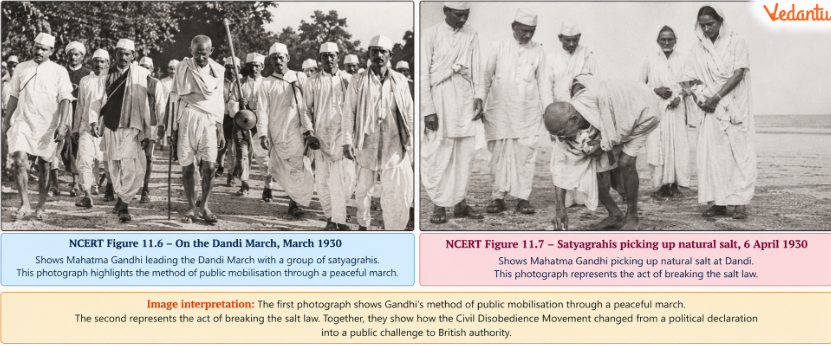
6. Salt Law as an Example: In 1930, Gandhi broke the salt law by collecting natural salt at Dandi.
7. Wider Protest Activities: People manufactured salt without permission, organised protests and challenged colonial restrictions.
8. Willingness to Accept Punishment: Participants often accepted arrest to demonstrate their opposition to unjust laws.
Comparison Between Non-Cooperation and Civil Disobedience
9. Similarities: Both movements relied on non-violent resistance and aimed to weaken colonial rule through public participation.
10. Historical Significance: They demonstrated that large numbers of Indians could challenge British authority without depending only on conventional political institutions.
Conclusion: Non-Cooperation encouraged people to withdraw support from British institutions, while Civil Disobedience encouraged them to challenge unjust laws openly.
Q21. Why is the Dandi March of 1930 considered a turning point in India's struggle for independence? Explain its events and national significance.
Answer: The Dandi March was one of Gandhi's most influential acts of civil disobedience. It transformed salt, an everyday necessity, into a powerful symbol of resistance against British rule.
1. Political Background: The Congress adopted Purna Swaraj at the Lahore Session in December 1929. The decision renewed momentum for complete independence.
2. Choice of Salt: Gandhi selected the salt monopoly because it affected every Indian household. The colonial government restricted salt production and taxed this essential commodity.
3. Announcement to Lord Irwin: Gandhi informed the Viceroy of his intention to begin a campaign against the salt law.
4. Beginning of the March: On 12 March 1930, Gandhi left Sabarmati Ashram near Ahmedabad with a group of followers.
5. Journey to Dandi: The marchers travelled on foot towards the Gujarat coast, addressing people along the route. The journey took about three weeks.
6. Breaking the Salt Law: On 6 April 1930, Gandhi picked up natural salt at Dandi, openly defying colonial restrictions.
7. Spread of Civil Disobedience: Similar acts of protest took place in other regions. People made salt, organised demonstrations and challenged colonial laws.
8. Participation of Women: Women joined the campaign in large numbers and accepted arrest for civil disobedience. Kamaladevi Chattopadhyay was a key advocate for their participation.
9. International Attention: The march received extensive coverage in European and American newspapers. This made Gandhi's campaign more visible outside India.
10. Challenge to British Legitimacy: By breaking a law that many people considered unreasonable, Gandhi questioned the moral authority of the colonial government.
11. Importance for Negotiations: The campaign increased pressure on the British to negotiate with Indian nationalist leaders.
12. Beginning of Political Dialogue: The developments led to the Gandhi-Irwin Pact in 1931 and Gandhi's participation in the Second Round Table Conference.
Three Major Reasons the Salt March Was Important
Conclusion: The Dandi March became a turning point because it used an ordinary commodity to unite people, challenge an unjust law, and strengthen the demand for independence.
Q22. Why were Gandhi's negotiations at the Round Table Conference inconclusive? Discuss the Gandhi-Irwin Pact and the different claims of political representation.
Answer: The British government organised the Round Table Conferences to discuss constitutional reforms in India. However, disagreements over political representation and the future structure of government limited their success.
1. Background of Civil Disobedience
The 1930 Salt Satyagraha increased pressure on the British government to discuss India's political future.
2. First Round Table Conference
The first conference was held in London in November 1930.
Gandhi and the Congress did not participate, reducing its significance for the wider nationalist movement.
3. Gandhi's Release
Gandhi was released from prison in January 1931.
He subsequently held discussions with Viceroy Lord Irwin.
4. Gandhi-Irwin Pact
They reached the agreement in March 1931.
Gandhi agreed to suspend Civil Disobedience, while the government accepted certain concessions.
5. Limitations of the Pact
The pact did not secure an immediate commitment to Indian independence.
Some nationalist groups criticised it for failing to meet the movement's central political demand.
6. Second Round Table Conference
Gandhi attended the second conference in London in 1931 as the Congress representative.
7. Congress Claim
Gandhi argued that the Congress represented the interests of the Indian nation.
8. Muslim League's Position
The Muslim League challenged the Congress claim and argued that the interests of Muslims required separate consideration.
9. Position of the Princely States
Representatives of the princes argued that the Congress did not speak for their territories.
10. B.R. Ambedkar's Criticism
Ambedkar questioned the Congress's claim to represent the interests of the oppressed castes.
He argued that these communities required effective political representation.
11. Absence of Agreement
Differences over representation and constitutional arrangements remained unresolved.
12. Resumption of Civil Disobedience
After the unsuccessful negotiations, Gandhi returned to India and resumed the movement.
Conclusion: The conferences were inconclusive because different political groups disagreed over who represented India and how political power should be organised. They also demonstrated the limits of colonial constitutional negotiations.
Q23. Explain Gandhi's role during the Quit India Movement and the communal violence of 1946–47. How did his priorities change in the final years of his life?
Answer: In the final years of British rule, Gandhi supported the demand for independence while placing increasing emphasis on preventing communal violence and protecting ordinary people.
Part A: The Quit India Movement
1. Background: The Second World War created a major political crisis because India had been drawn into the conflict without the consent of Indian political representatives.
2. Demand for British Withdrawal: In August 1942, the Congress launched the Quit India Movement, demanding an immediate end to British rule.
3. Do or Die: Gandhi urged Indians to continue the struggle for freedom with determination.
4. Arrest of National Leaders: The British arrested Gandhi and many Congress leaders soon after the movement began.
5. Spread of Public Resistance: Students, workers, peasants and other groups participated in protests. Some demonstrations involved attacks on symbols of colonial authority and disruptions to communication networks.
Part B: Communal Violence and Partition
6. Rising Communal Tensions: During 1946–47, relations between different religious communities deteriorated in many regions.
7. Gandhi's Visit to Noakhali: Gandhi visited Noakhali in eastern Bengal in 1946 following serious communal violence. He travelled through affected communities and appealed for peace.
8. Work in Riot-Affected Areas: Gandhi also worked in other places affected by communal tension, including Bihar and later Delhi.
9. Opposition to Religious Hostility: He urged Hindus, Muslims and Sikhs to reject revenge and protect people of other communities.
10. Independence and Partition: India became independent in August 1947, but Partition and widespread suffering accompanied independence.
11. Gandhi's Priorities: Rather than concentrate on official celebrations, Gandhi worked towards peace and reconciliation.
12. Final Fast: In January 1948, Gandhi undertook a fast in Delhi to encourage an end to communal hostility.
13. Assassination: On 30 January 1948, Gandhi was assassinated in New Delhi.
Conclusion: Gandhi's final years show that his understanding of freedom extended beyond the end of British rule. He also wanted an India shaped by non-violence, religious tolerance and the protection of vulnerable communities.
Q24. How can historians reconstruct Gandhi's political career using private letters, autobiographies, newspapers, photographs and colonial records? Explain the strengths and limitations of these sources.
Answer: Historians study Gandhi's role in the national movement through several types of evidence. Each source reveals different aspects of his activities, but none provides a completely neutral account.
1. Private Letters
Letters show Gandhi's discussions with political colleagues, friends and members of the public.
They can reveal personal concerns, disagreements and the reasons behind decisions.
However, letters may present a carefully chosen version of events because writers know they are communicating with specific people.
2. Autobiographies
Autobiographies provide information about how individuals understood their own lives.
Gandhi's autobiography helps historians examine his experiences and moral ideas.
However, autobiographies are written from the author's point of view and may leave out uncomfortable details.
3. Contemporary Newspapers
Newspapers reported Gandhi's speeches, travels, campaigns and arrests.
They also provide evidence of public reactions to political events.
Editorial opinions and readers' interests shaped their reporting.
4. Nationalist Newspapers
Indian nationalist newspapers often presented Gandhi as a leader challenging colonial injustice.
They could emphasise public participation and the achievements of national movements.
5. British Newspapers
Some British newspapers viewed Gandhi's campaigns through the lens of imperial authority and public order.
Their interpretations could differ significantly from those of Indian nationalist publications.
6. Colonial Government Records
The British administration collected detailed information about nationalist activities.
Confidential police and Home Department reports recorded meetings, public reactions, arrests and demonstrations.
7. Fortnightly Reports
The colonial Home Department prepared Fortnightly Reports to monitor the political situation.
These are particularly useful for examining official responses to the Salt March.
8. Limitations of Official Reports
Officials sometimes underestimated the popularity of nationalist campaigns or interpreted events through a law-and-order lens.
9. Historical Photographs
Photographs document Gandhi's clothing, public appearances, journeys and interactions with people.
They also show how his image circulated among different audiences.
10. Popular Prints and Posters
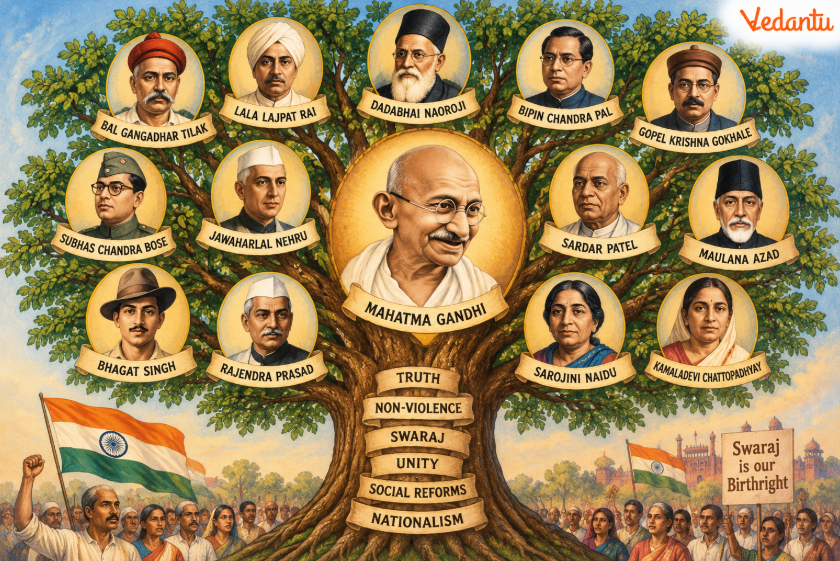
Prints of Gandhi, the charkha and other nationalist symbols reveal how people imagined and celebrated the freedom struggle.
However, popular images often emphasised symbolic meaning rather than accurately recording an event.
11. Comparing Different Sources
Historians compare personal writings, press reports and government documents to identify differences and test claims.
12. Understanding Historical Context
A source must be interpreted in relation to the time, circumstances and purpose for which it was produced.
Comparison of Historical Sources
Conclusion: Historians reconstruct Gandhi's political career by comparing different kinds of evidence rather than relying on one account. The differences between these sources help explain how nationalism was experienced, reported and remembered.
Why Practise Class 12 History Chapter 11 Important Questions with Vedantu?
Practising Class 12 History Chapter 11 Important Questions helps students connect Gandhi's ideas with the events, people and sources that shaped India's independence movement. These chapter-based questions cover political campaigns, social reform, important agreements and different interpretations of historical evidence.
How to Prepare Class 12 History Chapter 11 Important Questions with Vedantu?
Revise the timeline: Connect the years 1915, 1917, 1919, 1922, 1930, 1931, 1942 and 1948 with important developments.
Compare the movements: Understand how Non-Cooperation, Civil Disobedience and Quit India differed.
Study Gandhi's methods: Focus on satyagraha, khadi, non-violence and public participation.
Practise source-based answers: Interpret Gandhi's speeches, newspaper reports and colonial Home Department records.
Study historical illustrations: Explain what photographs and nationalist prints reveal about Gandhi's leadership and public image.
Important Study Material Links for Class 12 History Chapter 11
Chapter-Wise Important Questions for Class 12 History
Important Study Materials for Class 12 History
FAQs on Important Questions and Answers for Class 12 History Chapter 11 – Mahatma Gandhi and the Nationalist Movement (Themes in Indian History-III) | 2026-27
1. Why is Mahatma Gandhi's return to India in 1915 important in the history of nationalism?
Gandhi returned with experience in organising non-violent protests in South Africa. Over the following years, he helped connect the independence movement with peasants, workers, women and other ordinary Indians, expanding participation beyond educated political leaders.
2. What did Gandhi's speech at Banaras Hindu University in 1916 reveal about his political ideas?
Gandhi criticised the distance between wealthy nationalists and poor Indians. He believed that peasants and workers should be central to the national movement and that political freedom required concern for ordinary people's lives.
3. How were Gandhi's early satyagrahas in Champaran and Kheda different?
Champaran focused on European planters' exploitation of indigo cultivators, while Kheda concerned peasants facing difficulties with land revenue demands. Both demonstrated Gandhi's method of organising peaceful resistance around specific local grievances.
4. Why did Gandhi connect the Non-Cooperation Movement with the Khilafat Movement?
Gandhi hoped that supporting the Khilafat cause would encourage Hindu–Muslim cooperation against British rule. The alliance broadened political participation and created a larger anti-colonial movement.
5. Why did Gandhi consider khadi and the charkha important for Indian independence?
Khadi and the charkha represented self-reliance, productive labour, and reduced dependence on imported textiles. Gandhi believed that spinning and wearing locally made cloth could connect everyday economic activity with the national movement.
6. Why did the Congress declare Purna Swaraj at the Lahore Session in 1929?
The Congress adopted complete independence as its goal because limited constitutional reforms were no longer considered sufficient. Under Jawaharlal Nehru's presidency, the session marked an important shift toward demanding full freedom from British rule.
7. Why did Gandhi choose salt rather than another product for the Civil Disobedience Movement?
Everyone used salt, regardless of income or social position. The British salt monopoly and taxation affected ordinary households, making salt an effective symbol of the wider injustices of colonial rule.
8. What made the Dandi March of 1930 different from earlier nationalist protests?
The march openly violated the salt law, attracted extensive international attention, and encouraged wider participation by women. It also increased pressure on the British to negotiate with Indian nationalist leaders.
9. What role did Kamaladevi Chattopadhyay play during the Salt Satyagraha?
Kamaladevi Chattopadhyay strongly supported women's participation in the movement. She encouraged Gandhi not to limit the protests to men and participated in civil disobedience herself, helping widen women's involvement in nationalist politics.
10. Why did the Gandhi-Irwin Pact disappoint some nationalist leaders?
The pact secured certain concessions and allowed political negotiations to continue, but it did not obtain a British commitment to complete independence. Some nationalists felt that Gandhi had agreed to suspend Civil Disobedience without achieving the movement's main demand.
11. Why did B.R. Ambedkar disagree with Gandhi's claim that the Congress represented all Indians?
Ambedkar argued that the oppressed castes' interests required independent political consideration. He challenged the view that the Congress could automatically speak for every community, highlighting an important disagreement over representation.
12. How did Gandhi respond to communal violence during 1946–47?
Gandhi visited violence-affected areas such as Noakhali and worked to encourage peaceful relations among religious communities. He opposed revenge and appealed to people to protect neighbours belonging to different faiths.
13. Why are the colonial Fortnightly Reports useful for studying the Salt March?
These confidential reports show how British officials monitored Gandhi's campaign, public meetings, protests and the possibility of arrests. They are useful sources, but historians must consider the administrative viewpoint they reflect.
14. Which image-based and source-based questions are important for Class 12 History Chapter 11?
Students should practise interpreting photographs of the Dandi March, Gandhi's public appearances and nationalist prints. They should also study excerpts from the BHU speech, Gandhi's writings on the salt tax, confidential Fortnightly Reports and contemporary newspaper accounts.