


Class 12 Geography Chapter 9 Important Questions with Answers PDF
This question set contains 24 solved questions, including five MCQs, five very short answers, seven short answers and seven long answers. It includes source-based examples from the Ganga-Yamuna pollution table, the Daurala ecological restoration case, Ramesh's migration experience, Dharavi's living and working conditions, and watershed management in Jhabua.
Class 12 India People and Economy Chapter 9 Important Questions MCQ Practice
Q1. According to the chapter, which activity is identified as the most significant human contributor to water pollution?
(a) Pilgrimage and tourism
(b) Industrial activities
(c) Natural erosion
(d) Seasonal changes in rainfall
Answer: (b) Industrial activities.
Explanation: Industries discharge wastewater, chemical residues and heavy metals into water bodies. Industrial activities are a major cause of water pollution, although agriculture and cultural activities also contribute.
Q2. Which pollutant is mainly associated with an increase in nitrate content in surface water?
(a) Fertilisers
(b) Traffic noise
(c) Plastic containers
(d) Smoke from vehicles
Answer: (a) Fertilisers.
Explanation: Inorganic fertilisers used in agriculture can be washed into rivers and lakes. The textbook explains that fertilisers increase nitrate levels in surface water and may also affect groundwater.
Q3. Which of the following is a major objective of the Namami Gange Programme?
(a) Increasing untreated industrial discharge
(b) Removing all agricultural activities near rivers
(c) Developing sewage treatment systems in towns
(d) Expanding dumping grounds along riverbanks
Answer: (c) Developing sewage treatment systems in towns.
Explanation: The programme includes sewage treatment, monitoring industrial effluent, cleaning river surfaces, developing riverfronts, afforestation, and public awareness.
Q4. What was the main cause of groundwater contamination in the Daurala case study near Meerut?
(a) Untreated industrial wastewater seeping underground
(b) Excessive ocean waves
(c) Noise from mining machinery
(d) High-altitude glacial erosion
Answer: (a) Untreated industrial wastewater seeping underground.
Explanation: The Daurala case study shows how untreated industrial wastewater reached groundwater and introduced heavy-metal contamination, raising health concerns for residents.
Q5. In the Jhabua watershed management case, what does social fencing mainly involve?
(a) Allowing unrestricted grazing throughout the year
(b) Protecting restored common land from open grazing
(c) Replacing pastureland with industrial buildings
(d) Removing all trees from common property land
Answer: (b) Protecting restored common land from open grazing.
Explanation: The Bhil community in the Petlawad block protected regenerating pastureland through social fencing. The case study also describes tree planting, fodder grass cultivation and stall feeding of cattle.
Class 12 Geography Chapter 9 Very Short Answer Questions
Q6. What is the difference between pollution and pollutants?
Answer: Pollution is a harmful change in environmental quality caused by the addition of unwanted substances or energy. Pollutants are the substances or forms of energy, such as smoke, sewage, chemicals and excessive noise, that cause this change.
Q7. Name four major types of environmental pollution.
Answer: The four types are:
Air pollution.
Water pollution.
Land pollution.
Noise pollution.
These are classified by the environmental medium affected or by the medium through which pollutants spread.
Q8. What is urban smog?
Answer: Urban smog is polluted, smoky fog that forms over cities due to atmospheric contaminants. It reduces air quality and can harm human health.
Q9. In which unit is noise level measured? Name two major sources of urban noise pollution.
Answer: Noise level is measured in decibels (dB). Two important sources are road traffic and aircraft. Factories and mechanised construction are also significant sources.
Q10. What is land degradation?
Answer: Land degradation is a temporary or permanent decline in land productivity. It may result from soil erosion, waterlogging, salinity, alkalinity and other natural or human-induced processes.
Class 12 Geography Chapter 9 Short Answer Questions
Q11. Explain how industrial, agricultural and cultural activities pollute rivers and lakes in India.
Answer: Human activities introduce several harmful substances into rivers, lakes and groundwater.
1. Industrial Activities: Leather, textile, chemical, and pulp and paper industries may discharge toxic wastewater, heavy metals and chemical residues into nearby water bodies.
2. Agricultural Activities: Fertilisers, pesticides and herbicides are washed from cultivated fields into rivers and lakes during rainfall. Some chemicals can also seep into groundwater.
3. Cultural Activities: Pilgrimage, religious fairs and tourism may generate waste that enters water bodies when it is not disposed of properly.
4. Domestic Activities: Untreated sewage and solid waste from settlements increase contamination and reduce water quality.
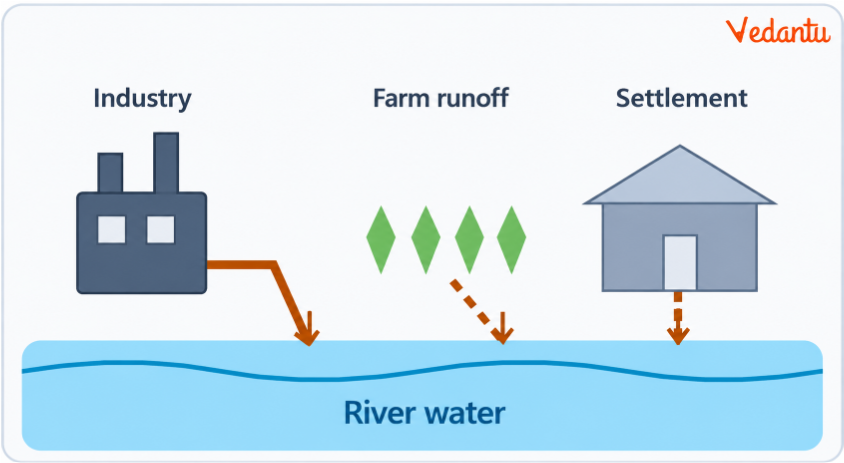
Q12. Using the river pollution data given in the chapter, compare the main sources of pollution in the Ganga and Yamuna rivers.
Answer: The Ganga and Yamuna receive pollution from cities, industries and other human activities, but the important polluted stretches and contributing factors differ.
Explanation: The textbook identifies urban and industrial discharge as major sources of contamination in both rivers.
In the Yamuna, water extraction for irrigation and wastewater discharge put pressure on the river system.
Q13. Why can air pollution cause both respiratory illnesses and acid rain?
Answer: Air pollution introduces gases, smoke and suspended particles into the atmosphere.
1. Harmful Gases: Burning fossil fuels and industrial processes release oxides of sulphur and nitrogen, carbon monoxide and other pollutants.
2. Respiratory Problems: Polluted air can affect the respiratory system and make breathing difficult.
3. Other Health Effects: Air pollution can also affect the nervous and circulatory systems
4. Acid Rain: Certain air pollutants react with atmospheric moisture and contribute to the formation of acidic precipitation.
5. Urban Smog: Smoke and other atmospheric contaminants can produce polluted fog over urban areas.
Q14. Why is traffic considered a major source of noise pollution in cities?
Answer: Traffic produces frequent and sometimes continuous noise in busy urban areas.
The important reasons are:
Large numbers of vehicles moving through busy roads.
Horns, engines and other vehicle-related sounds.
Differences in vehicle type and condition.
Poor road conditions that may increase traffic noise.
Aircraft and railway movements near transport corridors.
Noise pollution is location-specific, and its intensity generally decreases as distance from the source increases.
Q15. Differentiate between solid waste generated by households and industrial establishments. Explain their disposal problems.
Answer: Urban solid waste mainly comes from domestic, commercial, and industrial activities.
Explanation: Improperly discarded solid waste creates foul smells and provides breeding places for disease-carrying insects and rodents. Untreated waste may also enter drains and rivers.
Q16. Identify the push and pull factors responsible for Ramesh's rural–urban migration in Ramesh's migration case study
Answer: Ramesh left his village because of economic difficulties and the expectation of finding work elsewhere.
Example: Ramesh first migrated to Ludhiana, where he worked in a woollen factory. He later moved to Surat, learned welding and obtained work at construction sites in different cities.
Q17. Explain the difference between land degradation and wasteland. Can degraded land be restored?
Answer: Land degradation and wasteland are related concepts, but they are not the same.
Can degraded land be restored?
Yes, some degraded land can regain productive capacity through suitable conservation and restoration measures.
The chapter describes watershed management, tree planting, pasture improvement and community participation as important measures.
Class 12 Geography Chapter 9 Long Answer Questions
Q18. Describe the four major types of environmental pollution in India. Explain their sources and effects with suitable examples.
Answer: Environmental pollution results from the release of unwanted substances and energy through human activities. There are four major types of pollution, based on the environmental medium affected.
1. Air Pollution
Air pollution occurs when harmful gases, smoke, dust and other contaminants enter the atmosphere in excessive concentrations.
Major Sources:
Burning coal, petrol and diesel.
Industrial processes.
Mining and other dust-generating activities.
Improper waste disposal.
Important Pollutants: sulphur and nitrogen oxides, carbon monoxide, hydrocarbons, lead, and suspended particles.
Effects: Respiratory illnesses, polluted urban air, smog and acid rain.
2. Water Pollution
Water pollution occurs when unwanted substances enter rivers, lakes, reservoirs or groundwater and reduce water quality.
Major Sources:
Domestic sewage.
Industrial effluents.
Agricultural runoff.
Insecticides, pesticides and fertilisers.
Important Pollutants: Heavy metals, nitrates, suspended solids, bacteria and chemical residues.
Effects: Contamination of drinking-water sources, harm to aquatic ecosystems and water-borne diseases.
3. Land Pollution
Land pollution results from harmful substances and waste accumulating on land.
Major Sources:
Untreated industrial waste.
Garbage and human waste.
Excessive or unsuitable use of chemical fertilisers and pesticides.
Effects: Soil contamination, environmental degradation and health problems.
4. Noise Pollution
Noise pollution occurs when sound becomes excessive or uncomfortable.
Major Sources:
Automobiles and trains.
Aircraft.
Factories.
Construction and demolition work.
Loudspeakers and other amplified sounds.
Effects: Disturbance, discomfort and other adverse effects on health and well-being.
Comparison Table
Q19. Explain the nature of water pollution in India and discuss how the Namami Gange Programme addresses pollution in the Ganga.
Answer: Water pollution has become a serious environmental problem in India because of rising water demand, industrial expansion, urbanisation, and inadequate wastewater treatment.
1. Meaning of Water Pollution
Water becomes polluted when excessive quantities of suspended particles, chemicals, microorganisms or other contaminants reduce its quality.
Water bodies have a natural self-purifying capacity, but this becomes insufficient when pollutant concentrations become too high.
2. Industrial Pollution
Industries discharge wastewater containing chemical residues, heavy metals and other harmful substances.
The chapter identifies the leather, pulp and paper, textile, and chemical industries as major water polluters.
3. Agricultural Pollution
Fertilisers, pesticides and herbicides may enter surface water through runoff and reach groundwater through infiltration.
4. Domestic and Cultural Pollution
Urban sewage, waste disposal, pilgrimage activities and large gatherings can contribute to water contamination.
5. Health Effects
Contaminated water can cause illnesses such as diarrhoea, hepatitis, and intestinal worm infections.
6. Pollution of the Ganga
Pollution occurs in several stretches of the Ganga, including areas downstream of Kanpur and Varanasi.
Industrial discharge, domestic sewage, and waste disposal into the river are major concerns.
7. Namami Gange Programme
The textbook identifies the following objectives of the programme:
Developing sewage treatment systems in towns.
Monitoring industrial effluents.
Developing riverfront areas.
Planting trees along riverbanks to support biodiversity.
Cleaning the river surface.
Developing Ganga Grams in Uttarakhand, Uttar Pradesh, Bihar, Jharkhand and West Bengal.
Encouraging public awareness to prevent pollution.
8. Importance of Public Participation
Government measures are more effective when industries, local authorities, communities and visitors help prevent waste from entering the river.
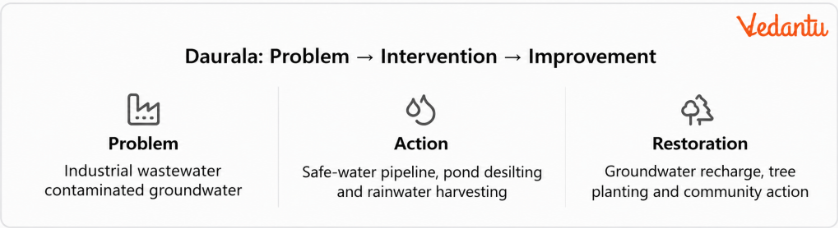
Q20. How did community participation help restore the environment in Daurala near Meerut? Explain the main problems, actions and outcomes of the Daurala case study.
Answer: The Daurala case study shows how local communities, organisations, industries and government representatives can work together to address environmental damage.
Daurala is a village near Meerut in Uttar Pradesh. The case study describes its ecological restoration efforts after groundwater contamination affected the local population.
1. Main Environmental Problem
Untreated industrial wastewater seeped into groundwater.
As a result, groundwater became contaminated with heavy metals, creating serious concerns for residents.
2. Identification of the Problem
In 2003, the village's environmental and health conditions drew civil society's attention.
A Meerut-based NGO conducted a door-to-door survey to understand residents' health problems.
3. Stakeholder Participation
The restoration efforts involved:
Village residents.
An NGO.
Industrial representatives.
Government officials.
People's representatives.
4. Application of the Polluter Pays Principle
The case study refers to the principle that polluters should bear responsibility for addressing the consequences of their pollution.
5. Improvement in Drinking-Water Supply
The village increased the overhead water tank capacity.
The village installed an additional 900-metre pipeline to improve access to potable water.
6. Restoration of the Village Pond
The village pond was desilted.
Removing accumulated silt helped improve the pond's water-storage and groundwater-recharge capacity.
7. Rainwater Harvesting
Rainwater harvesting structures were developed at different locations.
According to the case study, these helped recharge groundwater and dilute contaminants following the monsoon.
8. Tree Plantation
The textbook describes environmental improvement efforts that included planting approximately 1,000 trees.
9. Outcomes
The project improved local water management and demonstrated the value of cooperation between different stakeholders.
Q21. Why is urban solid waste disposal a serious problem in Indian cities? Explain the effects of uncollected and untreated waste.
Answer: Urban areas generate large quantities of waste because of population concentration, households, commercial activities and industrial development.
Waste disposal is a major problem that affects sanitation, water quality, and public health.
1. Increasing Waste Generation
Growing towns and cities produce large amounts of household refuse, industrial waste and construction debris.
2. Inadequate Collection
According to the chapter's historical information, major metropolitan cities such as Mumbai, Kolkata, Chennai, and Bengaluru collected a large share of their solid waste. Still, many other towns had substantial amounts of uncollected waste.
3. Open Dumping
Waste left on streets, vacant land and open spaces creates unpleasant smells and poor sanitary conditions.
4. Disease-Carrying Organisms
Discarded waste can attract flies and rodents that carry disease.
Poor waste management can contribute to diseases such as diarrhoea, cholera and typhoid.
5. Pollution of Water Bodies
Untreated sewage and industrial waste may flow into rivers and other water bodies.
This affects downstream communities and aquatic ecosystems.
6. Industrial Waste
Ash, chemical residues, and debris from factories, thermal power plants, and construction activities can cause serious environmental problems when disposed of improperly.
7. Methane Release
Untreated organic waste may decompose and produce gases, including methane.
8. Waste as a Resource
Suitable waste can generate energy and produce compost.
9. Importance of Better Management
Waste management requires effective collection, segregation, treatment and appropriate disposal.
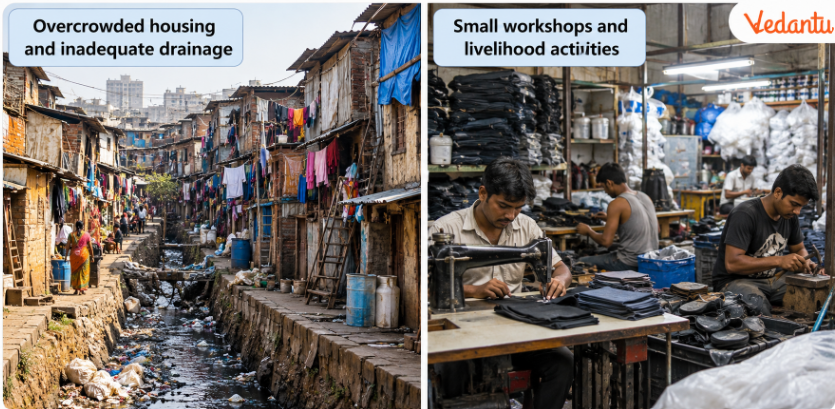
Q22. How does rural–urban migration contribute to the growth of slums? Explain with reference to Ramesh's migration experience and the Dharavi case study.
Answer: Rural–urban migration takes place when people move from villages to towns and cities, often in search of employment and better living opportunities.
However, affordable housing and essential services may not expand quickly enough to meet the needs of incoming populations.
1. Economic Reasons for Migration
Limited agricultural land, rural poverty and lack of regular work encourage migration.
Urban areas attract migrants by offering jobs in construction, manufacturing, and services.
2. Ramesh's Migration Experience
Ramesh's migration experience shows how he left his village because his family faced poverty and debt.
He first worked in a woollen factory in Ludhiana and later learned welding in Surat.
He later travelled with a contractor to several places for construction work.
3. Positive Effects of Migration
Ramesh sent money to his family.
The remittances helped support household expenses, children's education, healthcare, and improved living conditions.
4. Difficulties Faced by Migrants
His jobs were temporary and involved frequent workplace changes.
He also experienced separation from his family and difficulty adjusting to new environments.
5. Growth of Informal Settlements
Migrants with low or irregular incomes may find formal urban housing unaffordable.
Some settle in overcrowded neighbourhoods with inadequate basic services.
6. Living Conditions in Slums
Common problems associated with slum settlements include:
Overcrowded dwellings.
Poor ventilation.
Limited drinking-water facilities.
Inadequate sanitation and toilets.
Open or poorly managed drainage.
Narrow streets and poor environmental conditions.
7. Dharavi Case Study
The Dharavi case study highlights both difficult housing conditions and residents' economic contributions.
It describes activities such as pottery, embroidery, leatherwork, garment production, metalwork and furniture making.
This shows that low-income settlements can contain important productive economic activities despite serious infrastructure problems.
8. Education and Health
Low household income and inadequate living conditions can reduce access to education and healthcare.
Q23. Describe the major natural and human-induced causes of land degradation in India. Explain how degradation may lead to wasteland formation.
Answer: Land degradation is the decline in land's productive capacity due to natural processes or human activities.
It becomes a serious problem when land loses soil quality, vegetation cover or the ability to support productive uses.
1. Soil Erosion
Running water and wind may remove fertile topsoil.
This reduces the soil's capacity to support crops and natural vegetation.
2. Waterlogging
Excessive water accumulation can make soil unsuitable for normal plant growth.
3. Salinisation and Alkalinisation
Salt accumulation or excessive alkalinity can reduce soil productivity.
4. Natural Causes
The following land types are among those mainly associated with natural processes:
Gullied and ravinous lands.
Desertic and coastal sands.
Barren rocky areas.
Steep sloping lands.
Glacial areas.
5. Natural and Human-Induced Causes
Some degraded areas develop through a combination of natural and human factors.
Examples include waterlogged and marshy lands, saline and alkaline lands, and certain scrub-covered areas.
6. Human-Induced Causes
The textbook identifies:
Degraded shifting cultivation areas.
Degraded plantation lands.
Degraded forests.
Degraded pastures.
Mining and industrial wastelands.
7. Relationship Between Degradation and Wasteland
Repeatedly damaged land may lose its productive capacity.
Unchecked land degradation can eventually contribute to wasteland formation.
However, not all degraded land is wasteland, because some land remains usable or can be restored.
8. Role of Remote Sensing
The National Remote Sensing Centre (NRSC) uses remote sensing techniques to classify wastelands according to their characteristics and causes.
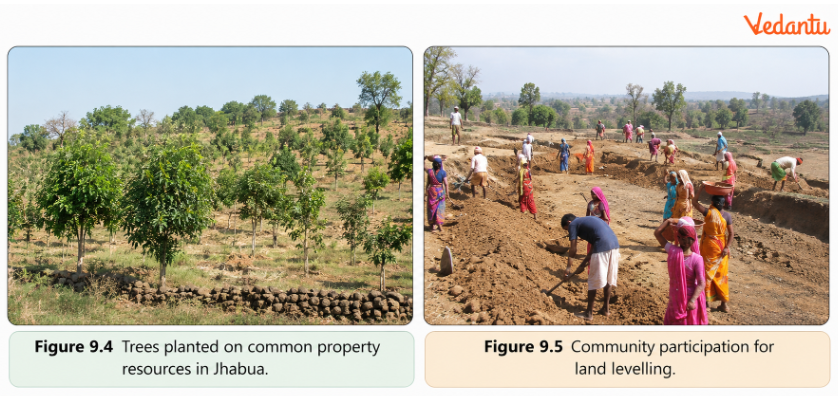
Q24. How did watershed management and community participation help restore degraded land in Jhabua district, Madhya Pradesh?
Answer: The Jhabua case study demonstrates how watershed management and community participation can improve degraded land and support local livelihoods.
1. Background of Jhabua
Jhabua district is located in western Madhya Pradesh.
The case study describes the district as having a significant tribal population, including the Bhil community, and experiencing poverty and resource degradation.
2. Main Environmental Problems
Forest and land degradation had reduced the quality of natural resources available to local communities.
This affected agriculture, pastures and livelihoods.
3. Watershed Management Programmes
The government implemented watershed projects to improve land, water, and vegetation conditions.
The programmes recognised that these resources are interconnected.
4. Community Participation
Residents actively participated in protecting and restoring common property resources.
Their involvement was important for maintaining restoration work over time.
5. Example from Petlawad Block
Bhil residents of Sat Rundi hamlet in Karravat village helped restore common land resources.
6. Tree Plantation
Each participating household planted and maintained a tree on common property land.
7. Pasture Development
Villagers planted fodder grass on common pastureland to improve its productivity.
8. Social Fencing
The community initially protected the restored land from open grazing.
They also supported stall feeding of cattle to prevent damage to regenerating pastures.
9. Resolving Encroachment
When an adjoining villager occupied part of the common land, residents sought clarification of land rights.
The community addressed the dispute through discussion and an arrangement that allowed the individual to join the user group and share in the benefits of restored common resources.
10. Importance of Collective Responsibility
The project's success depended not only on planting trees and grasses but also on the community's willingness to protect, maintain, and share the restored resources.
Why Practise Class 12 Geography Chapter 9 Important Questions with Vedantu?
Vedantu's Class 12 Geography Chapter 9 Important Questions help students revise pollution, urban waste, migration, slums and land degradation through simple explanations and important case studies.
How to Prepare Class 12 Geography Chapter 9 Important Questions with Vedantu?
Revise key concepts: Understand pollution types, sources and effects.
Learn case studies: Focus on Daurala, Dharavi, Ramesh's migration and Jhabua.
Practise important questions: Prepare short and long answers using relevant examples.
Understand conservation measures: Revise Namami Gange, social fencing and watershed management.
Check your answers: Use Vedantu's solved questions to improve accuracy and prepare for exams.
Important Study Material Links for Class 12 Geography Chapter 9
CBSE Class 12 Geography other books Important Questions and Study Resources
Chapter-Wise Important Questions for Class 12 Geography – India: People and Economy
Students can revise related topics from other chapters of India: People and Economy, including population, resources, agriculture, planning and transport.
Important Study Materials for Class 12 Geography
FAQs on Important Questions and Answers for Class 12 Geography Chapter 9 – Geographical Perspective on Selected Issues and Problems (India: People and Economy) | 2026-27
1. Why does the Yamuna face severe pollution in the Delhi stretch?
Domestic sewage and industrial wastewater entering the Yamuna from Delhi are major causes of pollution. Agricultural runoff and irrigation water extraction also affect parts of the river. These activities increase pollution pressure and reduce water quality.
2. Which industries contribute significantly to water pollution in India?
Leather, pulp and paper, textile and chemical industries are major contributors to water pollution. Untreated industrial wastewater may contain harmful chemicals, heavy metals and other contaminants.
3. What happens when the self-purifying capacity of a river is exceeded?
When pollutants enter a river in excessive quantities, its natural processes cannot remove or break down contaminants sufficiently. Water quality declines, aquatic ecosystems may be harmed, and the water may become unsafe for certain uses.
4. How does the Namami Gange Programme help reduce river pollution?
The programme includes developing sewage treatment systems, monitoring industrial effluents, cleaning river surfaces, planting trees along riverbanks and creating public awareness. These measures aim to reduce pollution and improve the river environment.
5. Why can untreated solid waste become dangerous during the rainy season?
Rainwater can spread waste and carry contaminants into drains, soil and water bodies. Uncollected garbage also creates unhealthy conditions and may attract disease-carrying flies and rodents.
6. What made the Daurala environmental restoration project different from a routine clean-up activity?
The Daurala project involved residents, an NGO, industrial representatives and government officials. It addressed groundwater contamination through improved water supply, pond restoration, rainwater harvesting, and tree planting, rather than relying on a single temporary clean-up measure.
7. Why do some rural migrants leave their families behind when working in cities?
Temporary jobs, low wages, frequent workplace transfers and expensive urban housing may prevent migrants from relocating their families. Ramesh's migration experience illustrates these difficulties.
8. How do remittances from migrant workers benefit rural households?
Money migrants send home can support food, healthcare, children's education, agriculture, and housing. In Ramesh's case, remittances improved his family's living conditions despite the difficulties associated with migration.
9. Why is Dharavi discussed as both a residential and an economic settlement?
The Dharavi case study describes overcrowded housing and sanitation problems alongside productive activities such as pottery, embroidery, leatherwork, garments and metalwork. It shows that residents contribute economically even when living conditions are inadequate.
10. What is the difference between natural and human-induced land degradation?
Natural land degradation may result from erosion, difficult terrain and other physical processes. Human-induced degradation may result from unsuitable land use, degraded pastures, mining, industrial activities, and forest damage. Some types develop through a combination of both.
11. What is the purpose of social fencing in watershed management?
Social fencing involves protecting regenerating common land through community-agreed restrictions on activities such as open grazing. In the Jhabua case study, this helped protect new vegetation and pasture development.
12. How did the Bhil community in Jhabua improve common property resources?
The community planted and maintained trees, grew fodder grass, protected common pastureland and encouraged stall feeding of cattle. These measures helped regenerate vegetation and improve shared resources.
13. Why are waterlogging, salinity and alkalinity considered causes of land degradation?
These conditions reduce soil suitability for healthy plant growth. Waterlogging keeps soil excessively wet, while salinity and alkalinity affect its chemical condition and can lower agricultural productivity.
14. What role does the National Remote Sensing Centre play in studying wastelands?
The National Remote Sensing Centre uses remote sensing techniques to classify wastelands. This helps identify different categories of degraded land and the natural or human processes associated with them.
15. Which case studies should students revise most carefully from Class 12 Geography Chapter 9?
Students should prepare the Daurala groundwater restoration case, Ramesh's rural–urban migration experience, the Dharavi slum case and the Jhabua watershed management example. Each connects a specific geographical problem with its causes, effects or possible solutions.