


CBSE Class 4 Maths Chapter 9 Important Questions with Answers – Equal Groups
The following questions cover important activities and problem-solving methods from Equal Groups. They include skip counting, multiplication charts, arrays, division with remainders and mathematical reasoning.
Multiple Choice Questions (MCQs) for Class 4 Maths Chapter 9
Q1. A frog jumps 3 steps at a time, starting from 0. Which number will it NOT land on?
A. 18
B. 27
C. 36
D. 40
Answer: D. 40
Explanation: The frog lands on multiples of 3. Since 40 is not a multiple of 3, the frog will not land on it.
Q2. Which number is a common multiple of 6 and 8?
A. 18
B. 24
C. 30
D. 36
Answer: B. 24
Explanation: 6 × 4 = 24 and 8 × 3 = 24.
Q3. Radha bakes 18 cupcakes in one tray. How many cupcakes can she bake using two trays?
A. 18
B. 24
C. 36
D. 40
Answer: C. 36
Solution: 18 × 2 = 36 cupcakes.
Q4. Which of the following can be the ones digit when a whole number is doubled?
A. 3
B. 5
C. 7
D. 8
Answer: D. 8
Explanation: Doubling a whole number always gives an even number.
Q5. A factory has 58 wheels. Each small tempo needs 3 wheels. How many complete tempos can be made?
A. 18
B. 19
C. 20
D. 21
Answer: B. 19
Solution: 58 ÷ 3 = 19 remainder 1. The factory can make 19 complete tempos.
Very Short Answer Questions for Class 4 Maths Chapter 9
Q6. A rabbit jumps 6 steps at a time. What is the smallest three-digit number it can land on? How many jumps are needed?
Answer: 102, after 17 jumps.
Solution: 6 × 17 = 102. This is the first multiple of 6 greater than 99.
Q7. A flower has 3 petals. How many petals are there in 12 such flowers?
Answer: 36 petals.
Solution: 12 × 3 = 36.
Q8. What is the double of 45?
Answer: 90.
Solution: 45 + 45 = 90.
Q9. What is the ones digit of 13 × 8?
Answer: 4.
Solution: 13 × 8 = 104.
Q10. A dairy farm has cows with 88 legs altogether. How many cows are there?
Answer: 22 cows.
Solution: Each cow has 4 legs. Therefore, 88 ÷ 4 = 22.
Short Answer Questions for Class 4 Maths Chapter 9
Q11. A frog jumps 3 steps at a time and a squirrel jumps 4 steps at a time. Write the numbers where both will land up to 60.
Solution:
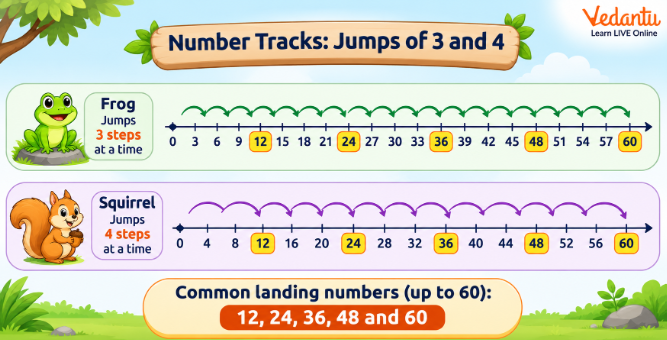
The frog lands on multiples of 3.
The squirrel lands on multiples of 4.
The common multiples of 3 and 4 up to 60 are 12, 24, 36, 48 and 60.
Answer: Both animals land on 12, 24, 36, 48 and 60.
Q12. A cat starts at number 6 and jumps 3 steps at a time. A rat starts at number 12 and jumps 2 steps at a time. If both jump together, will the cat catch the rat?
Solution:
Answer: Yes. The cat catches the rat at number 24 after 6 jumps.
Q13. A gardener arranges 36 saplings in equal rows. Show three different arrangements using multiplication.
Solution:
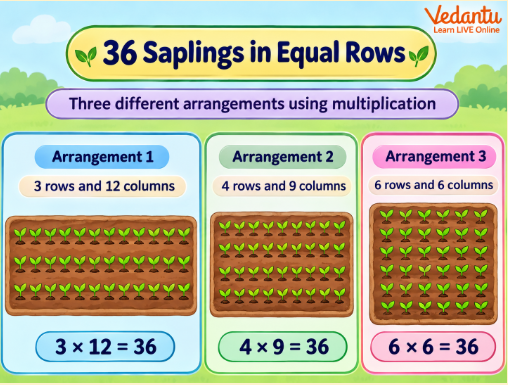
Answer: The gardener can arrange the saplings in 3 × 12, 4 × 9 or 6 × 6 rows and columns.
Q14. Radha packs 4 cupcakes in each box. She fills 18 boxes. Find the total number of cupcakes by breaking 18 into tens and ones.
Solution:
18 = 10 + 8.
10 × 4 = 40.
8 × 4 = 32.
40 + 32 = 72.
Answer: Radha packs 72 cupcakes.
Q15. In a multiplication chart, the number in row 4, column 7 is the same as the number in row 7, column 4. Explain why.
Solution:
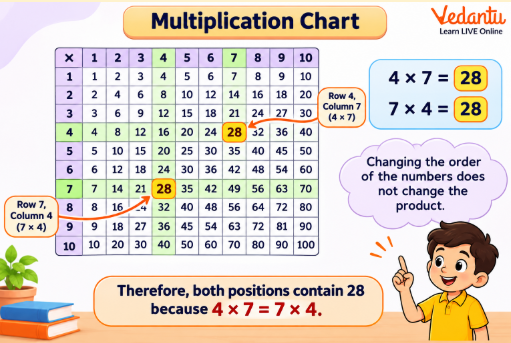
4 × 7 = 28.
7 × 4 = 28.
Changing the order of the numbers does not change the product.
Answer: Both positions contain 28 because 4 × 7 = 7 × 4.
Q16. A sports store has 50 shuttlecocks. It packs 4 shuttlecocks in each box. How many full boxes can it pack? How many shuttlecocks remain?
Solution:
50 ÷ 4 = 12 remainder 2.
12 × 4 = 48.
50 − 48 = 2.
Answer: The store can pack 12 full boxes, with 2 shuttlecocks remaining.
Q17. A school auditorium has 15 rows with 8 children sitting in each row. Find the total number of children using multiplication.
Solution:
15 = 10 + 5.
10 × 8 = 80.
5 × 8 = 40.
80 + 40 = 120.
Answer: There are 120 children in the auditorium.
Long Answer and Activity-Based Questions for Class 4 Maths Chapter 9
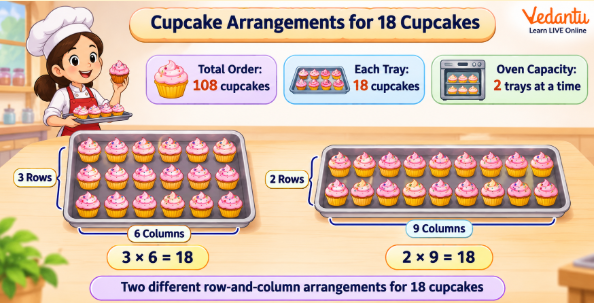
Q18. Radha's bakery has an order for 108 cupcakes. Each tray holds 18 cupcakes, and the oven can hold two trays at a time.
a) How many trays are needed?
b) How many cupcakes can be baked in one attempt?
c) How many attempts are required to bake all 108 cupcakes?
d) Show two different row-and-column arrangements for 18 cupcakes.
Solution:
a) 108 ÷ 18 = 6 trays.
b) 18 × 2 = 36 cupcakes per attempt.
c) 108 ÷ 36 = 3 attempts.
d) Two arrangements are 3 rows of 6 cupcakes and 2 rows of 9 cupcakes.
Answer: Radha needs 6 trays and 3 baking attempts. The cupcakes can be arranged as 3 × 6 or 2 × 9.
Q19. A shopkeeper has 174 boxes of kulhads. Each box contains 6 kulhads. Find the total number of kulhads using hundreds, tens and ones.
Solution:
174 = 100 + 70 + 4.
100 × 6 = 600.
70 × 6 = 420.
4 × 6 = 24.
Total = 600 + 420 + 24 = 1044.
Answer: The shopkeeper has 1044 kulhads.
Q20. A rafting company takes 259 people on a river-rafting trip. Each raft carries 7 people.
a) How many rafts are needed?
b) If 7 more people join, how many rafts are needed?
c) Explain how division helps solve this problem.
Solution:
a) 259 ÷ 7 = 37 rafts.
b) Total people = 259 + 7 = 266.
266 ÷ 7 = 38 rafts.
c) Division helps us find how many equal groups of 7 can be formed.
Answer: The company needs 37 rafts initially and 38 rafts if 7 more people join.
Q21. Read each statement and decide whether it is always true, never true or sometimes true for whole numbers. Give a reason.
Solution:
Answer: The statements are always, never, sometimes, always and sometimes true, respectively.
Important Topics and Preparation Tips for Class 4 Maths Chapter 9
The chapter introduces multiplication and division through pictures, number patterns and everyday situations. Use the following table to practise the main concepts.
Exam Tip: In multiplication problems, identify the number of groups and objects in each group. In division problems, check whether the objects must be shared equally or packed into groups of a fixed size.
Download Class 4 Maths Chapter 9 Important Questions PDF
Vedantu provides the Class 4 Maths Chapter 9 important questions PDF for Equal Groups. It includes practice questions on multiplication, division, common multiples, number patterns and word problems.
For Class 4 Maths Chapter 9 important questions PDF download, use the PDF download option available on this page to practise the questions and check the solved answers.
CBSE Class 4 Maths Chapter 9 Study Materials
Explore the following study materials to understand Equal Groups and strengthen multiplication and division skills.
CBSE Class 4 Maths Chapter-wise Important Questions
Related Study Materials for CBSE Class 4 Maths
FAQs on Important Questions and Answers for Class 4 Maths Chapter 9 Equal Groups | 2026–27
1. What are the main topics in Class 4 Maths Chapter 9 Equal Groups?
The chapter covers skip counting, common multiples, equal groups, arrays, doubling, multiplication charts, division and remainders. Students also learn to identify number patterns and solve everyday multiplication and division problems.
2. Where can I find Class 4 Maths Chapter 9 important questions with answers?
Vedantu provides Class 4 Maths Chapter 9 important questions with answers based on Equal Groups. Students can practise solved MCQs, short-answer questions and application-based problems covering the chapter's important concepts.
3. What types of Class 4 Maths Chapter 9 important questions MCQ should students practise?
Students should practise MCQs involving multiples, animal jumps, doubling, multiplication facts, equal groups and division with remainders. These questions help students check their understanding of number relationships.
4. How can I find common multiples using animal jumps?
Write the numbers reached by each animal. For example, a frog jumping 3 steps reaches 3, 6, 9 and 12, while a squirrel jumping 4 steps reaches 4, 8 and 12. Both reach 12, so it is a common multiple.
5. What is the difference between multiplication and division in Equal Groups?
Multiplication finds the total number of objects in equal groups. Division helps us share a total equally or find how many groups can be formed. For example, 4 × 6 = 24 and 24 ÷ 6 = 4.
6. How can I solve Class 4th Maths Chapter 9 question answer problems involving remainders?
Divide the total number of objects by the number in each group. The objects that cannot form another complete group are the remainder. For example, 50 ÷ 4 gives 12 complete groups with 2 objects left.
7. Why are multiplication charts useful in Class 4 Maths Chapter 9?
Multiplication charts help students identify products, common multiples and number patterns. They also show that changing the order of two numbers does not change their product, such as 4 × 7 = 7 × 4.
8. Where can I access the Class 4 Maths Chapter 9 important questions PDF?
The Class 4 Maths Chapter 9 important questions PDF is available through the PDF download option on Vedantu's chapter page. Students can use it to practise multiplication, division and reasoning questions and review their answers.