


CBSE Class 4 Maths Chapter 8 Important Questions with Answers – Weigh It, Pour It
The following solved questions cover the main concepts and activities from the chapter, including measuring weight, balancing objects, packing sweets, measuring liquids and understanding water usage.
Multiple Choice Questions (MCQs) for Class 4 Maths Chapter 8
Q1. How many grams make 1 kilogram?
A. 100 g
B. 500 g
C. 1000 g
D. 1500 g
Answer: C. 1000 g
Q2. Which unit is more suitable for measuring the weight of a pencil?
A. Kilogram
B. Gram
C. Litre
D. Millilitre
Answer: B. Gram
Q3. A 500 g packet of daal is balanced by two identical packets. What is the weight of each smaller packet?
A. 100 g
B. 200 g
C. 250 g
D. 500 g
Answer: C. 250 g
Solution: 250 g + 250 g = 500 g.
Q4. A shopkeeper packs 1 kg of kaju-katli into boxes of 100 g each. How many boxes are needed?
A. 5
B. 10
C. 15
D. 20
Answer: B. 10
Solution: 1000 g ÷ 100 g = 10 boxes.
Q5. Which of these containers is most likely to hold more than 1 litre of water?
A. Teaspoon
B. Small medicine cup
C. Bucket
D. Small drinking glass
Answer: C. Bucket
Q6. How many 250 ml bottles are needed to fill a 1 litre bottle?
A. 2
B. 3
C. 4
D. 5
Answer: C. 4
Solution: 250 ml + 250 ml + 250 ml + 250 ml = 1000 ml = 1 litre.
Q7. Which statement about a balanced pan balance is correct?
A. The left pan is always heavier.
B. The right pan is always heavier.
C. Both pans carry equal weight.
D. Both pans must contain the same number of objects.
Answer: C. Both pans carry equal weight.
Q8. A container holds 750 ml of water. How many complete 250 ml bottles can be filled from it?
A. 2
B. 3
C. 4
D. 5
Answer: B. 3
Solution: 250 ml + 250 ml + 250 ml = 750 ml.
Very Short Answer Questions for Class 4 Maths Chapter 8
Q9. What is half of 1 kg in grams?
Answer: 500 g.
Solution: 1 kg = 1000 g. Half of 1000 g is 500 g.
Q10. How many 100 g packets are needed to make 1 kg?
Answer: 10 packets.
Solution: 10 × 100 g = 1000 g = 1 kg.
Q11. How many 10 g erasers weigh the same as a 50 g haldi packet?
Answer: 5 erasers.
Solution: 5 × 10 g = 50 g.
Q12. How many 1 kg packets are needed to make 25 kg?
Answer: 25 packets.
Q13. A bottle contains 500 ml of water. How much more water is needed to make 1 litre?
Answer: 500 ml.
Solution: 1000 ml − 500 ml = 500 ml.
Q14. How many 1 ml droppers will fill a 10 ml dosing cup?
Answer: 10 droppers.
Q15. Which is heavier: a 750 g packet or a 1 kg packet? By how much?
Answer: The 1 kg packet is heavier by 250 g.
Solution: 1000 g − 750 g = 250 g.
Q16. What is one-fourth of a litre in millilitres?
Answer: 250 ml.
Solution: 1000 ml ÷ 4 = 250 ml.
Short Answer Questions for Class 4 Maths Chapter 8
Q17. Mr Shrinathan has 1 kg of kaju-katli. Find the number of boxes needed if each box holds the following weight.
a) 500 g
b) 250 g
c) 100 g
d) 50 g
Solution:
Answer: He needs 2, 4, 10 and 20 boxes respectively.
Q18. A weighing balance has one 500 g packet of daal on the left pan and three 100 g packets on the right pan. Which pan will move down? How much weight is needed to balance it?
Solution:
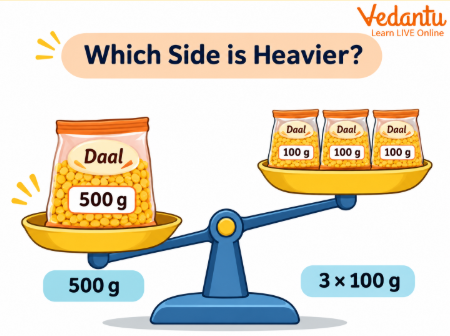
Left pan = 500 g.
Right pan = 100 g + 100 g + 100 g = 300 g.
The left pan is heavier by 200 g.
Answer: The left pan will move down. Add 200 g to the right pan to balance the scale.
Q19. Match each object with a suitable estimated weight.
Answer:
1 – B
2 – C
3 – A
4 – D
Q20. A shopkeeper has packets weighing 250 g, 500 g and 100 g. Suggest two different ways to make exactly 1 kg using these packets.
Solution:
Method 1: 500 g + 500 g = 1000 g.
Method 2: 250 g + 250 g + 250 g + 250 g = 1000 g.
Answer: Two 500 g packets or four 250 g packets make 1 kg.
Q21. A child has a 10 ml dosing cup. How many times must it be filled to measure the following quantities?
a) 100 ml
b) 250 ml
c) 500 ml
d) 1 litre
Solution:
Answer: 10, 25, 50 and 100 cups respectively.
Q22. Mr Krishna needs to pack 1 litre of perfumed oil into bottles of different capacities. How many bottles are required in each case?
a) 500 ml bottles
b) 200 ml bottles
c) 100 ml bottles
d) 50 ml bottles
Solution:
1 litre = 1000 ml.
Answer: 2, 5, 10 and 20 bottles respectively.
Q23. A water bottle holds 500 ml. A child drinks two full bottles in the morning and one full bottle in the afternoon. How much water does the child drink altogether?
Solution:
Morning = 500 ml + 500 ml = 1000 ml.
Afternoon = 500 ml.
Total = 1000 ml + 500 ml = 1500 ml.
Answer: 1500 ml, or 1 litre 500 ml.
Long Answer and Activity-Based Questions for Class 4 Maths Chapter 8
Q24. Study the following quantities of vegetables bought by Rita and Shabnam.
Answer the following questions.
a) What is the total weight of potatoes and onions?
b) What is the combined weight of all four items?
c) How much heavier are the potatoes than the onions?
Solution:
a) 750 g + 250 g = 1000 g = 1 kg.
b) 750 g + 500 g + 250 g + 500 g = 2000 g = 2 kg.
c) 750 g − 250 g = 500 g.
Answer: 1 kg, 2 kg and 500 g, respectively.
Q25. A student uses a 250 ml cup to fill a 1 litre bottle. After pouring three full cups, answer the following questions.
a) How much water has been poured?
b) How much more water is needed?
c) What fraction of the bottle is filled?
d) How many cups are needed to fill two such bottles?
Solution:
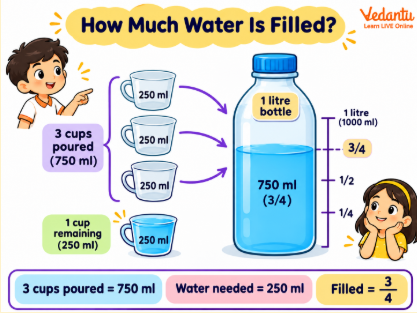
a) 250 ml × 3 = 750 ml.
b) 1000 ml − 750 ml = 250 ml.
c) 750 ml is three-fourths of 1000 ml.
d) One bottle needs 4 cups. Two bottles need 8 cups.
Answer: 750 ml poured, 250 ml remaining, three-fourths filled and 8 cups for two bottles.
Q26. A family records the amount of water used for four activities in one day.
a) Find the total water used.
b) Which activity uses the most water?
c) How much more water is used for watering plants than washing vegetables?
d) Suggest one way to reduce unnecessary water use.
Solution:
a) 8 + 12 + 5 + 15 = 40 litres.
b) Watering plants uses the most water.
c) 15 − 5 = 10 litres.
d) Use a watering can and avoid leaving a tap running.
Answer: 40 litres in total, watering plants uses the most, the difference is 10 litres, and careful water use can reduce wastage.
Q27. A leaking tap wastes 50 ml of water every hour. Find the amount wasted in one day and one week if the leak continues at the same rate.
Solution:
Water wasted in 1 hour = 50 ml.
Water wasted in 24 hours = 50 × 24 = 1200 ml.
1200 ml = 1 litre 200 ml.
Water wasted in 7 days = 1200 × 7 = 8400 ml.
8400 ml = 8 litres 400 ml.
Answer: The tap wastes 1 litre 200 ml in a day and 8 litres 400 ml in a week.
Q28. A student has the following containers: a 500 ml bottle, a 250 ml bottle, a 100 ml cup and a 50 ml cup. Find two different ways to measure exactly 900 ml.
Solution:
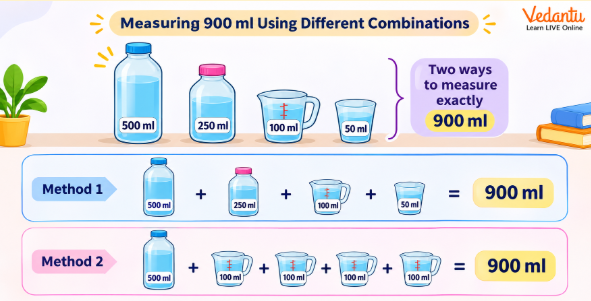
Method 1: 500 ml + 250 ml + 100 ml + 50 ml = 900 ml.
Method 2: 500 ml + 100 ml + 100 ml + 100 ml + 100 ml = 900 ml.
Answer: Both combinations measure exactly 900 ml.
Q29. A student is comparing the weight of different objects using a pan balance. The first pan holds a 1 kg bag of rice. The second pan holds two 250 g packets of sugar and four 100 g packets of pulses.
a) Find the total weight on the second pan.
b) Which pan is heavier?
c) How much weight must be added to the second pan to balance the scale?
d) Can the balance be achieved using only 50 g packets? If yes, how many?
Solution:
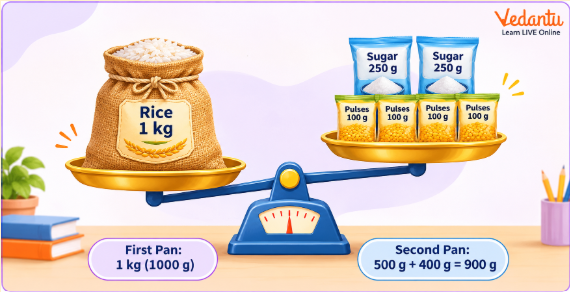
a) Two 250 g packets = 500 g.
Four 100 g packets = 400 g.
Total = 900 g.
b) The first pan has 1000 g and is heavier.
c) 1000 g − 900 g = 100 g.
d) Two 50 g packets make 100 g.
Answer: The second pan holds 900 g. The first pan is heavier by 100 g. Two 50 g packets will balance the scale.
Important Topics and Preparation Tips for Class 4 Maths Chapter 8
Exam Tip: Before calculating, check whether the quantities use the same unit. Convert kilograms to grams or litres to millilitres when needed.
Download Class 4 Maths Chapter 8 Important Questions PDF
Vedantu provides the Class 4 Maths Chapter 8 important questions PDF for Weigh It, Pour It. Students can use the chapter-wise PDF to practise questions on weight, capacity, measuring containers and everyday calculations.
Use the PDF download option on this page to access the Class 4 Maths Chapter 8 worksheet with answers PDF and practise the solved questions at your own pace.
CBSE Class 4 Maths Chapter 8 Study Materials
Explore the following study materials to understand Weigh It, Pour It and practise weight and capacity questions.
CBSE Class 4 Maths Chapter-wise Important Questions
Related Study Materials for CBSE Class 4 Maths
FAQs on Important Questions and Answers for Class 4 Maths Chapter 8 Weigh It, Pour It | 2026–27
1. What are the important topics in Class 4 Maths Chapter 8 Weigh It, Pour It?
The chapter covers comparing weights, kilograms and grams, pan balances, measuring capacity, litres and millilitres. It also includes sweet-box packing, measuring containers, estimating quantities and water conservation activities.
2. Where can I find Class 4 Maths Chapter 8 important questions with answers?
Vedantu provides Class 4 Maths Chapter 8 important questions with answers based on Weigh It, Pour It. Students can practise MCQs, short answers, calculations and activity-based questions covering the chapter's main concepts.
3. What types of questions are included in the Class 4 Maths Chapter 8 important questions worksheet?
The worksheet includes questions on converting measurement units, balancing weights, packing items, comparing containers and calculating water usage. Students can also practise picture-based questions involving scales and measuring bottles.
4. Where can I access the Class 4 Maths Chapter 8 important questions PDF?
The Class 4 Maths Chapter 8 important questions PDF is available on Vedantu's chapter page. Students can use the PDF download option to access the questions and solved answers for practice.
5. How can I solve Class 4 Maths Chapter 8 important questions MCQ correctly?
To solve, read the question and identify whether it is about weight or capacity. Check the units carefully and use 1 kg = 1000 g or 1 litre = 1000 ml wherever needed. Compare the options before selecting the answer.
6. How many 250 g packets make 1 kg?
Four 250 g packets make 1 kg because 250 + 250 + 250 + 250 = 1000 g. This is an important example of combining smaller weights to make a kilogram.
7. What is the difference between weight and capacity in Class 4 Maths Chapter 8?
Weight tells us how heavy an object is, while capacity tells us how much liquid a container can hold. The chapter uses grams and kilograms for weight and millilitres and litres for capacity.
8. How do I find the number of small bottles needed to fill a 1 litre bottle?
First, change 1 litre into 1000 ml. Then divide 1000 by the capacity of one smaller bottle. For example, five 200 ml bottles fill a 1 litre bottle.
9. Where can I get the Class 4 Maths Chapter 8 worksheet with answers PDF?
Students can access the Class 4 Maths Chapter 8 worksheet with answers PDF through Vedantu's chapter page. It supports practice with weight comparisons, capacity calculations and everyday measurement questions.
10. Why is water conservation included in Weigh It, Pour It?
The chapter helps students understand how water is measured and used in daily life. Activities involving leaking taps and water consumption show how small quantities can add up over time and why avoiding wastage matters.