


CBSE Class 4 Maths Chapter 10 Important Questions with Answers – Elephants, Tigers, and Leopards
The following questions cover important textbook activities, including the NIM game, addition charts, wildlife population problems, four-digit calculations and money-based word problems.
Multiple Choice Questions (MCQs) for Class 4 Maths Chapter 10
Q1. In the NIM game, players add either 1 or 2 to the running total. The player who reaches 10 wins. If the total is 8 and it is your turn, what should you add to win?
A. 0
B. 1
C. 2
D. 3
Answer: C. 2
Explanation: 8 + 2 = 10, so you win immediately.
Q2. What is the sum of 27 and its reverse?
A. 77
B. 88
C. 99
D. 101
Answer: C. 99
Solution: The reverse of 27 is 72. Therefore, 27 + 72 = 99.
Q3. Which of these is the correct sum of 6049 and 3054?
A. 9003
B. 9103
C. 9203
D. 9113
Answer: B. 9103
Q4. A number is 749 less than 8820. What is the number?
A. 8071
B. 8171
C. 8079
D. 9571
Answer: A. 8071
Solution: 8820 − 749 = 8071.
Q5. Which expression gives the greatest result?
A. 54 + 97
B. 54 + 90
C. 54 + 85
D. 54 + 79
Answer: A. 54 + 97
Explanation: The first number is the same in every expression. Adding the largest second number gives the greatest result.
Very Short Answer Questions for Class 4 Maths Chapter 10
Q6. What is the missing number in the pattern 2540, 2590, ___, 2690?
Answer: 2640.
Solution: The pattern increases by 50 each time.
Q7. What number must be added to 275 to make 500?
Answer: 225.
Solution: 500 − 275 = 225.
Therefore, 275 + 225 = 500.
Q8. What is the sum of 3999 + 290?
Answer: 4289.
Solution: 4000 + 290 − 1 = 4289.
Q9. Find the missing number: 354 + ___ = 521.
Answer: 167.
Solution: 521 − 354 = 167.
Q10. If 845 − 394 = 451, what is 845 − 395?
Answer: 450.
Explanation: Increasing the number being subtracted by 1 decreases the difference by 1.
Short Answer Questions for Class 4 Maths Chapter 10
Q11. In the NIM game, players add 1 or 2 to reach 10. If your opponent has reached 7 and it is your turn, can you guarantee a win? Explain.
Solution:
If you add 1, the total becomes 8. Your opponent can add 2 and reach 10.
If you add 2, the total becomes 9. Your opponent can add 1 and reach 10.
Answer: No. If your opponent plays correctly, they can win from either choice.
Q12. Look at the following part of an addition chart. Find the sums of the two diagonals. What do you notice?
Solution:
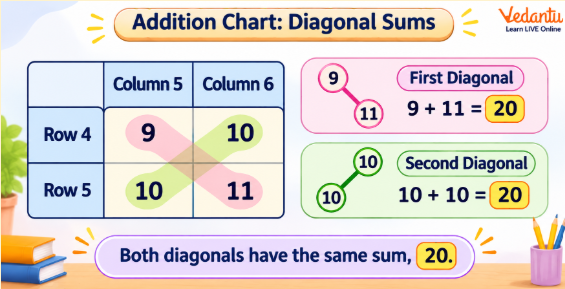
First diagonal: 9 + 11 = 20.
Second diagonal: 10 + 10 = 20.
Answer: Both diagonals have the same sum, 20.
Q13. Find two different two-digit numbers that give 88 when added to their reverse. Explain the pattern.
Solution:
17 + 71 = 88.
26 + 62 = 88.
For a two-digit number and its reverse, the sum is 11 times the sum of its digits.
In both examples, the digits add to 8.
Answer: Two possible numbers are 17 and 26.
Q14. The elephant population is 6049 in Karnataka and 3054 in Kerala. Estimate the total by rounding each number to the nearest thousand. Then find the exact total.
Solution:
Estimated total:
6049 is approximately 6000.
3054 is approximately 3000.
6000 + 3000 = 9000.
Exact total:
6049 + 3054 = 9103.
Answer: Estimated total = 9000 elephants; exact total = 9103 elephants.
Q15. Gujarat has 1355 leopards, Karnataka has 1131 and Madhya Pradesh has 1817. Find the total number of leopards in these three states.
Solution:
1355 + 1131 = 2486.
2486 + 1817 = 4303.
Answer: The three states have 4303 leopards altogether.
Q16. Assam has 5719 elephants, which is 3965 more than Meghalaya. How many elephants are there in Meghalaya?
Solution:
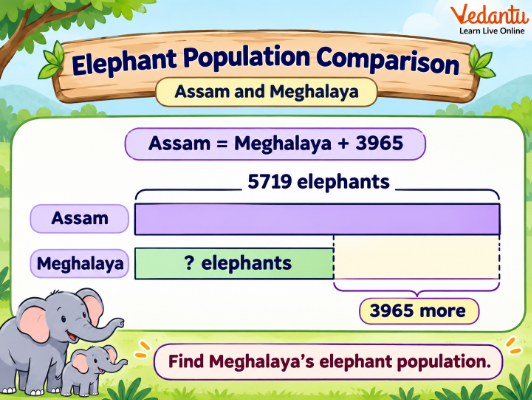
Meghalaya's elephant population = 5719 − 3965.
Regroup the numbers and subtract:
5719 − 3965 = 1754.
Answer: Meghalaya has 1754 elephants.
Q17. The visitor board at Kaziranga National Park shows 8591 visitors in December and 6415 in November. November had 1587 more visitors than October. Find:
a) How many more visitors came in December than November?
b) How many visitors came in October?
Solution:
a) 8591 − 6415 = 2176.
b) 6415 − 1587 = 4828.
Answer: December had 2176 more visitors than November, and October had 4828 visitors.
Q18. Without calculating both expressions fully, compare them using the correct sign: <, > or =. Explain your reasoning.
a) 54 + 97 ___ 54 + 90
b) 84 − 68 ___ 90 − 68
c) 73 − 54 ___ 73 − 56
d) 456 + 209 ___ 446 + 219
Solution:
a) 54 + 97 > 54 + 90 because 97 is greater than 90.
b) 84 − 68 < 90 − 68 because 84 is smaller than 90.
c) 73 − 54 > 73 − 56 because subtracting a smaller number gives a greater result.
d) 456 + 209 = 446 + 219 because one addend decreases by 10 while the other increases by 10.
Answer: a) >, b) <, c) >, d) =.
Long Answer and Activity-Based Questions for Class 4 Maths Chapter 10
Q19. Maharashtra has 444 tigers. Madhya Pradesh has 341 more tigers than Maharashtra, and Uttarakhand has 116 more tigers than Maharashtra.
a) How many tigers are there in Madhya Pradesh?
b) How many tigers are there in Uttarakhand?
c) Find the combined tiger population of Madhya Pradesh and Uttarakhand.
d) Find the total tiger population across all three states.
Solution:
a) Madhya Pradesh = 444 + 341 = 785.
b) Uttarakhand = 444 + 116 = 560.
c) Combined population = 785 + 560 = 1345.
d) Total population = 444 + 785 + 560 = 1789.
Answer: Madhya Pradesh has 785 tigers, Uttarakhand has 560, their combined population is 1345, and all three states together have 1789 tigers.
Q20. A juice factory records the following monthly production.
a) Find the number of guava juice bottles.
b) Find the number of orange juice bottles.
c) Find the combined number of guava and orange juice bottles.
d) Compare their combined total with the passion fruit juice bottles.
Solution:
a) Guava = 1348 + 759 = 2107.
b) Orange = 2107 + 1257 = 3364.
c) Combined total = 2107 + 3364 = 5471.
d) Difference = 5471 − 4781 = 690.
Answer: The factory packs 2107 guava bottles and 3364 orange bottles. Together, they make 5471 bottles, which is 690 more than the passion fruit bottles.
Q21. Raju, Rani and Roja are collecting money for a school Baal Mela. They deposit ₹2045, ₹3578 and ₹1240 respectively.
a) Find the total money deposited.
b) How much more does Rani deposit than Roja?
c) Show one possible combination of ₹500, ₹100, ₹50, ₹10 and ₹5 notes or coins to make Raju's ₹2045.
Solution:
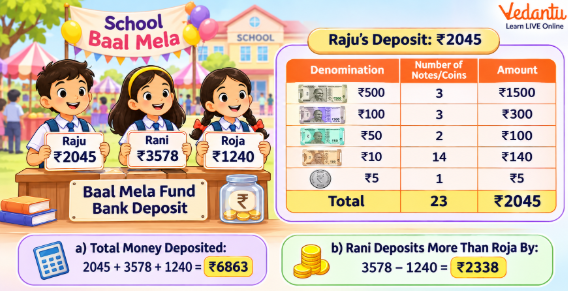
a) Total = 2045 + 3578 + 1240 = ₹6863.
b) Difference = 3578 − 1240 = ₹2338.
c) One possible combination for ₹2045 is:
Answer: The children deposit ₹6863 altogether. Rani deposits ₹2338 more than Roja. The table shows one valid combination for Raju's deposit.
Q22. Fill the numbers 1 to 9 in a 3 × 3 grid so that the difference between every pair of neighbouring squares connected horizontally or vertically is odd.
a) Complete one valid arrangement.
b) Explain why your arrangement works.
c) Can all neighbouring differences be even when using each number from 1 to 9 exactly once?
Solution:
a) One valid arrangement is:
b) Every horizontal pair contains one odd and one even number, so their difference is odd.
Every vertical pair also contains one odd and one even number. For example:
4 − 1 = 3, 5 − 2 = 3 and 6 − 3 = 3.
c) No. If every neighbouring difference were even, every connected square would need to contain numbers of the same parity. However, the numbers 1 to 9 include both odd and even numbers.
Answer: The grid shown is one valid arrangement for odd differences. An arrangement with all even differences is not possible using 1 to 9 exactly once.
Important Topics and Preparation Tips for Class 4 Maths Chapter 10
Chapter 10 includes number games, four-digit calculations and problems based on wildlife, money and everyday records. The following table highlights the main topics students should practise.
Exam Tip: Read the problem carefully to decide whether you need addition or subtraction. Estimate the answer first, then calculate and check whether the result is reasonable.
Download Class 4 Maths Chapter 10 Important Questions PDF
Vedantu provides the Class 4 Maths Chapter 10 important questions PDF for Elephants, Tigers, and Leopards. Students can practise questions involving four-digit addition and subtraction, number patterns, estimation, money calculations and mathematical reasoning.
Use the PDF download option on this page to access the chapter's important questions with solved answers. The material supports independent practice and helps students check their calculation methods.
CBSE Class 4 Maths Chapter 10 Study Materials
Explore the following study materials to strengthen your understanding of Elephants, Tigers, and Leopards.
CBSE Class 4 Maths Chapter-wise Important Questions
Related Study Materials for CBSE Class 4 Maths
FAQs on Important Questions and Answers for Class 4 Maths Chapter 10 Elephants, Tigers, and Leopards | 2026–27
1. What are the main topics in Class 4 Maths Chapter 10 Elephants, Tigers, and Leopards?
Chapter 10 covers four-digit addition and subtraction, regrouping, estimation, number games, addition charts, reverse-and-add patterns, money calculations and mathematical reasoning. Students also solve problems involving animal populations and visitor records.
2. Where can I find Class 4 Maths Chapter 10 important questions with answers?
Vedantu provides Class 4 Maths Chapter 10 important questions with answers based on Elephants, Tigers, and Leopards. Students can practise solved MCQs, short answers, and word problems that cover the chapter's major concepts.
3. What types of Class 4 Maths Chapter 10 important questions MCQ should students practise?
Students should practise MCQs involving addition, subtraction, missing numbers, number patterns, estimation and comparison of expressions. Questions based on the NIM game and reverse-and-add activities are also useful.
4. How can I solve Class 4 Maths Chapter 10 important questions with solutions involving regrouping?
Write the numbers in thousands, hundreds, tens and ones columns. Start calculating from the ones place. When needed, regroup 10 ones as 1 ten, 10 tens as 1 hundred or 10 hundreds as 1 thousand.
5. What is the reverse-and-add activity in Class 4 Maths Chapter 10?
In this activity, students reverse the digits of a two-digit number and add the two numbers. For example, reversing 27 gives 72, and 27 + 72 = 99. The activity helps students explore addition patterns.
6. How can I solve Class 4 Maths Chapter 10 question answer problems involving animal populations?
Identify whether the question asks for a combined population or the difference between two populations. Use addition to find a total and subtraction to find a missing or smaller population. Check the answer using estimation.
7. Where can I access the Class 4 Maths Chapter 10 important questions PDF?
The Class 4 Maths Chapter 10 important questions PDF is available through the download option on Vedantu's chapter page. Students can use it to practise solved questions and review the methods used.
8. How do addition charts help students understand number patterns?
An addition chart shows the sums of numbers in different rows and columns. Students can identify increasing patterns, compare neighbouring numbers and observe relationships between diagonal sums.
9. Are Class 4 Maths Chapter 10 important questions CBSE useful for school exams?
Yes. The questions help students practise important Class 4 Maths skills, including four-digit calculations, regrouping, estimation and word problems. They are useful for school assessments and strengthening mathematical understanding.