








What is Genetic Diversity and Why is it Essential for Survival?
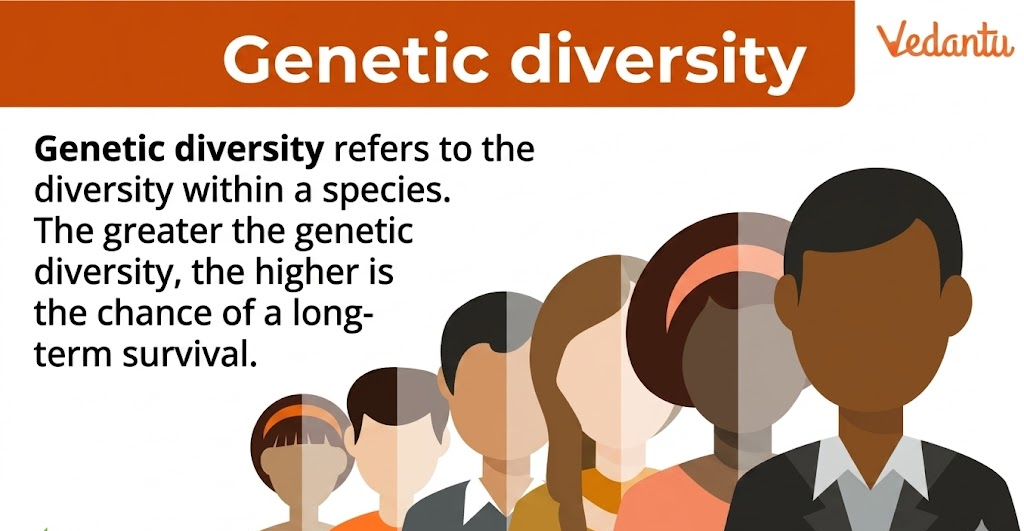
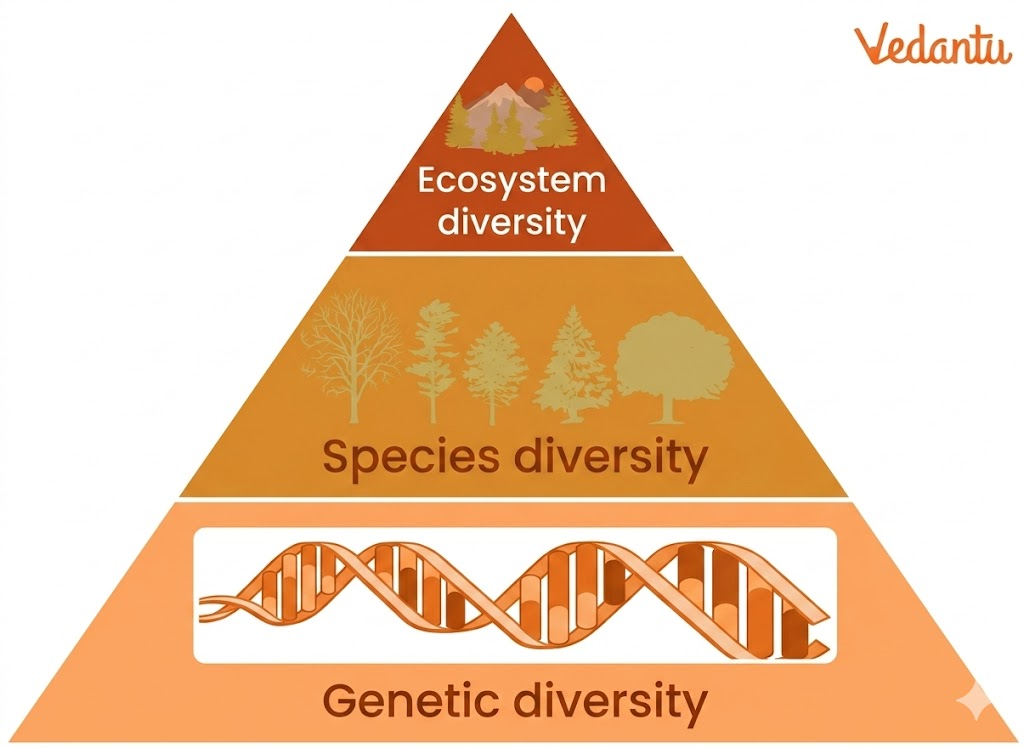
Genetic diversity is the variation in genes found within a species. It explains why individuals of the same species are not exactly identical and why some populations are better able to survive disease, environmental stress, or changing conditions. In biology, genetic diversity is one of the three major levels of biodiversity, along with species diversity and ecosystem diversity.
What is Biodiversity?
Biodiversity is the variety of plants and animals present in an ecosystem. It is broadly studied at three levels:
genetic diversity
Among these, genetic diversity forms the most basic level because it exists within a species and creates variation among individuals.
How Genetic Diversity Arises?
Genetic diversity does not appear randomly without cause. It is produced and maintained through several biological processes.
1. Recombination During Inheritance
One major source of genetic diversity is the recombination of genetic material during inheritance. During sexual reproduction, genes from two parents combine to produce offspring with unique combinations of traits. This creates new variations in every generation.
2. Sexual Reproduction
Sexual reproduction plays a central role in maintaining diversity because it creates unique offspring by combining parental genes. This is one of the strongest reasons why sexually reproducing populations often show considerable variation.
3. Mutation
Mutations introduce new genetic changes into a population. Some mutations may be harmful, some neutral, and some beneficial. Over long periods, mutations contribute to the genetic variation on which natural selection acts.
4. Genetic Drift
Genetic drift refers to random changes in gene frequencies in a population, especially small populations. It can alter diversity over time and may even reduce it when certain alleles disappear by chance.
5. Gene Flow
Gene flow occurs when genes move between populations, usually through migration and interbreeding. This introduces new alleles into a population and can increase genetic diversity.
In basic biological interpretation, genetic diversity is proportional to the amount of genetic variation present within a population or species. The more variation in gene combinations, alleles, and inherited traits, the greater the genetic diversity.
It is also closely linked to:
the range of DNA differences among individuals
the variety of gene sets in a population
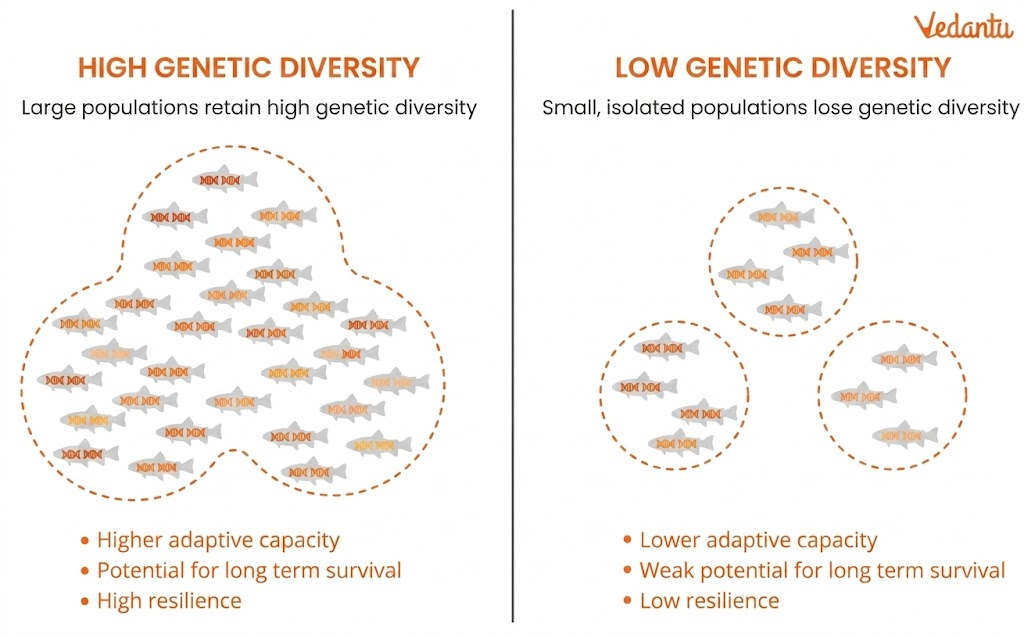
the ability of a population to tolerate environmental stress
So, in practical terms, greater variation means greater genetic diversity and greater adaptive potential. This idea is clearly supported by the point that a huge variety of gene sets equips a population to tolerate stress from environmental factors.
Importance of Genetic Diversity
The importance of genetic diversity is one of the most critical parts of this topic. Genetic diversity is not just a descriptive concept; it has direct biological and ecological significance.
1. Helps Individuals Show Different Physical Traits
Genetic diversity gives rise to different physical attributes among individuals. Variation in colour, size, stress tolerance, productivity, and resistance often reflects underlying genetic diversity.
2. Increases Adaptation to Stress and Disease
One of the most important roles of genetic diversity is that it improves a population’s capacity to tolerate stress, disease, and unfavourable environmental conditions. If all individuals are genetically similar, they may all respond similarly to danger. But if variation exists, some may survive.
3. Supports Natural Selection and Evolution
Environmental changes, whether natural or caused by human intervention, lead to selection. Individuals that are susceptible may die, while those with adaptive traits survive. This is why genetic diversity is one of the key forces driving evolution and natural selection.
4. Maintains a Healthy Population
A healthy population depends on having different gene variants. Some gene combinations may provide resistance to pests, disease, heat, drought, or other stresses. This diversity strengthens long-term population survival.
5. Helps in Crop Improvement
Cross-breeding different genetic variants can produce plants with desirable traits such as:
disease resistance
increased tolerance to stress
better productivity
This makes genetic diversity very valuable in agriculture and plant breeding.
6. Reduces Undesirable Inherited Traits
A genetically diverse population reduces the recurrence of harmful inherited traits by avoiding excessive genetic uniformity.
7. Ensures Species Survival
Genetic diversity ensures that at least some members of a species survive when conditions become difficult. This is one of the strongest reasons why conservation biologists give so much importance to genetic variation.
Genetic Diversity Examples
Some strong genetic diversity examples include both natural variation and human-selected variation.
1. Different Breeds of Dogs
Different breeds of dogs are a classic example of genetic diversity. Selective breeding has produced many combinations of traits such as body size, fur type, colour, speed, and behaviour.
2. Different Varieties of Rose and Wheat
Different varieties of rose flowers and wheat show genetic diversity within the same species group. These varieties differ in colour, height, resistance, productivity, and other inherited traits.
3. Rice Diversity in India
India has more than 50,000 varieties of rice, which is one of the most striking genetic diversity examples in crop plants.
4. Mango Diversity in India
There are more than a thousand varieties of mangoes in India. These differ in taste, aroma, size, shape, fibre content, and adaptation to different climates.
5. Rauvolfia vomitoria
Different varieties of the medicinal plant Rauvolfia vomitoria found in different Himalayan ranges differ in the amount of the chemical reserpine they produce. This is a good example of how genetic diversity can affect useful biochemical traits.
Loss of Genetic Diversity
The loss of genetic diversity is a serious biological and conservation problem. When valuable gene variants disappear, populations become weaker, less adaptable, and more vulnerable to disease or environmental change.
Causes of Loss of Genetic Diversity
The file points to activities such as:
specific selection for harvesting
destruction of natural habitats
These activities reduce the number of genetic variants available in a species.
Why Loss is Dangerous?
Genes that are lost may have great biological or human value. A lost gene may have provided:
disease resistance
drought tolerance
temperature tolerance
medicinal value
improved survival traits
Once lost, such variation may be difficult or impossible to recover. This is why loss of genetic diversity increases the risk of extinction and weakens future breeding potential.
Conservation of Genetic Diversity
The conservation of genetic diversity is essential for both human well-being and species survival. Conserving genetic variation ensures that useful genes are not permanently lost and that species retain the ability to adapt.
This becomes especially important during situations such as:
drought
sudden disease outbreak
large-scale crop failure
If diversity has been conserved, genetically diverse and resistant forms may be used to restore production or protect the species.
In Situ Conservation
In situ conservation means conserving species in their natural habitats. Since it is impossible to conserve all biodiversity everywhere, certain important areas or “hotspots” are identified and protected.
These are especially useful for conserving:
endemic species
threatened species
endangered species
species at high risk of extinction
Examples of In Situ Conservation
national parks
In situ methods help preserve not only species, but also the ecological and genetic interactions within natural environments.
Ex Situ Conservation
Ex situ conservation means taking threatened plants and animals out of their natural habitats and protecting them in controlled environments.
Examples of Ex Situ Conservation
botanical gardens
zoos
wildlife safari parks
This method is useful when species are under direct threat in the wild and need special care.
Also Read: What is Ex Situ and In Situ Biodiversity Conservation?
Modern Methods for Conservation of Genetic Diversity
The file also mentions several important modern techniques used in the conservation of genetic diversity.
1. Cryopreservation
Using cryopreservation techniques, gametes of threatened species can be preserved in viable and fertile condition for long periods. This is a powerful way to protect genetic material.
2. In Vitro Fertilisation
Eggs can be fertilised in vitro, which supports the continuation of threatened species when natural reproduction is difficult.
3. Tissue Culture
Plants can be propagated through tissue culture, allowing multiplication of valuable or threatened genetic lines.
4. Genomic Library
A genomic library is mentioned as a recent advancement in conserving genetic diversity. It stores genetic information and can support future research, recovery, and use of genetic resources.
Genetic Diversity and Evolution
Genetic diversity is one of the driving forces of evolution. Without variation, natural selection would have nothing to act upon. The survival of the fittest becomes meaningful only when different individuals carry different heritable traits.
Link with Evolution
variation exists in populations
environmental stress acts as a selective force
individuals with favourable traits survive
favourable genes are passed to the next generation
This is how genetic diversity directly contributes to adaptation and evolutionary change.
FAQs on Genetic Diversity: Definition, Examples, Importance, Loss and Conservation
1. What is meant by genetic diversity?
Genetic diversity means the variation in genes present within a species or population. It makes individuals of the same species genetically different from one another.
2. What is a good example of genetic diversity?
A good example of genetic diversity is the presence of different breeds of dogs or the many varieties of rice and mangoes found within the same species.
3. What are the 4 types of genetic variation?
The four main types of genetic variation are:
Single nucleotide changes
Insertions and deletions
Copy number variations
Structural changes such as inversions and translocations
4. Why is genetic diversity important?
Genetic diversity is important because it helps a species survive diseases, environmental changes, and stress. It increases the chances that some individuals will adapt and survive.
5. What is the main cause of genetic diversity?
The main causes of genetic diversity are mutation, recombination, gene flow, and genetic drift.
6. What are the three ways of genetic diversity?
The three major ways genetic diversity arises are:
Mutations
Gene flow
Genetic recombination during sexual reproduction
7. What happens when genetic diversity is high?
When genetic diversity is high, a population has a better chance of adapting to environmental changes, resisting diseases, and surviving over time.
8. What are the main threats to genetic diversity?
The main threats include habitat destruction, overharvesting, disease, environmental changes, and human activities that reduce the variety of genes in a population.
