








General Characteristics of Algae, Classification, Types and Economic Importance
Algae are simple, chlorophyll-containing, plant-like organisms that range from microscopic forms to large seaweeds. The economic importance of algae includes their use in food, medicine, agriculture, sewage treatment, industry, and space research.
Economic Importance of Algae
The economic importance of algae lies in their wide range of practical uses. They provide food, fodder, medicines, industrial products, biofertilisers, and raw materials. Some algae also help in nitrogen fixation, sewage disposal, and the formation of petroleum and natural gas over geological time.
What is Algae?
Algae are simple, non-flowering, plant-like organisms that usually grow in water or moist places. They contain chlorophyll and can prepare their own food by photosynthesis. The term algae comes from the Latin word for seaweeds. These organisms may be:
unicellular
colonial
filamentous
large multicellular seaweeds
So, algae include both microscopic forms and giant seaweeds like kelp.
General Characteristics of Algae
The general characteristics of algae help in understanding their nature and biological importance.
Main Characteristics of Algae
They are simple thalloid organisms.
They do not have true roots, stems, or leaves.
They contain chlorophyll and perform photosynthesis.
They are mostly aquatic.
Their body may be unicellular, colonial, filamentous, or multicellular.
They produce oxygen during photosynthesis.
They are important primary producers in aquatic ecosystems.
These general features make algae essential both ecologically and economically.
Classification of Algae
Blue-green algae
Green algae
Red algae
Brown algae
This basic classification is highly useful for student-level understanding and helps connect uses of algae with their major groups.
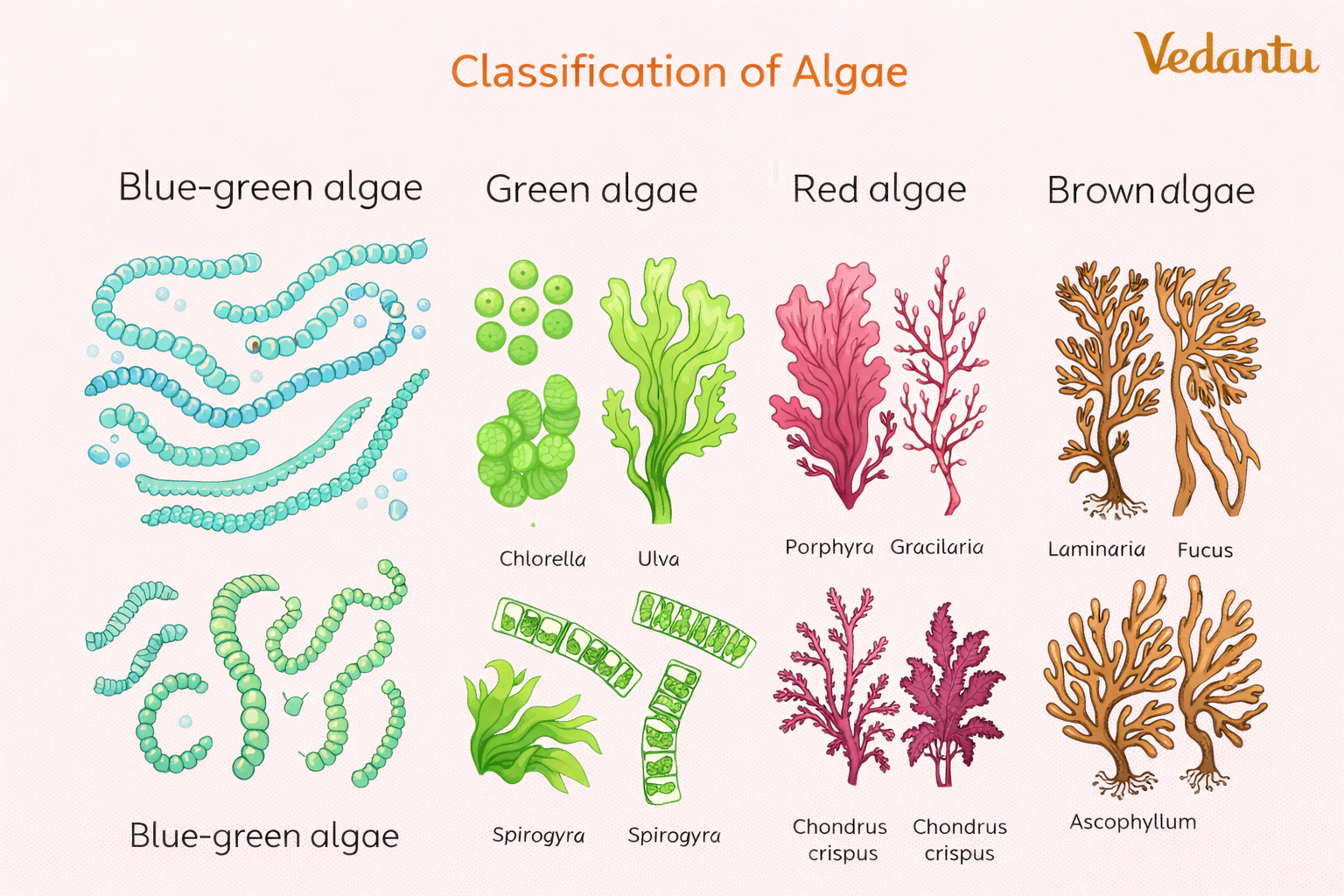
Types of Algae
This classification also helps students understand where blue-green algae, green algae, and brown algae are used economically.
What is the Economic Importance of Algae?
The economic importance of algae includes their uses in:
Food and fodder
Space travel
Medicines
Petroleum and gas origin
Sewage disposal
Agriculture
Industry
Because of this, algae are not just ecologically useful organisms. They are also commercially valuable biological resources.
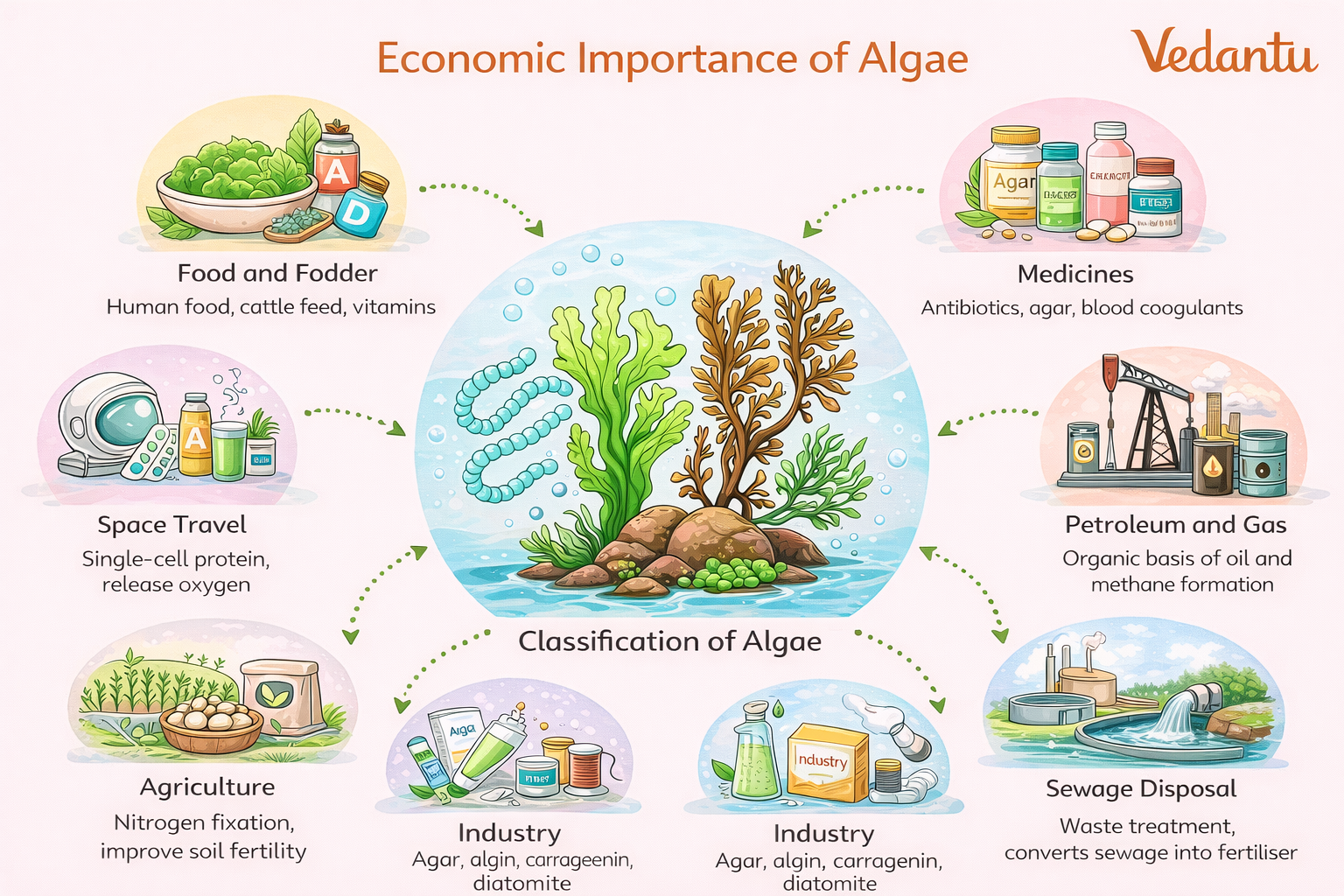
Economic Importance of Algae as Food and Fodder
Algae are highly useful as both food and fodder. They are rich in proteins, vitamins, minerals, and other nutrients. They also form the base of many aquatic food chains and support pisciculture.
Importance as Food
Some algae directly serve as food for fish and aquatic animals. These aquatic animals later become a food source for humans. Many algae are also eaten directly by people in different parts of the world.
Common Edible Algae and Their Uses
Nutritional Value of Algae
In countries such as China and Japan, seaweeds like Kombu and Porphyra form a major part of the daily diet and supply:
proteins
fats
vitamins A, B, C, and E
Algae as Fodder
Some seaweeds are processed into cattle feed. This improves the nutritional value of fodder and may even increase milk production in cattle. Therefore, algae are important not only as human food but also as useful animal feed.
Other useful algal sources
Fucus and Laminaria are good sources of iodine.
Polysiphonia species yield bromine.
Economic Importance of Algae in Space Travel
One of the most interesting uses of algae is in space travel.
Chlorella
Scenedesmus
Synchococcus
These algae are used as food sources for space travellers because they:
are rich in proteins
multiply rapidly
act as single-cell protein
use carbon dioxide
release oxygen during photosynthesis
This means they can help provide both food and oxygen, making them useful in closed space environments.
Role of Algae in Medicines
Algae have long been used in medicine and pharmaceutical preparations. Their medicinal importance is both traditional and modern.
Laminaria was used in ancient Chinese medicine to treat goitre because of its iodine content.
Members of Laminariales were used as surgical tools and during childbirth to expand the cervix.
Chlorellin, an antibiotic, is obtained from Chlorella.
Red algae provide agar, which is used in pharmaceuticals for pills and ointments.
Carrageenan and alginic acid act as blood coagulants.
Extracts of Codium, Alsidium, and Durvillea have been used as vermifuges.
In the Unani system of medicine, different algae are used for diseases of the lungs, kidneys, and bladder.
Extracts of Cladophora and Lyngbya show antiviral properties.
These examples clearly show the medicinal and pharmaceutical value of algae.
Role of Algae in the Origin of Petroleum and Gas
The role of algae in the origin of petroleum and gas is another important point.
plankton in marine environments captured solar energy by photosynthesis
this energy passed into marine food chains
dead plankton and marine organisms accumulated in shallow sea mud
these materials were buried in oxygen-free conditions
over time, they changed into oil and gas
The natural gas associated with oil, mainly methane, is linked to the activity of methane-producing bacteria acting on organic compounds from diatoms and cyanobacteria. This makes algae indirectly important in the formation of valuable energy resources.
Algae in Sewage Disposal
Algae also plays a very useful role in sewage disposal.
Important algae in sewage treatment include:
Chlamydomonas
Chlorella
Scenedesmus
Euglena
In sewage tanks, algae grow using the nutrients present in sewage. During photosynthesis, they release oxygen. This oxygen helps microorganisms break down the organic matter of sewage. As a result, sewage gets converted into a useful, odourless fertilizer in an efficient and low-cost way.
Thus, algae make sewage treatment:
quick
economical
environmentally useful
Algae in Agricultural Fields
The economic importance of algae in agriculture is very high, especially in relation to soil fertility and biofertilisers.
Blue green Algae in Agriculture
Blue green algae such as Anabaena and Nostoc are important because they fix atmospheric nitrogen in soil. This improves soil fertility, especially in rice fields.
Studies by P. K. De and R. N. Singh, which support the importance of these algae in:
nitrogen fixation
rice cultivation
reclamation of barren land
Cyanobacteria and Soil Improvement
Cyanobacteria such as:
Oscillatoria
Nostoc
Spirulina
Cylindrospermum
help reduce soil alkalinity and improve soil fertility. This is a major reason why blue green algae are agriculturally valuable.
Seaweeds as Biofertilisers
Large seaweeds, including kelps and red algae, have been used as biofertilisers for centuries, particularly in coastal areas. These seaweeds are rich in potassium and are useful for crops like:
potatoes
turnips
In some places, seaweeds are burned and their ash is applied in fields.
Commercial Cultivation
In Rajasthan, Spirulina and Anabaena are commercially grown in Sambhar Lake and used as manure by local farmers. Concentrated seaweed extracts are also sold as:
fertilisers
insecticides
Other Agricultural Uses
Ground forms of:
Lithothamnion
Lichophyllum
Chara
are used in place of lime in some countries. In fish culture, Chlorella also helps aerate water by removing carbon dioxide and restoring oxygen through photosynthesis.
Economic Importance of Algae in Industries
Algae are highly useful in industry because they provide many commercially valuable products.
Major Industrial Products from Algae
1. Agar-agar
Agar is obtained from red algae such as:
Gelidium
Gracilaria
Uses of agar
microbiology laboratories
pharmaceuticals
bread
pastries
jellies
2. Algin
Algin is obtained from brown algae such as:
Ascophyllum
Laminaria
Uses of algin
thickeners
cosmetics
textiles
plastics
artificial fibres
confectionery emulsifiers
dental products
paints
ice creams
3. Carrageenin
Carrageenin is obtained from red algae such as Chondrus crispus.
Uses of carrageenin
emulsifying agent
stabilizing agent
food industry
textiles
pharmaceuticals
cosmetics
4. Diatomite
Diatomite is made from fossilized diatoms.
Uses of diatomite
oil refineries
sugar industry
insulation
construction
soundproofing
toothpaste
5. Kelp
Kelp from brown algae such as Laminaria is a source of:
iodine
soda
potash
Japan alone produces about 100 tons of iodine annually from kelps.
Industrial Products from Algae
Economic Importance of Algae Summary
Why are Algae Economically Important?
Algae are economically important because they combine ecological value with commercial utility. They:
support aquatic food chains
provide food and vitamins
improve soil fertility
help in waste treatment
supply medicinal compounds
produce valuable industrial materials
This broad usefulness is why the economic importance of algae is a major biology topic.
Important Points to Remember
Algae are chlorophyll-containing, photosynthetic, plant-like organisms.
They are not true plants but share many similar features.
The main groups discussed here are blue green algae, green algae, red algae, and brown algae.
Algae are useful in food, fodder, agriculture, medicine, industry, sewage treatment, and space travel.
Blue green algae play a major role in nitrogen fixation.
Brown algae like Laminaria are important sources of iodine and algin.
Green algae such as Chlorella and Scenedesmus are valuable as protein-rich food.
Red algae provide agar and carrageenin.
Related Topics to Refer for NEET Preparation
FAQs on Economic Importance of Algae: Types, Classification, and Uses
1. What is algae?
Algae are simple, non-flowering, plant-like organisms that contain chlorophyll and perform photosynthesis. They range from unicellular forms to large seaweeds.
2. What is the economic importance of algae?
The economic importance of algae includes their use as food, fodder, medicines, fertilisers, sewage-treatment agents, industrial raw materials, and even space food.
3. What are the main types of algae?
The main types mentioned here are blue-green algae, green algae, red algae, and brown algae.
4. Why are blue green algae important in agriculture?
Blue green algae such as Anabaena and Nostoc fix nitrogen in the soil and improve fertility, especially in rice fields.
5. How are algae used as food?
Algae such as Porphyra, Ulva, Laminaria, Monostroma, Nostoc, and Spirogyra are used as food in different countries.
6. Which algae are useful in space travel?
Chlorella, Scenedesmus, and Synchococcus are useful in space travel because they are rich in protein, grow rapidly, and release oxygen.
7. What products are obtained from algae in industries?
Agar, algin, carrageenin, diatomite, iodine, soda, and potash are important products obtained from algae.
8. How do algae help in sewage disposal?
Algae releases oxygen during photosynthesis, which helps microorganisms break down organic matter in sewage and convert it into useful fertilizer.
9. Which brown algae are economically important?
Brown algae such as Laminaria, Ascophyllum, and Fucus are economically important for iodine, algin, and other products.
10. Which green algae are economically useful?
Green algae such as Chlorella, Ulva, Spirogyra, Scenedesmus, and Oedogonium are economically useful in food, nutrition, and environmental management.
