



 Watch Video







NEET Gravitation: How Universal Law, Gravity Variation & Kepler’s Laws Impact Exam Questions
Gravitation is the force of attraction between any two masses in the universe. Every object attracts every other object, although in most everyday cases the force is too small to notice. Gravitation explains why objects fall towards Earth, why planets move around the Sun, and why satellites remain in orbit.
What is Gravitational Force?
Gravitational force is the force with which two masses attract each other. It is always attractive, always acts along the line joining the centres of the two bodies, and depends only on the masses and the distance between them.
Universal Law of Gravitation
According to the universal law of gravitation, every particle in the universe attracts every other particle with a force that is directly proportional to the product of their masses and inversely proportional to the square of the distance between their centres.
Mathematically,
F = Gm1m2 / r²
where
F = gravitational force
G = universal gravitational constant
m1 and m2 = masses of the two bodies
r = distance between their centres
Value and SI Unit of Gravitational Constant
The universal gravitational constant is
G = 6.67 × 10⁻¹¹ N m² kg⁻²
Its dimensional formula is
[M⁻¹ L³ T⁻²]
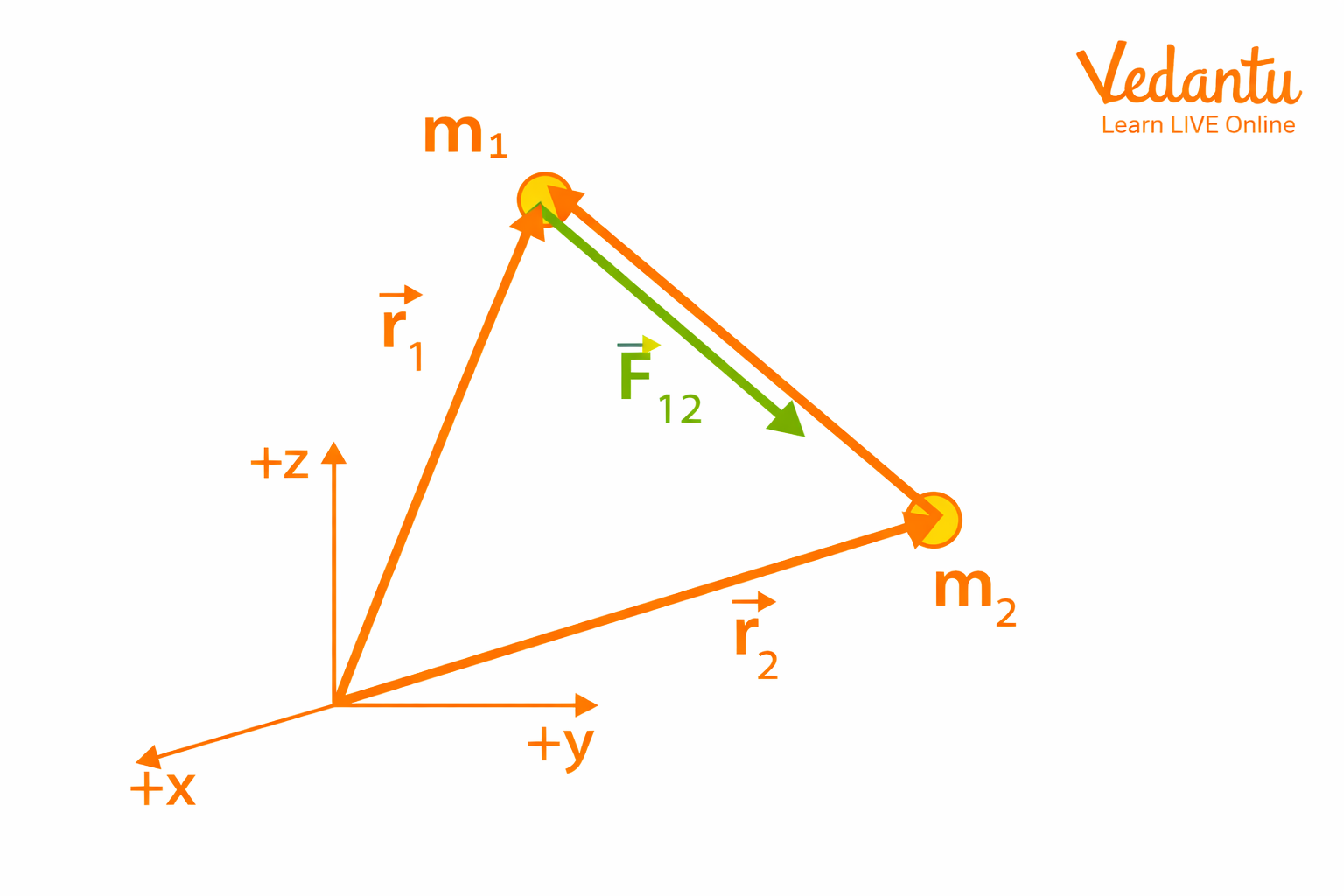
Vector Form of Newton’s Law of Gravitation
The gravitational force between two bodies is directed along the line joining them. If r-hat is the unit vector from one mass to the other, then the force can be written in vector form with a negative sign to indicate attraction.
This vector treatment is useful in understanding direction and in proving that gravitational forces form an action-reaction pair.
Properties of Gravitational Force
Gravitational force is always attractive.
It is a central force.
It is a conservative force.
It obeys the inverse square law.
It has an infinite range.
It follows the principle of superposition.
These properties are directly useful in NEET theory questions.
Principle of Superposition of Gravitation
If many masses act on a body, the net gravitational force is the vector sum of all individual gravitational forces acting on that body.
Fnet = F1 + F2 + F3 + …
Acceleration Due to Gravity
Acceleration due to gravity is the acceleration produced in a body due to Earth’s gravitational pull. It is denoted by g.
At the surface of Earth,
g = GM / R²
where
M = mass of Earth
R = radius of Earth
Near Earth’s surface, the standard value is approximately
g = 9.8 m/s²
This relation follows directly from Newton’s law of gravitation and the idea that the gravitational force on a body equals its weight.
Relation Between g and G
For a body of mass m on Earth’s surface,
mg = GMm / R²
So,
g = GM / R²
This relation is very important for deriving formulas involving height and depth.
Variation of g with Altitude
At a height h above Earth’s surface,
g(h) = GM / (R + h)²
This means acceleration due to gravity decreases as altitude increases.
For h much smaller than R,
g(h) ≈ g(1 - 2h/R)
Key point: As we go higher above Earth, g decreases.
Variation of g with Depth
At a depth d below Earth’s surface,
g(d) = g(1 - d/R)
This means acceleration due to gravity decreases linearly with depth, assuming Earth has uniform density.
At the centre of Earth,
g = 0
Key point: g is maximum at Earth’s surface and decreases both with height and depth.
Graph of g with Altitude and Depth
With altitude, g decreases non-linearly.
With depth, g decreases linearly and becomes zero at the centre.
These trend-based ideas are often asked in NEET conceptual questions.
Gravitational Potential Energy
The gravitational potential energy of a body in the gravitational field of another body is the energy due to its position.
For two masses separated by distance r,
U = -GMm / r
The negative sign shows that the gravitational force is attractive, and work must be done to separate the masses to infinity.
Gravitational Potential
Gravitational potential at a point is defined as the potential energy per unit mass at that point.
V = U / m = -GM / r
It is a scalar quantity and is always negative for an attractive gravitational field.
Difference Between Potential and Potential Energy
Gravitational potential is potential energy per unit mass.
Gravitational potential energy depends on both interacting masses.
Potential is a property of the field at a point.
Potential energy is the energy of a particular body placed in that field.
Kepler’s Laws of Planetary Motion
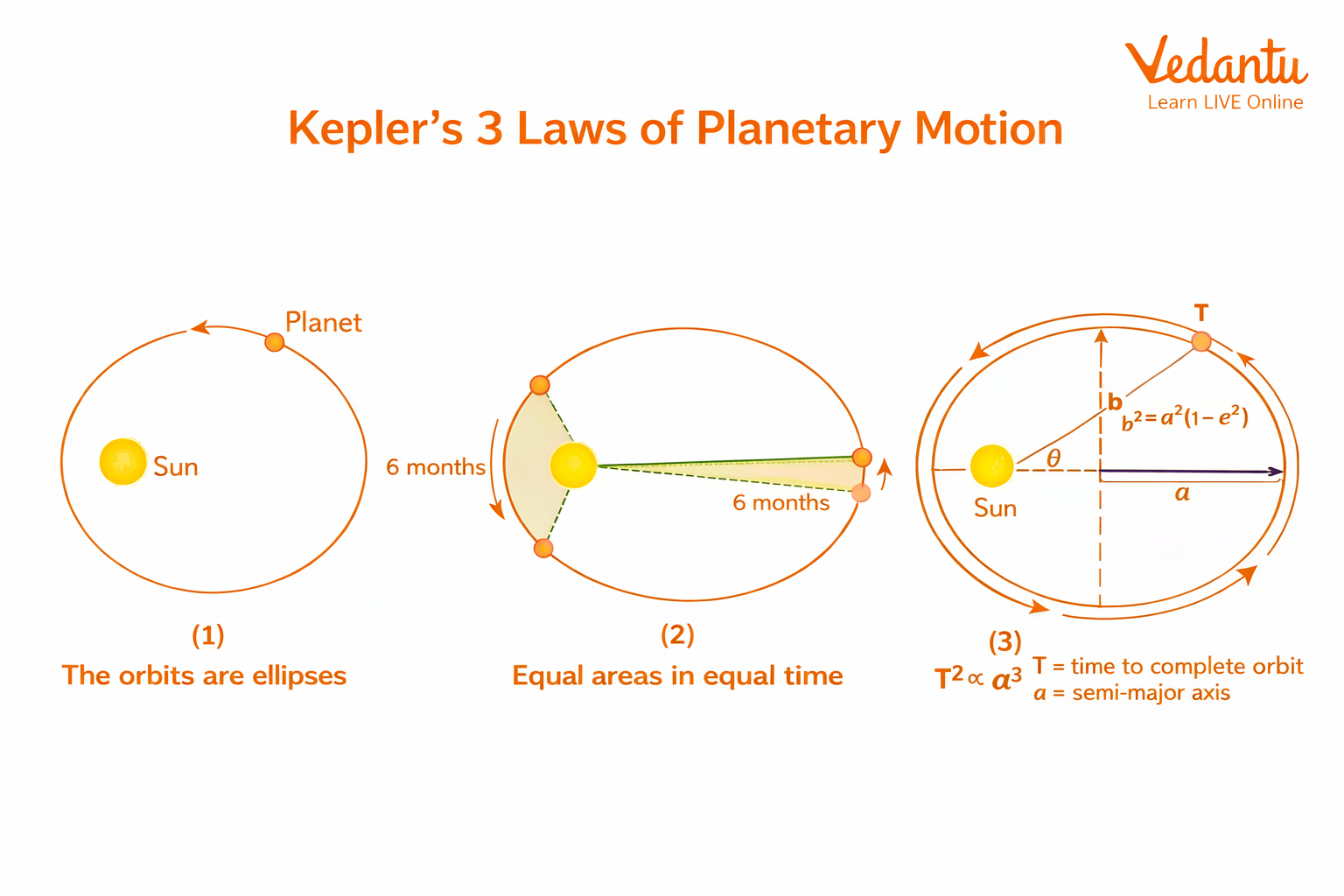
Kepler’s First Law
Each planet moves around the Sun in an elliptical orbit with the Sun at one focus.
Kepler’s Second Law
The line joining the Sun and a planet sweeps out equal areas in equal intervals of time.
Kepler’s Third Law
The square of the time period of revolution of a planet is directly proportional to the cube of the semi-major axis of its orbit.
T² ∝ r³
Importance of Kepler’s Laws for NEET
Kepler’s laws explain planetary motion clearly and help derive relations involving orbital time period and distance from the Sun. They are especially important for understanding satellite motion and gravitation-based orbital questions.
Escape Velocity
Escape velocity is the minimum speed required for a body to escape completely from the gravitational field of a planet without further propulsion.
For Earth,
ve = √(2GM / R)
Using g = GM/R²,
ve = √(2gR)
For Earth, its approximate value is 11.2 km/s.
Key point: Escape velocity does not depend on the mass of the escaping body.
Orbital Velocity
Orbital velocity is the minimum horizontal speed required by a satellite to remain in a stable circular orbit around a planet.
For a satellite near Earth,
vo = √(GM / r)
For an orbit very close to Earth’s surface,
vo = √(GM / R) = √(gR)
For Earth, this is about 7.9 km/s.
Relation Between Escape Velocity and Orbital Velocity
ve = √2 vo
This is a very important direct result relation for NEET.
Motion of a Satellite
A satellite remains in orbit because Earth’s gravitational force provides the required centripetal force.
GMm / r² = mv² / r
From this, we get orbital velocity:
v = √(GM / r)
Time Period of a Satellite
For a satellite in a circular orbit of radius r,
T = 2π √(r³ / GM)
This directly shows that the time period increases with orbital radius.
Energy of a Satellite
The total mechanical energy of a satellite in circular orbit is
E = K + U
Kinetic energy,
K = GMm / 2r
Potential energy,
U = -GMm / r
Total energy,
E = -GMm / 2r
Important result:
Total energy is negative, which means the satellite is bound to the planet.
Important Gravitation Formulas for NEET
Gravitational force:
F = Gm1m2 / r²
Acceleration due to gravity:
g = GM / R²
g at height h:
g(h) = GM / (R + h)²
Approximation:
g(h) ≈ g(1 - 2h/R)
g at depth d:
g(d) = g(1 - d/R)
Potential energy:
U = -GMm / r
Potential:
V = -GM / r
Escape velocity:
ve = √(2GM / R) = √(2gR)
Orbital velocity:
vo = √(GM / r)
Satellite time period:
T = 2π √(r³ / GM)
Satellite total energy:
E = -GMm / 2r
Kepler’s third law:
T² ∝ r³
Comparison of Escape Velocity and Orbital Velocity
Orbital velocity is the speed needed to keep a body in orbit.
Escape velocity is the speed required to escape a gravitational field.
Escape velocity is greater than orbital velocity.
For Earth, orbital velocity is about 7.9 km/s, and escape velocity is about 11.2 km/s.
Common Mistakes Students Make in Gravitation
Students often confuse g with G.
They forget that G is universal, but g changes from place to place.
They use R instead of R + h in altitude questions.
They forget the negative sign in gravitational potential and potential energy.
They mix up orbital velocity and escape velocity.
They use satellite formulas for bodies that are not in circular orbits.
They forget that gravitational potential is a scalar, while force is a vector.
Solved Examples on Gravitation
Example 1
Find the gravitational force between two bodies of masses 40 kg and 60 kg kept 2 m apart in air.
Solution:
Given,
m1 = 40 kg
m2 = 60 kg
r = 2 m
G = 6.67 × 10⁻¹¹ N m² kg⁻²
Using,
F = Gm1m2 / r²
F = (6.67 × 10⁻¹¹ × 40 × 60) / 4
F = 4.002 × 10⁻⁸ N
Answer:
The gravitational force is 4.002 × 10⁻⁸ N.
Example 2
Calculate the value of g at a height equal to Earth’s radius above the surface. Let g at the surface be 9.8 m/s².
Solution:
Here,
h = R
Using,
g(h) = g × R² / (R + h)²
g(h) = 9.8 × R² / (2R)²
= 9.8 / 4
= 2.45 m/s²
Answer:
The acceleration due to gravity at that height is 2.45 m/s².
Example 3
Find the gravitational potential at the surface of a planet of mass 8 × 10²⁴ kg and radius 8 × 10⁶ m.
Solution:
Using,
V = -GM / R
V = -(6.67 × 10⁻¹¹ × 8 × 10²⁴) / (8 × 10⁶)
V = -6.67 × 10⁷ J/kg
Answer:
The gravitational potential is -6.67 × 10⁷ J/kg.
Example 4
A satellite revolves close to Earth’s surface. Find its orbital speed if g = 9.8 m/s² and Earth’s radius is 6.4 × 10⁶ m.
Solution:
Using,
v = √(gR)
v = √(9.8 × 6.4 × 10⁶)
= √(6.272 × 10⁷)
≈ 7.92 × 10³ m/s
Answer:
The orbital speed is about 7.92 km/s.
Example 5
Find the escape velocity from a planet where g = 12 m/s² and radius = 5 × 10⁶ m.
Solution:
Using,
ve = √(2gR)
ve = √(2 × 12 × 5 × 10⁶)
= √(1.2 × 10⁸)
≈ 1.095 × 10⁴ m/s
Answer:
The escape velocity is about 10.95 km/s.
Example 6
A satellite moves in a circular orbit of radius 4R, where R is Earth’s radius. If the time period of a satellite near Earth’s surface is T, what will be the new time period?
Solution:
Using the Kepler-type relation for a circular orbit,
T² ∝ r³
So,
Tnew / T = (4R / R)^(3/2)
= 4^(3/2)
= 8
Therefore,
Tnew = 8T
Answer:
The new time period is 8T.
Most Important NEET 2027 Topics Physics
Gravitation for NEET: Universal Law, Kepler’s Laws, Escape Velocity and Satellite Motion

 Share
ShareFAQs on Gravitation for NEET: Universal Law, Kepler’s Laws, Escape Velocity and Satellite Motion
1. Will your weight be constant when you are travelling to Greenland from Brazil?
No, your weight will not remain constant. It will increase slightly as you move from Brazil towards Greenland. This is because the value of acceleration due to gravity is lower near the equator and higher near the poles. Since Brazil is closer to the equator and Greenland is closer to the North Pole, you will feel slightly heavier in Greenland.
2. Can you screen the effect of gravitation by any material medium?
No, the effect of gravitation cannot be screened by any material. Gravitational force acts through all media and cannot be blocked or shielded the way some other forces can be.
3. Why are space rockets launched eastward?
Space rockets are usually launched eastward because Earth rotates from west to east. Launching in the same direction gives the rocket an extra initial speed due to Earth’s rotation. This reduces the fuel needed and makes the launch more efficient.
4. Why does a bouncing ball bounce higher on hills than on planes?
A ball bounces higher on hills because the value of acceleration due to gravity decreases with altitude. Since gravity is slightly weaker at higher places, the ball can rise to a greater height after bouncing.
5. The gravitational potential energy is negative. Why?
Gravitational potential energy is negative because the zero level of potential energy is taken at infinity. Since gravity is an attractive force, energy is released when a body moves from infinity to a point in the gravitational field. Therefore, the potential energy at any finite distance is negative.
6. Why is Newton’s law of gravitation called the universal law?
Newton’s law of gravitation is called universal because it applies to every mass in the universe. It is valid for all objects, at all places and times, regardless of their size or nature.
7. What is the weight of the body at the centre of the Earth?
The weight of a body at the centre of the Earth is zero. At the centre, the value of acceleration due to gravity becomes zero, so weight, which is equal to mg, also becomes zero.
8. Does friction arise due to gravitation?
No, friction does not arise due to gravitation. Friction mainly arises from electromagnetic interactions between the surfaces in contact. Gravity only helps press the surfaces together, which can affect friction magnitude, but it is not the actual cause.
9. Can gravitation be screened?
No. Gravitational force cannot be blocked by any material medium.
10. Why are rockets launched eastward?
Rockets are launched eastward to use Earth’s rotational speed and save fuel.
11. Why is Newton’s law called universal?
It is called universal because it applies to all masses everywhere in the universe.
