



Stepwise NCERT Answers & PDF for Class 8 Science Pressure, Winds, Storms, Cyclones
Question 1.
Why do fall leaves rise in the air or trees bend when a strong wind blows? (Page 81)
Answer:
The wind applies a force that creates wind pressure, which can lift fallen leaves into the air and make trees bend or sway during strong gusts.
Question 2.
Can the shape or size of the straps make a difference, provided both bags are equally heavy? (Page 81)
Answer:
When we carry a bag, we feel its weight because gravity pulls it downward on our shoulders. A bag with narrow straps concentrates this weight on a small area, causing more discomfort. In contrast, broad straps spread the same weight over a larger area, reducing the pressure on our shoulders. Even though both bags weigh the same, the one with broader straps feels more comfortable to carry.
Question 3.
(a) Why are overhead tanks kept at a height?
(b) Suppose you are living on the second floor of a three-story building and an overhead tank is placed on the top floor. Will you or your friend on the first floor receive a more powerful stream of tap water? Give reasons. (Page 84)
Answer:
(a) Overhead tanks are installed at a height so that the water pressure in the taps increases, allowing water to flow out with a strong stream.
(b) Water pressure rises as the height of the water column increases. For example, if I live on the second floor of a three-storey building and the overhead tank is on the top floor, the pressure in my taps will depend on the height of the tank above them. A friend living on the first floor has an even greater height difference between the tank and his taps, meaning the water column above his taps is taller. As a result, he will get a stronger flow of water than I do on the second floor.
Question 4.
Why does water spurt out like a fountain from leaking joints or holes in water pipes? (Page 85)
Answer:
Water pipes contain tall columns of water because the tanks supplying them are placed at high levels. This creates high pressure inside the pipes. Water pushes against all sides of the pipe—the bottom as well as the walls. When this high-pressure water finds a small opening, such as a hole or a leaking joint, it escapes forcefully and shoots out like a fountain.
Question 5.
What happens when an inflated balloon is kept without closing its mouth? (Page 86)
Answer:
An inflated balloon contains air that pushes outward on its walls, causing it to expand in all directions. At the same time, the balloon’s elastic walls push back with an equal and opposite force. When the mouth of the balloon is left open, the high-pressure air inside rushes out toward the lower-pressure air outside.
Question 6.
Does the difference in air pressure have anything to do with the formation of winds? (Page 88)
Answer:
Air always flows from areas of high pressure to areas of low pressure. This moving air is what we call wind. Therefore, differences in air pressure are responsible for the formation of wind.
Keep the Curiosity Alive (Pages 94-96)
Question 1.
Choose the correct statement:
(i) Look at the Figure carefully. Vessel R is filled with water. When pouring of water is stopped, the level of water will be _________
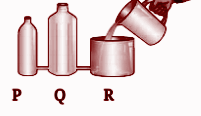
(a) the highest in vessel P
(b) the highest in vessel Q
(c) the highest in vessel R
(d) equal in all three vessels
Answer:
(d) equal in all three vessels
(ii) A rubber sucker (M) is pressed on a flat smooth surface, and an identical sucker (N) is pressed on a rough surface.
(a) Both M and N will stick to their surfaces
(b) Neither M nor N will stick to their surfaces
(c) M will stick, but N will not stick
(d) M will not stick, but N will stick
Answer:
(c) M will stick, but N will not stick
(iii) A water tank is placed on the roof of a building at a height ‘H’. To get water with more pressure on the ground floor, one has to
(a) Increase the height ‘H’ at which the tank is placed.
(b) Decrease the height ‘H’ at which the tank is placed.
(c) Replace the tank with another tank of the same height that can hold more water.
(d) Replace the tank with another tank of the same height that can hold less water.
Answer:
(a) increase the height ‘H’ at which the tank is placed.
(iv) Two vessels, A and B, contain water up to the same level as shown in the Figure. PA and
PB are the pressures at the bottom of the vessels. FA and FB are the forces exerted by the water at the bottom of the vessels A and B.
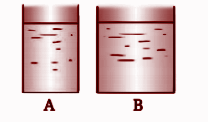
(a) PA = PB, FA = FB
(b) PA = PB, FA < FB
(c) PA < PB, FA = FB
(d) PA > PB, FA > FB
Answer:
(b) PA = PB, FA < FB
Question 2.
State whether the following statements are True (T) or False (F).
(i) Air flows from a region of higher pressure to a region of lower pressure.
(ii) Liquids exert pressure only at the bottom of a container.
(iii) The weather is stormy at the eye of a cyclone.
(iv) During a thunderstorm, it is safer to be in a car.
Answer:
(i) True
(ii) False (liquids exert pressure in all directions, including on the walls of the container.)
(iii) False (it is calm at the eye of a cyclone.)
(iv) True.
Question 3.
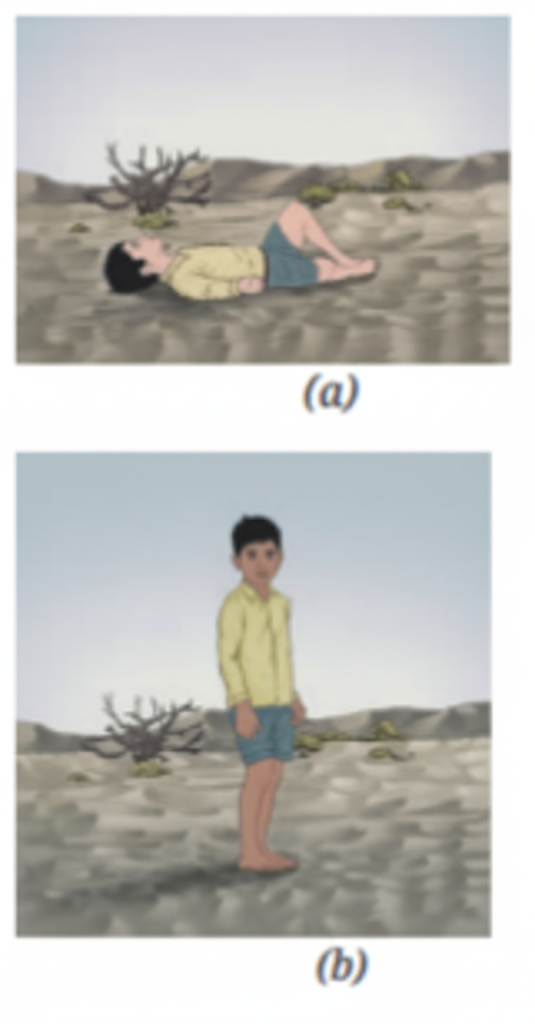
Figure (a) shows a boy lying horizontally, and Figure (b) shows the boy standing vertically on a loose sand bed. In which figure does the boy sink more into the sand? Give reasons.
Answer:
The boy in Figure (b) will sink deeper. Although his weight is the same in both cases, in Figure (a) the weight is spread over a larger area, so the pressure on the sand is lower. In Figure (b), the same weight acts on a much smaller area, creating greater pressure. Because of this increased pressure, the boy sinks more into the sand in Figure (b).
Question 4.
An elephant stands on four feet. If the area covered by one foot is 0.25 m2, calculate the pressure exerted by the elephant on the ground if its weight is 20000 N.
Answer:
Force (the weight) of the elephant acting on the ground = 20000 N
Area on the ground covered by the four feet of the elephant = 4 × 0.25 m2 = 1 m2
Pressure exerted by the elephant on the ground
= Force/Area = 200000 N/1 m2
= 20000 Pa
Question 5.
There are two boats, A and B. Boat A has a base area of 7 m2, and 5 persons are seated in it. Boat B has a base area of 3.5 m2, and 3 persons are seating in it. If each person weighs 700 N, find out which boat will experience more pressure on its base and by how much?
Answer:
Force of the weight of 5 persons acting on the base of boat A = 5 × 700 N = 3500 N
Base area of boat A = 7 m2
Pressure exerted on the base of boat A
= Force/Area = 3500 N/7m2
= 500 Pa
Force of the weight of 3 persons acting on the base of boat B = 3 × 700 N = 2100 N
Base area of boat B = 3.5 m2
Pressure exerted on the base of boat B
= Force/Area = 2100 N/3.5m2
= 600 Pa
Therefore, boat B will experience more pressure on its base by 100 Pa.
Question 6.
Would lightning occur if air and clouds were good conductors of electricity? Give reasons for your answer.
Answer:
If air and clouds were good conductors of electricity, charges would not be able to accumulate in the clouds because they would quickly flow away into the air. Without this buildup of charge, lightning could not form. Therefore, lightning would not occur if air and clouds conducted electricity well.
Question 7.
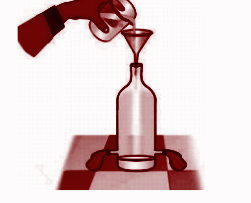
What will happen to the two identical balloons A and B as shown in Figure when water is filled into the bottle up to a certain height? Will both the balloons bulge? If yes, will they bulge equally? Explain your answer.
Answer:
When water is poured into the bottle up to a level well above the points where the balloons are attached, both balloons will expand. Since the water enters both balloons from the same height, the pressure acting on them is the same. The balloons are elastic, and if they have the same elasticity, they will stretch equally and bulge to the same extent.
Question 8.
Explain how a storm becomes a cyclone.
Answer:
Cyclones are powerful storms that develop over warm ocean waters.
As the ocean heats up, the air above it becomes warm and moist and begins to rise. At higher altitudes, the water vapor in this air condenses into raindrops.
When condensation occurs, heat is released into the atmosphere, warming the air even more. This warmer air rises further, creating an area of very low pressure below.
Air from the surrounding regions rushes in to fill this space and also begins to rise. Due to Earth’s rotation, the moving air starts to spin.
This process continues again and again, forming a deep low-pressure zone with strong, rotating winds.
This rotating system of clouds, winds, and rain is known as a cyclone.
Question 9.
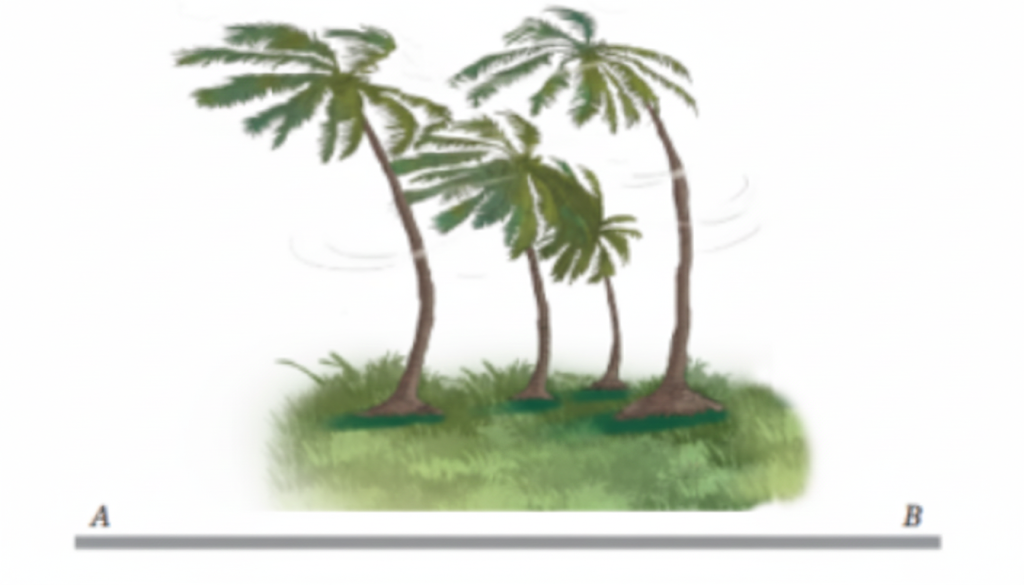
The figure shows trees along the sea coast on a summer afternoon. Identify which side is land – A or B. Explain your answer.
Answer:
On a summer afternoon, a sea breeze blows from the sea toward the land. This occurs because the land heats up more quickly, causing the air above it to rise and creating a low-pressure area. The cooler air over the sea, which is at higher pressure, moves in to replace it. The trees bending in the direction from B to A indicate that the wind is blowing from B toward A. This means that side A represents the land.
Question 10.
Describe an activity to show that air flows from a region of high pressure to a region of low pressure.
Answer:
Activity to show that air moves from high pressure to low pressure
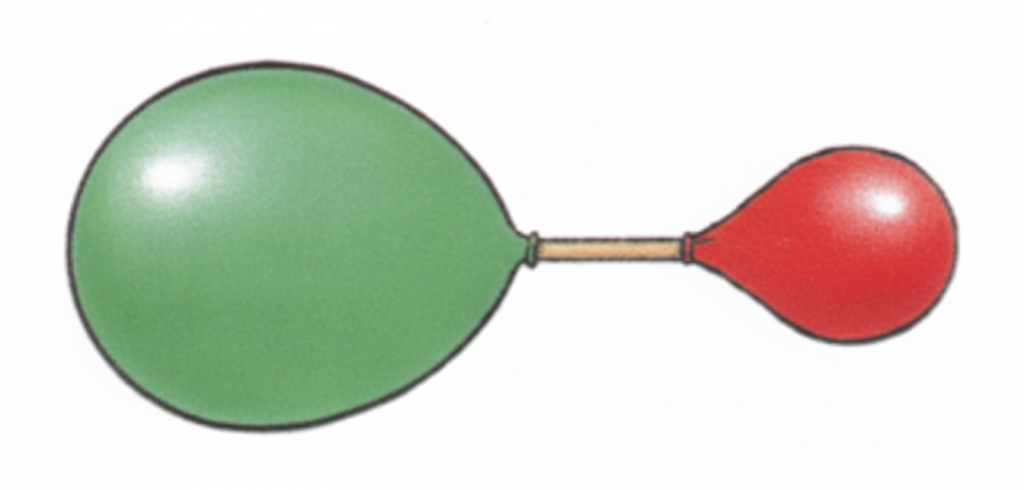
Materials needed: Two identical thin rubber balloons, a drinking straw, and some thread.
Procedure:
Insert one end of the straw into an empty balloon and tie it tightly with thread.
Inflate the second balloon. Then place the free end of the straw into the neck of this inflated balloon and secure it with thread, making sure no air can escape.
Observations:
Some of the air from the inflated balloon flows into the empty balloon, causing both balloons to change in size. After a while, they become nearly the same size, and the air flow stops.
Conclusion:
The inflated balloon initially contains air at higher pressure, while the uninflated balloon has lower pressure. When the two balloons are connected through the straw, air moves from the balloon with higher pressure to the one with lower pressure until the pressure in both becomes equal.
Question 11.
What is a thunderstorm? Explain the process of its formation.
Answer:
(i) During the rainy season in hot, humid, tropical regions of India, the land heats up quickly. The warm, moist air above it becomes lighter and rises, creating a low-pressure zone. Cooler air from nearby high-pressure areas moves in to replace it. This incoming air also warms up and rises, setting up a continuous cycle of wind circulation.
As the rising air expands, it cools, causing the moisture in it to condense into tiny water droplets that form clouds. These droplets combine to form larger, heavier drops that fall as rain, hail, or snow. Strong winds along with rainfall are known as a storm.
(ii) While a storm is forming, warm air may rise to great heights where temperatures are extremely low. There, water droplets freeze into ice particles. Powerful upward and downward winds create collisions between water droplets and ice particles, producing electric charges inside the cloud. Ice particles become positively charged and collect in the upper part of the cloud, while water droplets become negatively charged and gather in the lower part.
When the negatively charged droplets in the lower cloud come close to the ground, they induce a positive charge in the earth, trees, and buildings. Normally, air prevents opposite charges from meeting because it acts as an insulator. But when the charge buildup becomes very large, the insulating property of air breaks down, and a sudden movement of charges takes place. This produces a bright flash called lightning. Lightning can occur within a cloud, between different clouds, or between a cloud and the ground. The intense heat from lightning causes the surrounding air to expand rapidly, creating the loud sound we call thunder.
Question 12.
Explain the process that causes lightning.
Answer:
During the formation of a storm, warm air can rise to very great heights, where the low temperature turns water droplets into ice particles. Powerful upward and downward winds cause these droplets and ice particles to collide, creating electric charges inside the cloud. The ice particles become positively charged and gather in the upper regions of the cloud, while the negatively charged water droplets remain in the lower regions.
As the negatively charged lower part of the cloud approaches the ground, it induces a positive charge on trees, buildings, and the Earth’s surface. Normally, air acts as an insulator and prevents these opposite charges from meeting. However, when the charge buildup becomes extremely large, this insulating property breaks down. A sudden movement of charges occurs, producing a bright flash known as lightning.
Lightning may occur within a cloud, between two clouds, or between a cloud and the ground. The intense heat from the lightning causes the surrounding air to expand rapidly, creating the loud sound we call thunder.
Question 13.
Explain why holes are made in banners and hoardings.
Answer:
Holes in banners and hoardings help prevent them from being blown away by strong winds. Fast-moving wind creates low pressure. If a banner or hoarding has no holes, it blocks the wind completely. The wind then moves around the sides, creating low-pressure areas behind and along the edges, while the front side facing the wind remains a high-pressure area. This large pressure difference can cause the banner or hoarding to tear or be blown away.
When holes are present, the wind can pass through them, reducing the pressure difference on both sides. As a result, the banner or hoarding stays in place more securely.
NCERT Solutions for Class 8 Science Chapter 6: Pressure, Winds, Storms, and Cyclones (2026-27)
Master fundamental ideas like pressure and its effects for Class 8 Science Chapter 6 with detailed, step-by-step coverage of all NCERT topics. Grasp concepts such as atmospheric pressure, wind formation, cyclones, and safety tips easily for exams.
Understanding how winds, storms, and cyclones work is essential for scoring high marks. This chapter equips you to answer questions confidently and teaches you the real-life application of these science concepts.
Regularly revising key terms and practicing solved NCERT exercises will boost your exam preparation. Break down complex problems, review definitions, and apply knowledge for top performance in your 2026-27 annual Science exams.
FAQs on NCERT Solutions For Class 8 Science Chapter 6 Pressure Winds Storms And Cyclones - 2026-27 Free PDF Download (Sign-in Required)
1. What are NCERT Solutions for Class 8 Science Chapter 6: Pressure, Winds, Storms, and Cyclones?
NCERT Solutions for Class 8 Science Chapter 6 provide stepwise, syllabus-based answers designed to help students score full marks in school and CBSE exams.
Key features include:
• Detailed explanations for all textbook questions
• Structured answers matching CBSE marking scheme
• Helpful diagrams, definitions, and examples
• Practice questions, extra notes, and quick revision points
2. How can I score full marks in Class 8 Science Chapter 6?
To score full marks in Class 8 Science Chapter 6, follow a clear answer structure and focus on key concepts.
Tips include:
• Write stepwise, pointwise answers directly from NCERT solutions
• Add labelled diagrams where needed (e.g., cyclones, air pressure systems)
• Use all main definitions and keywords (pressure, wind, storm, cyclone)
• Highlight important facts and keep handwriting neat
• Revise from summary notes and attempt extra MCQs for practice
3. Which topics are most important in Pressure, Winds, Storms, and Cyclones (Class 8 Science)?
The most important topics in Chapter 6 are those frequently asked in CBSE and school tests.
Focus on:
• Air pressure: Definition, effects, and real-life examples
• Wind formation and movement
• Types of storms and cyclones
• Safety measures during storms and cyclones
• Diagrams: Air pressure demonstrations and cyclone structure
• Definitions of keywords: pressure, wind, storm, cyclone, anemometer
4. Are diagrams or definitions mandatory in Class 8 Science exam answers?
Including correct diagrams and clear definitions in your answers is essential to maximise marks in Class 8 Science Chapter 6.
Why they matter:
• Diagrams help explain complex concepts (like cyclone structure), often carrying separate marks
• Definitions of key terms (like pressure, wind, cyclone) are required for full credit
• Well-labelled and neat diagrams prevent loss of marks
5. How do I structure long answers in Class 8 Science Chapter 6 for better marks?
Structure long answers using the CBSE-marking friendly format.
Best practices:
1. Start with a direct definition or introduction
2. Add stepwise explanation with examples
3. Include diagrams if relevant (label clearly)
4. End with a summary or real-life application
• Use bullet points or numbered lists for clarity
6. Where can I download the Class 8 Science Chapter 6 solutions PDF?
You can easily download the free NCERT Solutions PDF for Class 8 Science Chapter 6: Pressure, Winds, Storms, and Cyclones from trusted educational websites offering section-wise and exercise-wise PDFs.
Steps:
• Visit a CBSE-aligned site
• Find the specific chapter or class section
• Click the download link/button for offline revision
7. Are NCERT Solutions enough for Class 8 Science exams?
NCERT Solutions are sufficient for most school and CBSE Class 8 Science exams when studied thoroughly with revision notes.
Add-on tips:
• Practice extra MCQs and exemplar questions
• Revise key diagrams and definitions
• Attempt previous year and sample questions for better confidence
8. How to learn and label diagrams/maps for this chapter effectively?
To learn and label diagrams in Pressure, Winds, Storms, and Cyclones:
Method:
• Practice drawing each diagram (cyclone structure, air pressure demonstration)
• Use correct labelling conventions
• Keep diagrams neat with horizontal lines for labels
• Revise from solved examples and previous year papers
• Check marking scheme for diagram-based questions
9. What are the common mistakes students make in Class 8 Science Chapter 6 exams?
Common mistakes in this chapter can cause loss of marks. Avoid these issues:
Common errors:
• Missing key definitions or diagrams
• Incomplete labelling on diagrams
• Mixing up differences between storm and cyclone
• Writing answers in paragraphs instead of bullet points
• Ignoring CBSE marking scheme steps
10. Do examiners award partial marks for correct steps even if the final answer is wrong in Class 8 Science?
Yes, CBSE examiners often award partial marks for correct steps, workings, or diagrams even if the final answer has a small mistake.
Tips:
• Always show your steps and working
• Include relevant diagrams or explanations
• Use correct keywords and formulae to maximise step marks
11. What is the CBSE marking scheme for Class 8 Science Chapter 6 answers?
The CBSE marking scheme for Class 8 Science Chapter 6 divides marks across steps, keywords, diagrams, and presentation.
Criteria:
• 1 mark for definitions or direct facts
• 1–2 marks for diagrams (if asked)
• 1–2 marks for detailed explanation/examples
• Step marks given, so attempt all parts even if unsure
12. Where to find revision notes and important questions for Class 8 Science Chapter 6?
You can find revision notes and important questions for Class 8 Science Chapter 6 on NCERT-aligned educational websites.
Look for:
• Summary notes, flash cards, and mind maps
• Topic-wise MCQs and extra questions
• Exemplar and previous year questions for practice
