



Stepwise Solutions, Diagrams & Revision Tips for Class 8 Science Chapter 13
Our Home: Earth, A Unique Life Sustaining Planet Class 8 Question Answer (InText)
Question 1. I wonder what makes the Earth unique for living beings to grow and survive! (Page 212)
Answer: Earth can support life because it possesses a unique combination of favourable conditions. Its distance from the Sun—about 93 million miles—keeps it within the habitable zone, where temperatures (-88°C to 58°C) allow liquid water to exist. The atmosphere, rich in nitrogen and oxygen, enables breathing, moderates temperature, and protects living organisms from harmful solar radiation through the ozone layer. Earth’s strong magnetic field shields the atmosphere from being stripped away by solar winds.
Geological processes such as plate tectonics and volcanic activity help recycle nutrients and maintain climate stability. The planet’s size and gravity are just right to hold on to a breathable atmosphere without making pressure unbearable for living things. The Moon also plays a key role by stabilizing Earth’s tilt, giving rise to steady and predictable seasons. Additionally, Earth contains essential chemical elements like carbon and hydrogen, which form the basis of life.
This remarkable balance of factors—unlike the harsh conditions on Mars or Venus—creates an environment where diverse ecosystems can flourish.
Question 2. Is the temperature or distance from the sun the only factor that makes the Earth habitable? (Page 215)
Answer: Earth is not habitable just because of its temperature or its distance from the Sun, although being in the habitable zone is vital for liquid water. Several other factors contribute to its ability to support life. A protective atmosphere filters harmful radiation and holds essential gases, while the magnetic field shields the planet from the solar wind. Geological activity, including plate tectonics, helps regulate climate and recycle nutrients. Earth’s rotation and the Moon’s stabilizing effect on its tilt ensure consistent seasons. In addition, Earth’s size, gravity, and chemical makeup supply the necessary elements and conditions for life to develop. Together, these features create a finely balanced environment that allows diverse life forms to thrive.
Question 3. What would happen if the size of the Earth were too small or too big? (Page 215)
Answer: If Earth were much smaller or larger, it would likely lose its ability to support life because gravity, atmosphere, and geological activity would change dramatically. A smaller Earth, with weaker gravity, would have trouble holding on to a thick atmosphere, resulting in low air pressure, little protection from radiation, and difficulty maintaining liquid water—similar to Mars. It might also lack the mass needed to drive plate tectonics, which are important for recycling nutrients and regulating climate.
On the other hand, a much larger Earth would have stronger gravity, which could trap a dense, heavy atmosphere like Venus. This could lead to extreme temperatures and crushing pressure at the surface. Increased mass might also fuel intense geological activity and frequent volcanic eruptions, destabilizing the climate.
In both cases, the delicate combination of conditions—liquid water, breathable air, and a stable environment—would be disrupted, making life as we know it impossible.
Keep the Curiosity Alive (Pages 226-227)
Question 1. What is one major reason Mars cannot currently support life like Earth?
(i) It has too many volcanoes.
(ii) It is too close to the Sun.
(iii) It lacks a thick atmosphere and liquid water.
(iv) Its magnetic field is too strong.
Answer:
(ii) It lacks a thick atmosphere and liquid water.
Question 2. Which of these is an example of geodiversity?
(i) A variety of birds chirping in a forest.
(ii) Different landforms like mountains, valleys, and deserts.
(iii) Changing weather during monsoons.
(iv) Number of different types of fish in a pond.
Answer:
(ii) Different landforms like mountains, valleys, and deserts.
Question 3. If the Earth were smaller with the same density, what might happen to its atmosphere?
(i) It would become thicker and hotter.
(ii) It would escape into space due to weaker gravity.
(iii) It would become frozen.
(iv) It would cause stronger winds.
Answer:
(ii) It would escape into space due to weaker gravity.
Question 4. In sexual reproduction, why are offspring different from their parents?
(i) They grow in different climates.
(ii) They eat different food.
(iii) They acquire new instructions after birth.
(iv) They get mixed instructions (genes) from both parents.
Answer:
(iv) They get mixed instructions (genes) from both parents.
Question 5. You notice tiny green plants growing in cracks on your school wall after the monsoon. Where do you think the seeds came from? What conditions helped these plants grow there?
Answer: The seeds most likely originated from nearby plants and were transported into the wall crack by wind, birds, or insects. A bird, for instance, may have dropped or passed the seed while feeding. Rainwater during the monsoon supplied the moisture needed for germination. The crack itself may have collected small amounts of soil or organic material, providing basic nutrients. With access to sunlight and air, the young plant could carry out photosynthesis and respiration. Altogether, the moist, protected crack created a small but suitable environment in which the seed could sprout and grow.
Question 6. A city has recently cut down a large patch of forest to build new roads and buildings. Discuss the possible effects this could have on the local climate and biodiversity. How might this affect water availability or quality in the area?
Answer:
Effects on Local Climate:
Cutting down forests removes trees that normally absorb carbon dioxide and provide shade, which can lead to higher local temperatures. It also interferes with rainfall patterns because trees release water vapour that helps form clouds. With fewer trees, this process weakens, potentially reducing rainfall.
Effects on Biodiversity:
When forests are cleared, many plants and animals lose their natural homes. Species such as deer and predators like tigers may struggle to find food or shelter, causing a decline in biodiversity and upsetting the balance of ecosystems.
Deforestation also disrupts the water cycle—trees help the soil hold moisture and play a role in bringing rain. Without them, soil dries out more quickly, and erosion increases. The eroded soil can then wash into rivers and ponds, degrading water quality and harming aquatic life.
Question 7. A friend says, “The Earth has always had climate changes in the past, so today’s global warming is nothing new.” How would you respond using what you’ve learnt in this and other chapters of your science book?
Answer: Although Earth has undergone natural climate shifts in the past, such as ice ages, the current trend of global warming is different because it is largely caused by human activities. Burning fossil fuels releases large amounts of greenhouse gases like carbon dioxide and methane, which amplify the greenhouse effect and lead to rapid temperature increases. This accelerated warming is melting ice caps, raising sea levels, and triggering more extreme weather events—changes far faster than those seen in natural cycles.
Today’s challenges are part of a broader “triple planetary crisis” that includes climate change, loss of biodiversity, and pollution. Human actions are disturbing Earth’s natural balance and putting many forms of life at risk. Unlike previous climate shifts, the present warming requires immediate, deliberate action—such as transitioning to renewable energy sources—to protect ecosystems and ensure a stable future.
Question 8. Imagine Earth’s magnetic field suddenly disappeared. What kinds of problems could arise for life on Earth? Explain.
Answer:
Without Earth’s magnetic field, powerful particles from the Sun and space—such as solar wind and cosmic rays—would strike the atmosphere directly. This could weaken or destroy parts of the ozone layer, allowing dangerous UV radiation to reach Earth’s surface. Such exposure can damage living cells, raise the risk of skin cancer, and harm plants and animals.
Over long periods, the atmosphere itself could slowly erode, reducing oxygen levels and disrupting climate patterns, making Earth far less suitable for life. Additionally, satellites and communication systems would be vulnerable to interference from these unfiltered particles, causing major technological disruptions.
Question 9. You are tasked with designing a new settlement for humans on Mars. Name three things you would need to recreate from Earth to support human life there. Which of these do you think is the hardest to replicate, and why?
Answer: Three Essential Requirements:
Liquid Water: Needed for drinking, agriculture, and basic life functions.
Breathable Air: An oxygen-rich atmosphere suitable for respiration, unlike Mars’ thin, carbon-dioxide-dominated air.
Temperature Regulation: A system to keep temperatures within a livable range, since Mars averages around –60°C.
Most Difficult to Create:
The toughest challenge would be producing a breathable atmosphere. Mars’ air is about 100 times thinner than Earth’s and consists mostly of carbon dioxide, so generating and maintaining enough oxygen at a safe pressure would require highly advanced technology. Ensuring protection from radiation and preventing atmospheric leaks would add even more complexity—far more than supplying water or controlling temperature with insulated habitats.
Question 10. In a village, the temperature has been increasing, and rainfall has become unpredictable over the past few years. What could be causing this change? Suggest two ways the village could adapt to these new conditions.
Answer:
Causes:
These changes are most likely the result of climate change, which is intensified by rising greenhouse gas emissions from burning fossil fuels. This leads to global warming and shifts in weather patterns. Local factors such as deforestation or changes in land use may also lower moisture levels and influence rainfall.
Adaptation Strategies:
Water Management: Adopt rainwater harvesting and efficient irrigation methods to store and use water wisely during periods of irregular rainfall.
Sustainable Agriculture: Grow drought-tolerant crops and use farming practices that conserve soil and water to better handle higher temperatures and limited water supplies.
Question 11. If there were no atmosphere on the Earth, would it affect life, temperature, and water on the planet? Explain.
Answer:
Life:
Most living organisms depend on oxygen to survive, and without an atmosphere, that oxygen would not exist. The lack of an ozone layer would also expose all life to intense UV radiation, causing severe cellular damage to plants, animals, and humans.
Temperature:
Without the insulating effect of the atmosphere, Earth would lose heat rapidly and become extremely cold, much like the Moon. Daytime temperatures would rise sharply under direct, unfiltered sunlight, while nights would plunge to freezing levels.
Water:
Liquid water could not remain stable. Low pressure and extreme temperature changes would cause it to either evaporate or freeze. With no water vapour in the air, clouds and rainfall would disappear, and the water cycle would completely stop, making life impossible.
Question 12. Discuss five examples of vegetative propagation.
Answer: Vegetative propagation is a form of asexual reproduction in which new plants grow from parts of an existing plant, such as stems, roots, or leaves.
Five examples:
Money Plant: A piece of the stem containing a node develops roots when placed in water or soil and grows into a new plant.
Potato: The small buds or “eyes” on a potato tuber can sprout and give rise to a new potato plant when planted.
Ginger: A rhizome segment with a bud will grow into a new plant once it is placed in soil.
Sugarcane: Sections of the stem that include nodes are planted to produce new sugarcane plants, since the crop seldom forms viable seeds.
Bamboo: Portions of the stem or rhizome can be planted to generate new bamboo shoots through vegetative propagation.
Activity 13.2: Let us find out (Page 213)
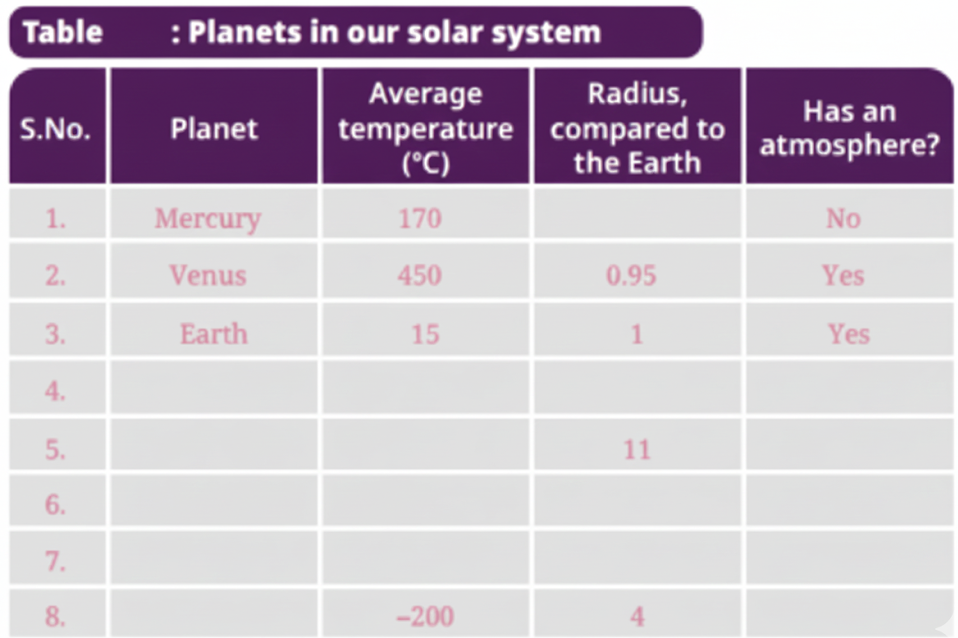
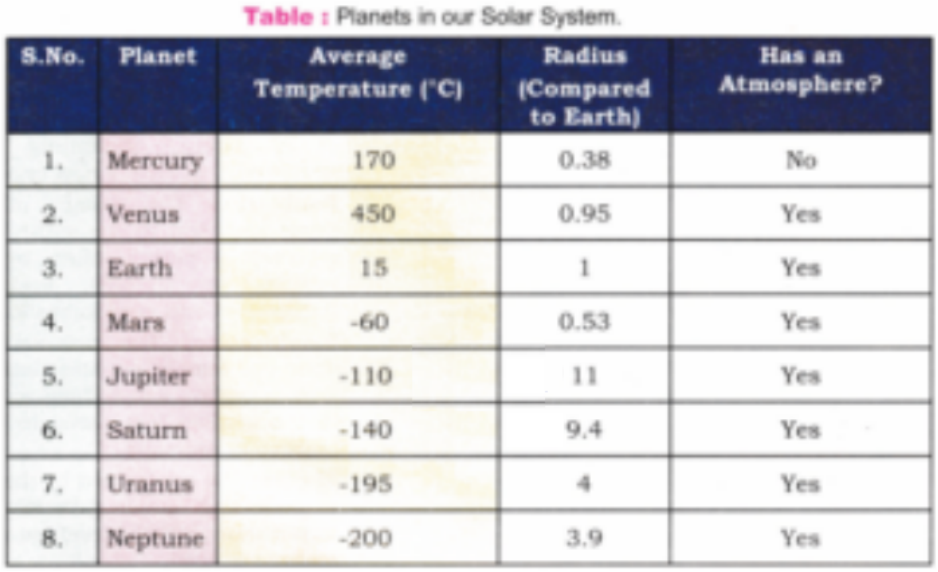
Collect information about the temperature and size of the planets in the solar system, and check if they have an atmosphere.
You may collect this information from books in your school library, trusted websites, or discuss it with your teachers.
Fill out the missing information in the Table.
Answer:
Why is Earth Called a Unique Life-Sustaining Planet?
The Earth's uniqueness lies in its perfect distance from the Sun, suitable atmosphere, and presence of water. These essential features enable a vibrant biosphere and support millions of life forms, making our planet truly special for sustaining life.
Understanding the interconnected systems like the hydrosphere, geosphere, and biosphere helps students grasp what keeps Earth habitable. Regular revision of NCERT Science Chapter 13 strengthens your basics for exams and increases your confidence in answering conceptual questions.
For best results, review key terms such as habitable zone, reproduction, and climate crisis. This not only boosts your marks but also builds awareness about maintaining the Earth's delicate balance for future generations.
FAQs on NCERT Solutions For Class 8 Science Chapter 13 Our Home Earth A Unique Life Sustaining Planet - 2026-27 Free PDF Download (Sign-in Required)
1. What is covered in Class 8 Science Chapter 13 Our Home: Earth, a Unique Life Sustaining Planet?
Chapter 13 provides an overview of Earth's unique features that support life and distinguishes our planet from others in the solar system. Key topics include:
- Earth's atmosphere and composition
- Conditions necessary for life (air, water, suitable temperature)
- Biosphere, hydrosphere, lithosphere, atmosphere
- Importance of oxygen, water cycle, soil
- Diagrams and map labelling practice
2. How to write stepwise NCERT Science answers to score full marks in Chapter 13?
To score full marks in Class 8 Science Chapter 13, follow these guidelines:
- Start by reading the question carefully
- Present each answer stepwise, using bullet points or short paragraphs
- Always include key definitions or terms stated in the question
- If a diagram is required, draw neatly and label correctly
- Refer to the CBSE marking scheme for step marks
3. Are diagrams and definitions mandatory in Class 8 Science answers?
Yes, diagrams and definitions are important for full marks in NCERT Class 8 Science answers.
- Definitions of key terms (like biosphere, atmosphere, hydrosphere) help get step marks
- Labeled diagrams are required wherever indicated in the question (e.g., Earth's layers, water cycle)
- Neat diagrams and precise labeling can fetch easy extra marks
4. What are the key definitions and terms students should revise from Chapter 13?
Important definitions from Class 8 Science Chapter 13 include:
- Biosphere: The global sum of all ecosystems where living beings exist
- Hydrosphere: All water bodies (oceans, rivers, lakes) present on Earth
- Atmosphere: Layer of gases surrounding the Earth
- Lithosphere: Rigid outer part of the Earth, consisting of the crust and upper mantle
- Water cycle, oxygen cycle, life-supporting zone
5. How do I structure a long answer in Science for Chapter 13 to match CBSE marking scheme?
For long answers in Chapter 13, use this structure:
- Introduction: Briefly introduce the topic
- Main body: State and explain key points step-by-step
- Include definitions and examples where required
- Draw diagrams if the question asks
- Conclusion/summary if needed
6. How to download the free PDF of NCERT Solutions for Class 8 Science Chapter 13?
You can download the free PDF of Class 8 Science Chapter 13 NCERT Solutions by clicking the Download PDF button on the respective solutions page for easy offline study.
7. What are the most important topics to prepare from Class 8 Science Chapter 13 for school exams?
The most important topics include:
- Earth's unique features supporting life
- Structure of Earth's spheres (biosphere, lithosphere, hydrosphere, atmosphere)
- Basic cycles: water, oxygen, carbon dioxide
- Map/diagram labelling of Earth's layers and cycles
- Key definitions and main functions of each sphere
8. Are NCERT Solutions enough for Class 8 Science chapter-wise exam preparation?
NCERT Solutions for Class 8 Science chapter-wise exercises cover all key concepts, back exercises, and example-based practice needed for school exams.
- They provide stepwise, CBSE-marking aligned answers
- Helpful as a primary resource, but supplement with revision notes and sample papers for thorough preparation
9. How to revise diagrams and map labelling in Chapter 13 effectively?
To master diagrams and map labelling:
- Practice drawing diagrams (Earth’s layers, water cycle) from memory
- Use labels and neat lines as per textbook conventions
- Go through exam-oriented diagram checklists
- Revise common mistakes and correction tips
10. Do examiners award partial marks for correct steps even if the final answer is incorrect?
Yes, CBSE marking scheme gives step marks for correct explanations and diagrams, even if the final statement has a mistake.
- Write all relevant steps and reasoning in your answer
- Label diagrams properly for partial marks, even if some details are missing
11. What are the possible exam pattern or question types from Chapter 13 Our Home: Earth, a Unique Life Sustaining Planet?
Exam questions from Chapter 13 typically include:
- Short answers on key definitions and concepts
- Diagram-based questions
- Long answers on Earth's support for life or the importance of different spheres
- Fill-in-the-blank or match-the-following
- Map/labelling exercises
