



Stepwise Answers, Diagrams & Exam Tips for Class 8 Science Exploring Forces
Question 1.
Why does it feel harder to pedal a bicycle when going uphill than on flat ground? (Page 62)
Answer:
When we ride a bicycle uphill, we work against Earth’s gravity, which pulls us downward. On flat ground, gravity acts straight down and doesn’t interfere much with forward motion. But on an incline, part of the gravitational force pulls us backward along the slope. Because of this opposing force, we need to apply more effort to pedal upward.
Question 2.
Why is it easier to slip on a wet surface? (Page 62)
Answer: It is easy to slip on a wet surface because the friction between your foot and the ground decreases. The water forms a thin layer that works like a lubricant, reducing grip and making slipping more likely.
Question 3.
Why do we feel ‘light’ or like we are ‘floating’ just after our swing reaches its highest point and begins to come down? (Page 62)

Answer:
The brief feeling of lightness or floating on a swing right after it reaches its highest point is caused by a change in acceleration. As the swing moves upward, it slows down and then pauses for a moment at the top before coming back down. At that instant, gravity is still pulling us downward, but the swing is not pushing up against us, so we feel almost weightless. When the swing starts to fall, we accelerate downward along with it, which makes the sensation of lightness even stronger.
Question 4.
Is there any other contact force? (Page 67)
Answer:
Yes. Force of friction.
Question 5.
Is it essential for an object applying force on another object to always be in contact with it? (Page 69)
Answer:
No, an object does not always need to touch another object to apply a force on it. Some forces act through direct contact, while others can act from a distance without any physical contact.
Question 6.
Does it mean that there are two kinds of electrical charges? (Page 71)
Answer:
Yes, electric charge exists in two forms—positive and negative. These charges are basic properties found in all matter.
Question 7.
Why do all the objects fall towards the Earth? (Page 72)
Answer:
Objects fall toward Earth because of gravity, a natural force of attraction between anything that has mass. Earth’s gravity pulls objects toward its center, making them fall. The greater the mass, the stronger the force, and this force becomes weaker as the distance increases.
Question 8.
Is there any force that acts on them? What exerts this force? (Page 72)
Answer:
Yes, every object in the universe experiences a force known as gravity. Gravity is an attractive force between any two objects that have mass. Because Earth has a very large mass, it pulls all nearby objects toward its center through this gravitational force.
Question 9.
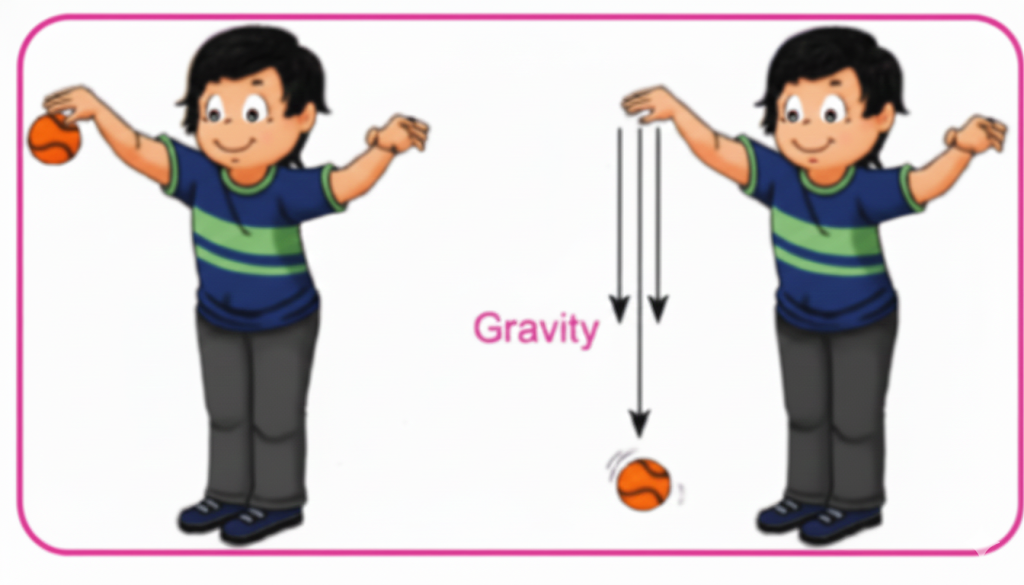
Does the Earth pull every object with equal force? (Page 72)
Answer:
No, the Earth does not pull all objects with the same force. Gravity acts on every object, but the strength of this pull increases with the object’s mass. Heavier objects experience a stronger gravitational force than lighter ones.
Question 10.
What is the difference between weight and mass? (Page 75)
Answer:
Mass refers to the amount of matter an object contains, while weight is the force with which gravity pulls that object downward. On Earth, weight and mass are directly proportional to each other.
Question 11.
If we place some objects on water, some of them float, while others fall to the bottom. The gravitational force of the Earth is acting on all objects, so why don’t all objects fall to the bottom? (Page 76)
Answer: Although Earth’s gravity pulls all objects downward, whether an object sinks or floats in water depends on the buoyant force and its density compared to water. If an object’s density is lower than that of water, the buoyant force acting on it is strong enough to make it float. If its density is higher, the buoyant force is weaker, and the object sinks.
Keep the Curiosity Alive (Pages 77-79)
Question 1.
Match items in Column A with the items in Column B.
Answer:
Question 2.
State whether the following statements are True or False.
(i) A force is always required to change the speed of motion of an object.
(ii) Due to friction, the speed of the ball rolling on a flat ground increases.
(iii) There is no force between two charged objects placed at a small distance apart.
Answer:
(i) True: A force is necessary to change an object’s speed. If no force acts on it, the object will continue moving at the same speed and in the same direction, or remain at rest if it is already still.
(ii) False: Friction works against motion, so it slows down a rolling ball rather than increasing its speed.
(iii) False: Charged objects always exert a force on each other. This force may be attractive or repulsive depending on the type of charges, but it is always present when the charges are nearby.
Question 3.
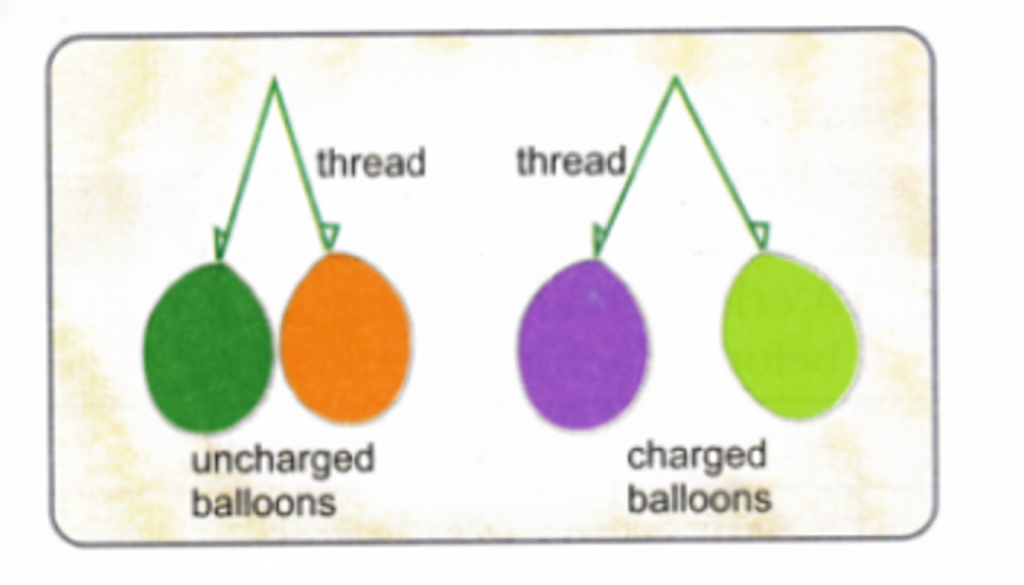
Two balloons rubbed with a woollen cloth are brought near each other. What would happen and why?
Answer:
When two balloons are rubbed with a woollen cloth and then brought close together, they repel each other. This is because both balloons gain a negative charge during rubbing, and like charges push away from one another.
Question 4.
When you drop a coin in a glass of water, it sinks, but when you place a bigger wooden block in water, it floats. Explain.
Answer:
A coin sinks in water because its density is higher than the density of water. A wooden block floats because it has a lower density than water, allowing the upward buoyant force to support it.
Question 5.
If a ball is thrown upwards, it slows down, stops momentarily, and then falls back to the ground. Name the forces acting on the ball and specify their directions.
(i) During its upward motion
(ii) During its downward motion
(iii) At its topmost position
Answer:
When a ball is thrown upward, gravity is the only force acting on it throughout the entire motion, always pulling it downward. However, the effect of this force changes depending on how the ball is moving:
(i) On the way up: Gravity acts downward, opposite to the ball’s upward motion, which slows the ball down.
(ii) On the way down: Gravity still pulls downward, but now it is in the same direction as the ball’s motion, causing it to speed up.
(iii) At the highest point: The ball momentarily comes to rest with zero velocity. Gravity continues to act downward, but at that instant, there is no upward or downward movement, so it does not change the ball’s motion at that exact moment.
Question 6.
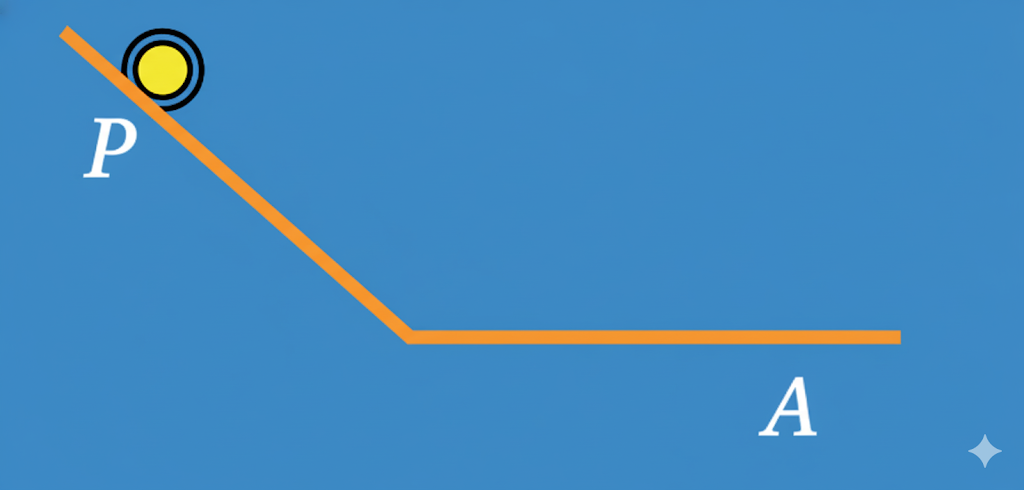
A ball is released from the point P and moves along an inclined plane and then along a horizontal surface as shown in the figure. It comes to a stop at point A on the horizontal surface. Think of a way so that when the ball is released from the same point P, it stops (i) before the point A, (ii) after crossing the point A.
Answer:
The ball’s movement is influenced by gravity and friction. On the inclined plane, gravity causes it to accelerate, while on the horizontal surface, friction is the only force slowing it down.
Stopping before A: If the friction on the horizontal surface is increased, the ball will slow down faster and may stop before reaching point A.
Stopping after A: If the friction is reduced, the ball loses speed more slowly, allowing it to travel farther and potentially stop beyond point A.
Question 7.
Why do we sometimes slip on smooth surfaces like ice or polished floors? Explain.
Answer:
When we walk on surfaces like ice, slipping is common because the friction needed to keep us balanced and moving is very low. Such surfaces have very few irregularities, so our shoes cannot grip them well. This reduced contact and low friction make it easy to slide instead of walk steadily. Even a thin layer of water on ice acts like a lubricant, lowering the friction even more and making the surface extremely slippery.
Question 8.
Is any force being applied to an object in a non-uniform motion?
Answer:
Yes, a force must act on an object for it to be in non-uniform motion. Non-uniform motion, or accelerated motion, occurs when an object’s speed or direction (or both) change, and such changes can only happen when a force is applied.
Question 9.
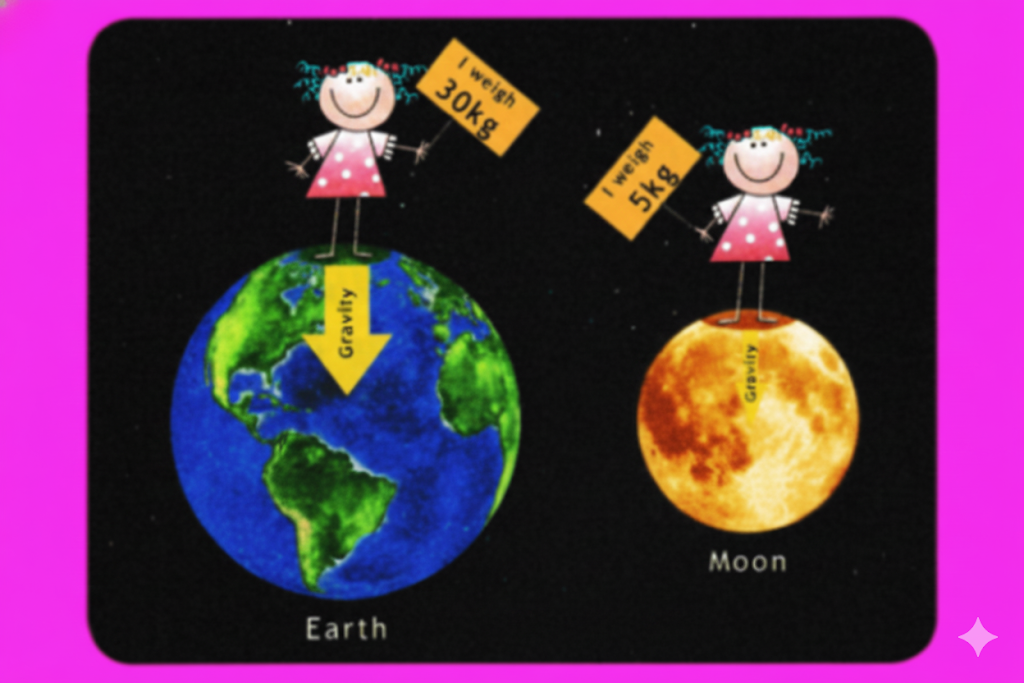
The weight of an object on the Moon becomes one-sixth of its weight on Earth. What causes this change? Does the mass of the object also become one-sixth of its mass on the Earth?
Answer:
An object’s weight changes on the Moon because the gravitational force there is much weaker—about one-sixth of Earth’s gravity. Although the weight decreases due to this reduced pull, the object’s mass stays the same no matter where it is.
Question 10.
three objects, 1, 2, and 3 of the same size and shape but made of different materials, are placed in the water. They dip to different depths as shown in the figure.
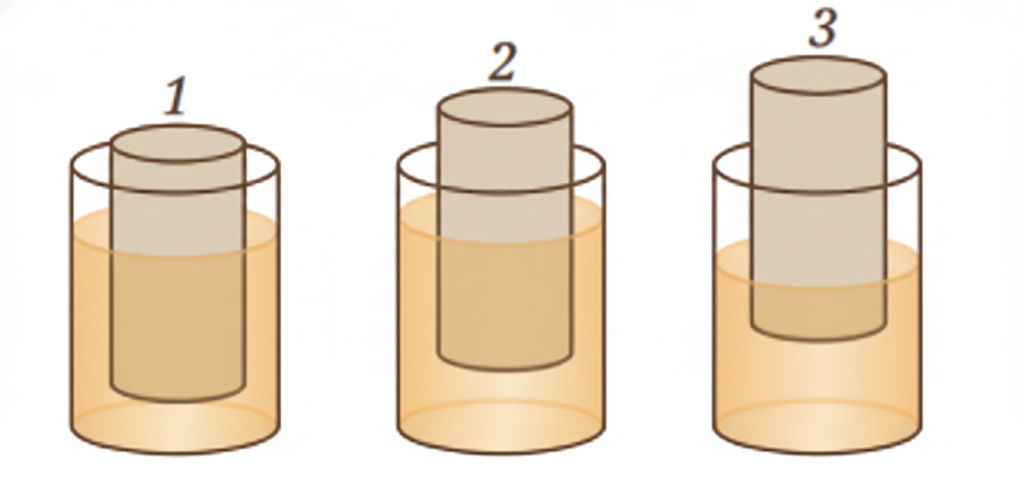
If the weights of the three objects 1, 2, and 3 are w1, w2, and w3, respectively, then
(i) w1 = w2 = w3
(ii) w1 > w2 > w3
(iii) w2 > w3 > w1
(iv) w3 > w1 > w2
Answer:
(ii) The weights of the objects follow the order w₁ > w₂ > w₃.
Object 1 sinks the deepest, meaning it displaces the most water.
Object 2 is not as deep as Object 1 but goes deeper than Object 3.
Object 3 floats the highest, displacing the least water.
Since all three objects have the same size and shape, a greater depth indicates a greater weight (assuming they are made of the same material). Therefore, the heaviest object sinks the most, while the lightest one stays closest to the surface.
Activity 5.3: Let Us Investigate (Page 67)
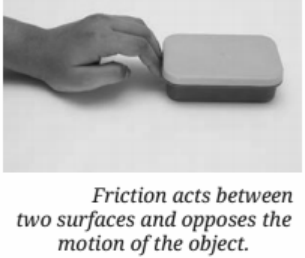
Take an object with a flat base (such as an empty lunch box/geometry box/a notebook) and place it on a table or floor.
Gently push it and observe. Does it stop after travelling some distance? Is there a force acting on it that brings it to rest?
Now repeat by pushing the object in the opposite direction. Does it stop again after travelling some distance?
on a table or floor.
Gently push it and observe. Does it stop after travelling some distance? Is there a force acting on it that brings it to rest?
Now repeat by pushing the object in the opposite direction. Does it stop again after travelling some distance?
Answer:
Yes, an object will come to rest after sliding a certain distance on a table or floor because friction opposes its motion and gradually slows it down. If the object is pushed in the opposite direction, friction will again act against the motion and stop it after some distance.
Activity 5.8: Let Us Observe (Page 71)
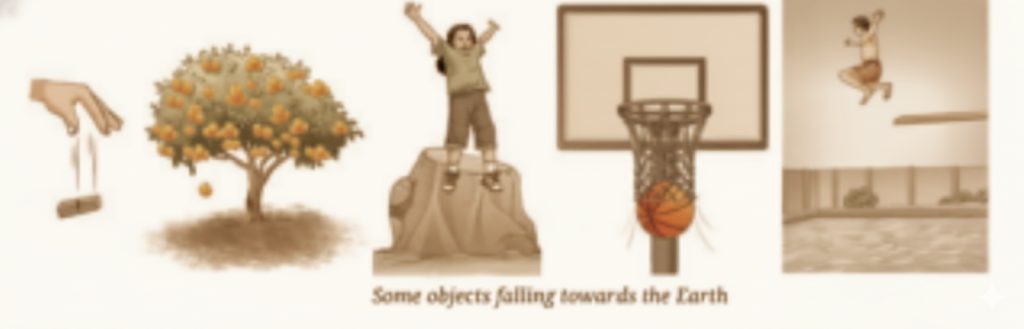
Take a ball and throw it vertically upwards. Does it come down?
Now throw it again, but this time harder. Does it still fall back down to the ground?
Think about different situations around you where any object thrown up in any direction finally falls or comes back to the ground or floor.
Answer:
When a ball is thrown upward, it always returns to the ground.
If we throw it with more force, the ball will still fall back down. A stronger throw only increases its initial upward speed, allowing it to rise higher before gravity slows it down and brings it back toward the ground.
Different Situations
Many everyday examples show how gravity works:
A thrown stone: Whether we toss a stone upward or sideways, it travels along a curved path and eventually lands on the ground because gravity pulls it down.
A falling mango: When a mango drops from a tree, gravity draws it toward the Earth.
Raindrops: Rain falls from the clouds to the ground due to Earth’s gravitational pull.
Key Concepts of Force, Types, and Measurement – Class 8 Science
Mastering Class 8 Science Chapter 5: Exploring Forces helps you understand how push, pull, friction, weight and gravity work in the real world. Learning these basics lays the foundation for higher classes and strengthens your problem-solving skills.
From contact forces like friction and muscular force to non-contact forces such as gravity and magnetism, this chapter covers all. Focus on how forces cause changes in motion, direction, or shape—these are common exam questions and important for scoring high marks.
Regular revision of NCERT exercises and activities will make concepts crystal clear. Don’t forget to note differences between weight and mass, and understand the use of spring balance. Practice more and you’ll ace science exams with confidence!
FAQs on NCERT Solutions For Class 8 Science Chapter 5 Exploring Forces - 2026-27 Free PDF Download (Sign-in Required)
1. What are the NCERT Solutions for Class 8 Science Chapter 5: Exploring Forces?
The NCERT Solutions for Class 8 Science Chapter 5: Exploring Forces provide detailed, stepwise answers to all textbook exercises and extra questions. Key features include:
- Accurate solutions for intext and back exercises
- Exam-focused explanations and important definitions
- Clear diagrams with labelling tips
- Free PDF download for quick revision
- Covers the entire CBSE 2026–27 syllabus
2. How can I score full marks in Science Class 8 Chapter 5 with NCERT Solutions?
To score full marks in Class 8 Science Chapter 5: Exploring Forces, follow these strategies:
- Write answers in stepwise format as shown in NCERT Solutions
- Include definitions, diagrams, and key points
- Structure long answers with an introduction, main explanation, conclusion, and labelled diagrams if required
- Revise using the free PDF and take quick notes for last-minute review
- Practice extra and MCQ questions for complete preparation
3. Where can I download the Class 8 Science Chapter 5 solutions PDF for free?
You can download the Class 8 Science Chapter 5: Exploring Forces PDF solutions for free from trusted educational sites. These PDFs offer:
- Offline access to stepwise NCERT answers
- Well-formatted diagrams and definitions
- Quick revision sheets for exam preparation
4. What is the syllabus covered in Class 8 Science Chapter 5: Exploring Forces?
Class 8 Science Chapter 5: Exploring Forces covers the following syllabus topics:
- Types of forces (contact and non-contact)
- Effects and examples of different forces
- Friction, gravity, and pressure concepts
- Applications of forces in daily life
- Important diagrams and definitions as per NCERT
5. Are diagrams or definitions mandatory in CBSE Class 8 Science exam answers?
Including diagrams and definitions is highly recommended in CBSE Class 8 Science exams. This helps:
- Earn step marks as per the marking scheme
- Make answers visually clear and complete
- Demonstrate good conceptual understanding of key terms and forces
6. Which are the most important questions from Class 8 Science Chapter 5 for exams?
Some important questions from Chapter 5: Exploring Forces commonly asked in exams include:
- Define force and explain its types with examples
- What is friction? State its advantages and disadvantages
- Describe how force can change the state of motion of an object
- Explain the difference between contact and non-contact forces
- Draw and label diagrams showing application of forces
7. How should I structure long answers in Science Chapter 5 to get full marks?
For full marks in long answers in Class 8 Science Chapter 5, follow this structure:
- Start with a short introduction/definition
- Include relevant examples or explanations
- Draw neat, labelled diagrams where needed
- End with a brief summary or conclusion
- Use bullet points for clarity and highlight key terms
8. Do examiners award partial marks if steps are correct but the final answer is wrong?
In CBSE marking schemes for Class 8 Science, examiners do award partial marks for correct steps shown in your answer, even if the final answer is incorrect. Make sure to:
- Write stepwise explanations for problem-solving questions
- Highlight important formulas and reasoning steps
- Use relevant scientific terms from the chapter
9. How can I revise Class 8 Science Chapter 5: Exploring Forces quickly before exams?
To revise Class 8 Science Chapter 5: Exploring Forces quickly, follow these tips:
- Go through summary notes and key definitions
- Practice stepwise NCERT solutions, especially diagrams
- Attempt extra questions and MCQs for self-assessment
- Use a 1-day or 3-day revision plan from the revision planner
- Download and use the free PDF solutions for last-minute revision
10. Why is mastering stepwise NCERT solutions important for the CBSE 2026–27 Science exam?
Mastering stepwise NCERT solutions for Class 8 Science Chapter 5 is essential because:
- They align answers with the CBSE 2026–27 marking scheme
- Ensure you cover all required points and keywords
- Help avoid common mistakes that lead to losing marks
- Boost your conceptual understanding and presentation skills
