



Stepwise Answers & Important Questions for Class 8 Science Chapter 4
Question 1.
Can we use electric current to make a magnet? (Page 49)
Answer:
Yes, the magnetic effect of electric current can be used to create a magnet. When current flows through a long wire wound around a metal nail or rod, the metal becomes magnetised. Once the current is switched off, the nail or rod loses its magnetic property.
Question 2.
Does an electromagnet also have two poles like a bar magnet? (Page 50)
Answer:
When an electric current flows through a wire that is tightly wound around an iron nail, the nail starts behaving like a magnet and forms two poles—just like a bar magnet. One end of the nail acts as the North pole, while the other behaves as the South pole. This can be verified by bringing the North pole of a compass needle close to each end of the nail (one at a time) while the current is passing through the coil. The direction in which the compass needle deflects helps identify the poles. Since magnets have the property that like poles repel each other, the observed repulsion confirms that an electromagnet also has two poles similar to a permanent bar magnet.
Question 3.
Are electromagnets also used in real life, for lifting objects? (Page 52)
Answer:
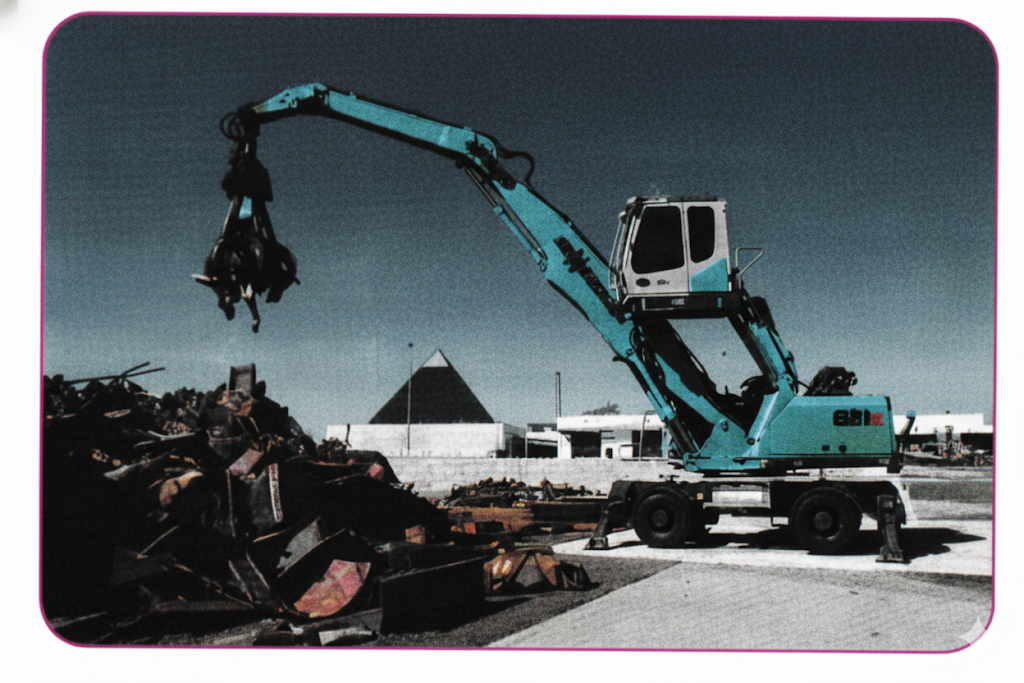
Electromagnets are commonly used in factories and scrap yards to lift, move, and separate heavy metal objects. These powerful magnets are attached to cranes. When the crane operator positions the magnet over a pile of metal and switches the current ON, the magnet becomes active and picks up all the magnetic items. The operator then moves the crane to the desired location and switches the current OFF. As soon as the magnetic field disappears, the metal objects drop to the ground.
Question 4.
While doing the activity for the electromagnet, did you also notice that the wire ends got warm? Why would that happen? (Page 52)
Answer:
When an electric current flows through a wire for a while, the ends of the wire become warm because of the heating effect of the current. Different metals used as conductors offer some resistance to the flow of electricity. Due to this resistance, a portion of the electrical energy changes into heat energy, which causes the wire ends to heat up.
Question 5.
Can we also make our Voltaic cell using easily available materials? (Page 56)
Answer:
We can create a simple Voltaic cell using fresh lemon pieces, iron nails, copper wires or strips, and an LED to test the current produced. Insert one iron nail and one copper strip into each of the five lemon pieces. Then, connect the copper strip of the first lemon to the iron nail of the second lemon. Similarly, connect the copper strip of the second lemon to the iron nail of the third, and continue this pattern for all the lemons.
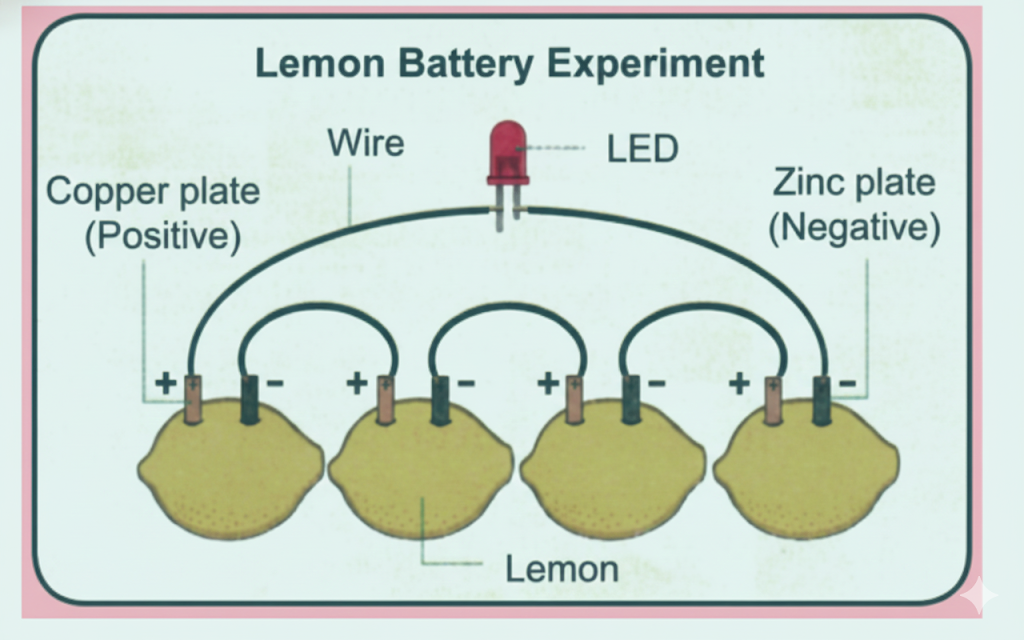
Connect the first iron nail to the negative terminal of the LED and attach the last copper strip to the positive terminal. If the setup is correct, the LED will glow, indicating that the Voltaic cell is functioning.
Keep the Curiosity Alive (Pages 58-61)
Question 1.
Fill in the blanks.
The solution used in a Voltaic cell is called __________________
A current carrying coil behaves like a __________________
Answer:
Electrolyte
Magnet
Question 2.
Choose the correct option:
Dry cells are less portable compared to Voltaic cells. (True/False)
A coil becomes an electromagnet only when an electric current flows through it. (True/False)
An electromagnet, using a single cell, attracts more iron paper clips than the same electromagnet with a battery of 2 cells. (True/False)
Answer:
False (Voltaic cells are less portable due to the liquid electrolyte.)
True
False (A stronger current of battery current of 2 cells makes the coil a stronger magnet.)
Question 3.
An electric current flows through a nichrome wire for a short time.
(i) The wire becomes warm.
(ii) A magnetic compass placed below the wire is deflected.
Choose the correct option:
(a) Only (i) is correct
(b) Only (ii) is correct
(c) Both (i) and (ii) are correct
(d) Both (i) and (ii) are not correct
Answer:
(c) Both (i) and (ii) are correct
Question 4.
Match the items in Column A with those in Column B.
Answer:
Question 5.
Nichrome wire is commonly used in electrical heating devices because it
(i) is a good conductor of electricity.
(ii) generates more heat for a given current.
(iii) is cheaper than copper.
(iv) is an insulator of electricity.
Answer:
(ii) Nichrome generates more heat for a given current
Question 6.
Electric heating devices (like an electric heater or a stove) are often considered more convenient than traditional heating methods (like burning firewood or charcoal). Give reasons to support this statement, considering societal impact.
Answer:
Traditional fuels such as firewood and charcoal are not very convenient to use because:
(i) They require a large amount of dry wood or charcoal to be stored at home, which takes up considerable space.
(ii) The smoke produced while burning them is harmful. It irritates the eyes and makes breathing difficult.
(iii) Burning firewood or charcoal releases gases like carbon dioxide and carbon monoxide, which pollute the air and harm the environment.
In comparison, electric heating devices such as heaters or electric stoves are much more convenient. They occupy less space and do not create pollution.
Question 7.
Look at the Figure. If the compass is placed near the coil deflects:
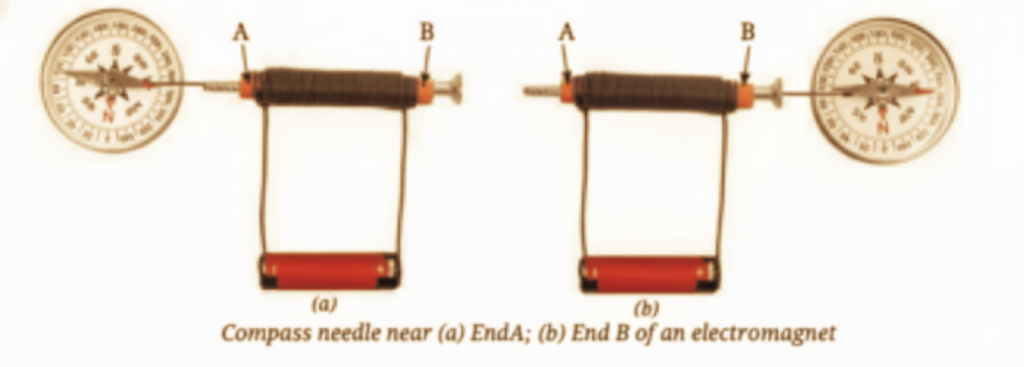
(i) Draw an arrow on the diagram to show the path of the electric current.
(ii) Explain why the compass needle moves when current flows.
(iii) Predict what would happen to the deflection if you reverse the battery terminals.
Answer:
(i) The electric current moves from the cell’s positive terminal to the coil’s end labeled A, flows through the coil to the end labeled B, and finally returns to the negative terminal of the cell, as indicated by the red arrows in the figure.
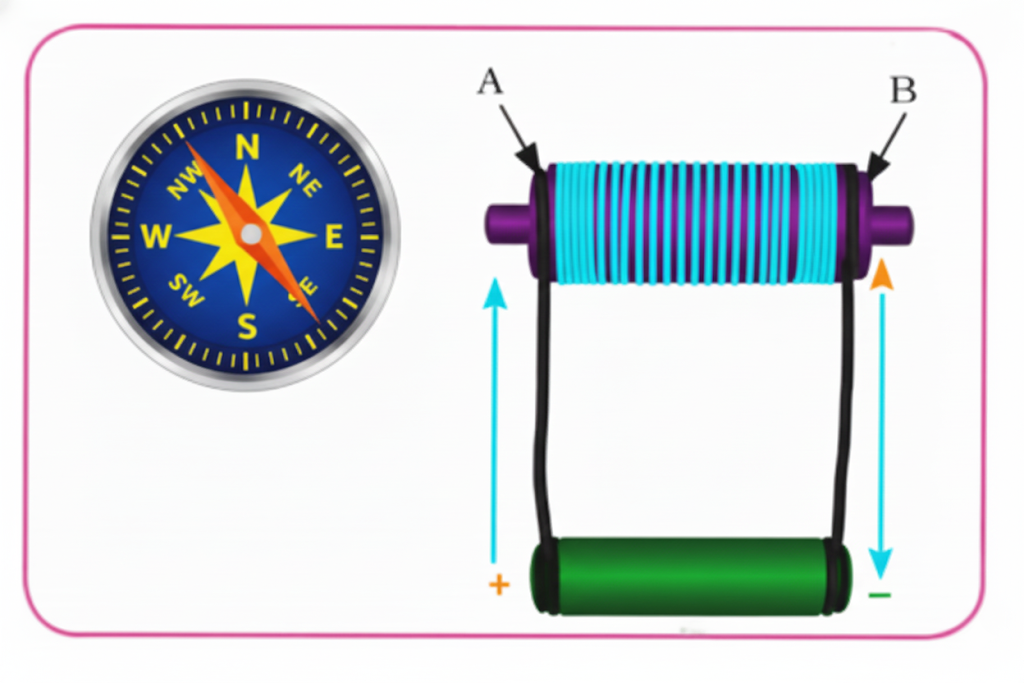
(ii) The compass needle shifts because the coil turns into a magnet when current passes through it, creating a magnetic field that affects the needle’s position.
(iii) If we reverse the battery terminals, the polarity of the electromagnet in the coil also reverses. As a result, the compass needle deflects in the opposite direction. The pole that was previously attracted to the coil will now be repelled, while the opposite pole will be drawn toward it.
Question 8.
Suppose Sumana forgets to move the switch of her lifting electromagnet model to the OFF position (in the introduction story). After some time, the iron nail no longer picks up the iron paper clips, but the wire wrapped around the iron nail is still warm. Why did the lifting electromagnet stop lifting the clips? Give possible reasons.
Answer:
A conducting coil acts like a magnet only while electric current is passing through it—this is the magnetic effect of electric current. Once the current is switched off, the coil immediately loses its magnetism. The magnetic effect exists only as long as the current flows through the wire.
The heating effect of electric current causes part of the electrical energy to change into heat, which warms up the wire. When the current stops, the heating effect also ends, but the wire that became warm needs some time to cool down and return to its normal temperature.
Question 9.
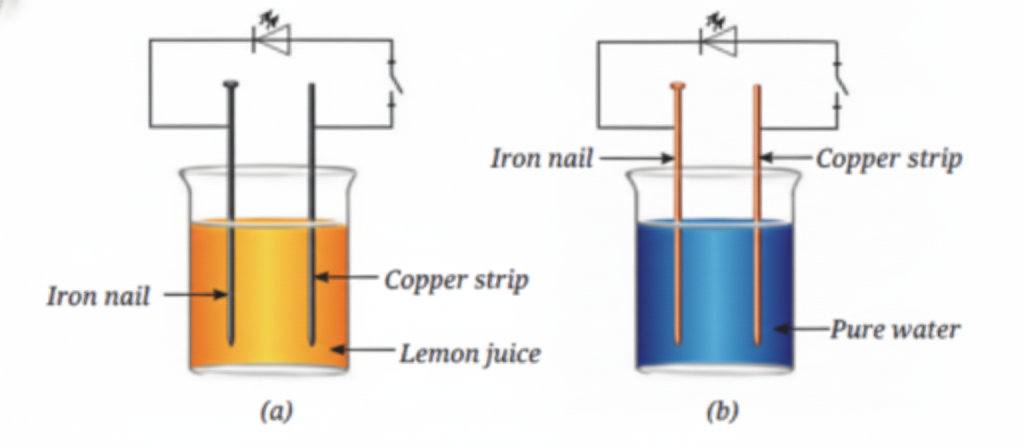
In Figure (below), in which case, the LED will glow when the switch is closed?
Answer:
In setup (a), the LED lights up when the switch is closed because the lemon juice acts as an electrolyte. When copper and iron plates are correctly placed in a weak acidic or salty solution and connected in a circuit, they generate electricity. In setup (b), however, the liquid used is pure water, which does not function as an electrolyte, so the LED does not glow.
Question 10.
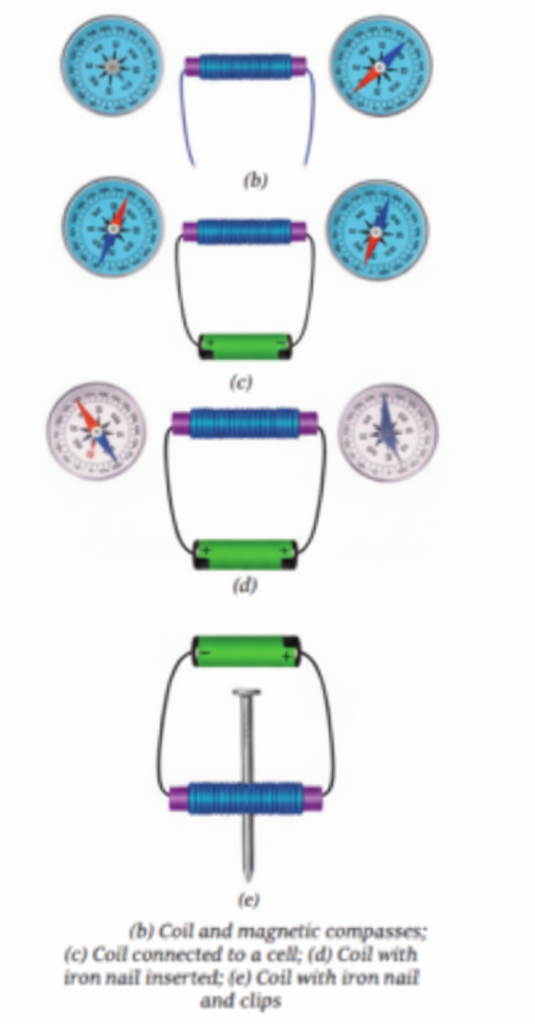
Neha keeps the coil the same way as in Activity 4.4 but slides the iron nail out, leaving only the coiled wire. Will the coil still deflect the compass? If yes, will the deflection be more or less than before?
Answer:
Yes, the coil will still cause the compass needle to deflect even after the iron nail is removed. The coil becomes magnetic whenever current flows through it. When an iron nail is placed inside the coil, it increases the strength of the electromagnet. So, once Neha removes the nail, the compass will still show deflection, but it will be weaker because the coil alone produces a less powerful electromagnet.
Question 11.
We have four coils, of similar shape and size, made up from iron, copper, aluminium, and nichrome as shown in the Figure:
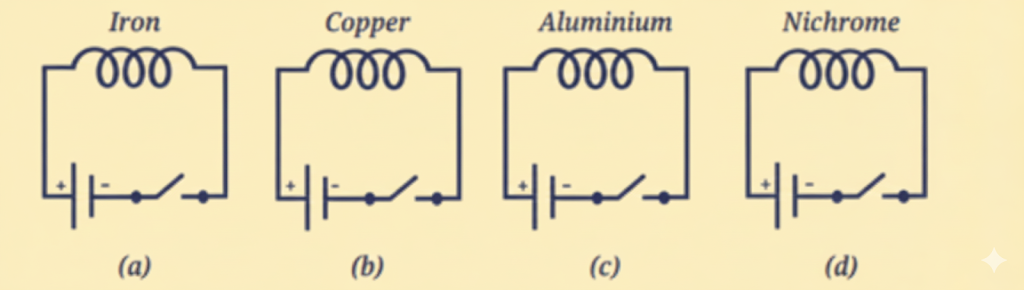
When current is passed through the coils, compass needles placed near the coils will show deflection.
(i) Only in circuit (a)
(ii) Only in circuits (a) and (b)
(iii) Only in circuits (a), (b), and (c)
(iv) In all four circuits
Answer:
The compass needles placed near the coils will show deflection in all four cases, but the amount of deflection will differ. The strength of an electromagnet depends on the type of material used. Magnetic materials such as iron, nickel, and cobalt create strong electromagnets, while materials like aluminium and nichrome—even if they have the same shape and size—do not produce magnets of equal strength. As a result, the compass deflection will vary based on how strong the electromagnet is in each case.
Understanding Electricity: Magnetic and Heating Effects – Class 8 Science
Mastering Class 8 Science Chapter 4: Electricity – Magnetic and Heating Effects is crucial for building foundational knowledge of electricity. With NCERT Solutions 2026-27, students can easily learn how electric current creates magnetic fields and heat, both in theory and activity-based questions.
Explore electromagnets, heating appliances, and batteries with clear explanations and solved activities. Strengthen your exam preparation by reviewing direct answers and remembering key facts like how electromagnets work or why nichrome is used in heaters.
Regular revision of NCERT exercise questions ensures a better understanding and high scores. With well-structured solutions, you can clarify doubts and reinforce tricky concepts, giving you the confidence to attempt every Science exam question with ease.
FAQs on NCERT Solutions For Class 8 Science Chapter 4 Electricity Magnetic And Heating Effects - 2026-27 Free PDF Download (Login Required)
1. What are the important topics in Class 8 Science Chapter 4: Electricity: Magnetic and Heating Effects?
Class 8 Science Chapter 4 covers key concepts related to the magnetic and heating effects of electricity. Important topics include:
- Electric current and its flow
- Heating effect of electric current (e.g., electric bulb, fuse)
- Magnetic effect of electric current (e.g., electromagnet, magnetic field)
- Applications of magnetic and heating effects in daily life
- Distinguishing between good and bad conductors
2. How do I write stepwise answers for NCERT Solutions for Class 8 Science Chapter 4?
The best way to write stepwise answers for NCERT Solutions for Class 8 Science Chapter 4 is to present each point in logical order and include proper terms. For maximum marks:
- Start with a clear definition or statement
- Present each reasoning or explanation step-by-step
- Use diagrams wherever required, labelling all parts neatly
- Highlight keywords like heating effect, magnetic effect, fuse, circuit
- Conclude with a summary, if needed
3. Are diagrams required in answers for Class 8 Science Chapter 4: Electricity: Magnetic and Heating Effects?
Yes, diagrams are often required and can help you score full marks in Class 8 Science Chapter 4: Electricity: Magnetic and Heating Effects.
- Draw neat and labelled circuit diagrams for questions involving electric circuits or magnetic fields
- Include the diagram wherever instructions mention it or where it supports your answer
- Use correct conventional symbols as per the NCERT textbook
4. Where can I download the free PDF of NCERT Solutions for Class 8 Science Chapter 4?
You can download a free PDF of NCERT Solutions for Class 8 Science Chapter 4: Electricity: Magnetic and Heating Effects from trusted educational platforms.
- Look for the Download PDF button on the solution page
- PDFs are useful for offline study and quick revision
- Make sure the solutions are aligned with the 2026–27 CBSE syllabus
5. Which types of questions are frequently asked from the Electricity: Magnetic and Heating Effects chapter in CBSE exams?
CBSE exams for Class 8 Science Chapter 4 typically include:
- Short answer questions on definitions, conductors, and insulators
- Diagram-based questions on circuits or fuses
- Long answer questions about the heating/magnetic effects and daily applications
- MCQs and fill-in-the-blanks covering core concepts
6. Why is practicing definitions and diagrams important for Class 8 Science Chapter 4?
Practicing definitions and diagrams is crucial for Class 8 Science Chapter 4 because:
- Definitions carry step marks in exams
- Diagrams help explain answers visually and fetch easy marks
- CBSE examiners look for neat, labelled sketches
- It boosts memory and quick recall during revision
7. How can I revise Class 8 Science Chapter 4 effectively for exams?
To revise Class 8 Science Chapter 4 effectively:
- Go through key definitions and formulae
- Practice labelled diagrams
- Solve all NCERT back and intext exercises
- Use flash notes and a 1-day to 7-day revision planner
- Attempt MCQs and important questions for self-testing
8. Do examiners give partial marks if the steps are correct but the final answer is wrong in Class 8 Science Chapter 4?
Yes, CBSE examiners often give partial marks for correct steps even if the final answer is wrong.
- Show your reasoning and logical steps clearly
- Use appropriate keywords as per the chapter
- Always attempt all parts of the answer to maximize step marks
9. Are NCERT Solutions alone enough for Class 8 Science Chapter 4: Electricity: Magnetic and Heating Effects?
NCERT Solutions for Class 8 Science Chapter 4 are usually sufficient for CBSE exams.
- NCERT covers all key concepts and exercise questions
- For thorough preparation, practice additional MCQs and exemplar questions
- Revision notes and sample papers add extra confidence
10. What is the heating effect of electric current as explained in Class 8 Science Chapter 4?
The heating effect of electric current is the phenomenon where electric energy is converted into heat energy when current passes through a conductor.
- Examples include electric heaters, bulbs, and fuses
- Explained by the fact that moving charges encounter resistance, producing heat
- Used in daily appliances and safety devices like fuses
