



Health: The Ultimate Treasure Class 8 – Important Questions & Stepwise Explanations
NCERT Probe and Ponder Questions (Page 28)
Question 1.
How does your body respond to an infection such as the common cold?
Answer:
The body reacts to a common cold (caused by viruses) through its immune system. Symptoms such as a runny nose, sore throat, and cough appear while the body works to fight off the infection. The immune system makes antibodies to counter the virus, and white blood cells destroy the infected cells. Adequate rest, plenty of fluids, and medicines for symptoms like fever support the healing process.
Question 2.
We rarely see cases of smallpox or polio these days, but diseases like diabetes and heart problems are more common. Why?
Answer:
Smallpox and polio have almost been eliminated because of large-scale vaccination efforts, such as Jenner’s smallpox vaccine and modern polio vaccines. On the other hand, non-communicable diseases (NCDs) like diabetes and heart conditions are on the rise due to lifestyle habits—unhealthy eating (processed and junk foods like pizza, burgers, etc.), insufficient physical activity, stress, and increased life expectancy.
Question 3.
Could climate change lead to new types of diseases?
Answer: Yes, climate change can contribute to the emergence or rise of various diseases. Higher temperatures and shifting weather patterns can widen the habitat of vectors such as mosquitoes (which spread malaria and dengue), affect water quality, and create environments where new pathogens can develop or existing ones can spread more easily.
Question 4.
How do emotions like stress or worry affect us and make us sick?
Answer: Stress or anxiety can weaken the immune system by increasing hormones like cortisol, making the body more prone to infections such as the common cold. Long-term stress can also play a role in non-communicable diseases like high blood pressure and diabetes by disrupting sleep, eating habits, and overall mental well-being.
Question 5.
Why do some groups of people get affected more than others during disease outbreaks?
Answer: Certain groups are more vulnerable because of reasons such as low immunity (like in young children and the elderly), unhealthy living conditions (such as poor sanitation), malnutrition, or existing medical problems. Social factors—including overcrowded housing and limited access to healthcare—can further increase their risk.
Keep the Curiosity Alive (Pages 42-45)
Question 1.
Group the diseases shown in the images as communicable or non-communicable.
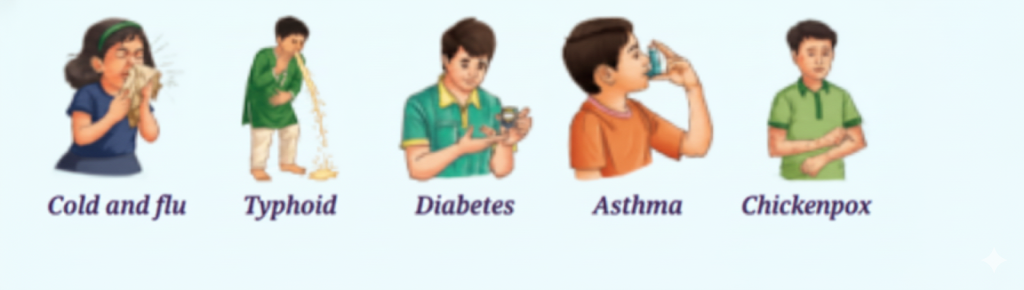
Answer:
Communicable Diseases
Cold and Flu
Typhoid Chickenpox
Non-communicable Diseases
Diabetes
Asthma
Question 2.
Diseases can be broadly grouped into communicable and non-communicable diseases. From the options given below, identify the non-communicable diseases.
(i) Typhoid
(ii) Asthma
(iii) Diabetes
(iv) Measles
(a) (i) and (ii)
(b) (ii) and (iii)
(c) (i) and (iv)
(d) (ii) and (iv)
Answer:
(b) (ii) and (iii)
Question 3.
There is a flu outbreak in your school. Several classmates are absent, while some are still coming to school coughing and sneezing.
What immediate actions should the school take to prevent further spread?
If your classmate, who shares the bench with you, starts showing symptoms of the flu, how can you respond in a considerate way without being rude or hurtful?
How can you protect yourself and others from getting infected in this situation?
Answer:
The school should shut down for a short period, disinfect all classrooms, and advise unwell students to remain at home to stop the infection from spreading.
You can gently recommend that your classmate visit a doctor, rest at home, and you may offer to share your notes with them.
To safeguard yourself and others, wash your hands regularly, avoid close contact, and wear a mask.
Question 4.
Your family is planning to travel to another city where malaria is prevalent.
What precautions should you take before, during, and after the trip?
How can you explain the importance of mosquito nets or repellents to your sibling?
What could happen if travellers ignore health advisories in such areas?
Answer:
To safeguard our family from malaria while travelling, we should concentrate on preventing mosquito bites and taking any preventive medicines recommended by a doctor.
Before the trip, consult a physician, obtain required vaccinations, and carry mosquito repellent and protective clothing.
During travel, keep applying repellent, wear long-sleeved clothes and full-length pants, and use mosquito nets while sleeping.
After returning, stay alert for symptoms such as fever and seek medical help right away if any appear.
Explain to your sibling that mosquitoes transmit malaria, and using nets or repellents helps prevent bites and reduces the risk of infection.
If travellers disregard health warnings in malaria-prone regions, they expose themselves to the danger of contracting malaria, which can lead to serious illness or even death.
Question 5.
Your uncle has started smoking just to fit in with his friends, even though it is well known that smoking can seriously harm health and even cause death.
What would you say to him to make him stop, without being rude?
What would you do if your friend offered you a cigarette at a party?
How can schools help prevent students from indulging in such harmful habits?
Answer:
Dear Uncle, I’m concerned about your health and want to discuss smoking with you. Smoking is known to cause major health problems, such as heart disease and lung cancer. Giving it up can significantly enhance your overall health and quality of life.
At the party, politely refuse the offered cigarette and inform your friend about its harmful effects.
Schools can discourage students from adopting such habits by teaching them about associated health risks and holding regular awareness programmes.
Question 6.
Saniya claims to her friend Vinita that “Antibiotics can cure any infection, so we don’t need to worry about diseases.” What question(s) can Vinita ask her to help Saniya understand that her statement is incorrect?
Answer:
Why Saniya’s Statement Is Incorrect:
Antibiotics are effective only against bacterial infections; they do not cure viral illnesses such as the flu or common cold.
Using antibiotics unnecessarily or incorrectly can lead to antibiotic resistance, reducing their effectiveness in the future.
Certain diseases are caused by fungi, protozoa, or viruses, and each requires a different type of treatment.
Vanita might respond to Saniya by saying:
“Do you know that antibiotics don’t work on viral infections like flu or measles? They help only in bacterial infections. If we take them when they aren’t needed, they may not work properly when we actually require them. That’s why doctors prescribe them very carefully.”
Question 7.
The following table contains information about the number of dengue cases reported in a hospital over one year:
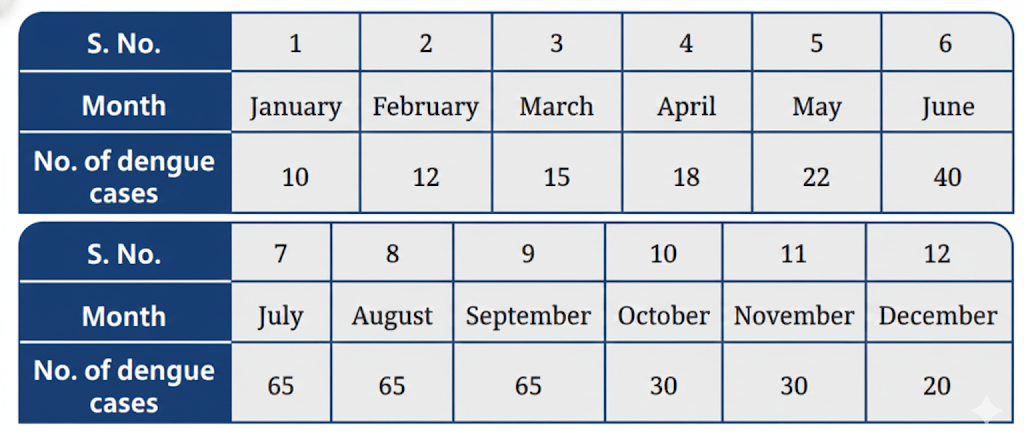
Make a bar graph of the number of cases on the Y-axis and the month on the X-axis. Critically analyse your findings and answer the following:
In which three months were the dengue cases highest?
In which month(s) were the cases lowest?
What natural or environmental factors during the peak months might contribute to the increase in dengue cases?
Suggest a few preventive steps that the community or government can take before the peak season to reduce the spread of dengue.
Answer:
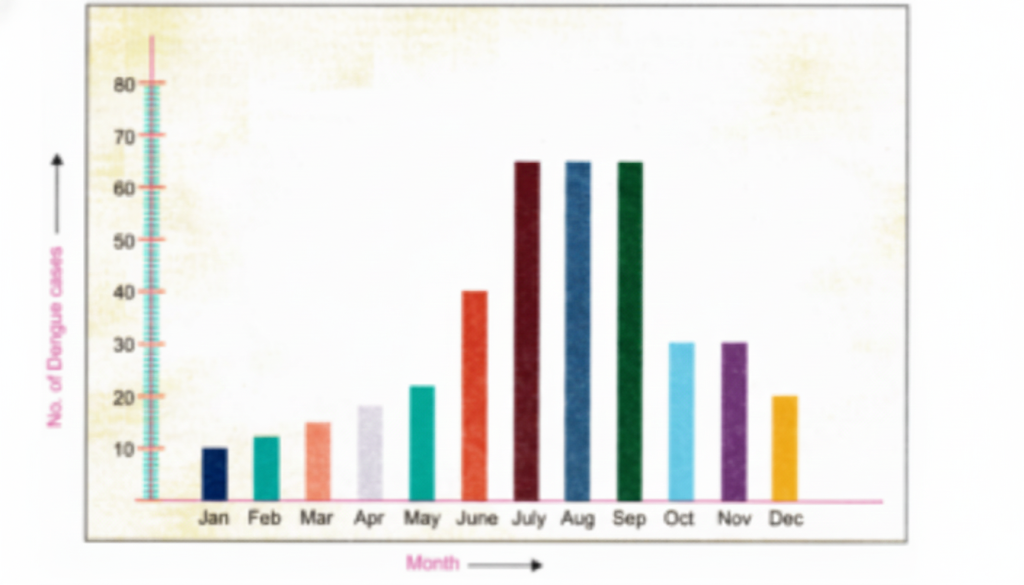
Dengue cases reached their highest levels in July, August, and September, while January saw the fewest cases.
Question 8.
Imagine you are in charge of a school health campaign. What key messages would you use to reduce communicable and non-communicable diseases?
Answer:
Important messages for a school health campaign aimed at reducing both communicable and non-communicable diseases include maintaining proper hand hygiene, following a nutritious diet, engaging in daily physical activity, staying up to date with vaccinations, and steering clear of smoking.
Question 9.
It is recommended that we not take an antibiotic for a viral infection like a cold, a cough, or the flu. Can you provide the possible reason for this recommendation?
Answer: The advice to avoid antibiotics for viral infections such as colds, coughs, or the flu is given because antibiotics are ineffective against viruses, which are responsible for these illnesses.
Question 10.
Which disease(s) among the following may spread if drinking water gets contaminated by the excreta from an infected person?
Hepatitis A, Tuberculosis, Poliomyelitis, Cholera, Chickenpox.
Answer: Diseases that can spread when drinking water becomes contaminated with the excreta of an infected person include Hepatitis A, Poliomyelitis, and Cholera.
Question 11.
When our body encounters a pathogen for the first time, the immune response is generally low, but on exposure to the same pathogen again, the immune response by the body is much more compared to the first exposure. Why is it so?
Answer:
When our body encounters a pathogen (such as a virus or bacterium) for the first time, the immune system requires time to:
• Recognize the foreign microbe
• Produce the right antibodies
• Develop memory cells that can recall the pathogen
This initial reaction is known as the primary immune response, and it tends to be slow and relatively weak.
If the same pathogen enters the body again:
• Memory B cells rapidly generate the appropriate antibodies
• Memory T cells help destroy infected cells more quickly
This is called the secondary immune response, which is much faster, stronger, and more efficient.
Activity 3.1: Let us Read (Page 29)
Question 1.
What was the cause of the boy’s health problems?
Answer:
The boy’s health issues resulted from several factors working together—loneliness, very little social support because his parents were busy, and not having friends. Spending too much time on screens and depending on social media made his emotional condition worse. This eventually led to physical problems such as headaches, weight loss, and difficulty sleeping. A lack of a supportive environment and the absence of healthy coping habits played a major role in his deteriorating health.
Question 2.
How did his habits and surroundings affect his well-being?
Answer:
Habits: Spending too much time on his phone and social media increased his loneliness and stress, which affected his sleep and mental health. Avoiding social contact pushed him into further isolation and harmed his emotional well-being.
Surroundings: Relocating to a new city without friends and having parents who were always busy created an unsupportive environment. This intensified his sense of isolation, and the absence of a social circle or guidance negatively affected both his mental and physical health.
Overall Impact: His overall well-being declined, showing up as physical issues like headaches, weight loss, and sleeplessness along with emotional struggles. This matches the WHO definition of health, which includes physical, mental, and social well-being.
Activity 3.3: Let us Compare (Page 31)
Question 1.
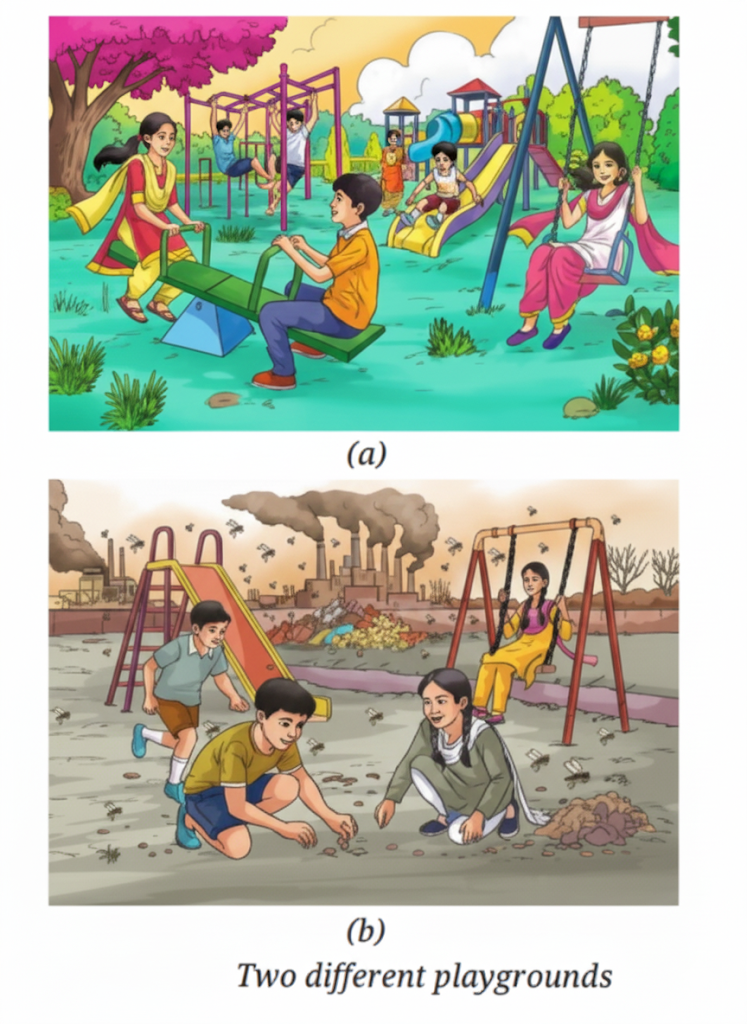
Look at Fig. (a) and Fig. (b). Which playground would you like to play in, and why?
Answer:
Preferred Playground:
Most students would likely choose the playground shown in Fig. (a).
Reason:
Fig. (a) is described as neat, well-kept, and visually appealing, making it a safe and pleasant place for children to play.
On the other hand, Fig. (b) is said to be polluted, dirty, unhygienic, and filled with flies and mosquitoes, which not only makes it uncomfortable but also increases the chances of falling ill.
A clean environment helps protect health by limiting contact with germs and harmful pollutants, which supports the chapter’s focus on environmental well-being.
Activity 3.6: Let us Read (Page 37)
Question 1.
What do you infer from this case study?
Ans.
The case study demonstrates that improving sanitation—such as constructing and regularly using toilets—can greatly reduce open defecation and enhance overall health, particularly for children. The sharp decline in diarrhoea and infections indicates that proper sanitation helps stop the spread of communicable diseases that arise from pathogens in contaminated soil or water.
It also emphasizes how community participation and simple hygienic practices play a vital role, consistent with the chapter’s focus on cleanliness and healthy surroundings for preventing illness.
Inference: Better sanitation directly improves physical health by limiting contact with disease-causing microbes, aligning with the WHO definition of health as physical well-being.
Question 2.
Find out about such community campaigns held in your location. Share in your class and discuss with your peers about the impact of such initiatives.
Answer:
Finding Campaigns:
(This will vary by location; the example below is based on general information and the document’s Indian context.)
Campaigns such as Swachh Bharat Abhiyan (Clean India Mission) aim to improve sanitation by constructing toilets and promoting hygiene, much like the campaign described in Odisha. Local initiatives may also include village cleanliness drives or projects to improve drinking water quality. Students can look for such campaigns through local news, school sources, or by speaking with community leaders.
Sharing and Discussion:
Impact: Students can explain that these campaigns help lower the incidence of diseases such as diarrhoea, cholera, and typhoid by ensuring access to toilets and clean water. The Odisha example—where child infections dropped significantly—shows how improved sanitation protects health and reduces medical expenses.
Discussion Points:
• How did the campaign influence people’s daily practices (e.g., choosing toilets instead of open defecation)?
• What difficulties might communities encounter (e.g., funding, lack of awareness)?
• In what ways can students participate (e.g., awareness drives, cleanliness activities)?
Example Contribution:
“In my locality, a clean-up programme reduced mosquito breeding areas, which helped decrease dengue cases—similar to the positive outcomes seen in Odisha.”
Comprehensive NCERT Solutions for Class 8 Science Chapter 3: Health: The Ultimate Treasure (2026-27)
Mastering Class 8 Science Chapter 3 is key to understanding how our habits, environment, and choices impact overall wellness. By exploring the NCERT Solutions 2026-27, students can build clear concepts about health, diseases, and prevention in their daily life and exams.
This chapter helps identify the difference between communicable and non-communicable diseases. Students are encouraged to develop healthy routines and to understand the importance of immunity and vaccines for a balanced life.
Focus on key preventive tips, like maintaining hygiene and getting proper sleep, to excel in exams. Regular review of exercise-based solutions will boost retention and help you write confident answers in Science assessments.
FAQs on NCERT Solutions For Class 8 Science Chapter 3 Health The Ultimate Treasure - 2026-27 Free PDF Download (Login Required)
1. What are the key concepts covered in Class 8 Science Chapter 3: Health: The Ultimate Treasure?
Class 8 Science Chapter 3: Health: The Ultimate Treasure covers the basics of personal and community health, prevention of diseases, and healthy habits.
Key concepts include:
- Definitions of health and disease
- Causes and prevention of diseases (communicable & non-communicable)
- Importance of hygiene and sanitation
- Role of balanced diet and immunization
- First aid and basic health care
2. How do NCERT Solutions for Class 8 Science Chapter 3 help improve exam marks?
NCERT Solutions for Class 8 Science Chapter 3 provide step-by-step answers that match the CBSE marking scheme.
They help you:
- Write structured, exam-ready answers
- Understand key definitions and diagrams
- Practice MCQs, extra questions, and long answers
- Identify important terms and concepts for revision
3. Where can I download the PDF of Class 8 Science Chapter 3 Solutions?
You can download the free PDF of Class 8 Science Chapter 3: Health: The Ultimate Treasure solutions directly from trusted educational platforms.
Steps to download:
- Go to the chapter solutions page
- Look for the "Free PDF Download" button
- Click to save the PDF for offline revision
4. Are diagrams and definitions compulsory in NCERT Science answers?
Yes, diagrams and definitions are often required in Class 8 Science exams.
For full marks:
- Neatly draw and label required diagrams
- Write accurate definitions using textbook terminology
- Include diagrams for processes like immunization, water purification, etc.
5. How should I structure long answers in Class 8 Science Chapter 3 for better marks?
Structure long answers stepwise to match CBSE marking criteria.
Follow these tips:
- Begin with a brief introduction
- Use headings and bullets for each point
- Incorporate keywords from the textbook
- Add diagrams and underline key terms
6. What are the most important topics from Class 8 Science Chapter 3 for the CBSE exam?
The most important topics include:
- Definition of health and disease
- Causes and prevention of communicable diseases
- Importance of hygiene, sanitation, and balanced diet
- First aid steps and immunization
- Short and long answer practice on disease prevention
7. Are NCERT Solutions enough for Class 8 Science exams?
NCERT Solutions are usually sufficient for scoring well in Class 8 Science exams.
For best results:
- Study the NCERT textbook carefully
- Practice all NCERT Solutions including extra and exemplar questions
- Use revision notes and MCQs for thorough practice
8. How to remember diagrams and maps for Class 8 Science Chapter 3?
To memorize diagrams and maps
- Practice drawing diagrams repeatedly
- Label all parts neatly and accurately
- Refer to NCERT textbook diagrams as templates
- Use flashcards and revision notes
9. What are common mistakes students make in Class 8 Science Chapter 3 exams and how to avoid them?
Common mistakes include skipping definitions, incomplete diagrams, and missing steps.
Avoid mistakes by:
- Always providing definitions and labels
- Following the stepwise format in solutions
- Practicing previous year questions
- Reviewing the marking scheme guidelines
10. Do examiners award partial marks for correct steps even if the final answer is wrong in NCERT Science answers?
Yes, examiners often give partial marks for correct steps, diagrams, or key points even if the final answer is incomplete or partly wrong.
To maximize your score:
- Show all steps and reasoning
- Draw diagrams wherever required
- Highlight key scientific terms
11. How to revise Class 8 Science Chapter 3 quickly before the exam?
Use a structured revision plan for fast and effective revision:
- Review flash notes and key definitions
- Practice short and long questions
- Do MCQs and diagrams for concept recall
- Check last-minute revision tables or summary charts
