



Step-by-Step Answers and Diagram Tips for The Invisible Living World – Class 8 Science
NCERT Probe and Ponder Questions (Page 8)
Question 1.
Have you ever wondered what you might see if the invisible world around you became visible?
Answer:
Yes, it would be truly fascinating to observe microorganisms such as bacteria, fungi, protozoa, and viruses that are always interacting with our environment and living within our bodies. It would completely shift our perspective on cleanliness, health, and the intricate ecosystems that surround us.
Question 2.
How do you think your observation of this hidden world might change the way you think about size, complexity, or even what counts as ‘living’?
Answer:
Yes, it would be truly fascinating to observe microorganisms such as bacteria, fungi, protozoa, and viruses that are always interacting with our environment and living within our bodies. It would completely shift our perspective on cleanliness, health, and the intricate ecosystems that surround us.
Question 3.
Have you thought about how these tiny living beings interact with each other?
Answer: Yes, microorganisms are always interacting—some live in symbiotic partnerships, while others compete for resources or even prey on each other. For instance, certain bacteria aid digestion while others cause illness, and fungi break down organic material, improving soil quality. Such interactions are essential to many ecological processes.
Keep the Curiosity Alive (Pages 25-26)
Question 1.
Various parts of a cell are given below. Write them in the appropriate places in the following diagram.
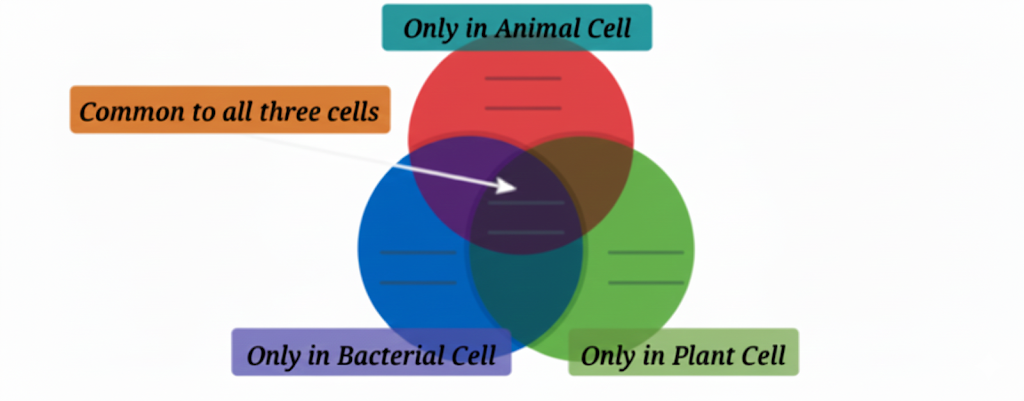
Nucleus
Cytoplasm
Chloroplast
Cell wall
Cell membrane
Nucleoid
Answer:
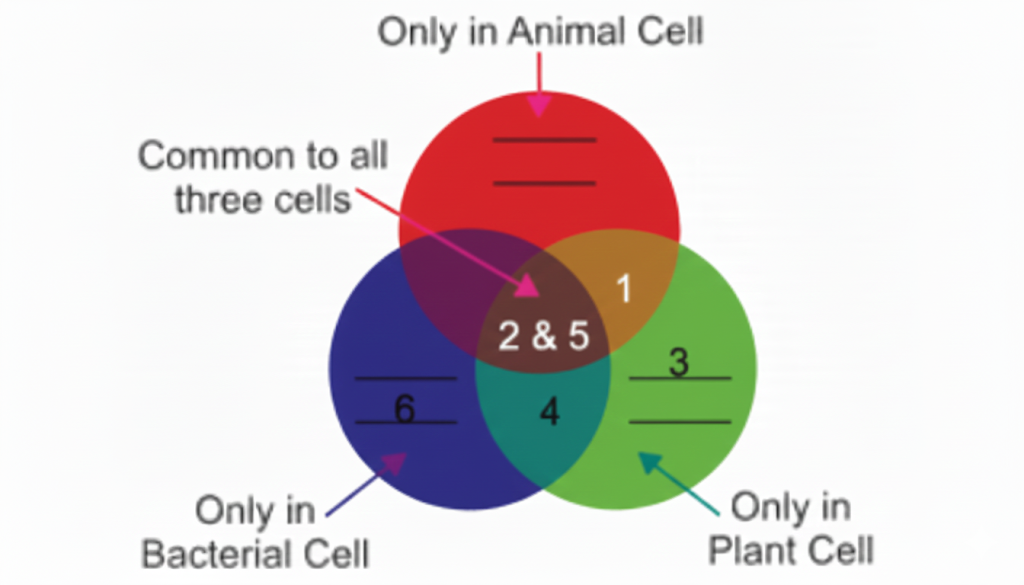
Nucleus: Present in both plant and animal cells (absent in bacteria); it regulates all cell activities.
Cytoplasm: A jelly-like material that fills the cell and holds the organelles.
Chloroplast: Found only in plant cells; it carries out photosynthesis.
Cell wall: Present in plant and bacterial cells, forming their outermost protective layer.
Cell membrane: Present in every cell; in plants and bacteria it lies just beneath the cell wall, while in animals it forms the outer boundary.
Nucleoid: Found only in bacterial cells; this region contains DNA because bacteria lack a true nucleus.
Question 2.
Aanandi took two test tubes and marked them A and B. She put two spoonfuls of sugar solution in each of the test tubes. In test tube B, she added a spoonful of yeast. Then she attached two incompletely inflated balloons to the mouth of each test tube. She kept the setup in a warm place, away from sunlight.
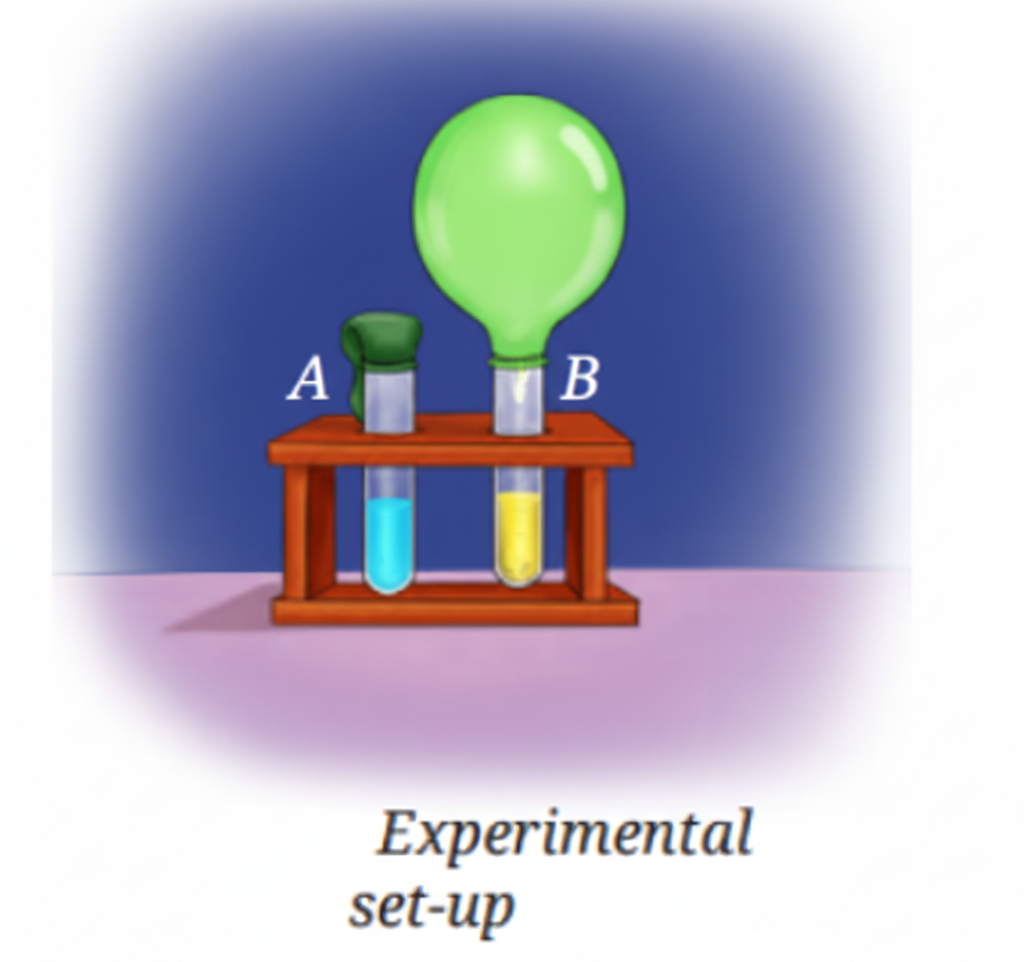
(i) What do you predict will happen after 3-4 days? She observed that the balloon attached to test tube B was inflated. What can be a possible explanation for this?
(a) Water evaporated in test tube B and filled the balloon with the water vapour.
(b) The warm atmosphere expanded the air inside test tube B, which inflated the balloon.
(c) Yeast produced a gas inside test tube B, which inflated the balloon.
(d) Sugar reacted with warm air, which produced gas, eventually inflating the balloon.
(ii) She took another test tube, 1/4 filled with lime water. She removed the balloon from test tube B in such a manner that the gas inside the balloon did not escape. She attached the balloon to the test tube with lime water and shook it well. What do you think she wants to find out?
Answer:
(i) (c) Yeast generated a gas in test tube B, which caused the balloon to expand.
Explanation: The yeast fermented the sugar and released carbon dioxide (CO₂), and this gas filled the balloon, making it swell.
(ii) She wants to check if the gas formed is carbon dioxide (CO₂). If the lime water becomes milky, it confirms CO₂ is present, as the gas reacts with lime water to produce calcium carbonate.
Question 3.
A farmer was planting wheat crops in his field. He added nitrogen-rich fertiliser to the soil to get a good yield of crops. In the neighbouring field, another farmer was growing bean crops, but she preferred not to add nitrogen fertiliser to get healthy crops. Can you think of the reasons?
Answer:

Beans are leguminous plants that develop a symbiotic partnership with Rhizobium bacteria found in their root nodules. These bacteria convert atmospheric nitrogen into a usable form in the soil, supplying natural nitrogen to the crop. Hence, the second farmer does not need to use nitrogen-rich fertilisers.
Question 4.
Snehal dug two pits, A and B, in her garden. In pit A, she put fruit and vegetable peels and mixed them with dried leaves. In pit B, she dumped the same kind of waste without mixing it with dried leaves. She covered both the pits with soil and observed after 3 weeks. What is she trying to test?
Answer:
She is examining how well composting works.
In Pit A, the combination of green waste (fruit and vegetable peels) and dry leaves creates the right carbon–nitrogen balance required for proper decomposition.
Pit B does not have this balance, so the waste will break down more slowly and may produce an unpleasant smell.
This experiment demonstrates that microorganisms decompose materials more effectively when both carbon-rich and nitrogen-rich components are available.
Question 5.
Identify the following micro-organisms:
(i) I live in every kind of environment, and inside your gut.
(ii) I make bread and cakes soft and fluffy.
(iii) I live in the roots of pulse crops and provide nutrients for their growth.
Answer:
(i) Bacteria
(ii) Yeast
(iii) Rhizobium
Question 6.
Devise an experiment to test that microorganisms need optimal temperature, air, and moisture for their growth.
Answer:
Arrange three bread slices as follows:
Slice A: Placed in a warm, moist spot (near the sink)
Slice B: Kept in a dry, sealed container
Slice C: Stored in a cold environment (refrigerator)
After three days, you will notice that Slice A shows the most fungal growth.
Conclusion: Microorganisms thrive when conditions such as temperature, moisture, and air supply are favorable.
Question 7.
Take 2 slices of bread. Place one slice on a plate near the sink. Place the other slice in the refrigerator. Compare after three days. Note your observations. Give reasons for your observations.
Answer: A bread slice kept near the sink will develop mold, whereas slices stored in the refrigerator will show little to no growth.
Reason: The warm, moist environment near the sink supports microbial growth, while the cold conditions inside the refrigerator slow it down or prevent it altogether.
Question 8.
A student observes that when curd is left out for a day, it becomes more sour. What are two possible explanations for this observation?
Answer: Lactic acid bacteria keep multiplying in the curd and produce increasing amounts of lactic acid, which causes the curd to taste more sour.
Higher temperatures accelerate bacterial activity, leading to faster acid formation and greater sourness.
Question 9.
Observe the set-up given in Figure and answer the following questions.
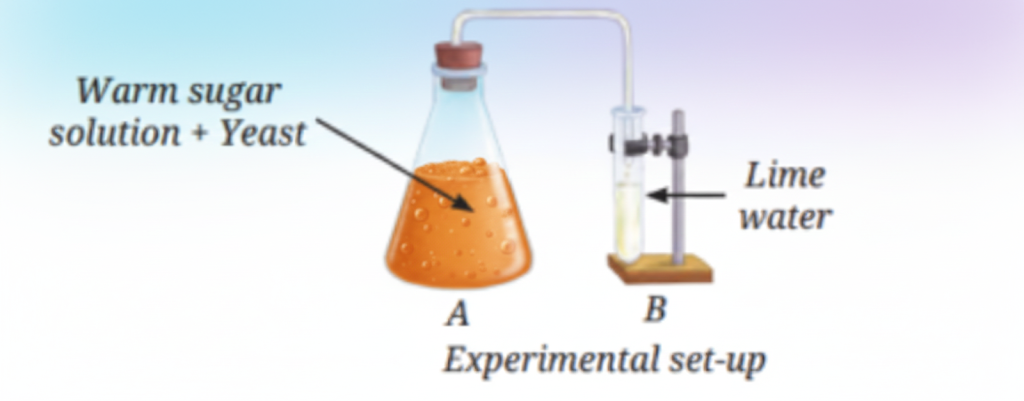
(i) What happens to the sugar solution in flask A?
(ii) What do you observe in test tube B after four hours? Why do you think this happened?
(in) What would happen if yeast were not added to flask A?
Answer:
(i) Yeast breaks down the sugar in the warm solution, generating carbon dioxide gas along with a small amount of alcohol.
(ii) The lime water in test tube B becomes milky because the CO₂ released in flask A passes through the delivery tube into flask B and reacts with the lime water, confirming that carbon dioxide is present.
(iii) Without warm conditions, fermentation would not take place, so no carbon dioxide would form. Consequently, the lime water in test tube B would stay clear.
Key Concepts of The Invisible Living World
Understanding the Invisible Living World in Class 8 Science helps students explore microorganisms, cell structure, and their essential roles. Grasping these fundamental principles supports stronger exam performance and builds a foundation for future biology studies.
By reviewing the NCERT Solutions (2026-27) for Chapter 2, learners can reinforce key facts about unicellular and multicellular organisms, their functions, and the amazing utility of microbes in the environment and food production.
For best exam results, regularly revise cell basics and microbe functions. Focus on labelled diagrams, activities, and real-life applications to make learning engaging and maximize your Science marks in Class 8.
FAQs on NCERT Solutions For Class 8 Science Chapter 2 The Invisible Living World Beyond Our Naked Eye - 2026-27 Free PDF Download (Sign-in Required)
1. What is the invisible living world?
The invisible living world refers to the group of microorganisms that cannot be seen with the naked eye and require a microscope to observe. This includes:
- Bacteria
- Viruses
- Fungi (like yeast and molds)
- Protozoa
- Algae (microscopic)
Understanding this world helps students in Class 8 Science Chapter 2 learn about their roles in health, environment, and industry.
2. How to write diagram answers in science?
To write diagram answers in science and score well in exams:
- Draw neat and well-labelled diagrams using a pencil.
- Include all required parts and labels as per the question.
- Give a brief caption or title below the diagram.
- If asked, provide a short explanation alongside the drawing.
- Follow all CBSE marking guidelines by keeping diagrams simple and accurate.
3. Are NCERT Solutions enough for class 8 science exam?
NCERT Solutions are usually enough for scoring well in Class 8 Science exams, especially for CBSE.
- They cover all textbook exercises, intext questions, and definitions.
- Following stepwise NCERT answers ensures the use of CBSE keywords and correct concepts.
- For better practice, also revise from exemplar, revision notes, and sample papers.
4. How to present long answers to match CBSE marking?
To score full marks in long answers in CBSE Science exams:
- Start with a brief introduction or definition.
- Write stepwise points or small paragraphs.
- Use all exam keywords and highlight important facts or examples.
- Include a neat diagram if required.
- Ensure the answer is structured, clear, and of recommended length.
5. Where to get chapterwise solutions PDF for offline study?
You can download free NCERT Solutions for Class 8 Science Chapter 2 PDF from trusted educational platforms. These PDFs:
- Cover stepwise, exercise-wise answers
- Are formatted for offline use and revision
- Include diagrams, definitions, and exam tips
6. What are the most important topics from this chapter?
The most important topics from Class 8 Science Chapter 2: The Invisible Living World are:
- Types of microorganisms (bacteria, virus, fungi, protozoa, algae)
- Useful and harmful microorganisms
- Diseases caused by microorganisms in humans, animals, plants
- Methods to prevent diseases
- Basic definitions and diagrams (bacterial cell, fungus, etc.)
7. Are diagrams or definitions mandatory in answers?
Including diagrams and definitions is highly recommended in Science answers:
- Diagrams fetch easy marks and improve presentation.
- Definitions of terms like microorganism, pathogen, etc., help meet marking criteria.
- Use labelled and neat drawings for questions that mention 'diagram' or 'explain with the help of diagram.'
8. Which questions are likely from this chapter in school exams?
Common exam questions from Class 8 Science Chapter 2 include:
- Define different types of microorganisms with examples.
- List useful and harmful effects of microorganisms.
- Name diseases caused by bacteria, virus, fungi, protozoa.
- Draw and label the structure of a microbe.
Practise NCERT intext, back exercises, and short/long answer questions for best results.
9. How to revise Science Chapter 2 quickly for exams?
To revise Class 8 Science Chapter 2 quickly:
- Go through NCERT Solutions and highlighted revision notes.
- Memorise key definitions, diagrams, and table of diseases.
- Practise a few sample and exemplar questions.
- Use 1-day or 3-day revision planners for last-minute prep.
10. Do examiners award partial marks for correct steps even if the final answer is wrong?
Yes, CBSE examiners often award step marks for correct explanations or diagrams, even if the final answer is incorrect. To maximise marks:
- Show all working steps clearly.
- Label diagrams and write relevant keywords.
- Try to attempt every part of the question, as some marks are for the approach and reasoning.
11. How does understanding 'The Invisible Living World: Beyond Our Naked Eye' help in exam preparation?
Understanding this chapter builds a foundation for:
- Correctly answering NCERT-based questions
- Relating to daily life applications (like food spoilage, diseases)
- Learning exam keywords, diagrams, and definitions
- Scoring full marks by using stepwise solutions and CBSE guidelines
