Class 7 Maths Chapter 7 (Ganita Prakash II) Finding the Unknown Solutions
7.1 Find the Unknowns & 7.2 Solving Equations Systematically
1. Solve these equations and check the solutions.
(a) 3x – 10 = 35
(b) 5s = 3s
(c) 3u – 7 = 2u + 3
(d) 4 (m + 6) – 8 = 2m – 4
(e) u / 15 = 6
Solution
(a) 3x – 10 = 35
Adding 10 to both sides,
3x – 10 + 10 = 35 + 10
⇒ 3x = 45
Dividing both sides by 3,
⇒ 3x/3 = 45/3
⇒ x = 15
Check:
LHS = 3x – 10 for x = 15
= 3 × 15 – 10
= 45 – 10
= 35
LHS = RHS
Hence, the solution is verified.
(b) 5s = 3s
Subtract 3s from both sides to bring the variable terms together.
⇒ 5s – 3s = 3s – 3s
⇒ 2s = 0
Divide both sides by 2,
⇒ 2s/2 = 0/2
⇒ s = 0
Check:
LHS = 5s = 5 × 0 = 0
RHS = 3s = 3 × 0 = 0
LHS = RHS
Therefore, the solution is verified.
(c) 3u – 7 = 2u + 3
Move the variable terms to one side by subtracting 2u from both sides.
⇒ 3u – 7 – 2u = 2u + 3 – 2u
⇒ u – 7 = 3
Adding 7 to both sides,
⇒ u – 7 + 7 = 3 + 7
⇒ u = 10
Check: For u = 10,
LHS = 3u – 7
= 3 × 10 – 7
= 30 – 7
= 23
RHS = 2u + 3
= 2 × 10 + 3
= 20 + 3
= 23
LHS = RHS
Hence, the answer is verified.
(d) 4(m + 6) – 8 = 2m – 4
Using the distributive property,
4m + 24 – 8 = 2m – 4
⇒ 4m + 16 = 2m – 4
Subtracting 2m from both sides,
4m + 16 – 2m = 2m – 4 – 2m
⇒ 2m + 16 = -4
Subtracting 16 from both sides,
2m + 16 – 16 = -4 – 16
⇒ 2m = -20
Dividing both sides by 2,
2m ÷ 2 = -20 ÷ 2
⇒ m = -10
Check:
LHS = 4(m + 6) – 8
= 4(-10 + 6) – 8
= 4(-4) – 8
= -16 – 8
= -24
RHS = 2m – 4
= 2(-10) – 4
= -20 – 4
= -24
LHS = RHS
Thus, the solution is verified.
(e) u/15 = 6
Multiplying both sides by 15,
u/15 × 15 = 6 × 15
⇒ u = 90
Check:
LHS = u/15
= 90/15 = 6
RHS = 6
LHS = RHS
Hence, the solution is verified.
2. Frame an equation that has no solution.
[Hint: 4 more than a number, and 5 more than a number can never be equal!]
Solution
Consider the equation u + 6 = u + 2, which has no solution.
Subtracting u from both sides,
u + 6 – u = u + 2 – u
⇒ 6 = 2
Since this statement is incorrect, the equation has no solution.
Figure it Out
1. Write 5 equations whose solution is x = – 2.
Solution
(i) x = -2
Adding 3 to both sides,
x + 3 = -2 + 3
⇒ x + 3 = 1
Multiplying both sides by 2,
2(x + 3) = 2
(ii) x = -2
Multiplying both sides by 3,
3x = -6
Adding 2 to both sides,
3x + 2 = -6 + 2
⇒ 3x + 2 = -4
(iii) x = -2
Dividing both sides by 4,
x/4 = -2/4
⇒ x/4 = -1/2
(iv) x = -2
Multiplying both sides by 5,
5x = -10
Adding 12 to both sides,
5x + 12 = -10 + 12
⇒ 5x + 12 = 2
(v) x = -2
Subtracting 7 from both sides,
x – 7 = -2 – 7
⇒ x – 7 = -9
2. Find the value of each unknown:
(a) 2y = 60
(b) – 8 = 5x – 3
(c) – 53w = –15
(d) 13 – z = 8
(e) k + 8 = 12 – k
(f) 7m = m – 3
(g) 3n = 10 + n
Solution
(a) 2y = 60
Dividing both sides by 2,
2y/2 = 60/2
⇒ y = 30
(b) -8 = 5x – 3
Adding 3 to both sides,
-8 + 3 = 5x
⇒ -5 = 5x
Dividing both sides by 5,
-5/5 = 5x/5
⇒ -1 = x
(c) -53w = -15
Dividing both sides by -5/3,
(-5/3)w ÷ (-5/3) = -15 ÷ (-5/3)
⇒ w = 15 × 3/5
⇒ w = 9
(d) 13 – z = 8
Subtracting 13 from both sides,
13 – z – 13 = 8 – 13
⇒ -z = -5
Dividing both sides by -1,
-z/-1 = -5/-1
⇒ z = +5
(e) k + 8 = 12 – k
Adding k to both sides,
k + 8 + k = 12 – k + k
⇒ 2k + 8 = 12
Subtracting 8 from both sides,
2k + 8 – 8 = 12 – 8
⇒ 2k = 4
Dividing both sides by 2,
2k/2 = 4/2
⇒ k = 2
(f) 7m = m – 3
Subtracting m from both sides,
7m – m = m – 3 – m
⇒ 6m = -3
Dividing both sides by 6,
6m/6 = -3/6
⇒ m = -1/2
(g) 3n = 10 + n
Subtracting n from both sides,
3n – n = 10 + n – n
⇒ 2n = 10
Dividing both sides by 2,
2n/2 = 10/2
⇒ n = 5
3. I am a 3-digit number. My hundreds digit is 3 less than my tens digit. My tens digit is 3 less than my units digit. The sum of all three digits is 15. Who am I?
Solution
Let the digit in the tens place be x.
Then, the hundreds place digit = x – 3
The unit’s place digit = x + 3
The sum of all digits = 15
From the given information,
(x – 3) + x + (x + 3) = 15
⇒ 3x = 15
Dividing both sides by 3,
3x/3 = 15/3
⇒ x = 5
Ten’s digit = 5
Hundred’s digit = 5 – 3 = 2
Unit’s digit = 5 + 3 = 8
Therefore, the number formed is 258.
4. The weight of a brick is 1 kg more than half its weight. What is the brick's weight?
Solution
Assume that the brick weighs x kg.
From the information provided,
x = x/2 + 1
Subtracting x/2 from both sides,
x – x/2 = x/2 + 1 – x/2
⇒ (2x – x)/2 = 1
⇒ x/2 = 1
Multiplying both sides by 2,
x/2 × 2 = 1 × 2
⇒ x = 2
∴ The weight of the brick is 2 kg.
5. One quarter of a number increased by 9 gives the same number. What is the number?
Solution
Let the required number be x.
Based on the question,
1/4 × x + 9 = x
x/4 + 9 = x
Subtracting x/4 from both sides,
x/4 + 9 – x/4 = x – x/4
⇒ 9 = (4x – x)/4 [LCM of 1 and 4 = 4]
⇒ 9 = 3x/4
Dividing both sides by 3/4,
⇒ 9 ÷ 3/4 = (3x/4) ÷ 3/4
⇒ 9 × 4/3 = (3x/4) × 4/3
⇒ 12 = x
Therefore, the required number is 12.
6. Given 4k + 1 = 13, find the values of:
(a) 8k + 2
(b) 4k
(c) k
(d) 4k – 1
(e) – k – 2
Solution
We are given
4k + 1 = 13
Subtracting 1 from both sides,
4k + 1 – 1 = 13 – 1
⇒ 4k = 12
Dividing both sides by 4,
4k ÷ 4 = 12 ÷ 4
⇒ k = 3
Substituting k = 3 into each expression,
(a) 8k + 2 = 8(3) + 2
= 24 + 2
= 26
(b) 4k = 4 × 3 = 12
(c) k = 3
(d) 4k – 1 = 4(3) – 1
= 12 – 1
= 11
(e) -k – 2 = -3 – 2 = -5
7.3 Mind the Mistake, Mend the Mistake & 7.4 A Pinch of History
Figure It Out
1. Fill in the blanks with integers.
(a) 5 × ____ -8 = 37
(b) 37 – (33 – ____) = 35
(c) -3 × (-11 + ____) = 45
Solution:
(a) 5 × ____ -8 = 37
Suppose the missing integer is x.
5 × x – 8 = 37
⇒ 5x – 8 = 37
⇒ 5x = 37 + 8
⇒ 5x = 45
⇒ x = 45 ÷ 5
⇒ x = 9
∴ 5 × 9 – 8 = 37
(b) 37 – (33 – ____) = 35
Let the missing integer be x.
37 – (33 – x) = 35
⇒ 37 – 33 + x = 35
⇒ 4 + x = 35
⇒ x = 35 – 4
⇒ x = 31
∴ 37 – (33 – 31) = 35
(c) -3 × (-11 + ____) = 45
Let the unknown integer be y.
-3 × (-11 + y) = 45
⇒ -11 + y = 45 ÷ (-3)
⇒ -11 + y = -15
⇒ y = -15 + 11
⇒ y = -4
∴ -3 × (-11 + (-4)) = 45
2. Ranju is a daily wage labourer. She earns ₹ 750 a day. Her employer pays her in ₹ 50 and ₹ 100 notes. If Ranju gets an equal number of ₹ 50 and ₹ 100 notes, how many of each does she have?
Solution
Let the number of ₹50 notes Ranju receives be x.
Since both types of notes are equal in number, the number of ₹100 notes is also x.
Total amount received = ₹750
Based on the given details,
Value of ₹50 notes = ₹50x
Value of ₹100 notes = ₹100x
₹50x + ₹100x = ₹750
⇒ 150x = 750
⇒ x = 5
Therefore, Ranju receives 5 ₹50 notes and 5 ₹100 notes.
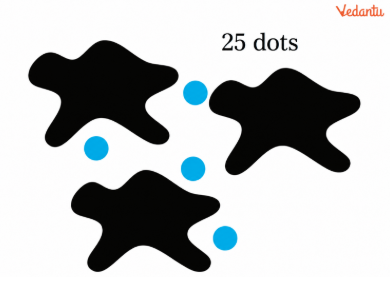
3. In the given picture, each black blob hides an equal number of blue dots. If there are 25 dots in total, how many dots are covered by one blob? Write an equation to describe this problem.
Solution
Let u represent the number of blue dots hidden under each black blob.
The picture contains 3 black blobs and 4 visible blue dots.
Total number of blue dots = 25
Using the given information,
3u + 4 = 25
⇒ 3u = 25 – 4
⇒ 3u = 21
⇒ u = 7
Therefore, each black blob covers 7 blue dots.
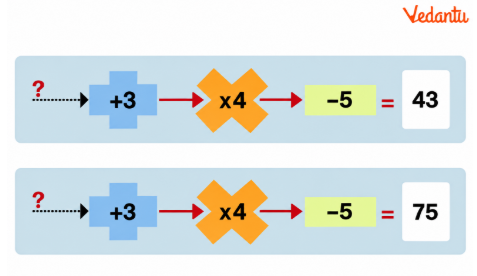
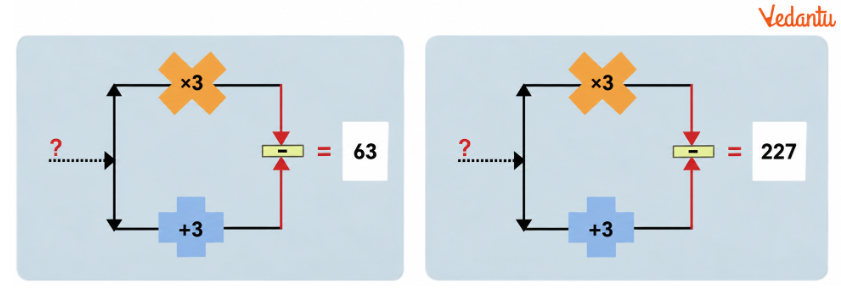
4. Here are machines that take an input, perform an operation on it, and send out the result as an output.
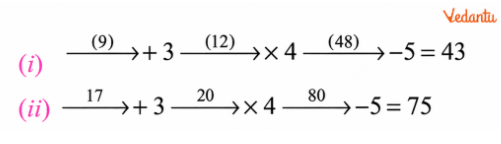
(a)
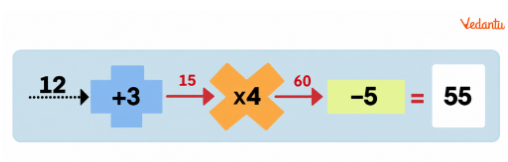
Find the inputs in the following cases:
b)
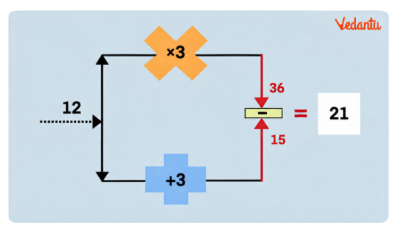
Find the inputs in the following cases:
Solution
a.
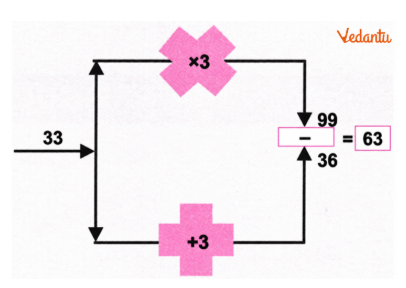
(b) (i) Let the unknown number be x.
x × 3 – (x + 3) = 63
⇒ 3x – x – 3 = 63
⇒ 2x – 3 = 63
⇒ 2x = 66
⇒ x = 33
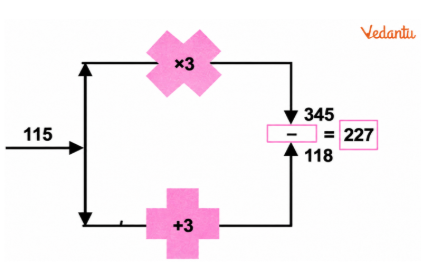
(ii) Let the unknown number be y.
y × 3 – (y + 3) = 227
⇒ 3y – y – 3 = 227
⇒ 2y = 227 + 3
⇒ 2y = 230
⇒ y = 115
The unknown number is 115.
5. What are the inputs to these machines?
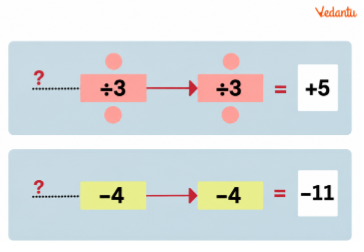
Solution
(i) Let the unknown input be a.
45 15
────────→ ÷ 3 ────────→ ÷ 3 = 5
(a ÷ 3) ÷ 3 = 5
⇒ a ÷ 3 = 5 × 3
⇒ a ÷ 3 = 15
⇒ a = 15 × 3
⇒ a = 45
Therefore, the required input is 45.
(ii)
-3 -7
────────→ − 4 ────────→ − 4 = -11
Let the unknown input be b.
(b – 4) – 4 = -11
⇒ b – 4 – 4 = -11
⇒ b – 8 = -11
⇒ b = -11 + 8
⇒ b = -3
Hence, the required input is -3.
6. A taxi driver charges a fixed fee of ₹ 800 per day plus ₹ 20 for each kilometre travelled. If the total cost for a taxi ride is ₹ 2200, determine the number of kilometres travelled.
Solution
Fixed charges by the taxi driver = ₹ 800
Charge per kilometer = ₹ 20
Let the distance covered be x km.
According to the question
x × 20 + 800 = 2200
⇒ 20x = 2200 – 800
⇒ 20x = 1400
⇒ x = 70
The total distance covered is 70 km.
7. The sum of two numbers is 76. One number is three times the other number. What are the numbers?
Solution
Let the two numbers be x and 3x.
According to the question
x + 3x = 76
⇒ 4x = 76
⇒ x = 19
The two numbers are 19 and 3 × 19, i.e., 19 and 57.
8. The figure shows the diagram for a window with a grill. What is the gap between the two rods in the grill?
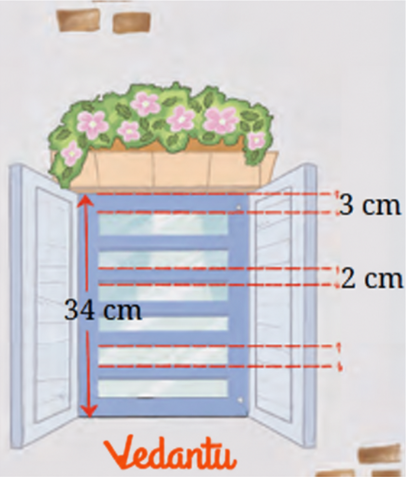
Solution
Total height of the window, including the frame = 34 cm
Height of the window excluding the frame = 34 cm – 3 cm – 3 cm = 28 cm
Width of each grill rod = 2 cm
Number of grill rods = 5
Total width of 5 rods = 5 × 2 cm = 10 cm
Let the height of each gap be x cm.
Number of gaps = 6
Total height occupied by gaps = 6x
Using the given measurements,
10 + 6x = 28
⇒ 6x = 28 – 10
⇒ 6x = 18
⇒ x = 3
Therefore, the gap between the two rods is 3 cm.
9. In a restaurant, a fruit juice costs ₹ 15 less than a chocolate milkshake. If 4 fruit juices and 7 chocolate milkshakes cost ₹600, find the cost of the fruit juice and the milkshake.
Solution
Let the price of one chocolate milkshake be ₹x.
Then, the price of one fruit juice = ₹(x – 15)
The total price of 4 fruit juices and 7 chocolate milkshakes is ₹600.
Forming an equation,
4(x – 15) + 7x = 600
⇒ 4x – 60 + 7x = 600
⇒ 4x + 7x = 600 + 60
⇒ 11x = 660
⇒ x = 60
Cost of one chocolate milkshake = ₹60
Cost of one fruit juice = ₹60 – ₹15 = ₹45
Therefore, a chocolate milkshake costs ₹60 and a fruit juice costs ₹45.
10. Given 28p – 36 = 98, find the value of 14p – 19 and 28p – 38.
Solution
Starting with the given equation,
28p – 36 = 98
⇒ 28p = 98 + 36
⇒ 28p = 134
⇒ p = 134/28
⇒ p = 67/14
Now, substituting this value,
(i) 14p – 19 = 14 × 67/14 – 19
= 67 – 19
= 48
(ii) 28p – 38 = 28 × 67/14 – 38
= 134 – 38
= 96
11. The steps to solve three equations are shown below. Identify and correct any mistakes.
(a) 6x + 9 = 66 x + 9 = 11 x = 11 – 9 x = 2
(b) 14y + 24 = 36 7y + 12 = 18 7y = 6 y = 67
(c) 4x – 5 = 9x + 8 4x = 9x + 8 – 5 4x = 9x + 3 4x – 9x = 3 -5x = 3 x = −53
Solution
(a) 6x + 9 = 66 → Error
The mistake occurs because you must move the constant term to the other side before dividing by the coefficient of x.
Correction:
6x + 9 = 66
6x = 66 – 9
6x = 57
x = 57/6
x = 19/2
x = 9½
(b) 14y + 24 = 36
7y + 12 = 18 [Each term is divided by 2]
7y = 6
y = 6/7
No Error
(c) 4x – 5 = 9x + 8
4x = 9x + 8 – 5 → Error
4x = 9x + 3
4x – 9x = 3
-5x = 3
x = -5/3 → Error
Correction:
4x – 5 = 9x + 8
4x = 9x + 8 + 5
4x = 9x + 13
4x – 9x = 13
-5x = 13
x = -13/5
x = -2⅗
12. Find the measures of the angles of these triangles.
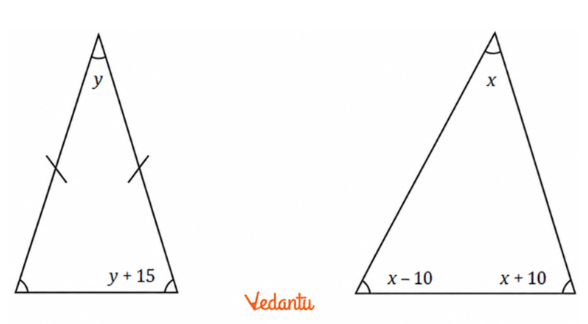
Solution
(i) In ∆ABC,
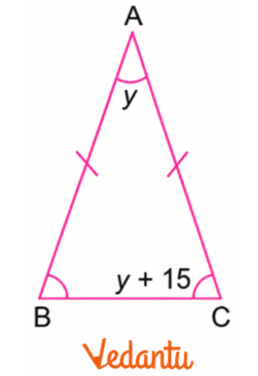
AB = AC [Given]
∠B = ∠C [Angles opposite to equal sides of a triangle are equal]
Therefore, ∠B = y + 15
Using the angle sum property of a triangle,
∠A + ∠B + ∠C = 180°
⇒ y + y + 15 + y + 15 = 180°
⇒ 3y + 30 = 180°
⇒ 3y = 180 – 30
⇒ 3y = 150
⇒ y = 50
Hence, ∠A = 50°, ∠B = 50° + 15° = 65°, and ∠C = 50° + 15° = 65°.
(ii) In ∆ABC,
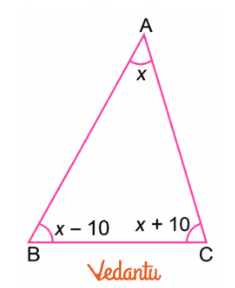
The sum of the three interior angles is 180°.
∠A + ∠B + ∠C = 180°
⇒ x + x – 10 + x + 10 = 180°
⇒ 3x = 180°
⇒ x = 60°
Therefore, ∠A = 60°, ∠B = 60° – 10° = 50°, and ∠C = 60° + 10° = 70°.
13. Write 4 equations whose solution is u = 6.
Solution
(i) u = 6
Multiplying both sides by 2/3,
⇒ (2/3)u = 2/3 × 6
⇒ (2/3)u = 4
(ii) u = 6
Adding 7 to both sides,
u + 7 = 6 + 7
⇒ u + 7 = 13
(iii) u = 6
Multiplying both sides by 2,
2u = 12
Adding 3 to both sides,
⇒ 2u + 3 = 12 + 3
⇒ 2u + 3 = 15
(iv) u = 6
Multiplying both sides by 3,
3u = 18
Subtracting 5 from both sides,
3u – 5 = 18 – 5
⇒ 3u – 5 = 13
14. The Bakhshali Manuscript (300 CE) mentions the following problem. The amount given to the first person is not known. The second person is given twice as much as the first. The third person is given thrice as much as the second, and the fourth person four times as much as the third. The total amount distributed is 132. What amount is given to the first person?
Solution
Let x be the amount given to the first person.
Amount given to the second person = 2x
Amount given to third person = 3(2x) = 6x
Amount given to fourth person= 4(6x) = 24x
Total amount = 132
⇒ x + 2x + 6x + 24x = 132
⇒ 33x = 132
⇒ x = 132/4
⇒ x = 4
The amount given to the first person is 4.
15. The height of a giraffe is two and a half metres more than half its height. How tall is the giraffe?
Solution
Let the height of a giraffe be x m.
According to the question
x m = 2½ m + (x/2) m
⇒ x = 5/2 + x/2
⇒ x/1 – x/2 = 5/2
⇒ (2x – x)/2 = 5/2
⇒ x/2 = 5/2
⇒ x = 5/2 × 2
⇒ x = 5
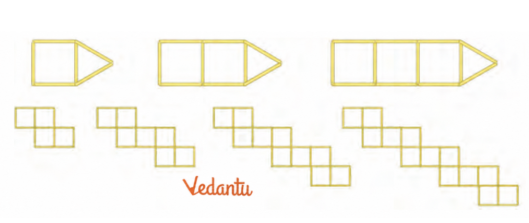
16. Two separate figures are given below. Each figure shows the first few positions in a sequence of stick arrangements. Identify the pattern and answer the following questions for each figure:
(a) How many squares are in position number 11 of the sequence?
(b) How many sticks are needed to arrange position number 11 of the sequence?
(c) Can an arrangement in this sequence be made using exactly 85 sticks? If yes, which position number will it correspond to?
(d) Can an arrangement in this sequence be made using exactly 150 sticks? If yes, which position number will it correspond to?
Solution
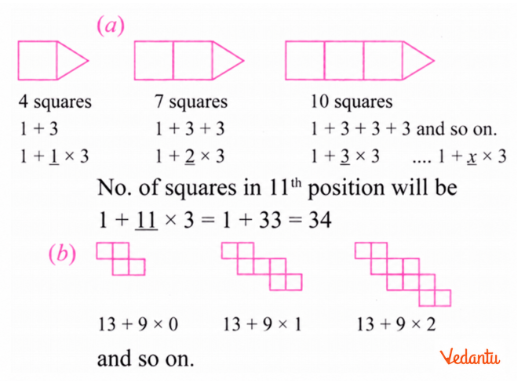
Hence, the number of sticks required for the 11th position is:
13 + 9 × 10 = 103
(c) Suppose the nth arrangement requires 85 sticks.
13 + (n – 1) × 9 = 85
⇒ 13 + 9n – 9 = 85
⇒ 4 + 9n = 85
⇒ 9n = 85 – 4
⇒ 9n = 81
⇒ n = 9
Yes, an arrangement using 85 sticks is possible at the 9th position.
(d) Suppose the nth arrangement contains 150 sticks.
13 + (n – 1) × 9 = 150
⇒ 13 + 9n – 9 = 150
⇒ 4 + 9n = 150
⇒ 9n = 150 – 4
⇒ 9n = 146
⇒ n = 146/9
⇒ n = 16 2/9
Since this is not a whole number, you cannot arrange exactly 150 sticks.
17. A number increased by 36 is equal to ten times itself. What is the number?
Solution
Let the number be x.
According to the question
x + 36 = 10 × x
⇒ x + 36 = 10x
⇒ 36 = 10x – x
⇒ 36 = 9x
⇒ 36 ÷ 9 = x
⇒ 4 = x
18. Solve these equations:
(a) 5(r + 2) = 10
(b) -3(u + 2) = 2(u – 1)
(c) 2(7 – 2n) = -6
(d) 2(x – 4) = -16
(e) 6(x – 1) = 2(x – 1) – 4
(f) 3 – 7s = 7 – 3s
(g) 2x + 1 = 6 – (2x – 3)
(h) 10 – 5x = 3(x – 4) – 2(x – 7)
Solution
(a) 5(r + 2) = 10
⇒ 5 × (r + 2) = 10
⇒ r + 2 = 10 ÷ 5
⇒ r + 2 = 2
⇒ r = 2 – 2
⇒ r = 0
(b) -3(u + 2) = 2(u – 1)
Expanding the brackets,
⇒ -3u – 6 = 2u – 2
⇒ -3u – 2u = -2 + 6
⇒ -5u = 4
⇒ u = -4/5
(c) 2(7 – 2n) = -6
⇒ 2 × (7 – 2n) = -6
⇒ 7 – 2n = -6 ÷ 2
⇒ 7 – 2n = -3
⇒ -2n = -3 – 7
⇒ -2n = -10
⇒ n = 5
(d) 2(x – 4) = -16
Dividing both sides by 2,
⇒ x – 4 = -8
⇒ x = -8 + 4
⇒ x = -4
(e) 6(x – 1) = 2(x – 1) – 4
Applying the distributive property,
⇒ 6x – 6 = 2x – 2 – 4
⇒ 6x – 6 = 2x – 6
⇒ 6x – 2x = -6 + 6
⇒ 4x = 0
⇒ x = 0
(f) 3 – 7s = 7 – 3s
Rearranging the terms,
⇒ 3 – 7 = -3s + 7s
⇒ -4 = 4s
⇒ s = -1
(g) 2x + 1 = 6 – (2x – 3)
Removing the brackets,
⇒ 2x + 1 = 6 – 2x + 3
⇒ 2x + 2x = 6 + 3 – 1
⇒ 4x = 8
⇒ x = 2
(h) 10 – 5x = 3(x – 4) – 2(x – 7)
Expanding the brackets,
⇒ 10 – 5x = 3x – 12 – 2x + 14
⇒ 10 – 5x = 3x – 2x – 12 + 14
⇒ 10 – 5x = x + 2
⇒ 10 – 2 = x + 5x
⇒ 8 = 6x
⇒ x = 4/3
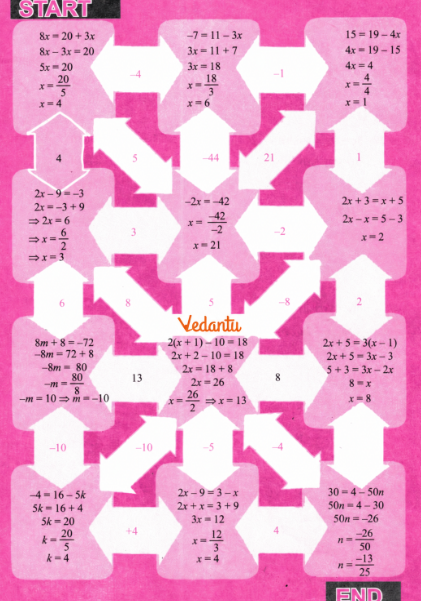
19. Solve the equations to find a path from Start to the End. Show your work in the given boxes provided and colour your path as you proceed.
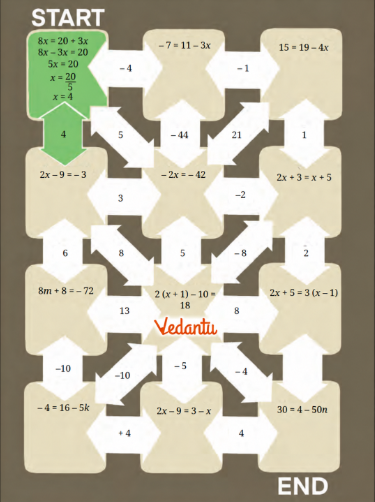
Solution
20. There are some children and donkeys on a beach. Together they have 28 heads and 80 feet. How many donkeys are there? How many children are there?
Solution
Let x be the number of children.
Let the number of donkeys be y.
x + y = 28
y = 28 – x ……(i)
Children have 2 feet, but donkeys have 4 feet.
According to the question
2x + 4y = 80
⇒ 2x + 4(28 – x) = 80 [From (i)]
⇒ 2x + 112 – 4x = 80
⇒ -2x + 112 = 80
⇒ -2x = 80 – 112
⇒ -2x = -32
⇒ x = 16
There are 16 children, and (28 – 16) = 12 donkeys.
Key Benefits of Vedantu’s NCERT Solutions for Class 7 Maths Chapter 7
Vedantu’s NCERT Solutions for Class 7 Maths Chapter 7 explain equations and unknown quantities through clear, student-friendly steps.
The solutions help students understand how to form an equation and why you must apply the same operation to both sides to maintain equality.
Students learn to move systematically from the given information to the required unknown value instead of guessing.
The solutions also show students how to check an answer by substituting the obtained value back into the original equation.
The NCERT Class 7 Maths Chapter 7 Solutions PDF download can support homework, concept revision, and practice of textbook questions at a convenient pace.
Regular practice with the chapter solutions can help students build a stronger foundation in algebra and prepare them for more advanced equations in higher classes.
Important Study Material Links for Chapter 7: Finding the Unknown
NCERT Solutions for Class 7 Maths Ganita Prakash I and II (New Syllabus)
Important Related Links for NCERT Class 7 Maths
FAQs on NCERT Solutions for Class 7 Maths Chapter 7 Finding the Unknown | 2026-27
1. What do students learn in Class 7 Maths Chapter 7 Finding the Unknown?
Chapter 7 (Ganita Prakash II) introduces students to unknown quantities and equations. They learn to represent an unknown value, form mathematical relationships, solve equations step by step, and check whether the solution satisfies the original equation.
2. How do NCERT Solutions for Class 7 Maths Chapter 7 help students understand equations?
The NCERT Solutions for Class 7 Maths Chapter 7 explain how to move from the given information to the unknown value using logical steps. Students can see which operation is performed, why it is used and how equality is maintained while solving the equation.
3. What is the best way to solve questions from Chapter 7 Finding the Unknown?
Students should first identify the unknown quantity, translate the given information into an equation and then simplify it step by step. After finding the unknown, they should substitute the value back into the original equation to check whether both sides are equal.
4. How are CBSE NCERT Solutions for Class 7 Maths Chapter 7 (Ganita Prakash II) useful for word problems?
CBSE NCERT Solutions for Class 7 Maths Chapter 7 help students convert word-problem statements into mathematical equations. This makes it easier to identify the unknown quantity, choose the correct operations and solve the problem systematically.
5. Can students use the NCERT Solutions for Class 7 Maths Chapter 7 PDF for exam revision?
Yes. The NCERT Solutions for Class 7 Maths Chapter 7 PDF helps students revise equation-solving methods, practise textbook questions, and review difficult problems before school tests. It is particularly useful for checking the correct steps while solving for unknown values.
6. What should students focus on while preparing Chapter 7 Finding the Unknown for exams?
Students should focus on forming equations correctly, maintaining equality, applying inverse operations carefully and checking their final answer. Students can use the NCERT Solutions for Class 7 Chapter 7 Maths after attempting the questions independently to compare steps, correct mistakes, and strengthen basic algebra concepts.