Class 7 Maths Chapter 4: Another Peek Beyond the Point Solutions
4.1 A Quick Recap of Decimals, 4.2 Decimal Multiplication
Figure It Out (Pages 73-74)
Question 1.
Recall that a tenth is 0.1, a hundredth is 0.01, and so on. Find the following products in tenths, hundredths, and so on:
(a) 6 × 4 tenths = 24 tenths
(b) 7 × 0.3
(c) 9 × 5 hundredths
Answer:
(a) 6 × 4 tenths = 24 tenths
(b) 0.3 = 3 tenths
Therefore,
7 × 0.3 = 7 × 3 tenths
= 21 tenths
(c) 9 × 5 hundredths
= 45 hundredths
Question 2.
Find the products:
(a) 27.34 × 6
(b) 4.23 × 3.7
(c) 0.432 × 0.23
Answer:
$\begin{gathered}(a)\ \text{Here, }27.34\times6=\dfrac{2734}{100}\times6=\dfrac{16404}{100}\\[6pt]=\underset{\text{(2 decimals)}}{164.04}\\[12pt](b)\ \text{Here }\underset{\text{(2 decimals)}}{4.23}\times\underset{\text{(1 decimal)}}{3.7}=\dfrac{423\times37}{100\times10}\\[6pt]=\dfrac{15651}{1000}=\underset{\text{(3 decimals)}}{15.651}\\[12pt](c)\ \text{We have }\underset{\text{(3 decimals)}}{0.432}\times\underset{\text{(2 decimals)}}{0.23}=\dfrac{9936}{1000\times100}\\[6pt]=\underset{\text{(5 decimals)}}{0.09936}\end{gathered}$
Question 3.
Thejus needs 1.65 m of cloth for a shirt. How many metres of cloth are needed for 3 shirts?
Answer:
Cloth needed for 1 shirt = 1.65 m
Cloth needed for 3 shirts
= 1.65 × 3
= (165/100)× 3
= 495 / 100
= 4.95 m
Therefore, 4.95 m of cloth is needed for 3 shirts.
Question 4.
Meenu bought 4 notebooks and 3 erasers. The cost of each book was ₹ 15.50, and each eraser was ₹ 2.75. How much did she spend in all?
Answer:
Here, the cost of 1 notebook = ₹ 15.50
Cost of 4 notebooks
= 4 × ₹15.50
= (4/1550)× 100
= 6200/100
= ₹62
Cost of 3 erasers
= 3 × ₹2.75
= (3 × 275)/100
= 825/100
= ₹8.25
Total amount spent
= ₹62 + ₹8.25
= ₹70.25
Therefore, Meenu spent ₹70.25 in all.
Question 5.
The thickness of a rupee coin is 1.45 mm. What is the total height of the cylinder formed by stacking 36 rupee coins one on top of the other? Write the answer in centimetres.
Answer:
Thickness of 1 coin = 1.45 mm
Thickness of 36 coins
= 36 × 1.45
= (36×145)/100
= 5220/100
= 52.2 mm
Since 10 mm = 1 cm,
52.2 mm = 52.2 ÷ 10
= 5.22 cm
Therefore, the cylinder's total height is 5.22 cm.
Question 6.
The price of 1 kg of oranges is ₹ 56.50. What is the price of 2.250 kg of oranges? Can we write 56.50 as 56.5 and 2.250 as 2.25 and multiply? Will we get the same product? Why?
Answer:
Price of 1 kg of oranges = ₹56.50
Price of 2.250 kg
= 56.50 × 2.250
= (5650×2250)/ 100×1000
= 12712500/100000
= ₹127.125
Yes, we can write 56.50 as 56.5 and 2.250 as 2.25.
56.5 × 2.25 = 127.125
We get the same product because trailing zeros in a decimal do not change its value.
Therefore, 56.50 = 56.5 and 2.250 = 2.25, so the product remains the same.
Question 6.
Dwarakanath buys notebooks at a wholesale price of ₹23.6 per piece and sells each notebook at ₹30/-. How much profit does he make if he sells 50 books in a week?
Answer:
Profit on one notebook
= Selling price − Cost price
= ₹30 − ₹23.6
= ₹6.4
Profit on 50 notebooks
= ₹6.4 × 50
= ₹320
Therefore, Dwarakanath makes a profit of ₹320.
Question 7.
Given that 18 × 12 = 216, find the products:
(a) 18 × 1.2
(b) 18 × 0.12
(c) 1.8 × 1.2
(d) 0.18 × 0.12
(e) 0.018 × 0.012
(f) 1.8 × 12
In which of the cases above is the product less than 1?
Answer:
Given: 18 × 12 = 216 ...(i)
(a) 18 × 1.2
= 18 × 12/10
= 216/10 [Using (i)]
= 21.6 (1 decimal place)
(b) 18 × 0.12
= 18 × 12/100
= 216/100 [Using (i)]
= 2.16 (2 decimal places)
(c) 1.8 × 1.2
= (18/10) × (12/10)
= 216/100 [Using (i)]
= 2.16 (2 decimal places)
(d) 0.18 × 0.12
= (18/100) × (12/100)
= 216/10000 [Using (i)]
= 0.0216 (4 decimal places)
(e) 0.018 × 0.012
= (18/1000) × (12/1000)
= 216/1000000 [Using (i)]
= 0.000216 (6 decimal places)
(f) 1.8 × 12
= (18/10) × 12
= 216/10 [Using (i)]
= 21.6 (1 decimal place)
When you multiply two positive numbers less than 1, their product is also less than 1.
Therefore, the product is less than 1 in (d) and (e).
Question 8.
In which of the following multiplications is the product less than 1? Can you find the answer without actually doing the multiplications?
(a) 7 × 0.6
(b) 0.7 × 0.6
(c) 0.7 × 6
(d) 0.07 × 0.06
Answer:
We can identify the products less than 1 by looking at the size of the numbers.
(a) 7 × 0.6 → Greater than 1
(b) 0.7 × 0.6 → Less than 1
(c) 0.7 × 6 → Greater than 1
(d) 0.07 × 0.06 → Less than 1
Therefore, the product is less than 1 in (b) and (d).
Question 9.
Multiply the following numbers by 10, 100, and 1000 to complete the table.
Answer:
4.3 Decimal Division
Figure It Out (Page 83)
Question 1.
Find the quotient by converting the denominator to 1, 10, 100, or 1000, and verify the solution using long division (division by place value).
(a) 18/5
(b) 415/4
(c) 1217/2
(d) 4827/8
Answer:
The fraction bars are missing in the extracted question. Based on the accompanying solution, these represent 18/5, 415/4, 1217/2 and 4827/8.
(a) 18 ÷ 5
To convert the denominator 5 into 10, multiply both the numerator and denominator by 2.
18/5 = (18×2)/ 5×2= 36/10
= 3.6
Verification: 18 ÷ 5
Dividing 1 ten and 8 ones into 5 equal parts.1 < 5
It means we need to regroup 1 ten as 10 ones,
i.e., 10 + 8 = 18 ones
18 ones ÷ 5
3 ones remain.
To divide 3 ones into 5 equal parts.
Regroup the 3 ones as 30 Tenths. (Place a decimal while regrouping ones into tenths).
30 Tenths ÷ 5 = 6
Then, 18 ÷ 5 = 3.6
$\begin{array}{r@{\;}l@{\;}l}&\overset{\text{}}{\phantom{03.6}}&\\[-4pt]5\ \big)&18&\big(03.6\\[-2pt]&\underline{-15}&\\&30&\\&\underline{-30}&\\&0&\end{array}$
Therefore, 18 ÷ 5 = 3.6.
(b) 415 ÷ 4
415/4 = (415×25)/4×25= 10375/100
= 103.75
$\begin{array}{r@{}l}4&\overline{)\,415}\,(\,103.75\\&\phantom{)\,}\underline{-4\phantom{00}}\\&\phantom{)\,4}15\\&\phantom{)\,}\underline{-12}\\&\phantom{)\,41}30\\&\phantom{)\,4}\underline{-28}\\&\phantom{)\,41}20\\&\phantom{)\,41}\underline{20}\\&\phantom{)\,41}\ \times\end{array}$
Therefore, 415 ÷ 4 = 103.75.
(c) 1217 ÷ 2
1217/2 = 1217×5/2×5= 6085/10
= 608.5
$\begin{array}{r@{}l}&\quad\ \ \\2&\overline{)\,1217}\,(\,608.5\\&\phantom{)\,}\underline{-12\phantom{00}}\\&\phantom{)\,}\ 017\\&\phantom{)\,0}\underline{-16}\\&\phantom{)\,01}10\\&\phantom{)\,0}\underline{-10}\\&\phantom{)\,011}0\end{array}$
Therefore, 1217 ÷ 2 = 608.5.
(d) 4827 ÷ 8
4827/8 = 4827×125/8×125= 603375/1000
= 603.375
$\begin{array}{r@{}l}8&\overline{)\,4827}\,(\,0603.375\\&\phantom{)\,}\underline{-48\phantom{00}}\\&\phantom{)\,}\ 027\\&\phantom{)\,0}\underline{-24}\\&\phantom{)\,02}30\\&\phantom{)\,02}\underline{-24}\\&\phantom{)\,02}60\\&\phantom{)\,02}\underline{-56}\\&\phantom{)\,02}40\\&\phantom{)\,02}\underline{-40}\\&\phantom{)\,02}\ \times\end{array}$
Therefore, 4827 ÷ 8 = 603.375.
Question 2.
Choose the correct answer:
(a) 1526/4 = _____
(i) 38.15
(ii) 380.15
(iii) 381.5
(iv) 381.05
(b) 3567/8 = _____
(i) 4458.75
(ii) 44.5875
(iii) 445.875
(iv) 4458.75
Answer:
The fraction bars are missing again in the extracted question. From the given options and reference answer:
(a) 1526/4
$\begin{array}{r@{}l}4&\overline{)\,1526}\,(\,381.5\\&\phantom{)\,}\underline{-12\phantom{00}}\\&\phantom{)\,}\ 32\\&\phantom{)\,}\underline{-32}\\&\phantom{)\,0}\ 06\\&\phantom{)\,0}\underline{-4}\\&\phantom{)\,0}\ 20\\&\phantom{)\,0}\underline{-20}\\&\phantom{)\,00}\ 0\end{array}$
Hence, option (iii) is correct.
(b) Given 3567/8
By using the Long Division Method:
$\begin{array}{r@{}l}8&\overline{)\,3567}\,(\,445.875\\&\phantom{)\,}\underline{-32\phantom{00}}\\&\phantom{)\,}\ 36\\&\phantom{)\,}\underline{-32}\\&\phantom{)\,0}\ 47\\&\phantom{)\,0}\underline{-40}\\&\phantom{)\,00}\ 70\\&\phantom{)\,00}\underline{-64}\\&\phantom{)\,00}\ 60\\&\phantom{)\,00}\underline{-56}\\&\phantom{)\,00}\ 40\\&\phantom{)\,00}\underline{-40}\\&\phantom{)\,000}\ 0\end{array}$
Hence, option (iii) is correct.
Question 3.
What is the quotient?
(a) 132 ÷ 4 = _____
(b) 13.2 ÷ 4 = _____
(c) 1.32 ÷ 4 = _____
(d) 0.132 ÷ 4 = _____
Answer:
(a) 132 ÷ 4 = 33
$\begin{array}{r@{}l}&\quad\ \ \\4&\overline{)\,132}\,(\,33\\&\phantom{)\,}\underline{-12\phantom{0}}\\&\phantom{)\,}\ 12\\&\phantom{)\,}\underline{-12}\\&\phantom{)\,0}\ 0\end{array}$
(b) 13.2 ÷ 4 = 3.3
$\begin{array}{r@{}l}&\quad\ \ \\40&\overline{)\,132}\,(\,3.3\\&\phantom{)\,}\underline{-120\phantom{0}}\\&\phantom{)\,}\ 120\\&\phantom{)\,}\underline{-120}\\&\phantom{)\,00}\ 0\end{array}$
(c) 1.32 ÷ 4 = 0.33
$\begin{array}{r@{}l}&\quad\ \ \\400&\overline{)\,1320}\,(\,0.33\\&\phantom{)\,}\underline{-1200\phantom{0}}\\&\phantom{)\,}\ 1200\\&\phantom{)\,}\underline{-1200}\\&\phantom{)\,000}\ 0\end{array}$
(d) 0.132 ÷ 4 = 0.033
$\begin{array}{r@{}l}&\quad\ \ \\4000&\overline{)\,132000}\,(\,0.033\\&\phantom{)\,}\underline{-12000\phantom{0}}\\&\phantom{)\,}\ 12000\\&\phantom{)\,}\underline{-12000}\\&\phantom{)\,0000}\ 0\end{array}$
Question 4.
What is the quotient?
(a) 126 ÷ 8 = _____
(b) 12.6 ÷ 8 = _____
(c) 1.26 ÷ 8 = _____
(d) 0.126 ÷ 8 = _____
(e) 0.0126 ÷ 8 = _____
Answer:
(a) 126 ÷ 8 = 15.75
$\begin{array}{r@{}l}&\quad\ \ \\8&\overline{)\,126}\,(\,15.75\\&\phantom{)\,}\underline{-8\phantom{0}}\\&\phantom{)\,}\ 46\\&\phantom{)\,}\underline{-40}\\&\phantom{)\,0}\ 60\\&\phantom{)\,0}\underline{-56}\\&\phantom{)\,0}\ 40\\&\phantom{)\,0}\underline{-40}\\&\phantom{)\,00}\ 0\end{array}$
(b) 12.6 ÷ 8 = 1.575
$\begin{array}{r@{}l}&\quad\ \ \\8&\overline{)\,12.6}\,(\,1.575\\&\phantom{)\,}\underline{-8\phantom{0}}\\&\phantom{)\,}\ 46\\&\phantom{)\,}\underline{-40}\\&\phantom{)\,0}\ 60\\&\phantom{)\,0}\underline{-56}\\&\phantom{)\,0}\ 40\\&\phantom{)\,0}\underline{-40}\\&\phantom{)\,00}\ 0\end{array}$
(c) 1.26 ÷ 8 = 0.1575
$\begin{array}{r@{}l}&\quad\ \ \\8&\overline{)\,1.26}\,(\,0.1575\\&\phantom{)\,}\underline{-0\phantom{00}}\\&\phantom{)\,}\ 12\\&\phantom{)\,}\underline{-8}\\&\phantom{)\,0}\ 46\\&\phantom{)\,0}\underline{-40}\\&\phantom{)\,00}\ 60\\&\phantom{)\,00}\underline{-56}\\&\phantom{)\,00}\ 40\\&\phantom{)\,00}\underline{40}\\&\phantom{)\,000}\ 0\end{array}$
(d) 0.126 ÷ 8 = 0.01575
$\begin{array}{r@{}l}&\quad\ \ \\8&\overline{)\,0.126}\,(\,0.01575\\&\phantom{)\,}\underline{-0\phantom{00}}\\&\phantom{)\,}\ 12\\&\phantom{)\,}\underline{-8}\\&\phantom{)\,0}\ 46\\&\phantom{)\,0}\underline{-40}\\&\phantom{)\,00}\ 60\\&\phantom{)\,00}\underline{-56}\\&\phantom{)\,00}\ 40\\&\phantom{)\,00}\underline{-40}\\&\phantom{)\,000}\ 0\end{array}$
(e) 0.0126 ÷ 8 = 0.001575
$\begin{array}{r@{}l}8&\overline{)\,0.0126}\,(\,0.001575\\&\phantom{)\,}\underline{\ 0\phantom{000}}\\&\phantom{)\,}\ 00\\&\phantom{)\,}\underline{\ 00}\\&\phantom{)\,00}\ 12\\&\phantom{)\,00}\underline{-8}\\&\phantom{)\,000}\ 46\\&\phantom{)\,000}\underline{-40}\\&\phantom{)\,0000}\ 60\\&\phantom{)\,0000}\underline{-56}\\&\phantom{)\,0000}\ 40\\&\phantom{)\,0000}\underline{-40}\\&\phantom{)\,00000}\ 0\end{array}$
Figure It Out (Pages 86-87)
Question 1.
Express the following fractions in decimal form:
(a) 2/5
(b) 13/4
(c) 4/50
(d) 5/8
Answer:
The fraction bars are missing in the extracted text. The accompanying solutions show the fractions as 2/5, 13/4, 4/50 and 5/8.
(a) 2/5
Multiply both the Nr and Dr by 2.
2/5×2/2=4/10
Now, put the decimal: 4/10 = 0.4
Hence, 2/5 in decimal form is 0.4.
(b) 13/4
Multiply both the Nr and Dr by 25.
13/4×25/25=325/100
Now, put a decimal
325/100 = 3.25
Hence, 13/4 in decimal form is 3.25.
(c) 4/50
Multiply both the Nr and Dr by 2.
4/50×2/2=8/100
Now, put the decimal
8/100 = 0.08
Hence, 4/50 in decimal form is 0.08.
(d) 5/8
Multiply both the Nr and Dr by 125.
5/8×125/125=625/1000
Now, put the decimal
6251000 = 0.625
Hence, 58 in decimal form is 0.625.
Question 2.
Find the quotients:
(a) 24.86 ÷ 1.2
(b) 5.728 ÷ 1.52
Answer:
(a) 24.86 ÷ 1.2
=24.86/1.2
=2486×10/12×100
=2486/120
$\begin{array}{r@{}l}120&\overline{)\,2486}\,(\,20.7166\\&\phantom{)\,}\underline{-240\phantom{00}}\\&\phantom{)\,}\ 860\\&\phantom{)\,}\underline{-840}\\&\phantom{)\,0}\ 200\\&\phantom{)\,0}\underline{-120}\\&\phantom{)\,0}\ 800\\&\phantom{)\,0}\underline{-720}\\&\phantom{)\,00}\ 80\end{array}$
∴ Quotient = 20.7166…
(b) 5.728 ÷ 1.52
Question 3.
Evaluate the following using the information 156 × 12 = 1872.
(a) 15.6 × 1.2 = _____
(b) 187.2 ÷ 1.2 = _____
(c) 18.72 ÷ 15.6 = _____
(d) 0.156 × 0.12 = _____
Answer:
Given:
156 × 12 = 1872
⇒ 156 = 1872/12 …….(ii)
⇒ 12 = 1872/156 …….(iii)
(a) Now converting division into a fraction
15.6 × 1.2 = 156×12/10×10=1872/100 = 18.72 [using (i)]
(b) Converting division into a fraction: 187.2 ÷ 1.2
187.2 ÷ 1.2 = 187.2/1.2=1872/12 = 156 [using (ii)]
(c) Converting division into a fraction: 18.72 ÷ 15.6, we get
18.72 ÷ 15.6 = 18.72/15.6=1872×10/156×100 = 12/10 = 1.2 [Using (iii)]
(d) Here 0.156 × 0.12 = 156×12/1000×100 [Using (i)]
= 1872/1000×100
= 0.01872
Question 4.
Evaluate the following:
(a) 25 ÷ _____ = 0.025
(b) 25 ÷ _____ = 250
(c) 25 ÷ _____ = 2.5
(d) 25 ÷ 10 = 25 × _____
(e) 25 ÷ 0.10 = 25 × _____
(f) 25 ÷ 0.01 = 25 × _____
Answer:
$\begin{array}{l}(a)\ \text{Let } 25÷ x=0.025\\\qquad\dfrac{25}{0.025}=x\ \Rightarrow\ x=\dfrac{25\times1000}{25}=1000\\(b)\ 25÷ x=250\\\qquad\Rightarrow x=\dfrac{25}{250}=\dfrac{1}{10}=0.1\\(c)\ 25÷ x=2.5\\\qquad\Rightarrow x=\dfrac{25}{2.5}=\dfrac{25\times10}{25}=1\times10=10\\(d)\ \text{Let } 25÷10=25\times x\\\qquad\dfrac{25}{10}=25\times x\ \Rightarrow\ x=\dfrac{25}{10\times25}=\dfrac{1}{10}=0.1\\(e)\ \text{Let } 25÷0.10=25\times x\\\qquad\Rightarrow\dfrac{25}{0.10\times25}=x\ \Rightarrow\ x=\dfrac{1}{0.10}=\dfrac{100}{10}=10\\(f)\ \text{Let } 25÷0.01=25\times x\\\qquad x=\dfrac{25}{0.01\times25}=x\ \Rightarrow\ x=\dfrac{1}{0.01}=\dfrac{100}{1}=100.\end{array}$
Question 5.
Find the quotients:
(a) 2.46 ÷ 1.5 = _____
(b) 2.46 ÷ 0.15 = _____
(c) 2.46 ÷ 0.015 = _____
Is the quotient obtained in 24.6 ÷ 1.5 the same as the quotient obtained in 2.46 ÷ 0.15?
Answer:
(a) Converting 2.46 ÷ 1.5 into a fraction
$\begin{array}{l}\dfrac{2.46}{1.5}=\dfrac{246\times10}{15\times100}=\dfrac{246}{150}\\150\overline{)\,246}\,(\,1.64\\\phantom{150)\,}\underline{-150\phantom{0}}\\\phantom{150)\,}\ 960\\\phantom{150)\,}\underline{-900}\\\phantom{150)\,0}\ 600\\\phantom{150)\,0}\underline{-600}\\\phantom{150)\,00}\ 0\end{array}$
Quotient = 1.64
(b) Converting 2.46 ÷ 0.15 into a fraction, we get
2.46/0.15=246×100/15×100=246/15
$\begin{array}{r@{}l}15&\overline{)\,246}\,(\,16.4\\&\phantom{)\,}\underline{-15\phantom{0}}\\&\phantom{)\,}\ 96\\&\phantom{)\,}\underline{-90}\\&\phantom{)\,0}\ 60\\&\phantom{)\,0}\underline{-60}\\&\phantom{)\,00}\ 0\end{array}$
Quotient = 16.4
(c)Converting 2.46 ÷ 0.015 into a fraction, we get 2.46/0.015=246×1000/15×100=2460/15
$\begin{array}{r@{}l}15&\overline{)\,246}\,(\,16.4\\&\phantom{)\,}\underline{-15\phantom{0}}\\&\phantom{)\,}\ 96\\&\phantom{)\,}\underline{-90}\\&\phantom{)\,0}\ 60\\&\phantom{)\,0}\underline{-60}\\&\phantom{)\,00}\ 0\end{array}$
Also,
24.6 ÷ 1.5 = 16.4
and
2.46 ÷ 0.15 = 16.4
Therefore, yes, both quotients are the same.
Question 6.
A 4 m long wooden block has to be cut into 5pieces of equal length. What is the length of each piece?
Answer:
Total length of the wooden block = 4 m
Number of equal pieces = 5
Length of each piece
= 4 ÷ 5
= 0.8 m
$\begin{array}{r@{}l}\text{Now }5&\overline{)\,4}\,(\,0.8\\&\phantom{)\,}\underline{-0\phantom{0}}\\&\phantom{)\,}\ 40\\&\phantom{)\,}\underline{-40}\\&\phantom{)\,0}\ 0\end{array}$
Therefore, each piece is 0.8 m long.
Question 7.
If the perimeter of a regular polygon with 12 sides is 208.8 cm, what is the length of its side?
Answer:
Perimeter = 208.8 cm
Number of sides = 12
Length of each side
= 208.8 ÷ 12
= 17.4 cm
$\begin{array}{r@{}l}12&\overline{)\,208.8}\,(\,17.4\\&\phantom{)\,}\underline{-12\phantom{0.0}}\\&\phantom{)\,}\ 88\\&\phantom{)\,}\underline{-84}\\&\phantom{)\,0}\ 48\\&\phantom{)\,0}\underline{-48}\\&\phantom{)\,00}\ 0\end{array}$
Therefore, each side of the polygon is 17.4 cm long.
Question 8.
3 litres of watermelon juice is shared equally among 8 friends. How much watermelon juice will each get? Express the quantity of juice in millilitres.
Answer:
Total juice = 3 litres = 3000 ml
Number of friends = 8
Juice received by each friend = ⅜ litres
= ⅜ ×1000ml
= 3000 ÷ 8
= 375 ml
$\begin{array}{r@{}l}8&\overline{)\,3000}\,(\,375\\&\phantom{)\,}\underline{-24\phantom{00}}\\&\phantom{)\,}\ -60\\&\phantom{)\,}\underline{\ \ 56}\\&\phantom{)\,0}\ 40\\&\phantom{)\,0}\underline{-40}\\&\phantom{)\,00}\ 0\end{array}$
Therefore, each friend will get 375 ml of watermelon juice.
Question 9.
A car covers 234.45 km using 12.6 litres of petrol. What distance is travelled per litre?
Answer:
Total distance = 234.45 km
Petrol used = 12.6 litres
$\begin{gathered}\text{Distance per litre}=\dfrac{\text{Total distance}}{\text{Total petrol}}\\[2pt]=\dfrac{234.45}{12.6}\\[1pt]=\dfrac{23445\times10}{126\times100}\\[1pt]=\dfrac{23445}{1260}=18.607\ \text{km}\\[]\text{Now}\\[4pt]1260\big)\overline{23445}\big(18.607\\[-2pt]\begin{array}{r}\underline{-1260}\\10845\\\underline{-10080}\\7650\\\underline{-7560}\\9000\\\underline{-8820}\\180\end{array}\end{gathered}$
Therefore, the car travels approximately 18.607 km per litre.
Question 10.
13.5 kg of flour (aata) was distributed equally among 15 students. How much flour did each student receive?
Answer:
Total flour = 13.5 kg
Number of students = 15
Flour received by each student
= 13.5 ÷ 15
= 0.9 kg
Now
$\begin{array}{r@{}l}15&\overline{)\,13.5}\,(\,.9\\&\phantom{)\,}\underline{-13.5}\\&\phantom{)\,00}\ 0\end{array}$
Therefore, each student received 0.9 kg of flour.
4.4 Look Before You Leap!
Figure It Out (Pages 93-95)
Question 1.
A 210-gram packet of peanut chikki costs ₹70.5, while a 110-gram packet of potato chips costs ₹33.25. Which is cheaper?
Answer:
Cost of peanut chikki per gram
= ₹70.5 ÷ 210
≈ ₹0.3357
Cost of potato chips per gram
= ₹33.25 ÷ 110
≈ ₹0.3023
Since ₹0.3023 < ₹0.3357, potato chips are cheaper per gram.
Question 2.
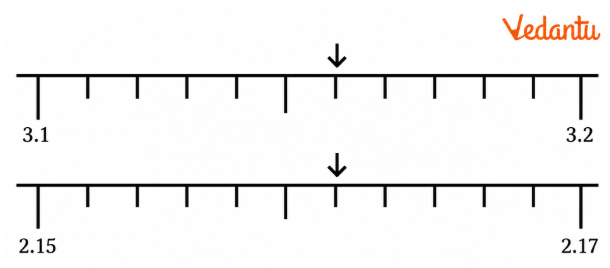
Write the decimal number at the arrow mark:
Answer:
(i) The interval from 3.1 to 3.2 is divided into 10 equal parts.
Value of each division
= 0.1 ÷ 10
= 0.01
The arrow is at the sixth mark after 3.1.
3.1 + (6 × 0.01)
= 3.1 + 0.06
= 3.16
(ii) The difference between 2.15 and 2.17 is 0.02.
Value of each division
= 0.02 ÷ 10
= 0.002
The arrow is at the sixth mark after 2.15.
2.15 + (6 × 0.002)
= 2.15 + 0.012
= 2.162
Question 3.
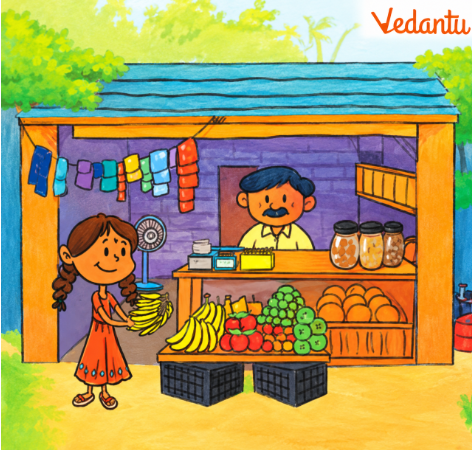
Shyamala bought 3 kg of bananas at ₹ 30/- per kg. She counted 35 bananas in all. She sells each banana for ₹ 5/-. How much profit does she make selling all the bananas?
Answer:
Cost of 3 kg of bananas
= 3 × ₹30
= ₹90
Amount received by selling 35 bananas
= 35 × ₹5
= ₹175
Profit
= ₹175 − ₹90
= ₹85
Therefore, Shyamala makes a profit of ₹85.
Question 4.
A teacher placed textbooks that are 2.5 cm thick on a bookshelf. The teacher wanted to place 80 textbooks on the shelf. The bookshelf is 160 cm long. How many books could be placed on the shelf? Was there any space left? If yes, how much?
Answer:
Thickness of one textbook = 2.5 cm
Length of bookshelf = 160 cm
Number of books that can be placed
= 160 ÷ 2.5
= 64
Space occupied by 64 books
= 64 × 2.5
= 160 cm
Therefore, 64 books can be placed on the shelf, leaving no space.
Question 5.
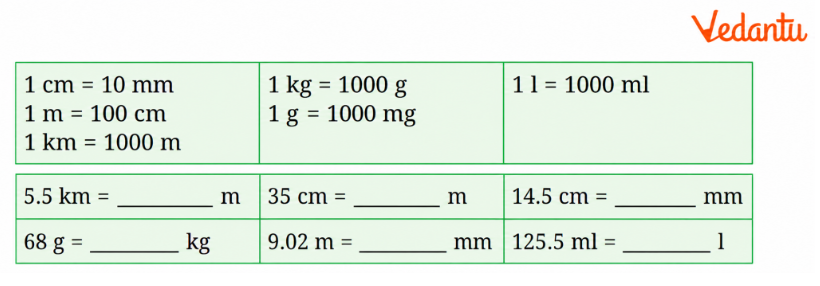
Fill in the following blanks appropriately:
Answer:
Here, (i) 1 km = 1000 m
5.5 km = 5.5 × 1000 = 5500 m
(ii) 1 m = 100 cm
35 cm = 35/100 = 0.35 m
(iii) 1 cm = 10 mm
14.5 cm = 14.5 × 10 = 145 mm
(iv) 1 kg = 1000 g
68 g = 68/1000 = 0068 kg
(v) 1 m = 1000 mm
9.02 m = 9.02 × 1000 = 9020 mm
(vi) 1 l = 1000 ml
125.5 ml = 125.5/1000 = 0.1255 l
Question 6.
Sridharacharya set the following problem in his book, Patiganita. “6(¼) is divided by 2(½), and 60(¼) is divided by 3(½). Tell the quotients separately.” Can you try solving it by converting the fractions to decimals?
Answer:
$\begin{array}{l}\text{Given }6\dfrac{1}{4}=6+\dfrac{1}{4}=6+0.25=6.25\\\text{and }\ 2\dfrac{1}{2}=2+\dfrac{1}{2}=2+0.5=2.5\\\qquad 60\dfrac{1}{4}=60+\dfrac{1}{4}=60+0.25=60.25\\\qquad 3\dfrac{1}{2}=3+0.5=3.5\\\text{Now }6\dfrac{1}{4}\text{ is divided by }2\dfrac{1}{2}.\\\Rightarrow\ \dfrac{6.25}{2.5}=\dfrac{625\times10}{25\times100}=\dfrac{625}{250}\\250\overline{)\,625}\,(\,2.5\quad\therefore\ \text{Quotient}=2.5\\\phantom{250)\,}\underline{-500\phantom{0}}\\\phantom{250)\,}\ 1250\\\phantom{250)\,}\underline{-1250}\\\phantom{250)\,0}\ 0\\\text{Also }60\dfrac{1}{4}\text{ is divided by }3\dfrac{1}{2}.\\\Rightarrow\ \dfrac{60.25}{3.5}=\dfrac{6025\times10}{35\times100}=\dfrac{6025}{350}\\\therefore\ 350\overline{)\,6025}\,(\,17.21\\\phantom{\therefore\ 350)\,}\underline{-350\phantom{0}}\\\phantom{\therefore\ 350)\,}\ 2525\\\phantom{\therefore\ 350)\,}\underline{-2450}\\\phantom{\therefore\ 350)\,0}\ 750\\\phantom{\therefore\ 350)\,0}\underline{-700}\\\phantom{\therefore\ 350)\,00}\ 500\\\phantom{\therefore\ 350)\,00}\underline{-350}\\\phantom{\therefore\ 350)\,00}\ 150\end{array}$
Quotient = 17.21
Question 7.
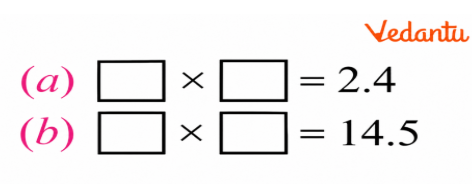
Fill the boxes in at least 2 different ways:
Answer:
One possible set is:
(a) 1.2 × 2 = 2.4
and
0.4 × 6 = 2.4
(b) 2.9 × 5 = 14.5
and
14.5 × 1 = 14.5
Question 8.
Find the following quotients, given that 756 ÷ 36 = 21:
(a) 75.6 ÷ 3.6
(b) 7.56 ÷ 0.36
(c) 756 ÷ 0.36
(d) 75.6 ÷ 360
(e) 7560 ÷ 3.6
(f) 7.56 ÷ 0.36
Answer:
$\begin{array}{l}(a)\ \text{Given }756÷36=21\hfill\ldots(i)\\\qquad\text{Here }\dfrac{75.6}{3.6}=\dfrac{756\times10}{36\times10}=\dfrac{756}{36}=21\qquad[\text{Using }(i)]\\(b)\ \text{Here }\dfrac{7.56}{0.36}=\dfrac{756\times100}{36\times100}=\dfrac{756}{36}=21\qquad[\text{Using }(i)]\\(c)\ \text{Here }\dfrac{756}{0.36}=\dfrac{756\times100}{36}=21\times100=2100\qquad[\text{Using }(i)]\\(d)\ \text{Here }\dfrac{75.6}{360}=\dfrac{756}{360\times10}=\dfrac{756}{360\times10}\\\qquad=\dfrac{21}{100}=0.21\qquad[\text{Using }(i)]\\(e)\ \text{Here }\dfrac{7560}{3.6}=\dfrac{7560}{36}\times10=\dfrac{756}{36}\times10\times10\\\qquad=21\times10\times10=2100\qquad[\text{Using }(i)]\\(f)\ \text{Here }\dfrac{7.56}{0.36}=\dfrac{756\times100}{36\times100}=\dfrac{756}{36}=21\qquad[\text{Using }(i)]\end{array}$
Question 9.
Find the missing cells if each cell represents a ÷ b:
Answer:
The table itself is image-based, so keep the original table on the page.
Using the relationship shown in the reference:
1517 ÷ 37 = 41
Therefore,
151.7 ÷ 3.7 = 41
15.17 ÷ 0.37 = 41
1.517 ÷ 37 = 0.041
Question 10.
Using the digits 2, 4, 5, 8, and 0, fill the boxes ◻◻. ◻ × ◻.◻ to get the:
(a) maximum product
(b) minimum product
(c) product greater than 150
(d) product nearest to 100
(e) product nearest to 5
Answer:
$\begin{array}{l}(a)\ \boxed{4}\,\boxed{2}\,.\,\boxed{0}\times\boxed{8}\,.\,\boxed{5}=357\\(b)\ \boxed{4}\,\boxed{5}\,.\,\boxed{8}\times\boxed{0}\,.\,\boxed{2}=9.16\\(c)\ \boxed{8}\,\boxed{5}\,.\,\boxed{4}\times\boxed{2}\,.\,\boxed{0}=170.8\\(d)\ \boxed{2}\,\boxed{0}\,.\,\boxed{5}\times\boxed{4}\,.\,\boxed{8}=98.4\\(e)\ \boxed{4}\,\boxed{5}\,.\,\boxed{8}\times\boxed{0}\,.\,\boxed{2}=9.16\end{array}$
Question 11.
Sort the following expressions in increasing order:
(a) 245.05 × 0.942368
(b) 245.05 × 7.9682
(c) 245.05 ÷ 7.9682
(d) 245.05 ÷ 0.942368
(e) 245.05
(f) 7.9682
Answer:
Let A = 245.05, B = 0.942368, C = 7.9682
We note that B < 1 and C > 1
(a) Now A × B = 245.05 × 0.942368 < 245.05
(∴ Multiplying a number by a value less than 1 results in a smaller number)
(b) A × C = 245.05 × 7.9682 > 245.05
(Multiplying a number by a value greater than 1 results in a larger number)
(c) A ÷ C = 2.4505 ÷ 7.9682 < 245.05
(Dividing a number by a value greater than 1 results in a smaller number)
(d) A ÷ B = 245.05 ÷ 0.942368 > 245.05
(Dividing a number by a value greater than 1 results in a smaller number)
(e) Now, the expression is less than 245.05
∴ 0.942368 is closer to 1 than 7.9682 is to 1.
0.942368 will result in a value closer to 245.05 than dividing by 7.9682.
∴ (c) < (a)
Again, 0.942368 is closer to 1 than 7.9682 is to 1.
∴ Dividing by 0.942368 yields a value closer to 245.05 than multiplying by 7.9682.
∴ (d) < (b)
Also, (f) 7.9682 is much smaller than 245.05, so it will be the smallest value.
(f) ∴ 7.9682 < (e) 245.05 ÷ 7.9682
Combining all, we get (f), (c), (a), (e),(d), (b).
Revise Another Peek Beyond the Point with Class 7 Maths Solutions
The NCERT Solutions for Class 7 Maths Chapter 4 help students understand decimal multiplication, division and place value through clear, step-by-step answers.
Strengthen decimal concepts: Practise multiplication, division and decimal place values.
Improve calculation accuracy: Learn to place decimal points correctly and avoid common mistakes.
Solve practical problems: Apply decimals to questions involving money, measurements and quantities.
Check your answers: Compare your working with the solved textbook questions.
Revise before exams: Use the NCERT Solutions for Class 7 Maths Chapter 4 PDF to revisit difficult questions and practise independently.
Important Study Material Links for Chapter 4: Another Peek Beyond the Point
NCERT Solutions for Class 7 Maths Ganita Prakash I and II (New Syllabus)
Important Related Links for NCERT Class 7 Maths
FAQs on NCERT Solutions for Class 7 Maths Chapter 4 - Another Peek Beyond the Point
1. What is Class 7 Maths Chapter 4 Another Peek Beyond the Point about?
Another Peek Beyond the Point builds students’ understanding of decimal numbers and how to use them in mathematical problems. Students work with decimal values and apply previously learned ideas as they solve various textbook activities and questions.
2. Which book contains Class 7 Maths Chapter 4, Another Peek Beyond the Point?
Another Peek Beyond the Point is Chapter 4 of Ganita Prakash II for Class 7 Maths. Students should note that Ganita Prakash I has a different Chapter 4 titled Expressions Using Letter-Numbers.
3. What are the main concepts covered in Class 7 Maths Chapter 4 Chapter 4: Another Peek Beyond the Point?
The chapter focuses on decimal numbers, place value, and decimal calculations. Students learn to interpret decimal quantities correctly and apply these ideas while solving different mathematical problems.
4. How should I solve the exercises in Class 7 Maths Chapter 4 Chapter 4: Another Peek Beyond the Point?
Read each question carefully, identify the given values and decide which mathematical operation or method is required. Show the calculation step by step and check the final answer before comparing it with the solution.
5. How can I avoid mistakes while solving decimal questions in Class 7 Maths?
Write decimal numbers carefully and pay attention to their place values. When performing calculations, arrange the numbers correctly and recheck the decimal point before writing the final answer.
6. Are the questions in Another Peek Beyond the Point important for Class 7 Maths exams?
The textbook questions help students practise the concepts and calculation methods introduced in the chapter. Solving them can also prepare students for similar concept-based questions in school assessments.
7. Can I download the Class 7 Maths Chapter 4 Another Peek Beyond the Point solutions in PDF format?
Yes. Students can use Vedantu's chapter solutions in PDF format for convenient practice and revision. This can help students check answers and revisit difficult textbook questions.