



How to Learn and Write the Table of 3 with Solved Examples
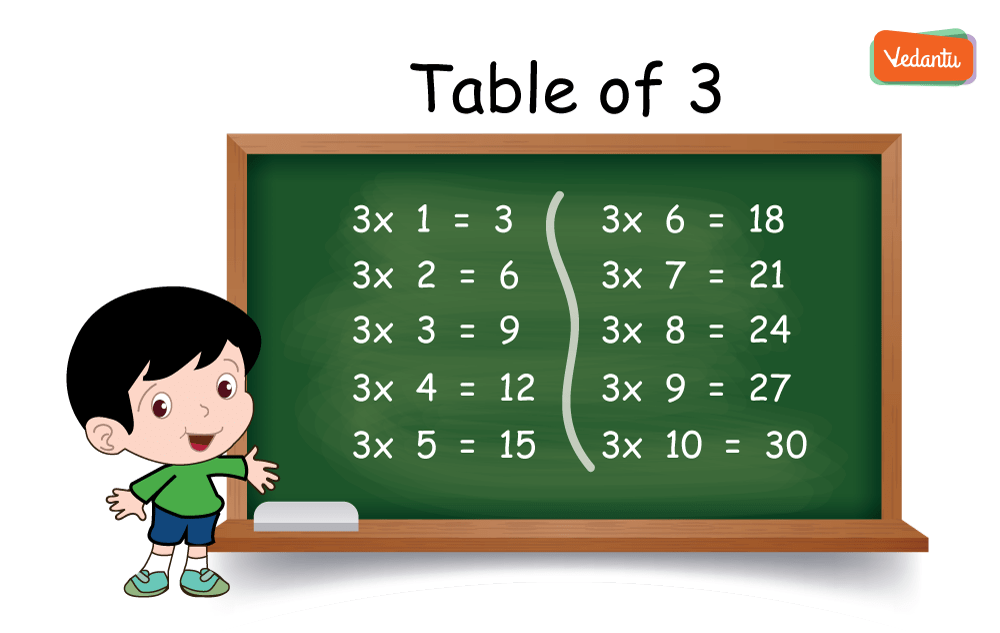
The Multiplication Table of 3 which is popularly known as Table of 3 contains a list of numbers that are the result of the multiplication of 3 with other Natural numbers (1 and above).
As 3 is a unit digit number, the table of 3 is considered as a building block for other multiplication tables.
And for a student, learning and memorising multiplication tables of 3 at an early age will help in solving problems of division, fraction, Algebraic equations, and multiplication of large numbers with speed and accuracy.
What Should Every Student Know About the Multiplication Table of 3?
The result of the sum of any number that is repeated thrice or three times is part of the multiplication table of 3.
Example:
2 times 3 is 6, and in terms of addition, it is 3+3=6.
Similarly, when we add 3 nine times, the result will be 27, i.e., 3+3+3+3+3+3+3+3+3=27.
Also, in terms of multiplication, 9 times 3 or 2 times 3 can be represented as 3 × 9 = 27 or 3 × 2 = 6, respectively.
FAQs on Table of 3 Multiplication Chart and Pattern
1. What is the table of 3?
The table of 3 is the list of multiples of 3 obtained by multiplying 3 by whole numbers. It helps in quick multiplication and division calculations.
- 3 × 1 = 3
- 3 × 2 = 6
- 3 × 3 = 9
- 3 × 4 = 12
- 3 × 5 = 15
- 3 × 6 = 18
- 3 × 7 = 21
- 3 × 8 = 24
- 3 × 9 = 27
- 3 × 10 = 30
2. How do you write the 3 times table up to 20?
The 3 times table up to 20 is written by multiplying 3 by numbers from 1 to 20. The last value is 3 × 20 = 60.
- 3 × 11 = 33
- 3 × 12 = 36
- 3 × 13 = 39
- 3 × 14 = 42
- 3 × 15 = 45
- 3 × 16 = 48
- 3 × 17 = 51
- 3 × 18 = 54
- 3 × 19 = 57
- 3 × 20 = 60
3. What are the first 10 multiples of 3?
The first 10 multiples of 3 are 3, 6, 9, 12, 15, 18, 21, 24, 27, 30. These numbers are obtained by multiplying 3 by 1 through 10.
- Formula: 3 × n, where n = 1 to 10
4. How do you calculate the table of 3 easily?
You can calculate the table of 3 easily by repeated addition or skip counting by 3. Each step adds 3 to the previous number.
- Start from 3
- Add 3 repeatedly: 3, 6, 9, 12, 15...
- Or use multiplication: 3 × n
5. What is 3 multiplied by 12?
3 multiplied by 12 equals 36. This comes directly from the 3 times table.
- Calculation: 3 × 12 = 36
- Repeated addition: 12 + 12 + 12 = 36
6. Why is the table of 3 important in maths?
The table of 3 is important because it builds a foundation for multiplication, division, and problem-solving. It helps students solve arithmetic quickly.
- Used in mental maths
- Helps with division by 3
- Useful in fractions and algebra
- Improves calculation speed
7. What pattern do you see in the table of 3?
The main pattern in the table of 3 is that each number increases by 3 and the digits follow a repeating cycle in the ones place. The ones digits repeat as 3, 6, 9, 2, 5, 8, 1, 4, 7, 0.
- Each term = previous term + 3
- All numbers are multiples of 3
- Digit sum of each multiple is divisible by 3
8. How do you divide using the table of 3?
To divide using the table of 3, find the number in the 3 times table that matches the dividend. The position gives the quotient.
- Example: 18 ÷ 3
- Since 3 × 6 = 18
- Therefore, 18 ÷ 3 = 6
9. Is 45 in the table of 3?
Yes, 45 is in the table of 3 because 3 × 15 = 45. This means 45 is a multiple of 3.
- Check: 4 + 5 = 9
- Since 9 is divisible by 3, 45 is divisible by 3
10. What is the formula for the table of 3?
The formula for the table of 3 is 3 × n, where n is any whole number. This formula generates all multiples of 3.
- For n = 1: 3 × 1 = 3
- For n = 5: 3 × 5 = 15
- For n = 10: 3 × 10 = 30
