








How to Solve Pattern Questions with Rules and Examples
Mathematics is based on numbers. It entails the investigation of various patterns. There are many distinct kinds of patterns, including word patterns, logic patterns, image patterns and number patterns. In Mathematics, number patterns are quite prevalent. All number patterns are very interesting. This article will cover what a pattern is, as well as several patterns, including arithmetic patterns, geometric patterns and many instances with solutions.
Pattern in Mathematics
A recurring arrangement of numbers, forms, colours and other elements constitutes a pattern in Mathematics. When a group of numbers is arranged in a particular way, the arrangement is referred to as a pattern. Patterns can also be sometimes referred to as a series. The number of patterns can be limitless or finite. Several examples of numerical patterns include the following:
The pattern of even numbers: 2, 4, 6, 8, 10, 1, 14, 16, 18...
The pattern of odd numbers: 3, 5, 7, 9, 11, 13, 15,...
The pattern of the Fibonacci series: 1, 1, 2, 3, 5, 8, 13, 21, and so forth.
Number Patterns
Number patterns are a collection of numbers that are arranged in a particular order. There are many distinct kinds of number patterns, including geometric, Fibonacci and algebraic or arithmetic patterns. Let's now examine the three distinct patterns that are there.
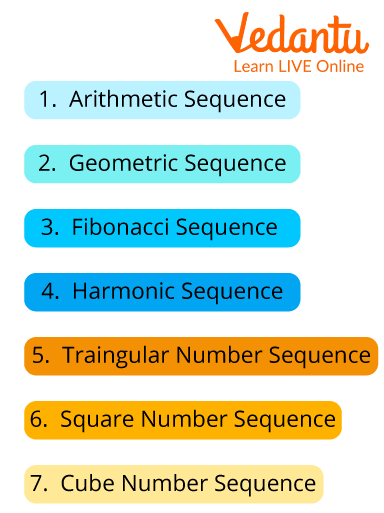
Different Types of Math Patterns
Pattern Rules in Mathematics
We need to be aware of some rules in order to create patterns. Understanding the nature of the sequence and the distinction between the two succeeding phrases is necessary in order to grasp the rule for any pattern.
Identifying Missing Term: Take a look at the patterns 1, 4, 9, 16 and 25. It is obvious from this pattern that each number is the square of the number corresponding to its location.
Example: What will be the value of x in the pattern: 1, 3, 5, x?
The answer will be 7 as there are all odd numbers in the sequence.
Difference Rule: In some cases, it is simple to determine the difference between two phrases that follow one another.
Example: 1, 5, 9, 13, 17, 21, and so on.
Solved Examples of Number Pattern Problems
1. Find the values of A and B in the following pattern.
15, 22, 29, 36, 43, C, 57, 64, 71, 78, 85, D.
Solution: Following is the given order: 15, 22, 29, 36, 43, C, 57, 64, 71, 78, 85, D.
In this case, the number is rising by \[ + 7\].
As the difference between the two numbers is 7 in this series, C will be equal to 50 by adding 43 and 7.
D's previous digit is 85. D will therefore be \[85 + 7 = 92\].
C, therefore, has a value of 50, and D has a value of 92.
2. Find the rule for the following hard number pattern: 81, 27, and 9.
Solution: It is a falling pattern, which is the first thing to notice.
Therefore, let's begin with the lowest number 9.
As can be seen, \[9 \times 3 = 27\].
Let's check the following number to see if this trend holds true.
\[27 \times 3\] Equals 81.
As a result, if we comprehend the series in the order provided, we can see that the pattern rule used in this situation is "Divide by 3".
This indicates that 81 divided by 3 gives us 27, and 27 divided by 3 gives us 9.
3. What are the next 2, 7, 8, 3, 12, and 9?
Solution: We have to find the pattern of numbers following the sequence:
2, 7, 8, 3, 12, 9
Assume that the sequence's final three terms are x, y, and z, making it 2, 7, 8, 3, 12, and x, y, z. The sequence should be divided into three groups. Let the first group consist of the numbers 2, 7, 8, 3, 12, 9, and the third group consists of [x, y, z].
The first element of the first and second group differs by 1, making \[3 - 2 = 1\], the second element of the first and second group differs by 5, making \[12 - 7 = 5\], and the third element of the first and second group differs by 1, making \[9 - 8 = 1\]. The second and third groups' components follow the same pattern: \[{\rm{x}} - 3 = 1\], \[{\rm{y}} - 12 = 5\], and \[z - 9 = 1\]; \[{\rm{x}} = 4\], \[{\rm{y}} = 17\], and \[{\rm{z}} = 10\].
Thus, 4 will be the following number.
Conclusion
Numbers are the foundation of Mathematics. It describes looking into various patterns. Every number pattern is fascinating. An arrangement of numbers is referred to as a pattern when it is done in a certain way. Children can practise Maths pattern problems with the help of worksheets available online.
FAQs on Pattern Questions in Mathematics Explained
1. What are pattern questions in Maths?
Pattern questions in Maths are problems that require identifying and continuing a sequence or arrangement based on a specific rule. These questions test logical reasoning and number sense.
- A pattern can involve numbers, shapes, or figures.
- It follows a specific rule such as adding, subtracting, multiplying, or repeating.
- Example: In 2, 4, 6, 8, the rule is add 2 each time.
2. How do you identify the rule in a number pattern?
To identify the rule in a number pattern, check the difference or ratio between consecutive terms.
- Find the difference: If constant, it is an arithmetic pattern.
- Find the ratio: If constant, it is a geometric pattern.
- Check for alternating or repeating operations.
3. What is the formula for an arithmetic pattern?
The formula for an arithmetic pattern (arithmetic sequence) is aₙ = a + (n − 1)d.
- a = first term
- d = common difference
- n = term number
4. What is the formula for a geometric pattern?
The formula for a geometric pattern (geometric sequence) is aₙ = a × rⁿ⁻¹.
- a = first term
- r = common ratio
- n = term number
5. How do you find the next term in a pattern?
To find the next term in a pattern, determine the rule of change and apply it to the last term.
- Check if numbers increase or decrease by a constant difference.
- Check if numbers are multiplied or divided by a constant value.
- Look for alternating or repeating patterns.
6. What is the difference between arithmetic and geometric patterns?
The main difference is that arithmetic patterns use a constant difference, while geometric patterns use a constant ratio.
- Arithmetic example: 4, 7, 10, 13 (add 3 each time).
- Geometric example: 5, 10, 20, 40 (multiply by 2 each time).
7. How do you solve missing number pattern questions?
To solve missing number pattern questions, first identify the pattern rule and then apply it to find the missing value.
- Check consecutive differences or ratios.
- Look for square numbers, cubes, or alternating patterns.
- Verify your answer by substituting it back.
8. What are repeating patterns in Maths?
Repeating patterns are patterns where a sequence of elements repeats in the same order.
- Common in shapes, colors, or simple number sets.
- Example: 1, 2, 3, 1, 2, 3, 1, 2, 3.
- The repeating block here is 1, 2, 3.
9. How do pattern questions appear in competitive exams?
Pattern questions in competitive exams usually test logical reasoning and number sequences.
- Finding the next term in a sequence.
- Identifying the wrong term.
- Finding missing numbers.
- Recognizing figure or shape patterns.
10. What are common mistakes to avoid in pattern questions?
Common mistakes in pattern questions include assuming the wrong rule or ignoring hidden operations.
- Checking only differences when the pattern uses multiplication.
- Overlooking alternating or mixed operations.
- Not verifying the rule with all terms.
