








How to Count by Ten with Number Patterns and Examples
Learning to count is fun! It can be done by learning from songs, pictures or any other fun activities. Three stages should be followed to learn this ability most quickly and efficiently as possible. When introducing counting by tens, let us start with the simplest activities.
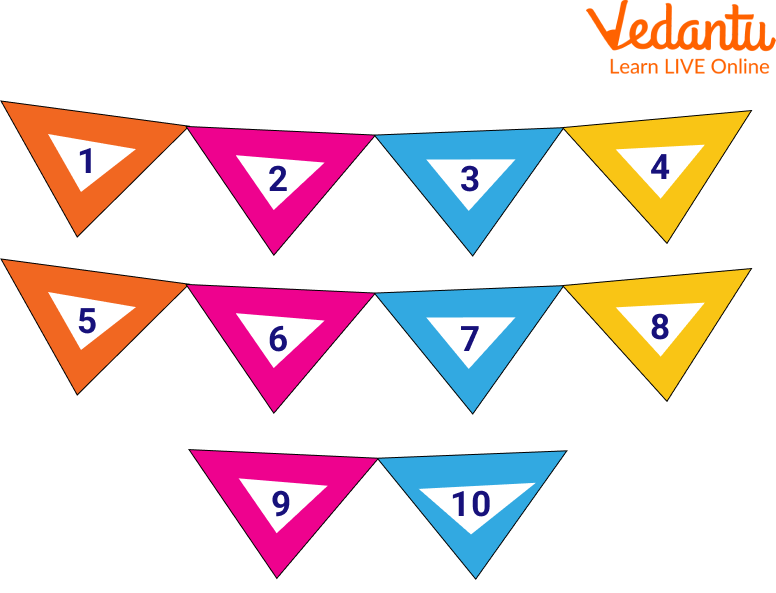
Introduction to Counting
After that, move on to activities where we may see and hear the numbers. Start thinking in tens as you enter the third phase. This is assisting kids in connecting their understanding of ten counting to real-world scenarios. It has been discovered that numerous activities are the most successful at imparting this skill.
Counting by Tens
Because humans have ten fingers, our number system is centred around the number 10.
The ability to think and compute in tens is advantageous for numerous tasks, including estimation, problem-solving, mental addition and subtraction, and many more. Counting in tens is enjoyable! Additionally, kids will have fun playing these games and learn a lot from them. It can be learned from the counting by 10s chart. When we count by tens, we increase a number by tenths of a unit each time.
1. Using Numerals To Count By Tens
10, 20, 30, 40, 50, 60, 70, 80, 90
2. Counting by Tens and Number Patterns
The numbers form a pattern when you count by tens. Every number has a zero at the end. When you count, the first few digits correspond to the numbers (1, 2, 3, 4, 5, etc.). The digits 10, 20, 30, 40, 50, etc. are produced by this pattern. The numbers in the dark green boxes count by 10.
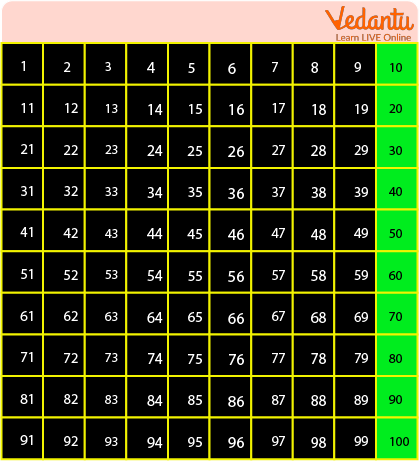
Counting by 10
How to Count by 10?
Create 10 object groups.
Start counting out loud still ten, as one, two, three, four, five, six, seven, eight, nine, ten.
Similarly, we can start the counting as 10, 20, 30, 40, 50, 60, 70, 80, 90, 100.
It can be learned from the hundred charts also.
The fact that the sum is the same whether you count in 1s or 10s is made tangible by observing these recurring groupings of 10. The counting sequence "10, 20, 30, 40..." can be practised. A hundred chart is another helpful tool for planning and visualising groups of ten as you count by tens.
Count to 100 by 10s
We can learn it by learning the count to 100 by 10s song which is fun and easy to learn.
The number line shows the series of numbers. Children should count the numbers out loud by seeing the image as 10, 20, 30, 40, 50, 60, 70, 80, 90, 100.
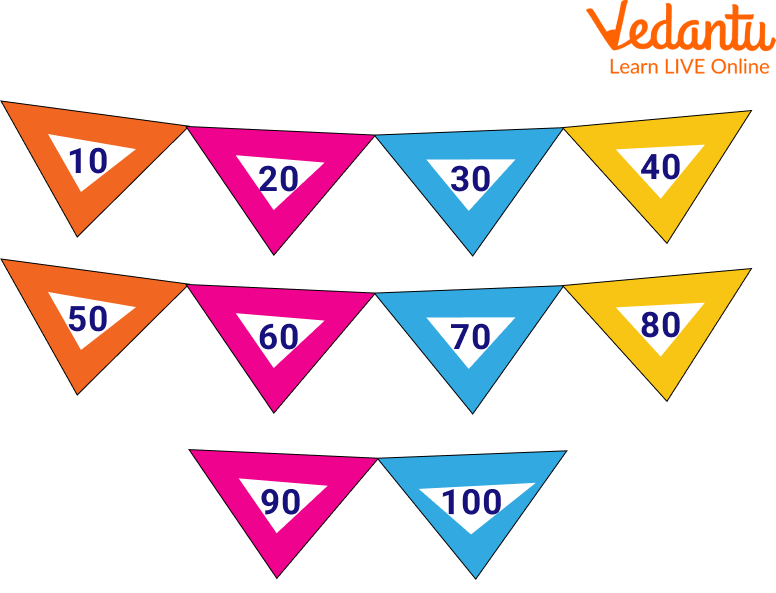
Count to 100 by 10s
Skip Count by 10
Usually, we count as 1,2,3,4,5…. But here we will learn something different. Here, we are going to learn counting by skipping. In this, we skip the 9 steps and straight away jump to the 10th. And we continue the counting as 10, 20, 30, 40, 50, 60, 70, 80, 90, 100.
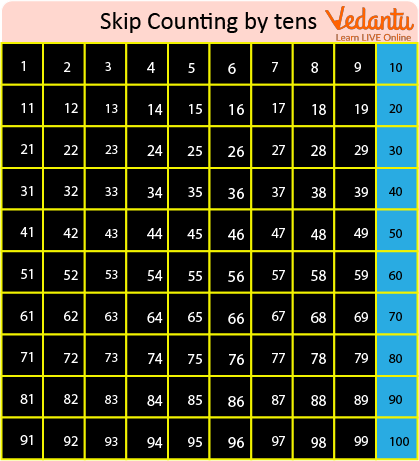
Skip Count by 10
Tens Number Line
Counting by tens can be learned by using the tens number line which is easy to understand. The number line shows the series of numbers. Children should count the numbers out loud by seeing the image as 10, 20, 30, 40, 50, 60, 70, 80, 90, 100.
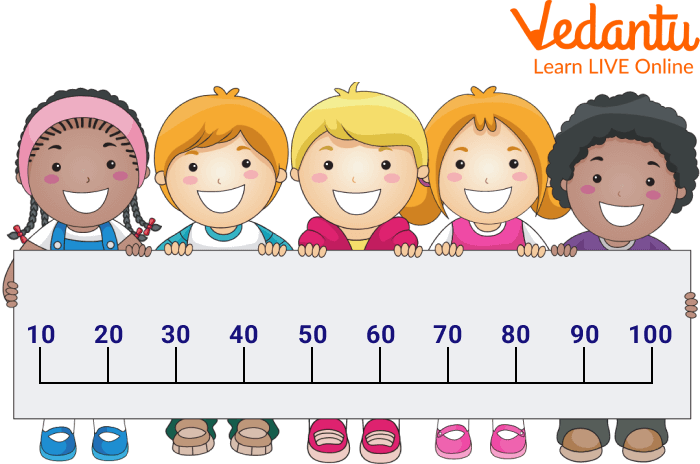
Tens Number Line
Solved Example
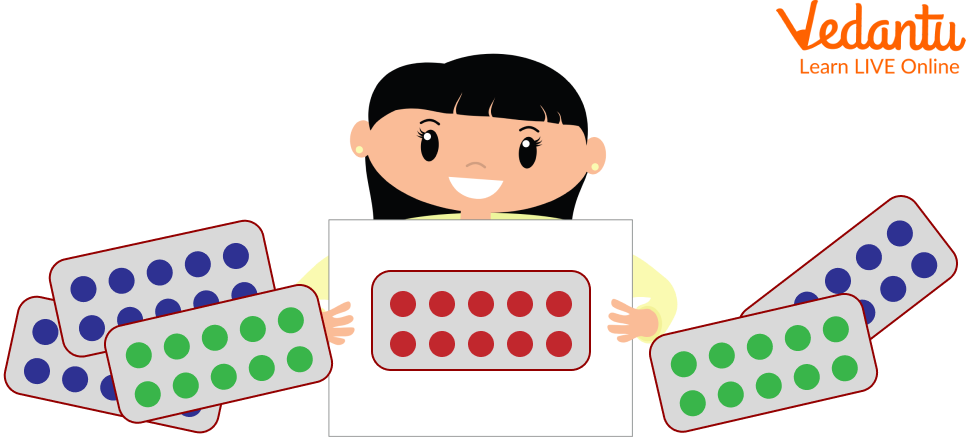
The Child likes Collecting Bindis
1. (a) How many packets does she have?
Ans: Six
(b) So how many bindis in all?
Ans: 10 + 10 + 10 + 10 + 10 + 10 = 60
60 bindis in all.
2. Complete the series:
10,20,_,_,_,60,_,_,_,_
Ans: 10, 20, 30, 40, 50, 60, 70, 80, 90, 100
Practice Questions
1. Complete the skip counting series by 10s:
(i) 20 , 30, ____, ____, ____, ____.
Ans: 20, 30, 40, 50, 60,70
(ii) ____, ____, 40, ____,60.
Ans: 20, 30, 40, 50
Summary
In this article, we have learned how we can count to 10 easily. We have seen an activity, in which we can learn counting by using either a chart or by reading numerals. Later on, we have seen the concept of skip counting. A skip count of 10s involves either adding 10 to the preceding number or jumping by 10. Every number is 10 more than the one before it. The counting sequence "10, 20, 30, 40..." can be practised to improve fluency when your youngster has realised that counting by tens indicates you're counting several groups of ten more quickly.
FAQs on How To Count By Ten in Maths
1. What does it mean to count by ten?
To count by ten means to add 10 to the previous number each time instead of adding 1. This is also called skip counting by 10.
- Start at any number.
- Add 10 each time.
- Example: 10, 20, 30, 40, 50.
2. How do you count by tens step by step?
To count by tens step by step, you repeatedly add 10 to the starting number. Follow these steps:
- Step 1: Choose a starting number (for example, 0).
- Step 2: Add 10 → 0 + 10 = 10.
- Step 3: Keep adding 10 each time.
3. What are the first 10 numbers when counting by tens?
The first 10 numbers when counting by tens starting from 10 are 10, 20, 30, 40, 50, 60, 70, 80, 90, 100. These numbers are called multiples of 10 because each number equals 10 multiplied by a whole number.
- 10 × 1 = 10
- 10 × 2 = 20
- 10 × 3 = 30
4. Why is counting by tens important?
Counting by tens is important because it helps students understand place value and the base-10 number system. It shows how numbers increase in the tens place while the ones digit stays 0.
- Builds mental math skills
- Helps with addition and subtraction
- Supports understanding of multiplication by 10
5. What pattern do you notice when counting by tens?
When counting by tens, the pattern is that the ones digit is always 0 and the tens digit increases by 1 each time. For example:
- 10 (1 ten)
- 20 (2 tens)
- 30 (3 tens)
6. Can you count by tens starting from a number other than 0?
Yes, you can count by tens starting from any number by adding 10 repeatedly. For example, starting at 5:
- 5
- 5 + 10 = 15
- 15 + 10 = 25
- 25 + 10 = 35
7. What is skip counting by 10?
Skip counting by 10 means counting forward by adding 10 each time instead of counting every single number. Example:
- 0, 10, 20, 30, 40
8. How is counting by tens related to multiplication?
Counting by tens is the same as multiplying by 10. Each step represents another group of ten.
- 10, 20, 30, 40
- 10 × 1 = 10
- 10 × 2 = 20
- 10 × 3 = 30
9. How do you count backwards by tens?
To count backwards by tens, subtract 10 each time from the starting number. Example starting at 100:
- 100
- 100 − 10 = 90
- 90 − 10 = 80
- 80 − 10 = 70
10. What are common mistakes when counting by tens?
A common mistake when counting by tens is changing the ones digit instead of keeping it at 0 when starting from a multiple of 10. Other mistakes include:
- Adding 1 instead of 10
- Skipping a number in the pattern
- Confusing counting by 10 with counting by 100
