








Definition steps and solved examples of making and breaking numbers
Hello kids! The concept of place values is perhaps one of the most fundamental and essential concepts that students learn when they are new to mathematics. Only when they know the difference between the place values of a number in the tens place and the one's place can they say that 100 is greater than 10 and 87 is less than 90. This lesson plan teaches students how to add a two-digit number to another two-digit number. This is done by breaking the numbers into ones, tens, and hundreds.
Breaking Numbers
The expanded form is a way of writing a number by adding the value of its digits by breaking the number. We can use a place value chart to think about the value of the digits of a number.
Place value is the value of a digit according to its position in the number, such as ones, tens, hundreds, and so on. For example, the place value of 5 in 3458 is 5 tens, or 50. However, the place value of 5 in 5781 is expressed as 5 thousand or 5,000. It is important to understand that a digit can be the same, but its value depends on its position in the number.
Let’s stretch the values

Breaking Numbers
In 12, the place values of the digits are given below:
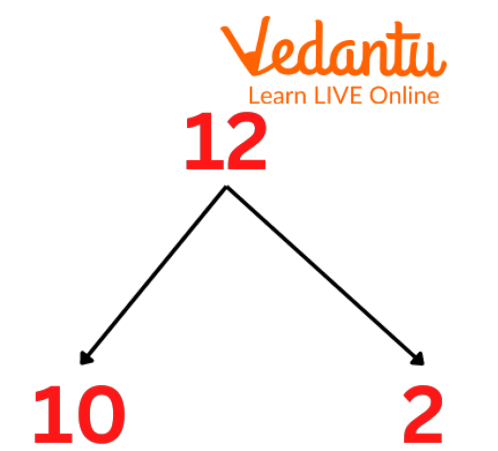
Breaking Number
In 211, the place values of the digits are given below:
In 2385, the digit place values are given below:
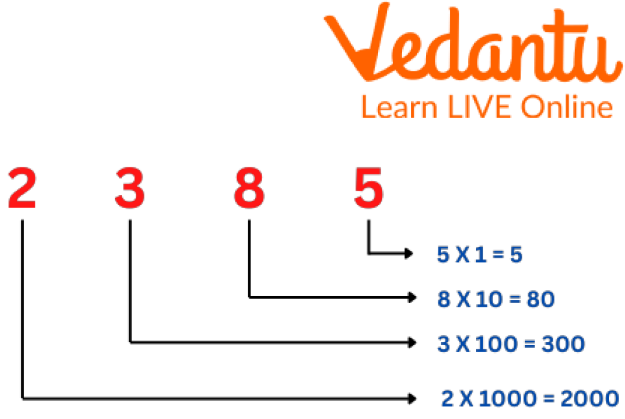
Breaking Numbers
Addition Using Breaking Numbers
Breaking Apart is a mental maths strategy for addition. Some students may find this method more effective than addition from left to right.
In this, we'll practice adding a two-digit number to a two-digit number by separating the numbers and then adding tens.
For example,
Example 1. We will add 14+12.
We will split the 12 into a 10 and a 2.
Now we add. First, we add 14 + 10 to make 24; then we add the remaining 2 to make 26.
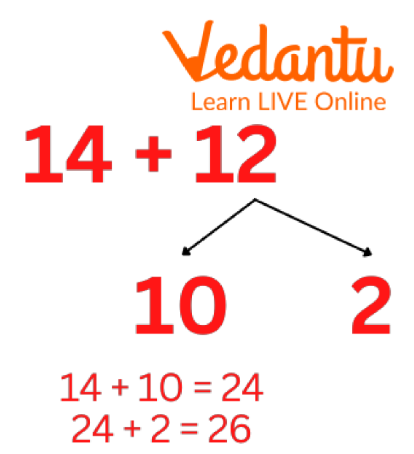
Example
Example 2. 50+12
First, we Split 12 into 10 and 2.
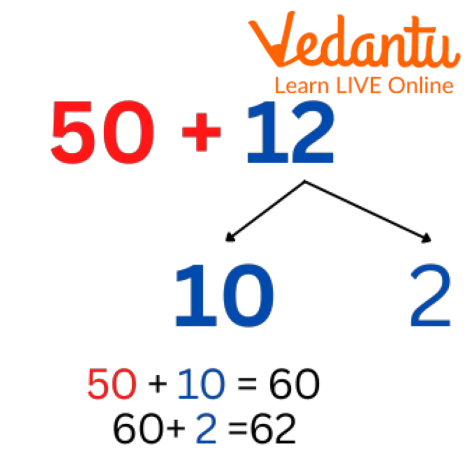
Example
We add 50 + 10 to make 60,
then add the remaining 2 to make 62.
Subtraction Using Breaking Numbers
Example 1. We will Subtract 43 - 17.
We will split the 17 into a 10 and a 7.
Then, we split 7 into 3 and 4.
Then, with the help of a line we subtract.
43 - 10 = 33
33 - 3 = 30
30 - 4 = 26
Example 2.We will Subtract 75 - 18.
We will split the 18 into a 10 and an 8.
Then, we split 8 into 5 and 3.
Then, with the help of a line we subtract.
75 - 10 = 65
65 - 5 = 60
60 - 3 = 57
Example 3. We will Subtract 75 - 12.
We will split the 12 into a 10 and a 2.
Then, with the help of a line we subtract.
75 - 10 = 65
65 - 2 = 63
Solved Examples
1. Breaking numbers:
Ans: After breaking numbers:
2. Adding by Breaking Apart Tens and Ones.
a. Break apart the numbers into tens and ones to add.
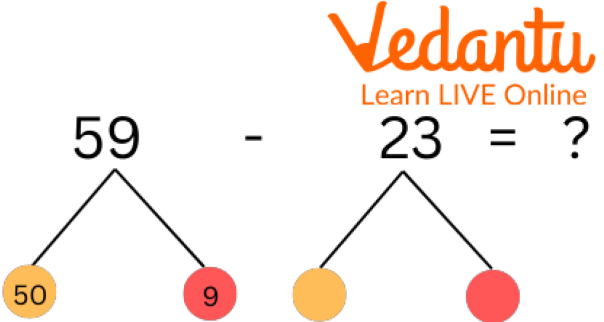
Solved Example
Ans: 36
b.
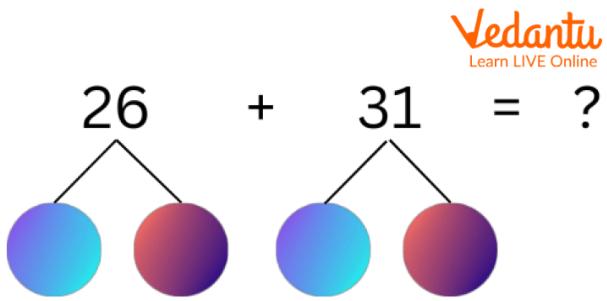
Solved Example
Ans: 57
Practice Questions
Q1. Break the given numbers
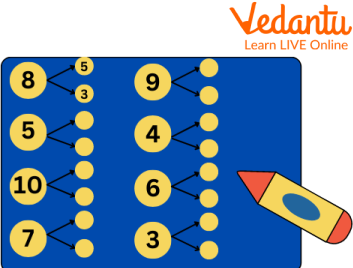
Practice Question
Ans: 9 = 4 + 5
5 = 2 + 3
4 = 3 + 1
10 = 6 + 4
6 = 4 + 2
7 = 6 + 1
3 = 2 + 1
Summary
In this article, we learned about place values, its importance and how we use them to make or break numbers. We also learned to separate tens and ones by breaking the tens digit and further using them to solve questions in addition, subtraction etc. For example, 56 = 50 + 6. Along with that, we learned more about it by solving numerous questions to grasp breaking numbers.
FAQs on Making and Breaking Numbers in Maths
1. What does making and breaking numbers mean in maths?
Making and breaking numbers means composing (putting together) and decomposing (splitting) numbers into smaller parts based on place value or number bonds.
- Making numbers: Combining smaller numbers to form a larger number (e.g., 30 + 4 = 34).
- Breaking numbers: Splitting a number into parts (e.g., 34 = 30 + 4).
- This concept helps with addition, subtraction, mental maths, and understanding place value.
2. How do you break a number using place value?
To break a number using place value, split it into its hundreds, tens, and ones parts.
- Example: Break 456.
- 456 = 400 + 50 + 6.
- 4 is in the hundreds place, 5 in the tens place, and 6 in the ones place.
3. How do you make a number using expanded form?
To make a number using expanded form, add together its place value parts to get the standard form.
- Example: 300 + 20 + 5
- Add step-by-step: 300 + 20 = 320
- 320 + 5 = 325
4. What is the expanded form of a number?
The expanded form of a number shows its value as the sum of its place values.
- Example: The expanded form of 782 is 700 + 80 + 2.
- Each digit is multiplied by its place value.
- This helps learners understand place value clearly.
5. What are number bonds in making and breaking numbers?
Number bonds are pairs or groups of numbers that combine to make a given total.
- Example: Number bonds for 10 include 7 + 3, 6 + 4, and 5 + 5.
- They help with mental addition and subtraction.
- Number bonds are an important strategy for making numbers quickly.
6. Why is breaking numbers useful in addition?
Breaking numbers makes addition easier by splitting numbers into manageable parts.
- Example: 48 + 35
- Break 35 into 30 + 5.
- 48 + 30 = 78
- 78 + 5 = 83
7. How do you break numbers to subtract easily?
To subtract easily, break the number being subtracted into tens and ones.
- Example: 64 − 27
- Break 27 into 20 + 7.
- 64 − 20 = 44
- 44 − 7 = 37
8. What is the difference between standard form and expanded form?
Standard form shows a number as a whole, while expanded form shows it as the sum of its place values.
- Standard form: 529
- Expanded form: 500 + 20 + 9
- Expanded form explains how each digit contributes to the number.
9. Can you give an example of making and breaking numbers with three digits?
Yes, a three-digit number can be broken and made using its hundreds, tens, and ones.
- Break 639: 600 + 30 + 9.
- Make the number again: 600 + 30 + 9 = 639.
- This shows how place value builds the full number.
10. What are common mistakes when making and breaking numbers?
A common mistake is confusing place values or adding digits without considering their position.
- Example mistake: Breaking 304 as 300 + 4 (missing the zero tens).
- Correct expanded form: 300 + 0 + 4.
- Always check the place value chart to avoid errors.
