









How to Find the Successor and Predecessor with Formula and Examples
“Honourable Mr. Narendra Modi is the 14th Prime Minister of the Republic of India. His predecessor was Dr. Manmohan Singh.”
We often see this sentence in our History or Social Studies books. But what does the term “predecessor” mean? Today, we will learn about successor and predecessor meanings and how to find them.
Predecessors and Successors: What are They?
In Mathematics, the terms predecessor and successor are used almost always in context with another given whole number. In general terms, the predecessor or successor to a person or an object is that which comes before or after it, respectively. For example, ‘the king’s son was chosen to be his successor’ implies that after the king, his son would rule after him.
While on the other hand, "Pandit Jawaharlal Nehru was Lal Bahadur Shastri's predecessor as the prime minister of independent India." This implies that prior to Lal Bahadur Shastri's term as the Prime minister of Independent India, Pandit Jawaharlal Nehru was the prime minister in charge of the affairs of India and her people.
What is Predecessor?
So what is the predecessor in mathematical terms? The predecessor is the number that “precedes” or comes before the given number. Simply put, the predecessor of a number is one less than it. Some examples of predecessors are-
The predecessor of 1 is 0.
The predecessor of 22 is 21.
The predecessor of 99 is 98.
For example, if “b” is the given value, then the predecessor of the given value (b) is the value “a”.
How Do We Find the Predecessor?
The formula to derive the predecessor is $(n-1)$ where $n$ is the given value, and one is subtracted to show the predecessor of that number.
Hence the formula to derive the predecessor: Predecessor $=n-1$
What is Successor?
Now that we have learned what the predecessor is, what is the successor in mathematics? The successor is the number that “succeeds” or comes after the given number. In simple terms, the successor of a number is one more than it. Some examples of successors are-
The successor of 1 is 2
The successor of 22 is 23
The successor of 99 is 100
For example, if the given value is 'b', then the successor of the given value (b) is the value 'c'.
How Do We Find the Successor?
The formula to derive the successor is: ( n + 1 ) where n is the given value, and one is added to gain the successor of that number.
Hence the formula to derive the successor: Successor = n + 1
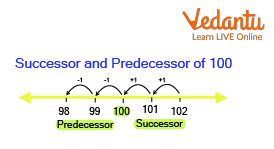
Example of Successor and Predecessor
Solved Examples
1. Find the predecessor for the following numbers:
1000
20
345
Ans: The predecessors of the numbers are:
(1000-1) = 999
(20-1) = 19
(345-1) = 344
2. Find the successors for the following numbers:
20
9999
4
Ans: The successors of the numbers are:
(20 + 1) = 21
(9999 + 1) = 10000
(4 + 1) = 5
Practice Questions
1. If the given value is 99999, what is its successor? Upon deriving the answer, find the successor to the derived value as well.
2. The given value is 120. Find the predecessor of the given value. Also, find the predecessor of the answer.
Answers:
1. Successor 1= 100000; Successor 2= 100001
2. Predecessor 1= 119; Successor 2= 118
Summary
To sum up, what we have learned so far:
The term predecessor refers to the number that precedes or comes before the given number.
The term successor refers to the number that succeeds or comes after the given number.
The formula to find the predecessor is: Predecessor = n - 1.
The formula to find the successor is: Successor = n + 1.
All whole numbers, upon using the formulae, may produce their respective successors and predecessors.
A predecessor for the number zero is not possible, but its successor is 1.
FAQs on Successor and Predecessor in Mathematics
1. What is the successor of a number in Maths?
The successor of a number is the number that comes immediately after it, found by adding 1 to the given number. In basic number concepts, the successor increases the value by one step on the number line.
- Formula: Successor = n + 1
- Example: Successor of 25 = 25 + 1 = 26
- Successor of 0 = 1
2. What is the predecessor of a number?
The predecessor of a number is the number that comes immediately before it, found by subtracting 1 from the given number. It represents one step backward on the number line.
- Formula: Predecessor = n − 1
- Example: Predecessor of 25 = 25 − 1 = 24
- Predecessor of 1 = 0
3. How do you find the successor and predecessor of a number?
To find the successor add 1, and to find the predecessor subtract 1 from the given number. These steps work for natural numbers, whole numbers, and integers.
- Step 1: Identify the given number (n).
- Step 2: Calculate successor using n + 1.
- Step 3: Calculate predecessor using n − 1.
4. What is the successor and predecessor of 0?
The successor of 0 is 1 and the predecessor of 0 is −1. This is because successor means adding 1 and predecessor means subtracting 1.
- Successor: 0 + 1 = 1
- Predecessor: 0 − 1 = −1
5. What is the difference between successor and predecessor?
The successor is the number obtained by adding 1, while the predecessor is obtained by subtracting 1 from a given number. They represent forward and backward movement on the number line.
- Successor formula: n + 1
- Predecessor formula: n − 1
- Example: For 10 → Successor = 11, Predecessor = 9
6. Can a number have more than one successor or predecessor?
No, a number has exactly one successor and one predecessor in the number system. This is because adding or subtracting 1 gives a unique result.
- For any number n:
- Successor = n + 1 (only one value)
- Predecessor = n − 1 (only one value)
7. What is the successor and predecessor of a negative number?
The successor of a negative number is found by adding 1, and the predecessor is found by subtracting 1. The rule remains the same for integers.
- Example: For −5
- Successor: −5 + 1 = −4
- Predecessor: −5 − 1 = −6
8. What is the successor and predecessor formula?
The formula for successor is n + 1 and for predecessor is n − 1. These formulas apply to natural numbers, whole numbers, and integers.
- If n is any number,
- Successor = n + 1
- Predecessor = n − 1
9. What is the successor and predecessor of the largest 3-digit number?
The largest 3-digit number is 999, its successor is 1000 and its predecessor is 998. This is calculated using the standard formulas.
- Largest 3-digit number = 999
- Successor: 999 + 1 = 1000
- Predecessor: 999 − 1 = 998
10. Why is understanding successor and predecessor important in Maths?
Understanding successor and predecessor is important because it builds the foundation for number sense, counting, and number line concepts. It helps learners understand order and sequence in Mathematics.
- Improves understanding of ascending and descending order
- Helps in learning integers and number systems
- Supports basic operations like addition and subtraction
