








What Is The Geometrical Meaning Of Zeroes Of A Polynomial With Graph And Examples
Expression consists of variables, coefficients, and arithmetic operations. An expression may consist of more than one variable, and the variable's power is any real number.
Let’s understand polynomials definition with example; a polynomial is an expression of one variable. The power of variables of a polynomial must be a natural number. A polynomial represented by P(x), where x is the variable of the polynomial. For example P(x) = \[2x^3+5x+3\].
Degree of a Polynomial
The degree of a polynomial is the highest power of the variable of the polynomial. The degree of linear polynomials is 1 because the highest degree of the polynomial is 1. The degree of a quadratic polynomial is 2 because the highest degree of the polynomial is 2. The degree of a cubic polynomial is 3 because the highest degree of the polynomial is 3.
Types of Polynomials
The type of polynomial depends on the degree of the polynomial.
The general form of a polynomial is \[P(x) = a_{n}x^{n}+a_{n-1}x^{n-1}+\cdots +a_1x+a_{0}\]
Constant polynomial: If \[a_{n}=a_{n-1}=\cdots =a_2=a_{1}=0\] and \[a_{0}\ne 0\], then the polynomial is known as a constant polynomial. For example: P(x) =3.
Zero polynomial: If \[a_{n}=a_{n-1}=\cdots =a_2=a_{1}=a_{0}= 0\], then the polynomial is known as a zero polynomial.
Linear polynomial: If \[a_{n}=a_{n-1} = a_2 = 0\] and \[a_{1}\ne 0\], then the polynomial is known as linear polynomial.
Quadratic polynomial: If \[a_{n}=a_{n-1} =\cdots =a_3=0\] and \[a_{2}\ne 0\], then the polynomial is known as quadratic polynomial.
Cubic polynomial: If \[a_{n}=a_{n-1} =\cdots0= a_4\] and \[a_{3}\ne 0\], then the polynomial is known as quadratic polynomial.
Zeroes of the Polynomial Definition
The zero of a polynomial is the value of the variable for which the value of the polynomial becomes zero.
The polynomial P(x) has a zero at x = a. This means the value of P(x) at x = a is zero that is P(a) = 0.
Assume a polynomial, \[ P(x)=2x+4\]
Now equate P(x) with zero.
P(x) = 0
\[\Rightarrow 2x+4=0\]
\[\Rightarrow 2x=-4\]
\[\Rightarrow x=-2\]
The zero of the polynomial P(x)=2x+4 is x = -2.
Number of Zeros of a Polynomial
The degree of a linear polynomial is 1. Thus the number of zeros of a linear polynomial is at most 1.
The degree of a quadratic polynomial is 2. Thus the number of zeros of a linear polynomial is at most 2.
The degree of a cubic polynomial is 3. Thus the number of zeros of a linear polynomial is at most 3.
How to Obtain the Zero of a Linear Polynomial Geometrically?
The degree of a polynomial is the highest power of the variable of the polynomial. The degree of a linear polynomial is 1. Thus the number of zeros of the polynomial is 1.
To get a zero of linear polynomials geometrically, we will find the point where the given linear polynomial cuts the x-axis. Suppose the polynomial cuts the x-axis at x = a, then the zero of the polynomial is a.
For Example,
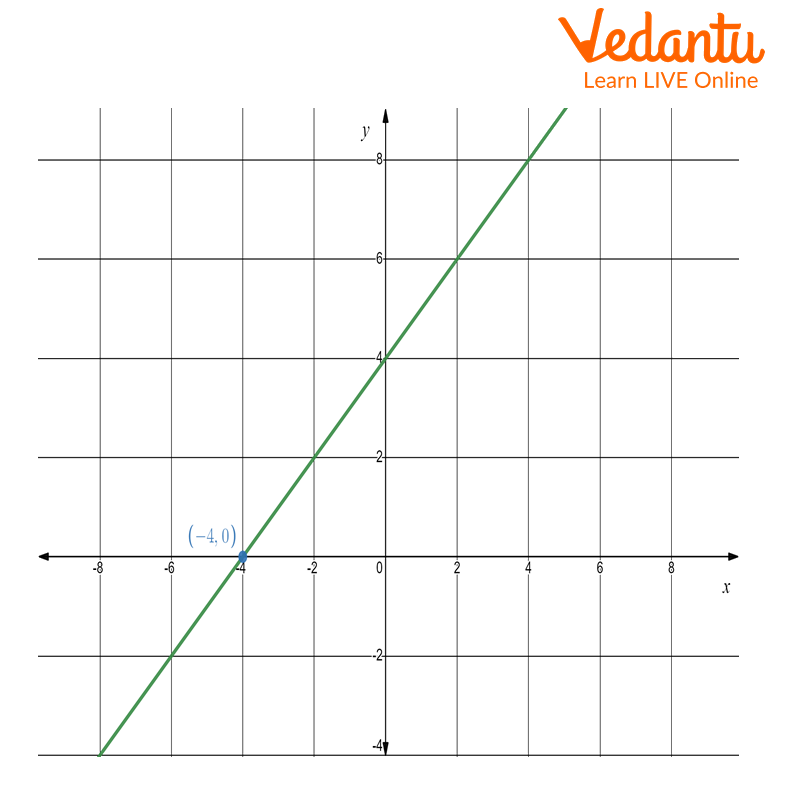
Assume an equation of a linear polynomial P(x) = x+4.
The graphical representation of a linear polynomial is shown below:
Linear polynomial
The linear polynomial P(x) cuts the x-axis at (-4,0). Thus the zero of the polynomial is -4. It means P(-4) = 0. The zero of the polynomial P(x) = x+4 is -4.
Since the given polynomial is a linear polynomial, thus it intersects the x-axis at a point.
Geometrical Meaning of the Zeros of a Polynomial
The number of zeros of a polynomial is dependent on the degree of that polynomial. The number of zeros of a polynomial is less than or equal to the degree of the polynomial. The number of zeros of a polynomial is equal x-intercepts of the polynomials.
Geometrical Representation of Zeros
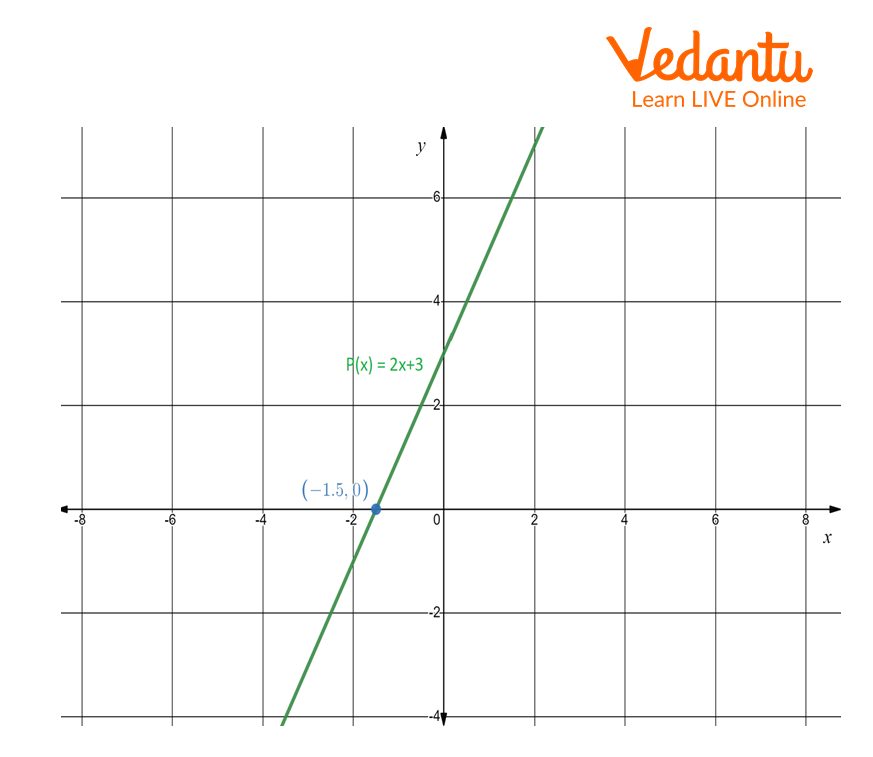
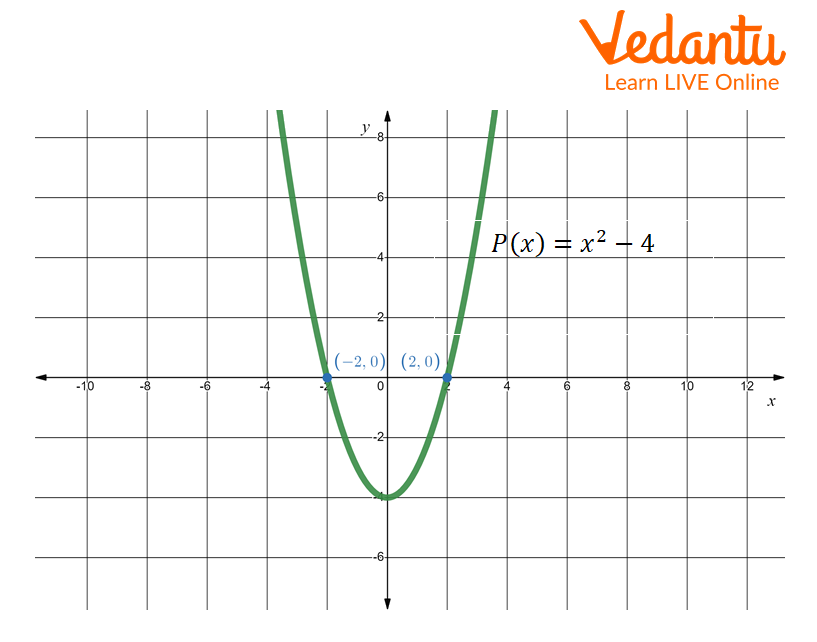
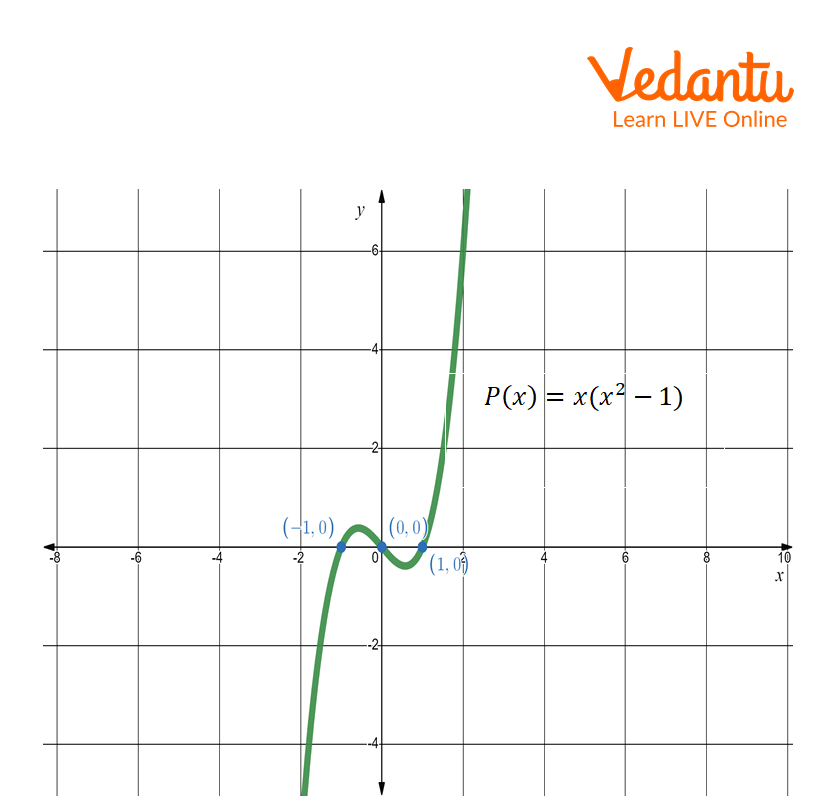
The number of zeros is equal to the number of the x-intercept of the polynomial graph. Below we have the geometrical meaning of zeroes of polynomials with examples
Linear polynomial: The number of the x-intercepts is 1. Thus, the number of zeros is 1 for the linear polynomial.
Graph of a linear polynomial
Quadratic polynomial: The quadratic polynomial has at most 2 zeros. Thus, the graph of quadratic polynomial intercepts at two points.
Graph of the quadratic polynomial
Cubic polynomial: The cubic polynomial has at most 3 zeros. Thus, the graph of cubic polynomial intercepts at three points.
Graph of a cubic polynomial
Solved Problems
Q1 Find the number of zeroes of the polynomial in a given graph.
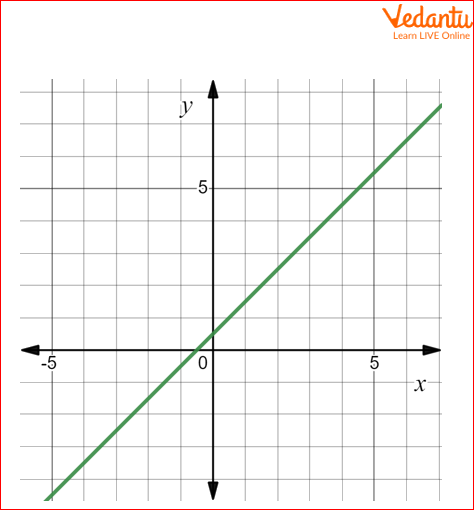
Solution 1: From the above geometrical presentation we can see that the straight line intersects the x-axis at one time, therefore the number of zeros in the given polynomial is one.
Q2 Find the zeros of the polynomial \[P(x) =4x^{2}-16\].
Solution 2: Given polynomial is \[P(x) =4x^{2}-16\].
Equate P(x) with zero:
\[4x^{2}-16=0\]
\[\Rightarrow 4x^{2}=16\]
Divide both sides by 4:
\[\Rightarrow x^{2}=4\]
Take square root both sides
\[\Rightarrow x=\pm 4\]
The zeros of the polynomial are \[\pm 4\].
Q3 Find out the zero of the polynomial y=x+1 geometrically.
Solution3: First we make the table for y=x+1
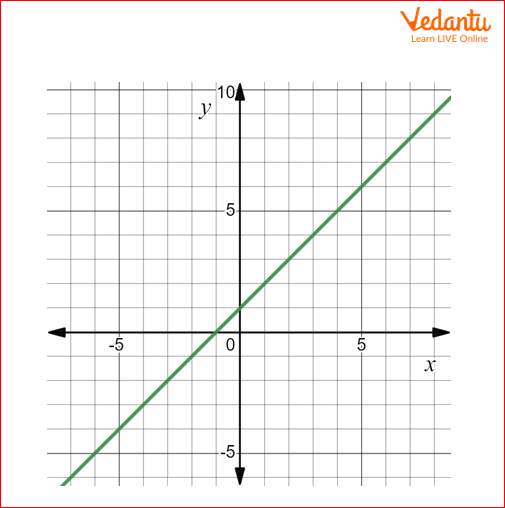
Graph for given table
We can see that at x=-1, given straight line intersecting the x-axis, therefore x=-1 is zero of the given polynomial.
Interesting Facts
If the zeros of a quadratic polynomial are the same, then the graph of the quadratic polynomial touches the x-axis at a point.
If the zeros of a cubic polynomial are the same, then the graph of the cubic polynomial cuts the x-axis at a point.
Summary
The number of zeros of a polynomial depends on the degree of the polynomial. The number of zeros of a polynomial equals the number of x-intercepts of the polynomial. If P(a) = 0, then a is a zero of the polynomial P(x). A linear polynomial has at most 1 zero. A quadratic polynomial has at most 2 zeros and a cubic polynomial has at most 3 zeros.
Practice Problem
Q1 Write the type of the given polynomial (1) 2x+3 (2) \[2x^{2}+3\]
Solution: (1) linear polynomial (2) Quadratic polynomial
Q2 From the given table find the zero of the polynomial.
Solution: The zero is X = 2
FAQs on Geometrical Meaning Of Zeroes Of The Polynomial In Graphs
1. What is the geometrical meaning of zeroes of a polynomial?
The geometrical meaning of zeroes of a polynomial is that they represent the x-coordinates of the points where the graph of the polynomial intersects the x-axis. In other words, a zero of a polynomial f(x) is a value of x for which f(x) = 0.
- If the graph cuts the x-axis at a point, that x-value is a zero.
- If the graph just touches the x-axis, that x-value is also a zero.
- The number of zeroes equals the number of x-axis intersection points.
2. How do you find the zeroes of a polynomial graphically?
You can find the zeroes of a polynomial graphically by locating the points where its graph intersects the x-axis. Follow these steps:
- Draw the graph of the polynomial on a coordinate plane.
- Identify the points where the graph crosses or touches the x-axis.
- The x-coordinates of those points are the zeroes of the polynomial.
3. What is the geometrical meaning of zeroes of a linear polynomial?
The geometrical meaning of the zero of a linear polynomial is the point where its straight-line graph intersects the x-axis. A linear polynomial has the form f(x) = ax + b (where a ≠ 0).
- Its graph is a straight line.
- It intersects the x-axis at exactly one point.
- Hence, a linear polynomial has exactly one zero.
4. What is the geometrical meaning of zeroes of a quadratic polynomial?
The geometrical meaning of the zeroes of a quadratic polynomial is the x-coordinates of the points where its parabolic graph intersects the x-axis. A quadratic polynomial has the form f(x) = ax² + bx + c (a ≠ 0).
- If the parabola cuts the x-axis at two points, it has two distinct real zeroes.
- If it touches the x-axis at one point, it has one real zero (repeated).
- If it does not intersect the x-axis, it has no real zeroes.
5. How many zeroes can a polynomial have?
A polynomial of degree n can have at most n zeroes. The number of zeroes depends on how many times its graph intersects the x-axis.
- A linear polynomial (degree 1) has at most 1 zero.
- A quadratic polynomial (degree 2) has at most 2 zeroes.
- A cubic polynomial (degree 3) has at most 3 zeroes.
6. Can a polynomial have no zeroes?
Yes, a polynomial can have no real zeroes if its graph does not intersect the x-axis. For example, consider f(x) = x² + 1.
- For all real values of x, x² ≥ 0.
- So x² + 1 ≥ 1, which is always positive.
- The graph never touches or cuts the x-axis.
7. What is the difference between algebraic and graphical methods of finding zeroes?
The algebraic method finds zeroes by solving equations, while the graphical method finds zeroes by observing x-axis intersections on a graph.
- In the algebraic method, set f(x) = 0 and solve for x.
- In the graphical method, draw the graph and read the x-coordinates where it meets the x-axis.
- The algebraic method gives exact values; the graphical method may give approximate values.
8. What does it mean when a graph touches the x-axis but does not cross it?
When a graph touches the x-axis but does not cross it, it means the polynomial has a repeated (equal) zero at that point. This usually occurs in quadratic polynomials when the discriminant is zero.
- The graph forms a turning point on the x-axis.
- The x-value is counted twice algebraically.
- There is one real repeated zero.
9. How are zeroes of a polynomial related to its degree?
The number of zeroes of a polynomial is at most equal to its degree. For a polynomial of degree n:
- It can have at most n real zeroes.
- It may have fewer real zeroes depending on the graph.
- The Fundamental Theorem of Algebra states it has exactly n zeroes (real or complex) counting multiplicity.
10. Can you give an example to explain the geometrical meaning of zeroes?
Yes, consider the quadratic polynomial f(x) = x² - 4; its zeroes are -2 and 2, which are the x-coordinates where its graph intersects the x-axis.
- Set f(x) = 0: x² - 4 = 0.
- Factor: (x - 2)(x + 2) = 0.
- So x = -2 and x = 2.
