








Taylors Theorem formula proof and solved examples step by step
In this article, Taylor's Theorem and its proof are discussed in detail. Taylor’s Theorem is used to express the value of a function as a sum of infinite terms that are calculated from the values of the derivatives of the function at a single point. Quantitative estimates of error are given by Taylor’s Theorem.
In this article, we will discuss the theorem along with proof, statement, and solved examples. We will also cover its limitations and applications in real life and in books. Some frequently asked questions by the readers are also answered at the end of the article.
Table of Contents
Introduction to Taylor's Theorem
History of Brook Taylor
Statement of Taylor's Theorem
Proof of Taylor's Theorem
Limitation of Taylor's Theorem
Applications of Taylor's Theorem
History of Brook Taylor

Brook Taylor
Image credit: Wikimedia
Name: Brook Taylor
Born: 18 August 1685
Died: 29 December 1731
Field: Mathematics
Nationality: British
Statement of Taylor's Theorem
Consider a function either real or composite, $f(x)$ that is differentiable.
Then, the power series for that function is described using the Taylor series as:
$f(x)=f(a) \dfrac{f^{\prime}(a)}{1 !}(x-a)+\dfrac{f^{\prime \prime}(a)}{2 !}(x-a)^{2}+\dfrac{f^{(3)}(a)}{3 !}(x-a)^{3}+\ldots$
which can be written as:
$f(x)=\sum_{n=0}^{\infty} \dfrac{f^{n}(a)}{n !}(x-a)^{n}$
where, $f^{(n)}(a)$ represents $n^{\text {th }}$ derivative of $f$
and $n$! represents the factorial of $n$.
Proof of Taylor's Theorem
We know the power series for any function is defined as follows:
$f(x)=\sum_{n=0}^{\infty} a_{n} x^{n}=a_{0}+a_{1} x+a_{2} x^{2}+a_{3} x^{3}+\ldots$
At $x=0$,
$f(x)=a_{0}$
Differentiating the given function:
$f^{\prime}(x)=a_{1}+2 a_{2} x+3 a_{3} x^{2}+4 a_{4} x^{3}+\ldots$
Substitute $x=0$ in the above equation, and we get:
$f^{\prime}(0)=a_{1}$
Differentiating again, we get
$f^{\prime \prime}(x)=2 a_{2}+6 a_{3} x+12 a_{4} x^{2}+\ldots$
Substituting $x=0$ in second-order differentiation
$f^{\prime \prime}(0)=2 a_{2}$
Therefore, $\dfrac{f^{\prime \prime}(0)}{2 !}=a_{2}$
Generalising the equation,
we have: $\dfrac{f^{n}(0)}{n !}=a_{n}$
Substitute the values in the power series:
$f(x)=f(0)+f^{\prime}(0) x+\dfrac{f^{\prime \prime}(0)}{2 !} x^{2}+\dfrac{f^{\prime} n(0)}{3 !} x^{3}+\ldots$
Generalising $f$ in the general form again, we get:
$f(x)=b+b_{1}(x-a)+b_{2}(x-a)^{2}+b_{3}(x-a)^{3}+\ldots$
At $x=a$, we have
$b_{n}=\dfrac{f^{n}(0)}{n !}$
Now, substituting the value of $b_{n}$ in a generalised form,
$f(x)=f(a) \dfrac{f^{\prime}(a)}{1 !}(x-a)+\dfrac{f^{\prime \prime}(a)}{2 !}(x-a)^{2}+\dfrac{f^{(3)}(a)}{3 !}(x-a)^{3}+\ldots$
Hence, Taylor's Theorem Formula is proved.
Taylor's Theorem for Two Variables
If $f(x, y)$ has continuous partial derivatives up to the nth order in a neighbourhood of a point $(a, b)$, then
$f(a+h, b+k)=f(a, b)+\left[h \dfrac{\partial}{\partial x}+k \dfrac{\partial}{\partial y}\right] f(a, b)+\dfrac{1}{2 !}\left[h \dfrac{\partial}{\partial x}+k \dfrac{\partial}{\partial y}\right]^{2} f(a, b)$
$+\dfrac{1}{3 !}\left[h \dfrac{\partial}{\partial x}+k \dfrac{\partial}{\partial y}\right]^{3} f(a, b)+\ldots \ldots+\dfrac{1}{(n-1) !}\left[h \dfrac{\partial}{\partial x}+k \dfrac{\partial}{\partial y}\right]^{n-1} f(a, b)+R_{n}$
Where,
$R_{n}=\dfrac{1}{n !}\left[h \dfrac{\partial}{\partial x}+k \dfrac{\partial}{\partial y}\right]^{n} f(a+\theta h, b+\theta k)$ for some $\theta: 0<\theta<1$
Here $R_{n}$ is called the remainder after $n$ times.
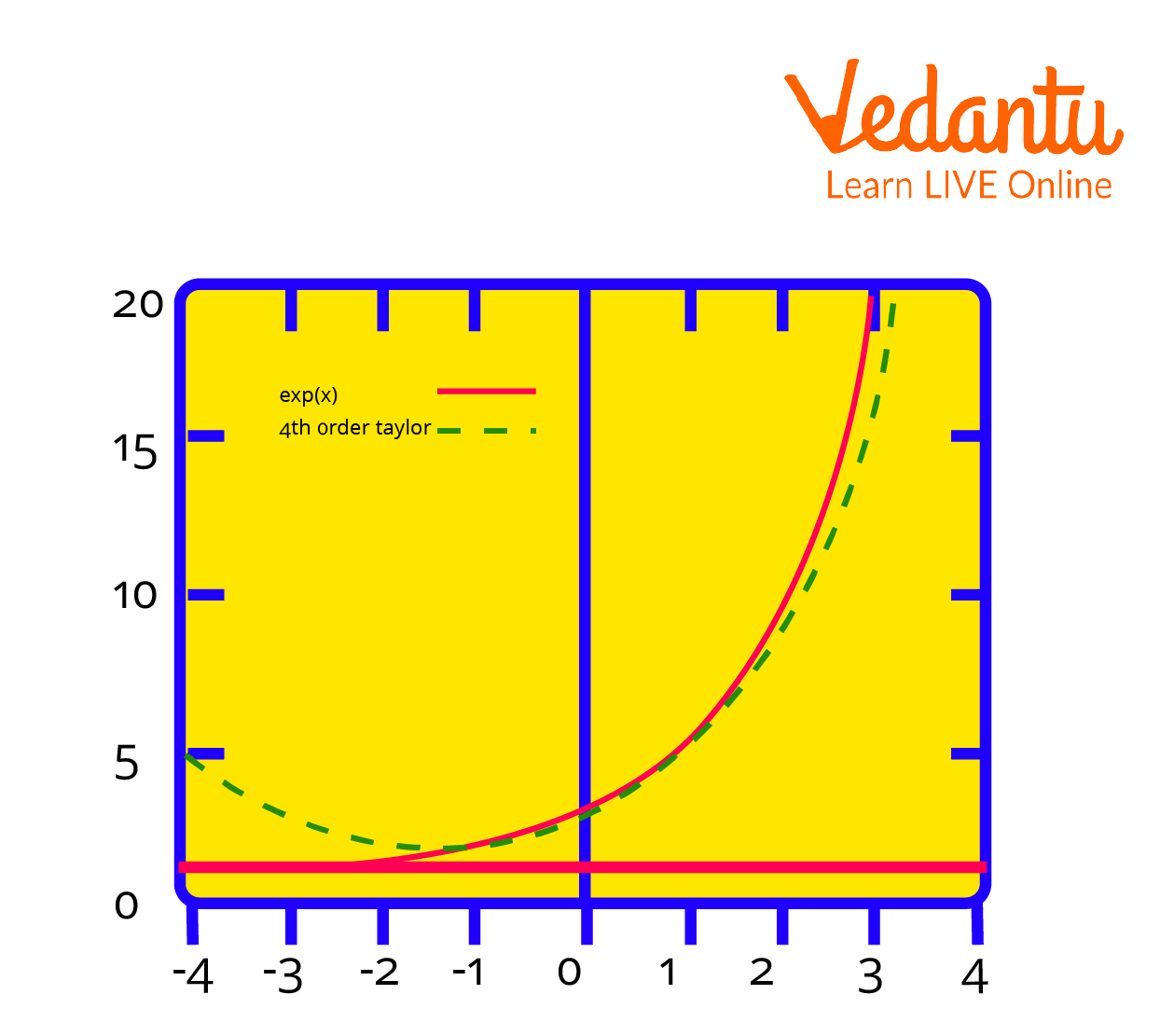
The Exponential Function y = ex
Limitation of Taylor's Theorem
Taylor's theorem is not applicable in the case of non-differentiable functions.
Applications of Taylor's Theorem
Taylor's Theorem is used in electric power systems to analyse power flow.
Taylor’s Theorem is also a multivariate theorem used in optimisation techniques in operation research.
Taylor’s Theorem approximates the value of the function at any point with the help of values of the function at one point only and, hence, reduces a lot of mathematical computational work.
Solved Examples
1. Find the first 4 terms of the Taylor series for the $\ln x$ function centred at $a=1$
Ans.
$f(x)=\ln x$ So,
$\Rightarrow f^{(1)}(x)=\dfrac{1}{x}$
$\Rightarrow f^{(2)}(x)=-\dfrac{1}{x^{2}}$
$\Rightarrow f^{(3)}(x)=\dfrac{2}{x^{3}}$
$\Rightarrow f^{(4)}(x)=-\dfrac{6}{x^{4}}$
and so on $\ln x=\ln 1+(x-1) \times 1+\dfrac{(x-1)^{2}}{2 !} \times(-1)+\dfrac{(x-1)^{3}}{3 !} \times(-2)+\ldots$
$\Rightarrow(x-1)-\dfrac{(x-1)^{2}}{2}+\dfrac{(x-1)^{3}}{3}-\dfrac{(x-1)^{4}}{4}+\ldots$
2.Find the first 4 terms of the Taylor series for the $\dfrac{1}{x}$ function centered at $a=1$
Ans.
$\Rightarrow f(x)=\dfrac{1}{x}$
So
$\Rightarrow f^{(1)}(x)=-\dfrac{1}{x^{2}}$
$\Rightarrow f^{(2)}(x)=\dfrac{2}{x^{3}}$
$\Rightarrow f^{(3)}(x)=-\dfrac{6}{x^{4}}$
and so
$\Rightarrow \dfrac{1}{x}=1+(x-1) \times(-1)+\dfrac{(x-1)^{2}}{2 !} \times(2)+\dfrac{(x-1)^{3}}{3 !} \times(-6)+\cdots$
$\Rightarrow 1-(x-1)+(x-1)^{2}-(x-1)^{3}-\cdots$
3. Find the first 4 terms of the Taylor series for the $\sin x$ function centred at $x=\dfrac{\pi}{4}$
Ans.
$f(x)=\sin x$.
So,
$\Rightarrow f'(x)=\cos x\\\Rightarrow f''(x)= -sinx\\\Rightarrow f'''(x)= - cosx\\$
and so
$\Rightarrow \sin x=\dfrac{\sqrt{2}}{2}+\left(x-\dfrac{\pi}{4}\right) \times\left(\dfrac{\sqrt{2}}{2}\right)+\dfrac{\left(x-\dfrac{\pi}{4}\right)^{2}}{2 !} \times\left(-\dfrac{\sqrt{2}}{2}\right)+\dfrac{\left(x-\dfrac{\pi}{4}\right)^{3}}{3 !} \times\left(-\dfrac{\sqrt{2}}{2}\right)+\cdots $
$\Rightarrow \dfrac{\sqrt{2}}{2}\left(1+\left(x-\dfrac{\pi}{4}\right)-\dfrac{\left(x-\dfrac{\pi}{4}\right)^{2}}{2}-\dfrac{\left(x-\dfrac{\pi}{4}\right)^{3}}{6}+\cdots\right)$
Conclusion
In the article, we have learned to State and Prove Taylor's Theorem PDF, the detailed proof of Taylor's Series Theorem, and solved questions related to the theorem. The expression for Taylor’s Series and Taylor's Theorem for Two Variables is discussed in detail. And the applications of the theorem shows us that the theorem has a wide range of application and importance in our day-to-day life besides Mathematics.
Important Formula to Remember
Taylor’s Series of a function around a point a is defined as:
$f(x)=\sum_{n=0}^{\infty} \dfrac{f^{n}(a)}{n !}(x-a)^{n}$
where $f$ is a function of $x$ and $a$ is any fixed point.
Related Links
FAQs on Taylors Theorem in Calculus Explained Clearly
1. What is Taylor’s Theorem in calculus?
Taylor’s Theorem states that a sufficiently differentiable function can be approximated near a point by a Taylor polynomial plus a remainder term. If a function f(x) has derivatives up to order n at a point a, then
f(x) = f(a) + f′(a)(x − a) + f″(a)/2!(x − a)² + ... + f⁽ⁿ⁾(a)/n!(x − a)ⁿ + Rₙ(x).
- The polynomial part is called the Taylor polynomial of degree n.
- Rₙ(x) is the remainder (error) term.
- It is widely used for function approximation and series expansion.
2. What is the formula for the Taylor series?
The Taylor series of a function f(x) about x = a is ∑ₙ₌₀^∞ f⁽ⁿ⁾(a)/n! (x − a)ⁿ.
In expanded form:
f(x) = f(a) + f′(a)(x − a) + f″(a)/2!(x − a)² + f‴(a)/3!(x − a)³ + ...
- f⁽ⁿ⁾(a) is the nth derivative evaluated at a.
- n! (factorial) appears in the denominator.
- If the series converges to f(x), it represents the function exactly.
3. What is the Maclaurin series?
The Maclaurin series is a special case of the Taylor series expanded about a = 0.
Its formula is:
f(x) = ∑ₙ₌₀^∞ f⁽ⁿ⁾(0)/n! xⁿ.
For example, the Maclaurin series for eˣ is:
eˣ = 1 + x + x²/2! + x³/3! + ...
It is commonly used to approximate functions near x = 0.
4. How do you find the Taylor polynomial of a function?
To find a Taylor polynomial, compute derivatives at the center point and substitute them into the Taylor formula.
- Step 1: Choose the center a.
- Step 2: Find f(a), f′(a), f″(a), … up to the desired degree.
- Step 3: Substitute into f(x) = ∑ₙ₌₀^n f⁽ⁿ⁾(a)/n! (x − a)ⁿ.
Example: For f(x) = eˣ at a = 0 up to degree 2:
1 + x + x²/2.
5. What is the remainder term in Taylor’s Theorem?
The remainder term measures the error between the function and its Taylor polynomial approximation.
One common form is the Lagrange remainder:
Rₙ(x) = f⁽ⁿ⁺¹⁾(c)/(n+1)! (x − a)ⁿ⁺¹,
where c is between a and x.
- It estimates approximation error.
- If Rₙ(x) → 0 as n → ∞, the Taylor series converges to f(x).
6. What is the difference between Taylor series and Taylor polynomial?
A Taylor polynomial is a finite approximation, while a Taylor series is an infinite expansion.
- Taylor polynomial: Sum up to degree n (finite terms).
- Taylor series: Infinite sum ∑ₙ₌₀^∞.
- The polynomial approximates the function near a.
- The series may equal the function if it converges.
7. Can you give an example of Taylor’s Theorem?
Yes, for f(x) = sin x about a = 0, the Taylor (Maclaurin) series is sin x = x − x³/3! + x⁵/5! − ....
Derivatives at 0:
- f(0) = 0
- f′(0) = 1
- f″(0) = 0
- f‴(0) = −1
This alternating series provides accurate approximations for small x.
8. Why is Taylor’s Theorem important?
Taylor’s Theorem is important because it allows complex functions to be approximated by simple polynomials.
- Used in numerical methods and scientific computing.
- Helps estimate function values without calculators.
- Forms the basis of error analysis.
- Widely applied in physics, engineering, and economics.
9. When does a Taylor series converge to the function?
A Taylor series converges to the function if the remainder term Rₙ(x) → 0 as n → ∞.
- The function must be infinitely differentiable in an interval around a.
- Convergence depends on the radius of convergence.
- Some smooth functions do not equal their Taylor series everywhere.
10. What are common mistakes when using Taylor’s Theorem?
Common mistakes include incorrect derivatives, forgetting factorials, and ignoring the remainder term.
- Missing the n! in the denominator.
- Evaluating derivatives at the wrong point a.
- Confusing Taylor and Maclaurin series.
- Assuming convergence without checking the interval.
Careful computation and checking the center point help avoid errors.
