








What Is the Commutative Property of Multiplication With Examples and Proof
Welcome to the world of magic – Maths Magic. Wondering how maths can be magic? To know that, you have to dive deep into the world of maths. To start with, let’s start with brushing up ‘what is multiplication?’ Multiplication is a process that will help you to understand the result of the combination of groups of equal size. It is also a process of shortening the repetitive addition. For example: 2 + 2 + 2 + 2 = 8 can be written as 2 × 4 = 8.

Multiplication as Repetitive Addition
There are six properties of multiplication: Closure property, Commutative property, Associative property, Distributive property, Multiplication by zero and Multiplicative identity. In this article, we will learn in brief about the Closure property, Associative property, Distributive property, Multiplication by zero and Multiplicative identity and in detail about the Commutative property. Let’s start.
Closure Property of Multiplication
The Closure Property of Multiplication states that if two whole numbers a and b are multiplied, then their result will also be a whole number. In simple words, a × b will be the whole number for the whole numbers a and b.
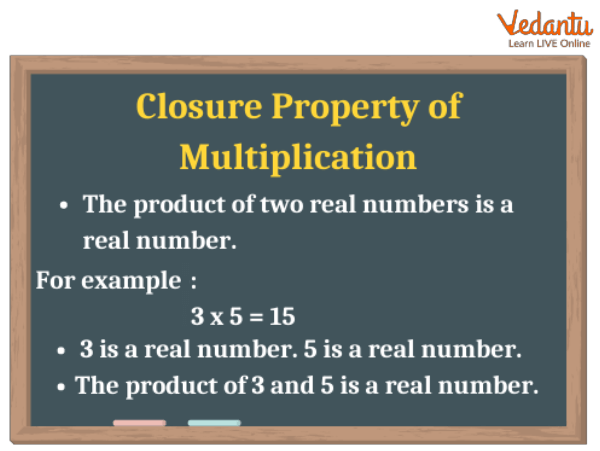
Closure Property of Multiplication
Associative Property of Multiplication
The result of the product of three or more numbers remains the same irrespective of their grouping. For example, (a × b) × c = a × (b × c).
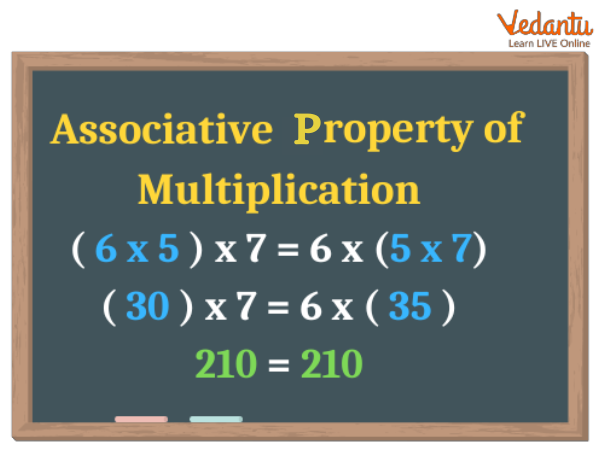
Associative Property of Multiplication
Distributive Property of Multiplication
The distributive property of multiplication states that if a, b and c are three numbers then,
a × (b + c) = (a × b) + (a × c).
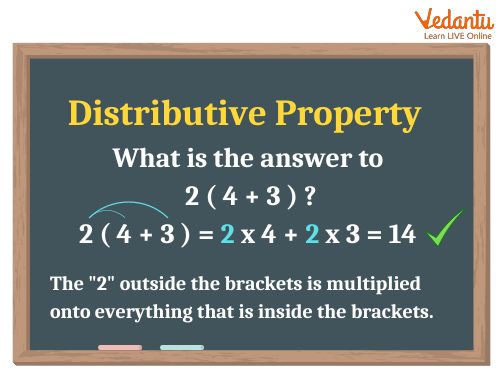
Distributive Property of Multiplication
Multiplication by 0
This is the most interesting property of multiplication. This property states that whenever any number is multiplied by 0, the result will be 0. In a simple way,
0 × anything = 0
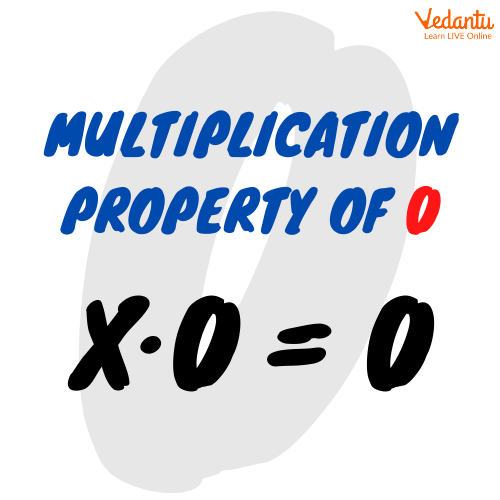
Multiplication by 0
Multiplicative Identity
The multiplicative identity states that if we multiply any number with 1, the answer is the number itself. In a simple way,
1 × a = a; 1 × b = b; 1 × c = c and so on.
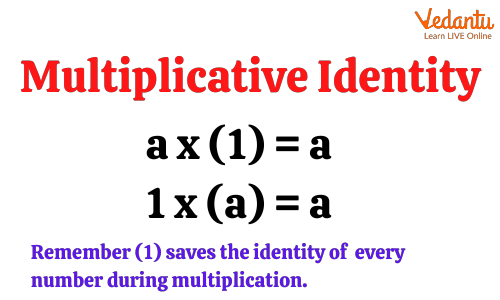
Multiplicative Identity
Commutative Property of Multiplication
The commutative property of multiplication states that changing the order of the numbers while multiplication does not change the result. In simpler words, whether you multiply a with b or b with a, the result will be the same. The order does not matter while multiplication. Example:
2 × 3 = 6 and
3 × 2 = 6
Exercise on Commutative Property of Multiplication
Here are a few questions for you to solve:
2 × _____ = 4 × _____ = 8
3 × _____ = 5 × _____ = 15
6 × _____ = 3 × _____ = 18
5 × _____ = 7 × _____ = 35
8× _____ = 6 × _____ = 48
9 × _____ = 8 × _____ = 72
4 × _____ = 5 × _____ = 20
7 × _____ = 3 × _____ = 21
5 × _____ = 9 × _____ = 45
2 × _____ = 8 × _____ = 16
Answers:
2 × 4 = 4 × 2 = 8
3 × 5 = 5 × 3 = 15
6 × 3 = 3 × 6 = 18
5 × 7 = 7 × 5 = 35
8 × 6 = 6 × 8 = 48
9 × 8 = 8 × 9 = 72
4 × 5 = 5 × 4 = 20
7 × 3 = 3 × 7 = 21
5 × 9 = 9 × 5 = 45
2 × 8 = 8 × 2 = 16
Quick Facts on Commutative Property
Did you enjoy learning the properties of multiplication? You know, we have a lot more for you. You can explore other topics of mathematics as well. Don’t wait anymore. Explore now and enjoy your learning!
FAQs on Understanding the Commutative Property in Multiplication
1. What is the commutative property of multiplication?
The commutative property of multiplication states that changing the order of numbers does not change the product. In other words, a × b = b × a.
- If you multiply 3 × 5, you get 15.
- If you multiply 5 × 3, you also get 15.
- The product remains the same regardless of order.
2. What is the formula for the commutative property of multiplication?
The formula for the commutative property of multiplication is a × b = b × a.
- a and b can be any real numbers.
- The product remains unchanged when the order of factors is switched.
3. Can you give an example of the commutative property of multiplication?
An example of the commutative property of multiplication is 6 × 8 = 8 × 6.
- 6 × 8 = 48
- 8 × 6 = 48
4. Why is the commutative property of multiplication important?
The commutative property of multiplication is important because it allows flexibility in solving multiplication problems.
- You can rearrange factors to make mental math easier.
- It simplifies algebraic expressions.
- It helps in understanding advanced properties like the distributive property.
5. Does the commutative property apply to all numbers?
Yes, the commutative property of multiplication applies to all real numbers.
- Whole numbers (e.g., 2 × 9 = 9 × 2)
- Integers (e.g., −3 × 5 = 5 × −3)
- Fractions (e.g., 1/2 × 4 = 4 × 1/2)
- Decimals (e.g., 0.5 × 8 = 8 × 0.5)
6. Is multiplication always commutative?
Yes, multiplication of real numbers is always commutative, meaning a × b = b × a.
- This rule holds for positive and negative numbers.
- It also applies to fractions and decimals.
7. What is the difference between the commutative and associative property of multiplication?
The commutative property changes the order of factors, while the associative property changes the grouping of factors.
- Commutative: a × b = b × a
- Associative: (a × b) × c = a × (b × c)
8. How do you use the commutative property in solving multiplication problems?
You use the commutative property by rearranging factors to make multiplication easier.
- Identify the numbers in the expression.
- Switch their order if it simplifies calculation.
- Multiply to find the product.
9. Does the commutative property apply to subtraction or division?
No, subtraction and division are not commutative operations.
- For subtraction: 10 − 3 = 7, but 3 − 10 = −7.
- For division: 12 ÷ 4 = 3, but 4 ÷ 12 ≠ 3.
10. How does the commutative property help in algebra?
The commutative property helps in algebra by allowing variables and constants to be rearranged without changing the product.
- For example, 3x × 5 = 5 × 3x.
- This can be rewritten as 15x.
- It simplifies expressions and supports equation solving.
