








What Is Addition For Class 1 with Simple Steps and Examples
Addition happens when you put two or more numbers together to find the total amount. The result of adding two or more numbers is called the sum. So, you would add your 4 cookies and your friend's 4 cookies to find that the sum is 8 cookies.
Addition is a mathematical operation that is used to add numbers. The sum of the provided numbers is the outcome of adding the given numbers. For instance, if we add 2 and 3, (2 + 3), the result is 5. We used the addition function on two numbers, 2 and 3, to get the sum, 5. In this article, we are going to see problems based on addition like the word problem of addition for class 1.
Addition Symbol
Different symbols are used in Mathematics. One of the most used arithmetic symbols is the addition symbol. We read about adding two integers, 2 and 3, in the definition of addition above. If we look at the addition pattern (2 + 3 = 5), we can see that the symbol (+) joins the two numbers and completes the supplied phrase. The addition symbol is made up of one horizontal and one vertical line. It is also known as the plus symbol (+) or the addition sign (+).
Simple Addition for Class 1
The basic formula of easy addition for Class 1 or the mathematical equation of addition can be explained as follows. Here, 2 and 5 are the addends and 7 is the sum.
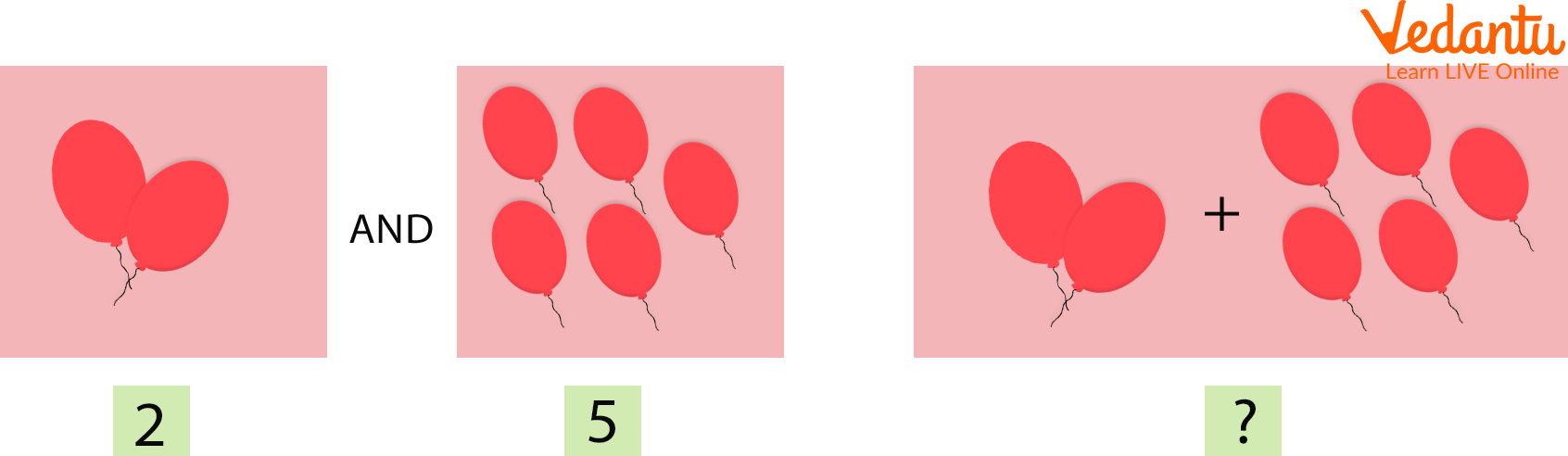
Simple Addition
2 Digit Addition for Class 1
2-digit addition for Class 1 is a simple form of addiction in which numbers are placed according to their place value of ones and tens and then added. Once both columns are added, we obtain the final sum. For finding a total of two single-digit numbers, just count the first number on your fingers and then count the second number on your finger, and the sum of the total fingers is the result.
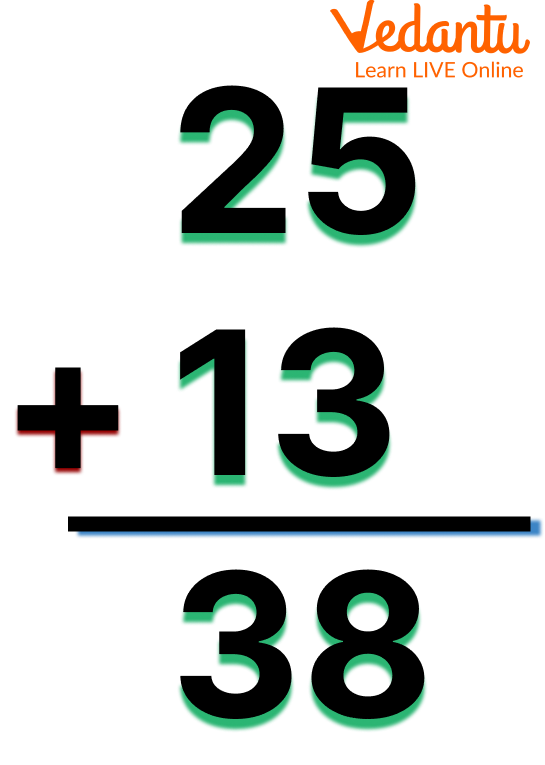
2-Digit Addition for Class 1
Carryover Addition for Class 1
When adding numbers, if the sum of the addends in any of the columns is more than 9, we regroup this amount into tens and ones. The tens digit of the sum is then carried over to the preceding column, and the one's digit of the sum is written in that column. In other words, we just write the number in the 'ones place digit' in that column, while moving the number in the 'tens place digit' to the column to the immediate left. With the help of an example, let us learn how to add two or more numbers in carrying over addition for Class 1.
Example: Add 3475 and 2865.
Solution: Let us follow the given steps:
Step 1: Start with the digits in one place. (5 + 5 = 10). Here the sum is 10. The tens digit of the sum, that is, 1, will be carried to the preceding column.
Step 2: Add the digits in the tens column along with the carryover 1. This means, 1 (carry-over) + 7 + 6 = 14. Here the sum is 14. The tens digit of the sum, that is, 1, will be carried to the hundreds place.
Step 3: Now, add the digits in the hundreds place along with the carryover digit 1. This means, 1 (carry-over) + 4 + 8 = 13. Here the sum is 13. The tens digit of the sum, that is, 1, will be carried to the thousands place.
Step 4: Now, add the digits in the thousands place along with the carryover digit 1, that is, 1 (carry-over) + 3 + 2 = 6
Step 5: Therefore, the sum of 3475 + 2865 = 6340
Addition Story Sums for Class 1
One morning, your mother called you and gave you 4 chocolates. After that, your father called you and gave you 5 chocolates. Amazing isn’t it? Now you have so many chocolates. Can you tell me how many chocolates you have? If you have to answer this question then you need to use addition.
Addition is basically counting the total number of objects you have. While adding two numbers, count forward the numbers equal to the second number after the first number. Addition will be easy if we take the bigger number and then count forward the smaller number. While adding 5 + 4 counting four numbers after 5 is easier than counting five numbers after 4. So the answer is 9 chocolates.
Learning becomes easy if you imagine stories in your mind and then think accordingly. Solving the word problems on addition for Class 1 will help you to understand addition in the real world.
Example 1: Peter has two boxes of Chocolates. There are 25 chocolates in one box and 15 chocolates in the other box. How many Chocolates does Peter have in total?
Solution: 25 Chocolates in one box and 15 chocolates in the other box makes a total of 40 chocolates in both boxes.
Example 2: Sam went to a park, 8 boys and 10 girls were already playing there when Sam came to the park. How many children were playing in the Park when Sam came to the park?
Solution: On adding 8 boys and 10 girls together, we get 18. So, when Sam came to the park, he saw 18 Children Playing.
Solved Examples
Q1. Add 100 + 150
Ans: Adding both we get 250.
Q2. Add 27 + 30
Ans: Adding both we get 57.
Q3. Add 65 + 10
Ans: Adding both we get 75.
Q4. Add 73 + 76 using the carry method.
Ans: Adding both we get 149
Q5. Add 59 + 94 using the carry method.
Ans: Adding both we get 153
Practice Questions
Some practice questions for simple addition Class 1.

Practice Question
Summary
The process of combining two or more items is known as an addition. The procedure of determining the sum of two or more numbers in Mathematics is known as addition. It is a basic mathematical operation that we all employ on a daily basis. Addition (usually denoted by a plus sign +) is one of the four basic operations of arithmetic, the other three being subtraction, multiplication, and division. Also, we have seen some word problems related to the addition of numbers. We hope this article will help you in understanding the addition for Class 1.
FAQs on Addition For Class 1 Simple Guide for Kids
1. What is addition in Maths for Class 1?
Addition is the process of putting two or more numbers together to find their total or sum. In Addition for Class 1, children learn to combine small numbers to get a bigger number.
- The numbers being added are called addends.
- The answer is called the sum.
- Example: 2 + 3 = 5.
2. How do you teach addition to Class 1 students?
Addition for Class 1 students is best taught using objects, pictures, and number lines to make learning visual and simple. Follow these steps:
- Use objects like apples or blocks (e.g., 1 apple + 2 apples = 3 apples).
- Draw pictures to count and combine items.
- Use a number line to jump forward while adding.
- Practice simple sums like 4 + 1 = 5.
3. What is the symbol used for addition?
The symbol used for addition is the plus sign (+). It shows that two or more numbers are being added together.
- Example: 3 + 2 = 5
- The plus sign means “add together.”
4. What is the formula for addition?
The basic formula for addition is a + b = sum. This means when two numbers are added, the result is called the sum.
- Example: 6 + 2 = 8
- Here, 6 and 2 are addends, and 8 is the sum.
5. Can you give an example of addition for Class 1?
A simple example of addition for Class 1 is 5 + 3 = 8. Let’s solve it step by step:
- Start with 5.
- Count 3 more: 6, 7, 8.
- The total is 8.
6. What are addition facts in Class 1?
Addition facts are simple number combinations that students memorize to solve sums quickly. These are basic sums usually within 10 or 20.
- Example: 1 + 1 = 2
- Example: 4 + 5 = 9
- Example: 7 + 2 = 9
7. What is adding using a number line?
Adding using a number line means moving forward on the number line to find the sum. It helps Class 1 students visually understand addition.
- Example: To solve 3 + 4
- Start at 3 on the number line.
- Jump 4 steps forward.
- You land on 7.
8. What is the commutative property of addition?
The commutative property of addition means that changing the order of numbers does not change the sum. In simple words, a + b = b + a.
- Example: 2 + 5 = 7
- And 5 + 2 = 7
9. What are common mistakes in addition for Class 1?
Common mistakes in Class 1 addition include counting errors and forgetting to add all numbers. Students should watch for:
- Skipping numbers while counting.
- Starting from 1 instead of the given number.
- Misreading the plus (+) sign.
10. Why is addition important for Class 1 students?
Addition is important for Class 1 students because it builds the foundation for all future Maths concepts. It helps children:
- Understand totals and counting.
- Solve daily life problems like counting toys or fruits.
- Prepare for subtraction, multiplication, and higher Maths.
