








How to Tell Which Number Is Larger with Examples and Rules
It's vital to remember that every number on a number line is larger than the number to its left and less than the number to its right while learning greater than and less than symbols. In arithmetic, the terms larger or less than and equal are used to help children comprehend how one number differs from another. Whether one number is more than or less than the other, or whether both numbers are equal. Important symbols or signs are needed to identify numbers in order to comprehend the larger, smaller, and equal numbers.
What is Greater Than?
Inequality can be defined as a comparison between two or more numbers, quantities, or values. It's utilized when the first or second amount or number is more than the second or remainder quantity or number. When comparing numbers and values, the sign > is used. The sign's large open side always points to the larger number, while the little end always points to the smaller number.

Plane is Larger Than Bus and Cab
To compare integers and expressions, greater than and less than symbols can be employed. > is the greater than symbol. As a result, 9 >7 means '9 is greater than 7'. The sign for less than is. (greater than or equal to) and (less than or equal to) are two other comparison symbols (less than or equal to).
It appears to be a straightforward concept: larger than less than. We would discuss which number the "alligator" ate.
We use the greater than the symbol “>” when one integer is greater than the other.
We use the less-than sign “<” when one number is less than the other.
When one number equals another, we use the equal to symbol “=”.
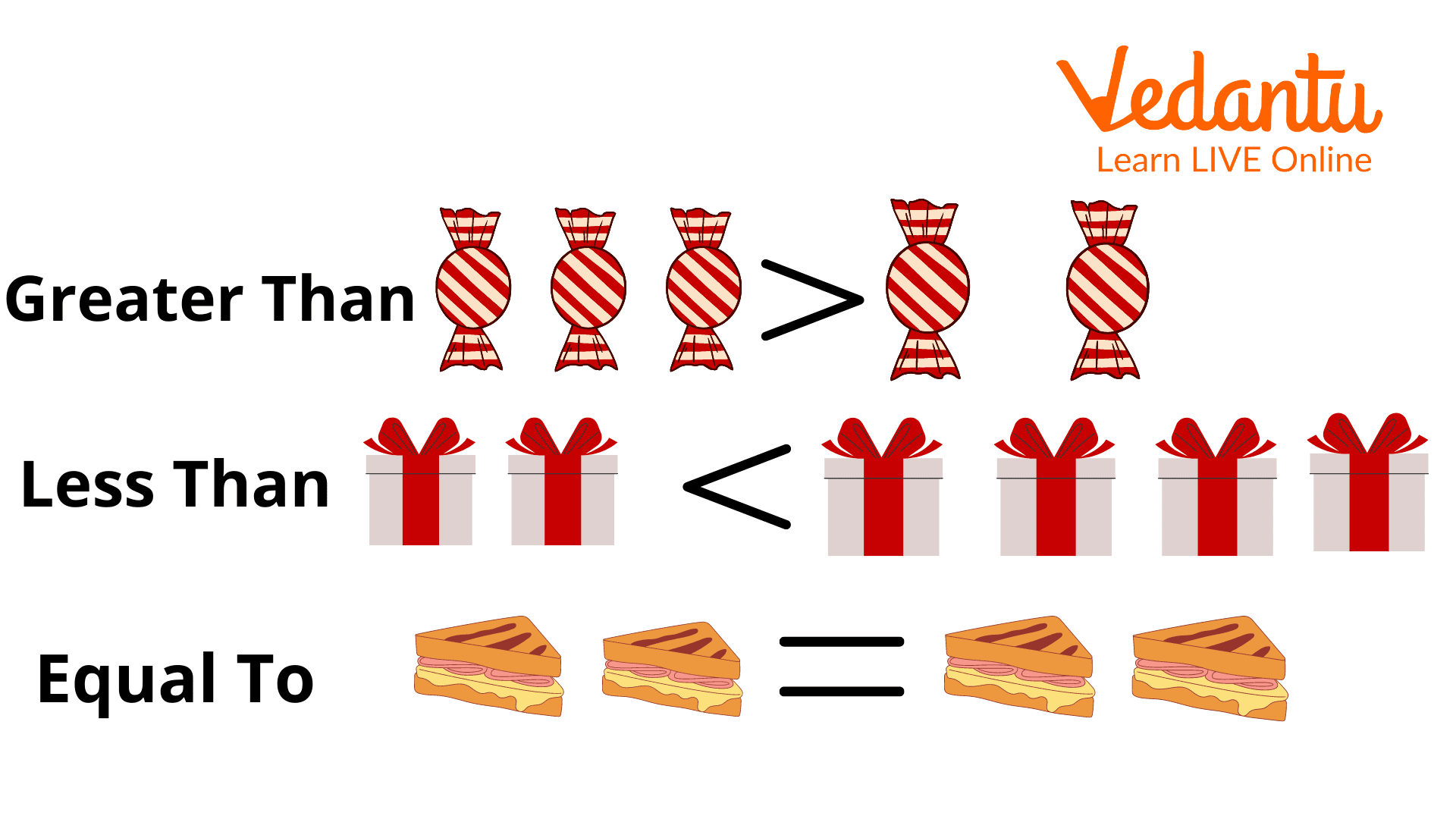
Greater Than, Less Than, and Equal to Signs.
> The open right hand is usually greater than the sign.
< The open left hand is usually greater than the sign.
Examples
8 is greater than 3
8 > 3
4 is less than 9
4 < 9
5 is equal to 5
5 = 5
Compare the numbers in each set and place a > sign between them.
45 > 39
89 > 12
27 > 23
100 > 95
50 > 30
Tips for Parents
Ask your child to compare the sizes of plates, glasses, and cups, describing the differences using words like "huge," "larger," and "largest."
Compare and contrast your child's hands and feet with your own. Ask who has the larger hand or foot by placing your hand or foot next to your child's. Inquire about the person with the smaller hand or foot.
Use your hands or feet to measure things around the house. "Could you tell me how many walls there are in the room?" Measure the height of the TV with your hands.
Conclusion
To represent the connection between two numbers, greater than and less than symbols are employed. It is vital to teach children the concepts of more and less so that they can compare the quantities of goods and determine which is more or less.
Toys, attractive objects, fruits, vegetables, and other stuff, rather than simply words, may be used to teach more and fewer ideas to children with autism. The wide-open side of the sign is always towards the higher-valued number. These symbols come in handy when there is no clear answer to an arithmetic issue.
FAQs on What Is Larger in Mathematics and How to Compare Numbers
1. What does "what is larger" mean in maths?
"What is larger" in maths means determining which number or quantity has the greater value when comparing two or more values. To decide which is larger, you can:
- Compare digits from left to right (for whole numbers).
- Convert fractions or decimals to the same form.
- Use number lines to visually compare positions.
- Apply comparison symbols like >, <, or =.
2. How do you compare two whole numbers to see which is larger?
To compare two whole numbers, compare digits starting from the leftmost place value to find which has the greater place value. Follow these steps:
- Check the number of digits (more digits usually means larger).
- If digits are equal, compare from left to right.
- The first differing digit determines the larger number.
3. Which is larger: a fraction or a decimal?
To know which is larger between a fraction and a decimal, convert them into the same form and compare their values. Steps:
- Convert the fraction into a decimal by dividing numerator by denominator.
- Or convert the decimal into a fraction.
4. How do you know which fraction is larger?
To determine which fraction is larger, compare their numerators and denominators or use a common denominator. Methods:
- If denominators are the same, the fraction with the larger numerator is larger.
- If numerators are the same, the fraction with the smaller denominator is larger.
- Otherwise, find a common denominator.
5. How do you compare decimal numbers to see which is larger?
To compare decimals, line up the decimal points and compare digits from left to right. Steps:
- Write decimals vertically with aligned decimal points.
- Add zeros if needed (e.g., 0.50 = 0.5).
- Compare digits place by place.
6. Which is larger: negative numbers or positive numbers?
Any positive number is always larger than any negative number. On a number line:
- Positive numbers are to the right of zero.
- Negative numbers are to the left of zero.
7. How do you compare large numbers with many digits?
To compare large numbers, check the number of digits and then compare place values from left to right. Steps:
- The number with more digits is larger.
- If equal digits, compare each place value starting from the highest.
8. How can a number line help determine what is larger?
A number line shows that the number further to the right is always larger. To use it:
- Plot both numbers on the line.
- See which number appears further right.
9. What symbol is used to show which number is larger?
The symbol used to show a larger number is the > (greater than) sign. Common comparison symbols include:
- > means greater than
- < means less than
- = means equal to
10. What are common mistakes when deciding which number is larger?
Common mistakes when deciding what is larger include ignoring place value and misreading decimals. Watch out for:
- Thinking 0.5 is larger than 0.75 (since 0.75 has greater tenths and hundredths).
- Believing −8 is larger than −3 (−3 is actually larger because it is closer to zero).
- Comparing fractions without finding common denominators.
