








How To Write Roman Numerals 1 To 500 With Chart and Examples
Roman numbers are defined as a way of representing numbers in the Roman numerical system: I = 1, V=5, L=50, and so on. It is a numerical representation of digits as in the ancient Roman system.
We can also define Roman numbers as a number system that originated in ancient Rome. There are no zeros in this system. This system is still used in many places. In Roman numerals, alphabets are used to represent the fixed positive numbers, these are written as follows:
Roman Numbers
In this system, a letter placed after another of greater value adds whereas a letter placed before another of greater value subtracts.
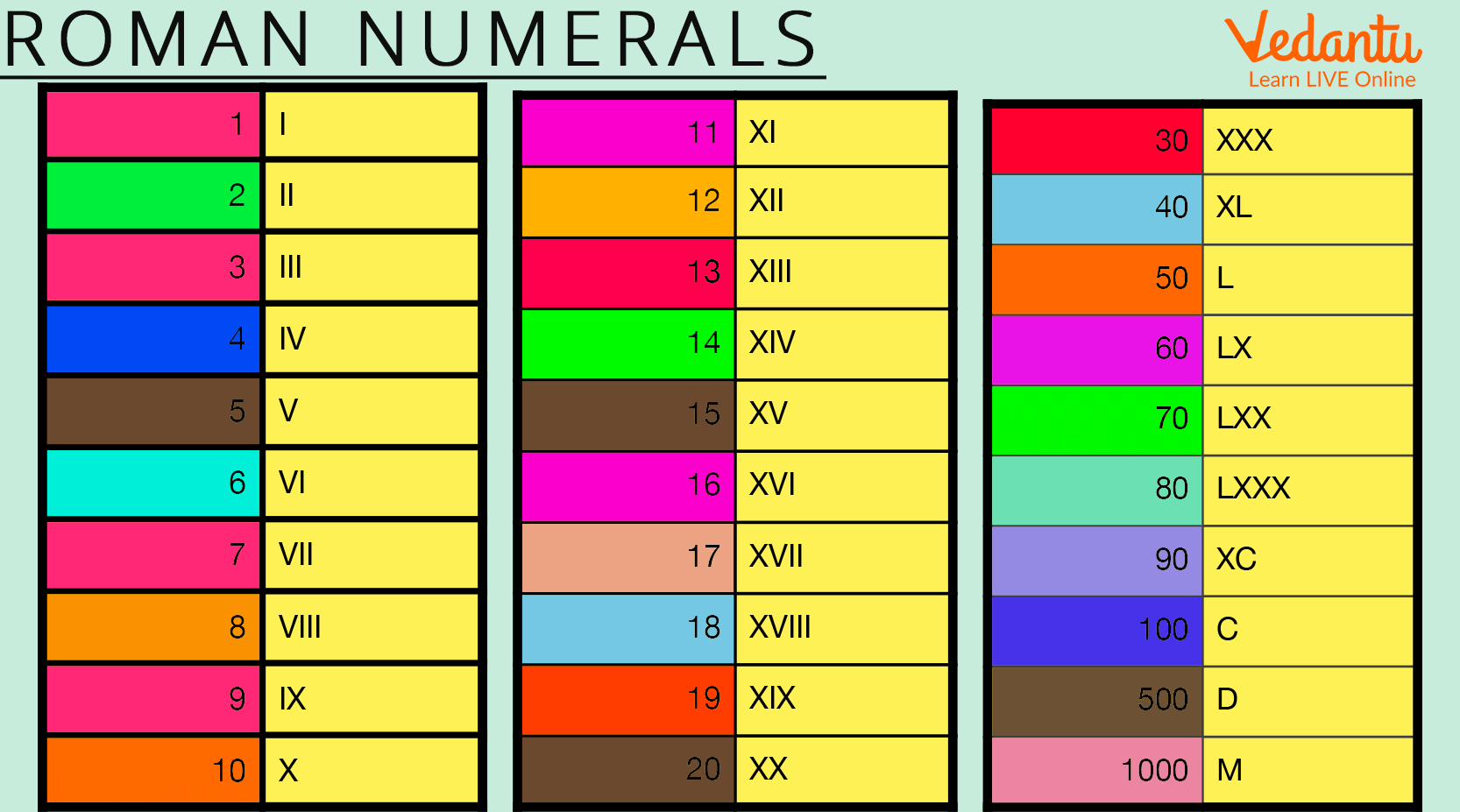
We all have come across different types of fonts and different ways in which digits are written. Some addresses are written including numbers X and VII, and even sections or classes in a school are written in such patterns or ways. After 10, the Roman numerals are followed by XI for 11, XII for 12….till XX for 20. The most common Roman numbers are given in the table below:

Roman Numerals
In this article, Roman numerals have been discussed in detail. A chart containing Roman numbers from 1 to 500 is also shown in the article below.
Roman Numerals (1 to 500)
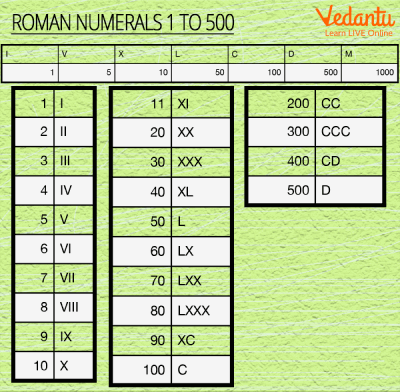
Below is the chart for Roman numerals that shows the Roman numerals from 1 to 500. Using this chart, we can easily write numbers and can understand the concept of Roman numbers.
Roman Numerals
Rules to Write Roman Numerals
There are certain rules to be followed while presenting a number in Roman numerals which are as follows:
The value of the symbol is added to itself as many times as it is repeated. For example II = 2, XX = 20, XXX = 30.
Symbols such as V, L, and D are never repeated and are never subtracted.
When a symbol of a smaller value appears after a symbol of greater value, its value will be added for example- VI = V + I =5 + 1 = 6.
When a symbol of smaller value appears before a symbol of greater value symbol, its value will be subtracted for example IX = X - I = 10 -1 = 9
The symbol I can be subtracted from V and X only and symbol X can be subtracted from symbols L, M, and C only.
Also, we can clearly understand that there is no requirement of writing zeros to represent 50 or 100; we can just write L and C. Thus, these letters are considered to be very easy and indicate the entire number system.

Content of Book in Roman
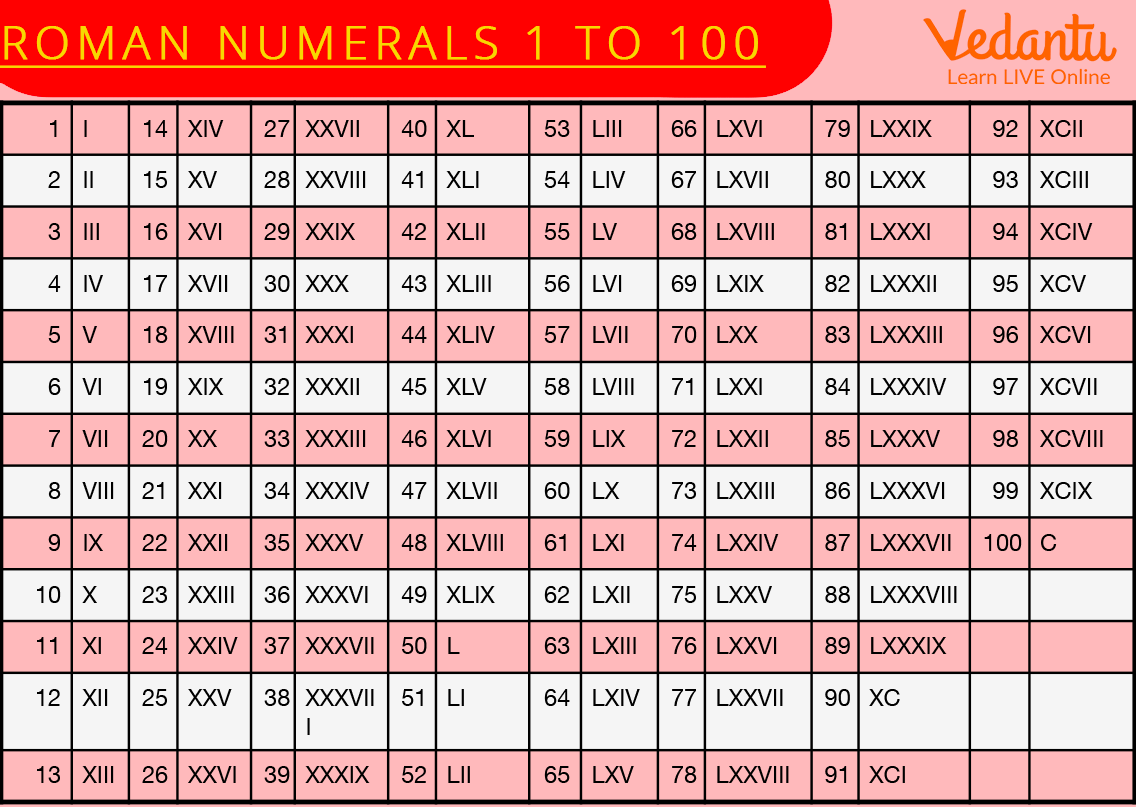
One to Hundred Roman Number
Interesting Facts About Roman Numerals
Roman numerals are used in many places, and things such as on the faces of watches and clocks, in calendars some dates are written in Roman numerals, and roll numbers are assigned to students in Roman numerals in schools. Also in books, the numbering of chapters follows the Roman numerals. They are also used in astronomy to designate the moon's position.

The Face of a Wall Clock in Roman Numbers
Roman numerals are also used in fractions, which are uncia.
Kings and Queens are named after Roman numerals such as Henry VII.
The Romans would sometimes use Roman numerals as the days of the week.
Around the 8th to 9th century B.C.E, Roman numerals were discovered.
Roman numerals are also used in the National Football League in the numbering system of the Super Bowl.
Solved Examples
Q 1. Write 1774 in Roman Numerals.
Ans: So let us understand how we can write this:
First of all, we need to break 1774 into 1000, 700, 70, and 4 and then do each conversion
As we know 1000 = M, 700 = DCC,70 = LXX,4 = IV
So adding all it becomes:
1000 + 700 + 70 + 4 = 1774,
Hence, 1774 = MDCCLXXVI
Q 2. Write 800 in Roman numerals.
Ans: First we need to break 800
800 = 500 + 100 + 100 + 100
As we know that 500 = D and 100 = C
Therefore, 800 = DCCC
Practise Questions
Q 1. Write the following in roman numbers.
450
600
500
920
Ans: 450 = CDL , 600 = DC, 500 = D, 920 = CMXX
Summary
Historians believed that the Roman numerals played a critical part during the creation of architecture. Also, their importance cannot be underestimated as it enabled Romans to put a price on their goods and services. Also, there are countless theories based on Roman numerals.
FAQs on Roman Numbers From 1 To 500 Complete List and Rules
1. What are Roman numbers from 1 to 500?
Roman numbers from 1 to 500 are numbers written using the Roman numeral system based on seven symbols: I, V, X, L, C, D, M.
- 1 = I
- 5 = V
- 10 = X
- 50 = L
- 100 = C
- 500 = D
All numbers from 1 to 500 are formed by combining these symbols using addition and subtraction rules, such as 4 = IV and 90 = XC.
2. How do you write numbers from 1 to 500 in Roman numerals?
To write numbers from 1 to 500 in Roman numerals, break the number into hundreds, tens, and ones and convert each part using Roman numeral symbols.
- Step 1: Write the hundreds (e.g., 300 = CCC)
- Step 2: Write the tens (e.g., 40 = XL)
- Step 3: Write the ones (e.g., 7 = VII)
Example: 347 = 300 + 40 + 7 = CCCXLVII.
3. What is the Roman numeral for 500?
The Roman numeral for 500 is D.
In the Roman numeral system:
- 100 = C
- 500 = D
- 1000 = M
So, D represents five hundreds in Roman numbers.
4. What is the Roman numeral for 100, 200, 300, and 400?
The Roman numerals for 100, 200, 300, and 400 are C, CC, CCC, and CD respectively.
- 100 = C
- 200 = CC
- 300 = CCC
- 400 = CD (500 − 100)
The number 400 uses the subtraction rule where C is placed before D.
5. How do you convert Roman numerals to numbers up to 500?
To convert Roman numerals to numbers up to 500, add or subtract the values of the symbols based on their order.
- If a smaller numeral comes before a larger one, subtract it (e.g., IV = 5 − 1 = 4).
- If a smaller numeral comes after a larger one, add it (e.g., VI = 5 + 1 = 6).
Example: CDXL = (500 − 100) + (50 − 10) = 400 + 40 = 440.
6. Why is 400 written as CD in Roman numerals?
The number 400 is written as CD because C (100) is placed before D (500) to indicate subtraction.
- D = 500
- C = 100
- CD = 500 − 100 = 400
This follows the subtraction rule in Roman numerals where a smaller value before a larger value means subtraction.
7. What are the rules for writing Roman numbers from 1 to 500?
The rules for writing Roman numbers from 1 to 500 include repetition, addition, and subtraction principles.
- A symbol can be repeated up to three times (e.g., III = 3).
- When a smaller number follows a larger one, add them (e.g., VIII = 8).
- When a smaller number comes before a larger one, subtract it (e.g., IX = 9).
- V, L, and D are never repeated.
These rules help form all Roman numerals up to 500 correctly.
8. What is the Roman numeral chart from 1 to 100?
The Roman numeral chart from 1 to 100 lists numbers using combinations of I, V, X, L, and C.
- 1–10: I, II, III, IV, V, VI, VII, VIII, IX, X
- 20 = XX
- 30 = XXX
- 40 = XL
- 50 = L
- 90 = XC
- 100 = C
This chart forms the foundation for writing Roman numbers up to 500.
9. How do you write 250 and 375 in Roman numerals?
The Roman numerals for 250 and 375 are CCL and CCCLXXV respectively.
- 250 = 200 + 50 = CC + L = CCL
- 375 = 300 + 70 + 5 = CCC + LXX + V = CCCLXXV
Break the number into hundreds, tens, and ones to convert accurately.
10. What are common mistakes when writing Roman numerals up to 500?
Common mistakes when writing Roman numerals up to 500 include repeating symbols incorrectly and ignoring subtraction rules.
- Writing 4 as IIII instead of IV
- Repeating V, L, or D (which is not allowed)
- Writing 90 as LXXXX instead of XC
- Placing symbols in the wrong order
Following the correct Roman numeral rules ensures accurate number representation from 1 to 500.
