








How to Solve 4 Digit Subtraction Without Regrouping Step by Step
For centuries, we have been using subtraction for numerous uses. Brahmagupta is a famous Indian mathematician for introducing subtraction to the globe. In medieval Europe, this was referred to as the "Modus Indorum" or "Method of the Indians." The four fundamental mathematical operations are addition, subtraction, multiplication, and division. So, let’s learn how to do subtraction of 4-digit numbers without regrouping in this article.
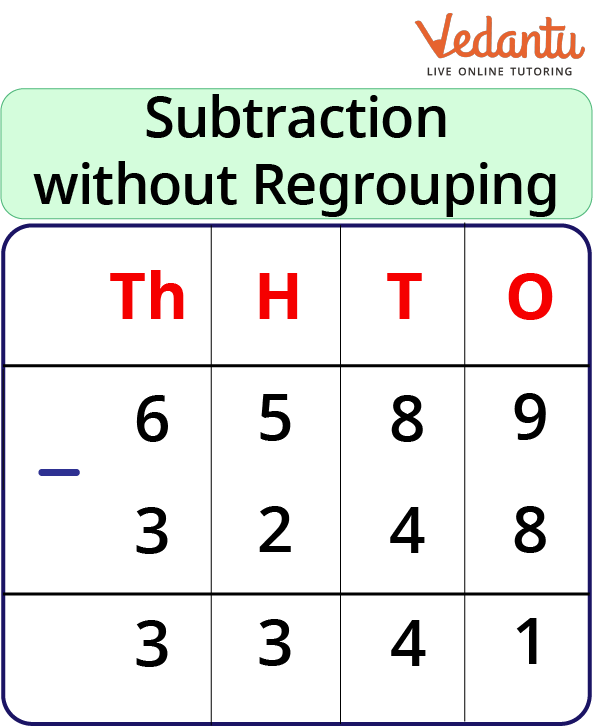
Subtraction of 4-digit numbers
What is Subtraction?
Only by first understanding the subtraction method will we be able to accomplish 4-digit subtraction. It is the difference in the numbers. The four-digit subtraction involves subtracting two or more four-digit values from one another. The result is known as the four-digit numbers' difference. Minuend and subtrahend are the parts of subtraction. Like any other essential mathematical operation, subtraction also has a unique symbol, i.e., ‘- ‘’.
How to Perform 4 Digit Subtraction Without Borrowing?
Following are the rules for solving the subtraction of 4 – digit numbers –
Firstly, arrange the numbers vertically so that the thousand’s place digits and one's place digits are lined up, meaning simply one number should be written above the other. Draw a line under the bottom number.
6 4 3 2
- 5 1 2 1
Subtract the digits in the one's place. Subtract (2 - 1 = 1). Place 1 in the one column as shown.
6 4 3 2
- 5 1 2 1
—-----------------
1
Subtract the digits in the tens' place. Subtract (3 - 2 = 1). Place 1 in the tens column as shown.
6 4 3 2
- 5 1 2 1
—-----------------
1 1
Subtract the digits in the hundreds place. Subtract (4 - 1 = 3). Place 3 in the hundreds column as shown.
6 4 3 2
- 5 1 2 1
—-------------------
3 1 1
Subtract the digits in the thousands place. Subtract (6 - 5 = 1). Place 1 in the thousands column as shown.
6 4 3 2
- 5 1 2 1
—------------------
1 3 1 1
The difference between 6432 – 5121 is 1311.
Worksheets on 4 Digit Subtraction Without Borrowing
Let us see a look at some 4-digit subtraction without carrying worksheets:
Example 1:
A total of 2550 students attend college. How many boys are there if 1320 are girls?
Solution:
Total no. of children = 2550 and no. of girls = 1320
According to the given question,
2 5 5 0
- 1 3 2 0
--------------------
1 2 3 0
No. of boys = 2550 – 1320
No. of boys = 1230
Therefore, the total no. of boys is 1230.
Example 2:
Meena read 2790 books from a popular book series. If there are 1040 books in the series. Then how many books are yet to be read?
Solution:
According to the given question,
2 7 9 0
- 1 0 4 0
—-------------------
1 7 5 0
No. of books are yet to be read = 2790 – 1040 = 1750
Therefore, no. of books that are yet to be read is 1750.
Example 3:
Dimple scored 4744, while Mayur scored 2521 in a video game. How many additional points did Dimple get?
Solution:
Score of Dimple = 4744 , and score of Mayur = 2521
According to the given question,
4 7 4 4
- 2 5 2 1
—-----------------
2 2 2 3
Extra points for Dimple = 4744 – 2521 = 2223
Therefore, the additional points that Dimple got are 2223.
Conclusion
At a young age, we start to learn how to subtract. After learning about numbers, we learn how to count with them. For example, we learn about subtraction by counting how many candies we still have after eating. The term "4-digit subtraction without borrowing" refers to subtracting two or more numbers, each with four digits, without taking any carry. Refer to the 4-digit subtraction without regrouping worksheets PDF to practice the questions.
FAQs on Practice 4 Digit Subtraction Without Borrowing Worksheets
1. What is 4 digit subtraction without regrouping?
4 digit subtraction without regrouping is a subtraction method where each digit is subtracted place by place without borrowing from the next column. In this method, the digit in the minuend is always greater than or equal to the digit in the subtrahend in every place value.
- Align numbers by thousands, hundreds, tens, and ones.
- Subtract each column from right to left.
- No borrowing or regrouping is needed.
2. How do you solve a 4 digit subtraction without regrouping step by step?
To solve 4 digit subtraction without regrouping, subtract each place value column starting from the ones place without borrowing. Follow these steps:
- Step 1: Write the numbers vertically by place value.
- Step 2: Subtract the ones digits.
- Step 3: Subtract the tens digits.
- Step 4: Subtract the hundreds digits.
- Step 5: Subtract the thousands digits.
3. Can you give an example of 4 digit subtraction without regrouping?
An example of 4 digit subtraction without regrouping is 8956 − 4321 = 4635. Here is how it works:
- Ones: 6 − 1 = 5
- Tens: 5 − 2 = 3
- Hundreds: 9 − 3 = 6
- Thousands: 8 − 4 = 4
4. When do you not need regrouping in 4 digit subtraction?
You do not need regrouping in 4 digit subtraction when every digit in the top number is greater than or equal to the corresponding digit below it. In other words:
- Ones digit ≥ ones digit
- Tens digit ≥ tens digit
- Hundreds digit ≥ hundreds digit
- Thousands digit ≥ thousands digit
5. What is the difference between subtraction with regrouping and without regrouping?
The main difference is that subtraction with regrouping requires borrowing, while subtraction without regrouping does not.
- Without regrouping: Each top digit is greater than or equal to the bottom digit.
- With regrouping: At least one top digit is smaller, so you must borrow from the next place value.
Example with regrouping: 6004 − 2789.
6. Why is place value important in 4 digit subtraction without regrouping?
Place value is important because it ensures digits are subtracted correctly according to their value. In 4 digit subtraction without regrouping:
- Digits must line up under thousands, hundreds, tens, and ones.
- Incorrect alignment leads to wrong answers.
7. What are common mistakes in 4 digit subtraction without regrouping?
Common mistakes in 4 digit subtraction without regrouping include incorrect alignment and subtracting in the wrong order. Watch out for:
- Not lining up digits by place value.
- Subtracting the larger digit from the smaller digit incorrectly.
- Starting from the left instead of the ones place.
8. How can worksheets help with 4 digit subtraction without regrouping?
Worksheets help students practice repeated problems to build accuracy and speed in 4 digit subtraction without regrouping. They provide:
- Structured column subtraction problems.
- Gradual difficulty levels.
- Opportunities to reinforce place value understanding.
9. What is an easy trick to check 4 digit subtraction answers?
The easiest way to check a subtraction answer is by using addition to verify the result. Simply add the difference to the subtrahend.
- If 7643 − 2311 = 5332,
- Then check: 5332 + 2311 = 7643.
10. Who should practice 4 digit subtraction without regrouping?
Students in Grade 2 and Grade 3 typically practice 4 digit subtraction without regrouping to strengthen place value and basic subtraction skills. This skill helps learners:
- Understand multi-digit subtraction.
- Prepare for subtraction with regrouping.
- Improve mental math and number sense.
