








How to Do Subtraction With Borrowing Step by Step with Examples
Learning subtraction is different than learning addition, but kids can perform it effortlessly if taught correctly- start with simple numbers and go slowly. You can progress to more advanced subtraction sums when you develop a solid foundation. You can accomplish this by explaining subtraction as taking away, using number lines, and practising subtraction vocabulary.
In Mathematics, subtraction is the removal of items from a group. Always remember that we start subtraction from one’s place. Using the number line, we can subtract the integers. You can add a positive integer by going to the right on the number line. Subtraction is when we remove a specified number of objects from a specified collection of objects. The '–' symbol represents it. When one number is subtracted from another, the result is known as the difference.
How to Borrow in Subtraction?
When subtracting big integers, the top digit in a column may be less than the bottom digit in that column. In that situation, you must borrow from the column to your left.
subtraction with borrowing consists of two steps:
Cross out the number from which you're borrowing, subtract one, and write the result above the number you crossed out.
Add 10 to the number at the top of the column you were working in.
For example: In subtracting 26 from 53, as you can notice, the upper rightmost digit of the first number (i.e. 3) is smaller than the lower number’s digit (i.e. 6). Since 3 < 6, we borrow from the left side which is 5 and add 10 to that number the 3 becomes
(10 + 3) = 13. Subtract one from the top number in the column on the left (i.e. 5 – 1 = 4).
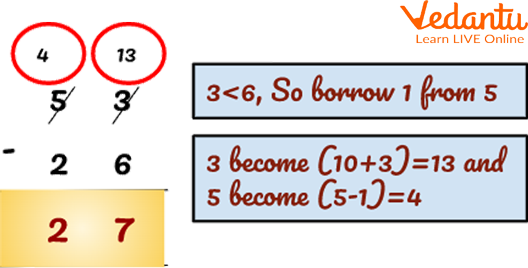
Subtraction with Borrowing
Subtraction with Carrying Over
Let's say you wish to subtract 34 from 926.
The first step is to remove 4 from 6 in the ones column, yielding 2.
When you move to the tens column 3, however, you need to subtract 2 – 3. Because 2 is smaller than 3, you need to borrow from the hundreds column.
First, cross out the 9 and replace it with 8, because 9 – 1 = 8. Next, add 10 into 2, changing it to 12, because 2 + 10 = 12. Now you can subtract in the tens column: 12 – 3= 9.
The final step is simple: 8 – 0 = 8.
Hence, the answer is 892.
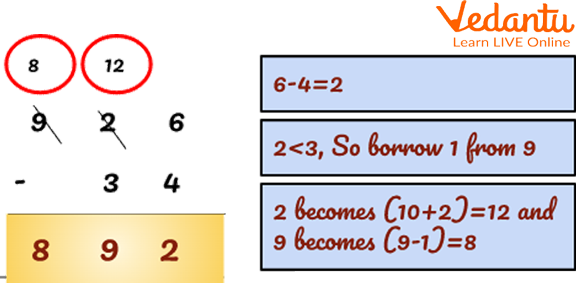
Subtraction with Carrying Over
Let takes another example of subtraction borrowing problems:
Q.1 Subtract 458 – 67.
Ans: The steps to solve this problem is as follows:
The first step is to remove 7 from 8 in the ones column, yielding 1.
When you move to the tens column 5, however, you need to subtract 5 – 6. Because 5 is smaller than 6, you need to borrow from the hundreds column.
First, cross out the 4 and replace it with a 3, because 4 – 1 = 3.
Next, place a 1 in front of the 5, changing it to 15, because 5 + 10 = 15. Now you can subtract in the tens column: 15 – 6= 9.
The final step is simple: 3– 0 = 3.
Hence, the answer is 391.
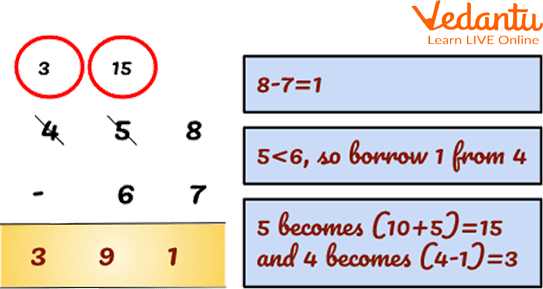
Subtraction with Carrying Over
Q 2. Subtract 245 – 36
Ans: The steps to solve this problem is as follows:
Firstly, we can borrow 10 from tens place to one’s place.
Now, begin the subtraction.
In ones place, subtract 6 from 15 i.e. 15 – 6 = 9.
In tens place, after lending 10 to ones place, it is left with 3. Now, subtract 3 from 3 that is 3 – 3 = 0.
In the hundredth place, 2 is left which is written as it is.
Hence 245 - 36 = 209
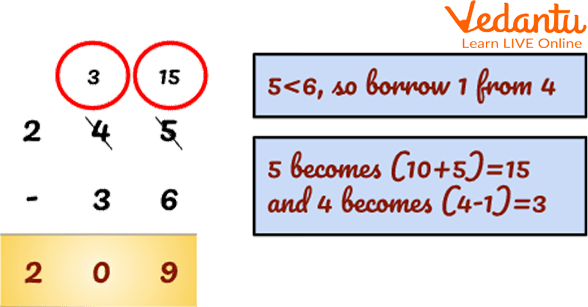
Subtraction of 245 – 36
Q 3. Subtract 952 – 456.
Ans: The steps to solve this problem is as follows:
First, borrow 10 from tens places to one's places.
Now, begin the subtraction.
In ones place, subtract 6 from 12. I.e. 12 – 6 = 6.
In tens place, after lending 10 to ones place it is left with 4. Now borrow 10 from hundreds of places.
In tens place subtract 5 from 14 i.e. 14 – 5 = 9.
After lending to tens place it is left with 8.
In the hundreds place, subtract 8 – 4 = 4
Hence, 952 – 456 = 496
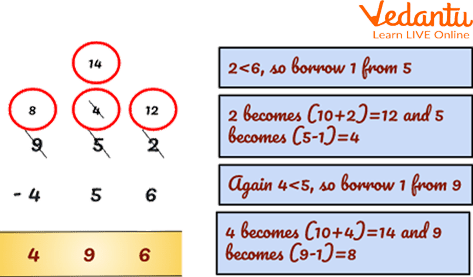
Subtraction of 952 – 456
Practice on Your Own
Q 1. Subtract 933 – 456.
Ans: 477
Q 2. Subtract 10000 – 12.
Ans: 9988
Summary
In this article, we have discussed that subtraction is done or used when we are asked to remove a specified number of objects from a specified collection of objects. Always start subtracting from one’s place. Subtraction can be done by borrowing or without borrowing. Subtraction with borrow is used when the right-most digit of the first number is smaller than the right-most digit of the second number. Always start subtracting from one’s place.
FAQs on Subtraction With Borrowing Made Simple
1. What is subtraction with borrowing?
Subtraction with borrowing is a method used when a digit in the minuend is smaller than the corresponding digit in the subtrahend, so you borrow 1 from the next higher place value. In this process:
- Subtract digits from right to left.
- If the top digit is smaller, borrow 1 from the next place (equal to 10 in base 10).
- Add 10 to the smaller digit and reduce the next digit by 1.
2. How do you do subtraction with borrowing step by step?
To do subtraction with borrowing, subtract each column from right to left and regroup when needed. Follow these steps:
- Step 1: Write numbers in place value columns (ones, tens, hundreds).
- Step 2: Start from the ones place.
- Step 3: If the top digit is smaller, borrow 1 from the next column.
- Step 4: Add 10 to the smaller digit and subtract.
- Step 5: Move to the next column and repeat.
3. Why do we need to borrow in subtraction?
We borrow in subtraction because a smaller digit cannot subtract a larger digit in the same place value without regrouping. In base 10:
- 1 ten equals 10 ones.
- Borrowing converts a higher place value into 10 units of the lower place.
4. Can you give an example of subtraction with borrowing?
Yes, an example of subtraction with borrowing is 73 − 48 = 25. Solution:
- Ones place: 3 is less than 8, so borrow 1 ten.
- 13 − 8 = 5
- Tens place: 6 − 4 = 2
5. What is the difference between subtraction with borrowing and without borrowing?
The difference is that subtraction with borrowing requires regrouping, while subtraction without borrowing does not.
- Without borrowing: Each top digit is greater than or equal to the bottom digit (e.g., 65 − 23).
- With borrowing: At least one top digit is smaller, so regrouping is required (e.g., 52 − 38).
6. How do you subtract numbers with zeros using borrowing?
To subtract numbers with zeros, borrow from the nearest non-zero digit to the left. Example: 400 − 186.
- Borrow from 4 hundreds.
- 400 becomes 3 hundreds, 9 tens, and 10 ones after regrouping.
- Then subtract normally.
7. What is the borrowing rule in subtraction?
The borrowing rule in subtraction states that if a digit in the minuend is smaller than the subtrahend digit, borrow 1 from the next higher place value and add 10 to the current digit. Key points:
- Reduce the higher place by 1.
- Add 10 to the smaller digit.
- Subtract as usual.
8. What are common mistakes in subtraction with borrowing?
Common mistakes in subtraction with borrowing include forgetting to reduce the borrowed digit and subtracting in the wrong order. Frequent errors:
- Not decreasing the next column after borrowing.
- Subtracting the smaller number from the larger regardless of position.
- Misaligning place values.
9. How do you check subtraction with borrowing?
You can check subtraction with borrowing by adding the difference to the subtrahend to see if you get the original minuend. Formula:
- Difference + Subtrahend = Minuend
10. Is subtraction with borrowing the same as regrouping?
Yes, subtraction with borrowing is the same as regrouping in subtraction. Both terms describe converting 1 unit from a higher place value into 10 units of a lower place value to make subtraction possible. For example, 1 ten becomes 10 ones when regrouping.
