









How to Solve Subtraction Word Problems with Step by Step Examples
Subtraction is used to calculate the remaining number from the two given numbers. There are certain basic rules to the concept of subtraction word problems.
We have to find the larger number out of the two given numbers. Then we have to find out the number which has to be subtracted from the larger number. We always start by subtracting the digits which are on the rightmost side. Further, the tens place digits are subtracted, then the hundredth, and so on.
We will be looking at the subtraction sums for Class 1, subtraction sums for Class 2, subtraction sums for Class 4, and subtraction sums for Class 5. These all sums would be based on the subtraction word problems. Let us start by subtraction sums for Class 1.
Subtraction Word Problems for Class 1
Word Problems are a little advanced form of subtraction problems. Firstly, we need to understand the story behind the text. Afterward, we need to identify the larger number and the number which is to be subtracted from the larger number.
Let us take an example to understand this.
Mike bought 12 pens from a shop on Monday. He gave 6 pens to Will on Tuesday. How many pens are left with Mike?
To understand this question we have to look at the story behind this question.
Pens bought by Mike = 12
Pens given to Will by Mike = 6
Number of pens left with Mike = 12 - 6
The answer to this would be 6 pens.
In the worksheet given below, there are three questions attached to a story. Children have to solve all the questions carefully. These questions will help them in understanding all the problems in a better manner.
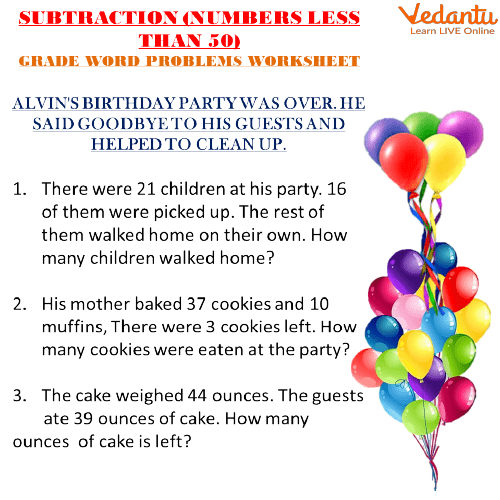
Worksheet for Word Problems
Subtraction Sums for Class 2
In the subtraction word problems for class 2, the digits are either 3 or 4 in the problems. For this, we need to keep the concept of place value in mind while solving the questions.
Let us take an example to understand this better.
Meena has 400 Rs. with her given to her as pocket money. Meena spent 200 Rs. in the fair where she bought toys, candies, and clothes. How much money is left with her?
Total money Meena has = Rs. 400
Money spent in fair = Rs. 200
Remaining money with Meena = 400 - 200
The answer to this question would be Rs. 200.
These kinds of questions can be moulded in various ways to make kids grasp the concept well and understand it fully.
Subtraction Sums for Class 4
In Class 4, the concepts are given an advanced level by including subtraction with borrowing concepts. These problems are the same as before except the borrowing part is added.
Let us take an example of the same.
Rony has 1846 marbles won by him in a contest. Rony decided to give 547 marbles to his sister Nancy. How many marbles are left with him?
Total number of marbles Rony has = 1846
Rony gave marbles to his sister = 547
Marbles left with Rony = 1846 - 547
Now as we know that 7 cannot be subtracted from 6 so a carry will be given to him by 4. Now 4 would become 3 and 2 will also need a carry from 8 to subtract 4 from it.
Likewise, the subtraction will be solved and the answer would be 1299 Marbles.
Subtraction Sums for Class 5
In Class 5, the combination of addition and subtraction is given. This makes word problems even more complex.
Let us take an example of this.
Team Magnum scored 478 runs in the first innings and 345 runs in the second innings. Team Rodger scored 389 runs in the first innings and 472 runs in the second innings. Which team won the match and by how many runs?
To find the answer to this question, we have to take it step by step. Firstly, we have to add the score of both innings.
Team Magnum Score in First Innings + Team Magnum score in Second Inning
478 + 345 = 823 runs
Team Rodger score in First Innings + Team Roger score in Second Innings
389 + 472 = 861 runs
Now we can clearly see that Team Rodger has won the match, to find out by how many runs it has won we have to subtract the run of Team Magnum out of the score of Team Rodger.
861- 823 = 38 Runs
Team Rodger won by 38 runs.
Solved Examples
Q1. If Mohan plants 5 saplings on day 1 and 15 on day 2, how many saplings does he plant more on day 2?
Ans: Saplings planted on Day 2 = 15
Saplings planted on Day 1 = 5
Saplings planted more in = 15 - 5 = 10
On Day 2, he planted 10 more saplings.
Q2. Sita ran for 1500 metres on Sunday and 2500 metres on Tuesday. Which day did she run more?
Ans: Metre on Sunday = 1500
Metre on Tuesday = 2500
2500 - 1500 = 1000 metres
She ran more metres on Tuesday.
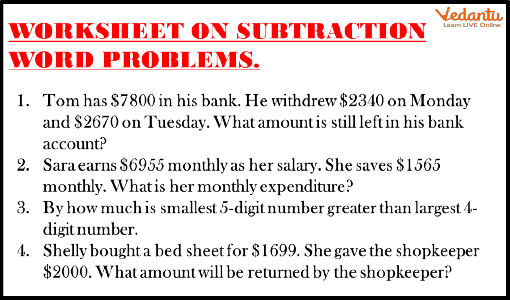
Worksheet
Practice on Your Own
Q1. Soumya went 200 km far from home to Calcutta, then she went 500 km from Calcutta to another place? How much more does she walk in second place from Calcutta?
Ans: 500 - 200 = 300 Kilometres
Q2. Meena made 20 cakes on Monday and 55 on Tuesday? How many more did she make on Tuesday?
Ans: 55 - 20 = 35 cakes.
Summary
Subtraction Word Problem-based questions are extremely important for students to learn. These questions help them to connect these concepts in their daily lives. Students must connect these concepts while counting money, going to shops, etc. these will help them in understanding the advanced level of problems as well.
FAQs on Subtraction Word Problems Explained with Simple Steps
1. What are subtraction word problems?
Subtraction word problems are maths problems that use real-life situations to find the difference between two numbers. They usually describe a situation where something is taken away, reduced, compared, or how many are left.
- Look for keywords like left, fewer, difference, take away, minus, remain.
- Identify the total and the part being removed.
- Write a subtraction equation to solve.
2. How do you solve subtraction word problems step by step?
To solve subtraction word problems, first identify the numbers and subtract the smaller amount from the larger amount.
- Step 1: Read the problem carefully.
- Step 2: Highlight important numbers and keywords.
- Step 3: Decide what is being taken away or compared.
- Step 4: Write a subtraction equation.
- Step 5: Solve and check your answer.
3. What keywords indicate subtraction in word problems?
Subtraction word problems often include keywords that signal taking away or finding a difference.
- Take away
- Left
- Fewer
- Difference
- Minus
- Remain
4. What is the formula for subtraction?
The basic subtraction formula is Minuend − Subtrahend = Difference. In this formula:
- The minuend is the number you start with.
- The subtrahend is the number you take away.
- The difference is the result.
5. Can you give an example of a subtraction word problem with a solution?
A subtraction word problem example is: Tom had 25 marbles and gave 9 to his friend; he has 16 marbles left.
- Total marbles = 25
- Marbles given away = 9
- Equation: 25 − 9 = 16
6. What is the difference between subtraction and addition word problems?
The main difference is that subtraction word problems find how much is taken away or the difference, while addition word problems find the total combined amount.
- Subtraction: focuses on taking away, remaining, or comparing.
- Addition: focuses on putting together or increasing.
7. How do you solve subtraction word problems with borrowing?
To solve subtraction word problems with borrowing, regroup from the next place value when the top digit is smaller than the bottom digit.
- Example problem: 42 − 18
- Since 2 is less than 8, borrow 1 ten from 4 tens.
- 42 becomes 3 tens and 12 ones.
- Now subtract: 12 − 8 = 4 and 3 − 1 = 2.
8. How do you solve multi-step subtraction word problems?
Multi-step subtraction word problems require performing more than one operation in order.
- Step 1: Break the problem into smaller parts.
- Step 2: Solve the first subtraction.
- Step 3: Use that result to continue solving.
9. What are common mistakes in subtraction word problems?
Common mistakes in subtraction word problems include choosing the wrong operation or subtracting in the wrong order.
- Ignoring important keywords like difference or left.
- Mixing up the minuend and subtrahend.
- Forgetting to borrow when needed.
- Not answering the question fully.
10. How are subtraction word problems used in real life?
Subtraction word problems are used in real life to calculate how much remains, how much is spent, or the difference between amounts.
- Finding change after buying something.
- Tracking money left in a budget.
- Comparing scores in games.
- Measuring decreases in quantity.
