








What Is the Shape of a Heptagon Definition Properties and Angle Sum Formula
Can you spot any seven-sided objects when you look around? These objects can range from old coins, vases, paperweights, erasers, pencils, and so on. These objects are heptagonal in shape. A heptagon is a geometric shape with seven sides. In the following sections, we will discuss the definition of a heptagon, the shape and types of heptagons, the properties of heptagons, and some real-life examples of heptagon shapes.
So, let’s first learn the definition of a heptagon.
What is a Heptagon?
A heptagon can be defined as a polygon that has seven sides, seven angles, and seven edges. The sum of all the angles of a heptagon is 900°. Fourteen diagonals can be drawn in a heptagon. Sometimes heptagon is also known as septagon. The word ‘Heptagon’ is a combination of two Greek words ‘heptá’ which means seven and ‘gōnía’ which means angle.
What does a Heptagon Shape Look Like?

Heptagon Shape
As we can see in the above image, all the seven sides meet with each other end to end and form the heptagon shape.
Types of Heptagon Shapes
Based on the sides and angles, there are different kinds of heptagon shapes.
Based on the side length of the heptagons, heptagons can be categorised into the following two types.
Regular Heptagon
All sides of a regular heptagon are equal in length and all the angles are equal in measure. The sum of all the interior angles of the regular heptagon is 900°. So, each of the interior angles measures 900°/7, i.e., 128.57°.

Shape of a Regular Heptagon
Irregular Heptagon
All sides and angles of an irregular heptagon have different measures. Each of the interior angles of an irregular heptagon is different in measure but the sum of the interior angles is 900°.
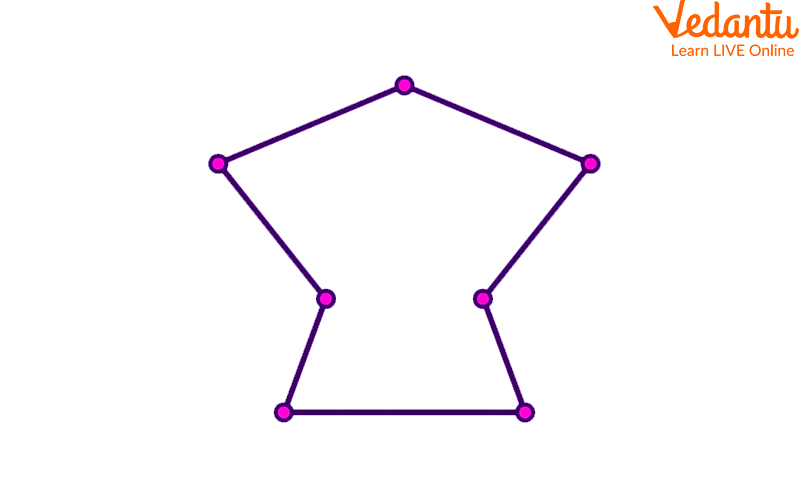
Irregular Heptagon
Based on the angle measures, the heptagon can be classified into the following two types.
Convex Heptagon
In a convex heptagon, the value of the interior angles is less than 180°. So, no diagonals of the convex heptagon can lie outside the polygon.
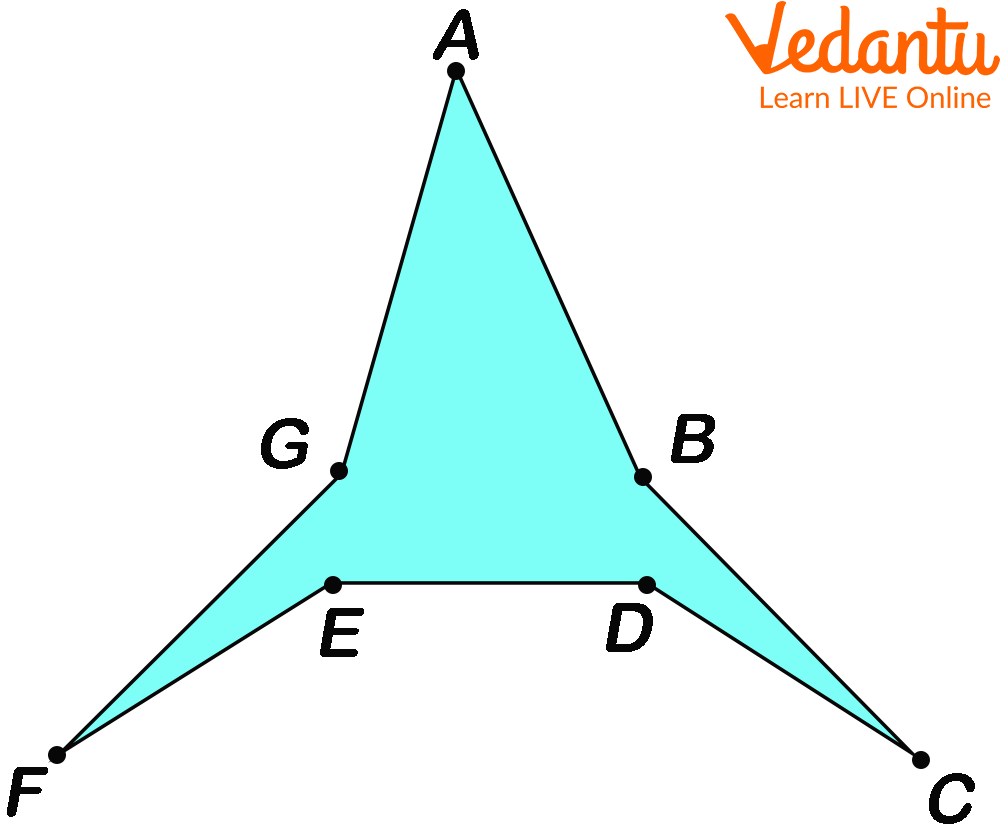
Convex Heptagon
Concave Heptagon
In a concave heptagon, at least one of the interior angles is greater than 180° and at least one of the diagonals lies outside the polygon.
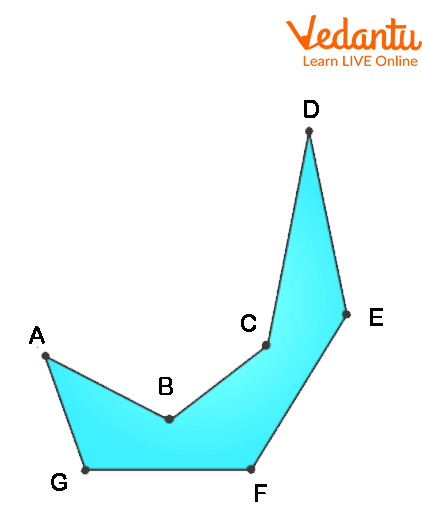
Concave Heptagon
Heptagon Properties
The key properties of a heptagon help us to identify a heptagon shape easily. The properties are as follows.
A heptagon has seven angles, seven sides, and seven vertices.
The sum of all the interior angles in a heptagon is equal to 900 degrees.
The sum of all the exterior angles of a heptagon is equal to 360 degrees.
In a regular heptagon, the value of each of the interior angles is approximately 128.57 degrees.
The value of the central angle of a regular heptagon is approximately 51.43 degrees.
Fourteen diagonals can be drawn in a heptagon.
Regular heptagons are also known as convex heptagons because all of their interior angles measure less than 180 degrees.
Five triangles can be formed in a heptagon.
A Few Real-Life Examples of Heptagons
We have created a list of some real-life examples of heptagons. Check out the list and see whether you can find any of these objects around you and try to see if you have got your own to add to this list.

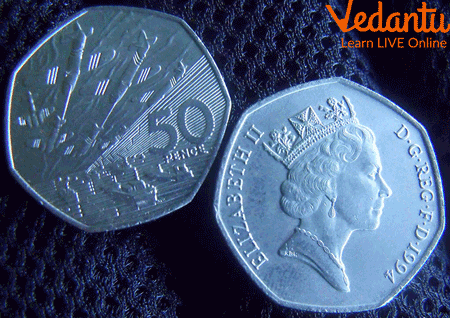



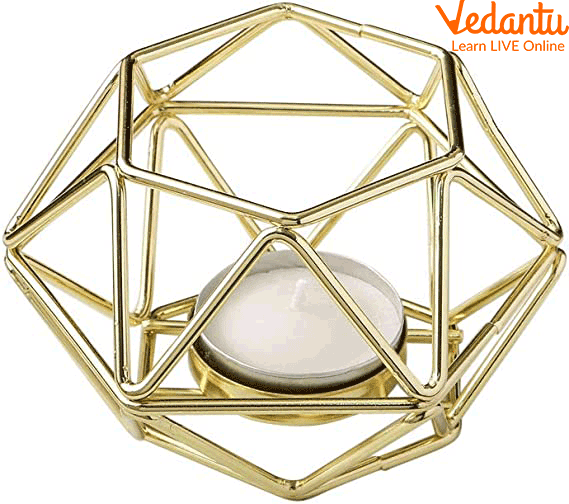
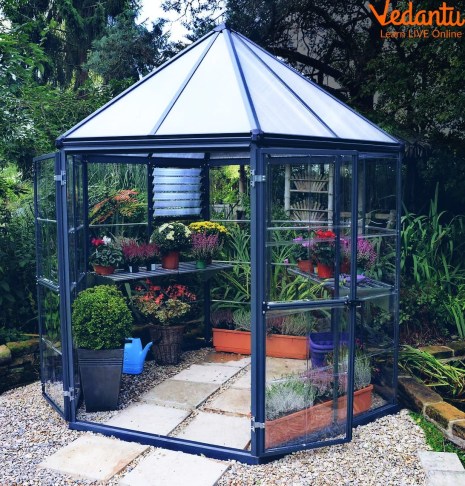
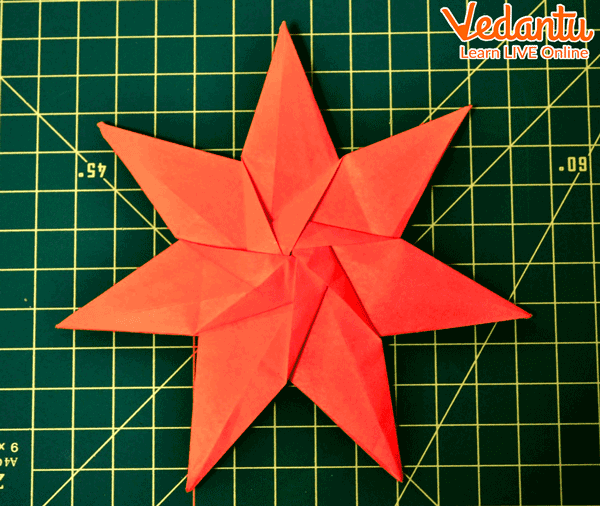
Now, we hope that it is clear to you what the shape of a heptagon looks like and here we have learned about different types of heptagons and their properties. We have also provided some real-life examples of the heptagon. This information will be really helpful while studying geometry.
FAQs on Shape of a Heptagon in Geometry
1. What is the shape of a heptagon?
A heptagon is a seven-sided polygon with seven angles and seven vertices. It is a closed 2D shape formed by joining seven straight line segments end to end. A heptagon can be:
- Regular – all sides and angles are equal.
- Irregular – sides and angles are not all equal.
2. How many sides and angles does a heptagon have?
A heptagon has 7 sides and 7 interior angles. Because it is a polygon with seven straight edges, it also has:
- 7 vertices (corners)
- 7 exterior angles
3. What is the sum of interior angles of a heptagon?
The sum of interior angles of a heptagon is 900°. It is calculated using the polygon formula:
Sum = (n − 2) × 180°
For a heptagon, n = 7:
- (7 − 2) × 180°
- 5 × 180° = 900°
4. What is each interior angle of a regular heptagon?
Each interior angle of a regular heptagon is approximately 128.57°. Since the total interior angle sum is 900°, divide by 7 sides:
- 900° ÷ 7 = 128.57° (approx)
5. What is the formula for the area of a regular heptagon?
The area of a regular heptagon with side length a is given by Area = (7a²) / [4 tan(π/7)]. This formula works only for a regular heptagon. To calculate:
- Square the side length (a²).
- Multiply by 7.
- Divide by 4 tan(π/7).
6. How many diagonals does a heptagon have?
A heptagon has 14 diagonals. The number of diagonals in any polygon is calculated using:
Diagonals = n(n − 3) / 2
For n = 7:
- 7(7 − 3) / 2
- 7 × 4 / 2 = 28 / 2 = 14
7. What is the difference between a regular and an irregular heptagon?
A regular heptagon has all sides and angles equal, while an irregular heptagon does not. Key differences include:
- Regular: All 7 sides equal, each angle ≈ 128.57°.
- Irregular: Sides and angles may vary.
- Regular heptagons have symmetry; irregular ones may not.
8. What is the measure of each exterior angle of a regular heptagon?
Each exterior angle of a regular heptagon is approximately 51.43°. Exterior angles of any regular polygon are calculated using:
Exterior angle = 360° / n
For n = 7:
- 360° ÷ 7 = 51.43° (approx)
9. How do you draw a regular heptagon?
A regular heptagon can be drawn by dividing a circle into seven equal central angles of about 51.43°. Steps:
- Draw a circle with a compass.
- Mark the center and measure 51.43° angles at the center.
- Mark seven equal points on the circle.
- Join adjacent points with straight lines.
10. What are some real-life examples of a heptagon shape?
A heptagon shape appears in objects that have seven sides or edges. Common examples include:
- Certain coins in some countries.
- Architectural designs and floor tiles.
- Decorative patterns in art and geometry.
