




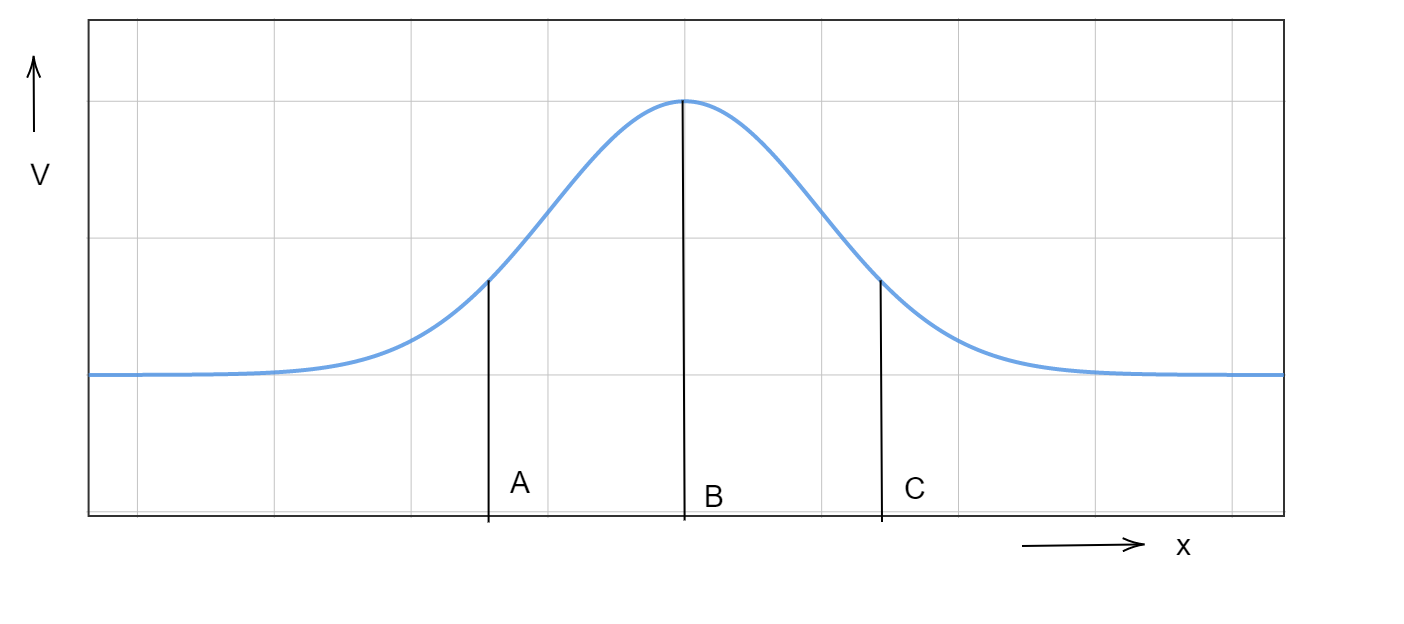
Variation of electrostatic potential along the x-direction is shown in the graph. The correct statement about the electric field is:
(A) $x$ component at the point $B$ is maximum
(B) The $x$ component of point $A$ is towards the positive x-axis
(C) The $x$ component of point $C$ is along the negative x-axis
(D) The $x$ component of point $C$ is along the positive x-axis
Answer
 Verified
255.9k+ views
Hint The first half of the curve has a positive increase with respect to the x-axis and the second half of the curve has a negative increase or a decrease with respect to the x-axis. The midpoint of the curve has no increase or decrease with respect to the x-axis. Use this along with the relation between the electric field and the potential to arrive at the answer.
Complete Step by step answer
From the given graph, we can see that the point $A$ is situated in the left half of the curve that has a positive increase with the x-axis. This means that the tangent at this point will be positive. Similarly, point $C$ is situated in the right half of the curve that has a negative increase or positive decrease with the x-axis, which means that in the second half, the tangent is negative. The midpoint has a tangent equal to zero.
The tangent at any point is given by $\dfrac{{dV}}{{dx}}$, where $V$ is the potential in the y-axis in this case and $x$ is the distance of separation of the two charges in the x-axis.
As stated above, the tangent at point $A$, $\dfrac{{dV}}{{dx}} = + ve$
The tangent at point $B$, $\dfrac{{dV}}{{dx}} = 0$
And the tangent at point $C$, $\dfrac{{dV}}{{dx}} = - ve$
But, the change in potential with the change in distance of separation between two charges is defined as the electric field. Mathematically,
$E = - \dfrac{{dV}}{{dx}}$
Therefore, the electric field at point $A$ will be $ - ve$ , the electric field at point $B$ will be $0$ and the electric field at point $C$ will be $ + ve$ .
The $x$-component of the electric field at point is towards $A$ negative $x$-direction, the $x$ component of point $B$ is zero and the $x$ component of point $C$ is towards the positive $x$-direction.
Hence, option (D) is the correct option.
Note
The electric potential is defined as the work done to move a unit charge from a reference point in space to the desired point in an electric field. Or the electric field is defined as the negative gradient of electric potential. This means that the electric field points the direction in which electric potential is decreasing.
Complete Step by step answer
From the given graph, we can see that the point $A$ is situated in the left half of the curve that has a positive increase with the x-axis. This means that the tangent at this point will be positive. Similarly, point $C$ is situated in the right half of the curve that has a negative increase or positive decrease with the x-axis, which means that in the second half, the tangent is negative. The midpoint has a tangent equal to zero.
The tangent at any point is given by $\dfrac{{dV}}{{dx}}$, where $V$ is the potential in the y-axis in this case and $x$ is the distance of separation of the two charges in the x-axis.
As stated above, the tangent at point $A$, $\dfrac{{dV}}{{dx}} = + ve$
The tangent at point $B$, $\dfrac{{dV}}{{dx}} = 0$
And the tangent at point $C$, $\dfrac{{dV}}{{dx}} = - ve$
But, the change in potential with the change in distance of separation between two charges is defined as the electric field. Mathematically,
$E = - \dfrac{{dV}}{{dx}}$
Therefore, the electric field at point $A$ will be $ - ve$ , the electric field at point $B$ will be $0$ and the electric field at point $C$ will be $ + ve$ .
The $x$-component of the electric field at point is towards $A$ negative $x$-direction, the $x$ component of point $B$ is zero and the $x$ component of point $C$ is towards the positive $x$-direction.
Hence, option (D) is the correct option.
Note
The electric potential is defined as the work done to move a unit charge from a reference point in space to the desired point in an electric field. Or the electric field is defined as the negative gradient of electric potential. This means that the electric field points the direction in which electric potential is decreasing.
Recently Updated Pages
Electricity and Magnetism Explained: Key Concepts & Applications

JEE Energetics Important Concepts and Tips for Exam Preparation
JEE Isolation, Preparation and Properties of Non-metals Important Concepts and Tips for Exam Preparation
JEE Main Mock Test 2025-26: Electromagnetic Induction & Alternating Currents
JEE Main 2023 (February 1st Shift 1) Maths Question Paper with Answer Key
JEE Main 2023 (February 1st Shift 2) Maths Question Paper with Answer Key
Trending doubts
JEE Main 2026: Exam Dates, Session 2 Updates, City Slip, Admit Card & Latest News
JEE Main Participating Colleges 2026 - A Complete List of Top Colleges
JEE Main 2026 Application Login: Direct Link, Registration, Form Fill, and Steps
JEE Main Colleges 2026: Complete List of Participating Institutes
JEE Main Marking Scheme 2026- Paper-Wise Marks Distribution and Negative Marking Details
Hybridisation in Chemistry – Concept, Types & Applications
Other Pages
CBSE Class 12 Physics Question Paper 2026: Download SET-wise PDF with Answer Key & Analysis
JEE Advanced 2026 - Exam Date (Released), Syllabus, Registration, Eligibility, Preparation, and More
JEE Advanced Marks vs Ranks 2025: Understanding Category-wise Qualifying Marks and Previous Year Cut-offs
JEE Advanced Weightage 2025 Chapter-Wise for Physics, Maths and Chemistry
Understanding the Electric Field of a Uniformly Charged Ring
Derivation of Equation of Trajectory Explained for Students