




The central region between the crust of earth and core of earth is called
(A) Mantle
(B) Crust
(C) Core
(D) None of these
Answer
 Verified
233.1k+ views
Hint: If we subdivide the Earth based on rheology, we see the lithosphere, asthenosphere, mesosphere, outer core, and inner core. However, if we differentiate the layers based on chemical variations, we lump the layers into the crust, mantle, outer core, and inner core.
Complete answer:
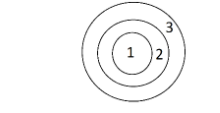
According to the fig. In 1 that is the core of earth in the inner core there is a hot, dense ball of (mostly) iron. It has a radius of about 1,220 kilometers (758 miles). The liquid outer core separates the inner core from the rest of the Earth, and as a result, the inner core rotates a little differently than the rest of the planet.
According to the fig. In position 2 that is the mantle of the earth. The mantle is the mostly-solid bulk of Earth's interior. The mantle lies between Earth's dense, super-heated core and its thin outer layer, the crust. The other major type of rock found in the mantle is magnesium oxide. Other mantle elements include iron, aluminum, calcium, sodium, and potassium.
And in the 3rd point of the fig that is the crust of the earth. The crust is made of solid rocks and minerals. Beneath the crust is the mantle, which is also mostly solid rocks and minerals, but punctuated by malleable areas of semi-solid magma. At the center of the Earth is a hot, dense metal core.
So,The central region between the crust of earth and core of earth is called Mantle.
Note: The mantle under the crust is about 1,800 miles deep (2,890 km). It is composed mostly of silicate rocks rich in magnesium and iron. Intense heat causes the rocks to rise. They then cool and sink back down to the core.
Complete answer:
According to the fig. In 1 that is the core of earth in the inner core there is a hot, dense ball of (mostly) iron. It has a radius of about 1,220 kilometers (758 miles). The liquid outer core separates the inner core from the rest of the Earth, and as a result, the inner core rotates a little differently than the rest of the planet.
According to the fig. In position 2 that is the mantle of the earth. The mantle is the mostly-solid bulk of Earth's interior. The mantle lies between Earth's dense, super-heated core and its thin outer layer, the crust. The other major type of rock found in the mantle is magnesium oxide. Other mantle elements include iron, aluminum, calcium, sodium, and potassium.
And in the 3rd point of the fig that is the crust of the earth. The crust is made of solid rocks and minerals. Beneath the crust is the mantle, which is also mostly solid rocks and minerals, but punctuated by malleable areas of semi-solid magma. At the center of the Earth is a hot, dense metal core.
So,The central region between the crust of earth and core of earth is called Mantle.
Note: The mantle under the crust is about 1,800 miles deep (2,890 km). It is composed mostly of silicate rocks rich in magnesium and iron. Intense heat causes the rocks to rise. They then cool and sink back down to the core.
Recently Updated Pages
JEE Main 2023 April 6 Shift 1 Question Paper with Answer Key

JEE Main 2023 April 6 Shift 2 Question Paper with Answer Key
JEE Main 2023 (January 31 Evening Shift) Question Paper with Solutions [PDF]
JEE Main 2023 January 30 Shift 2 Question Paper with Answer Key
JEE Main 2023 January 25 Shift 1 Question Paper with Answer Key
JEE Main 2023 January 24 Shift 2 Question Paper with Answer Key
Trending doubts
JEE Main 2026: Session 2 Registration Open, City Intimation Slip, Exam Dates, Syllabus & Eligibility
JEE Main 2026 Application Login: Direct Link, Registration, Form Fill, and Steps
Understanding the Angle of Deviation in a Prism
Hybridisation in Chemistry – Concept, Types & Applications
How to Convert a Galvanometer into an Ammeter or Voltmeter
Understanding Uniform Acceleration in Physics
Other Pages
JEE Advanced Marks vs Ranks 2025: Understanding Category-wise Qualifying Marks and Previous Year Cut-offs
Dual Nature of Radiation and Matter Class 12 Physics Chapter 11 CBSE Notes - 2025-26
Understanding the Electric Field of a Uniformly Charged Ring
JEE Advanced Weightage 2025 Chapter-Wise for Physics, Maths and Chemistry
Derivation of Equation of Trajectory Explained for Students
Understanding Electromagnetic Waves and Their Importance