






How Vivian Derozio’s Young Bengal Movement Influenced Social Reform in India
Vivian Derozio and the Young Bengal Movement represent an important phase in the intellectual and social awakening of 19th century Bengal. Henry Louis Vivian Derozio was a radical thinker, poet, and teacher who inspired a group of young students at Hindu College in Calcutta to question orthodox traditions and promote rationalism. The Young Bengal Movement played a significant role in shaping early social reform and modern thought in India. This topic is important for understanding the early roots of Indian nationalism, social reform movements, and the Bengal Renaissance.
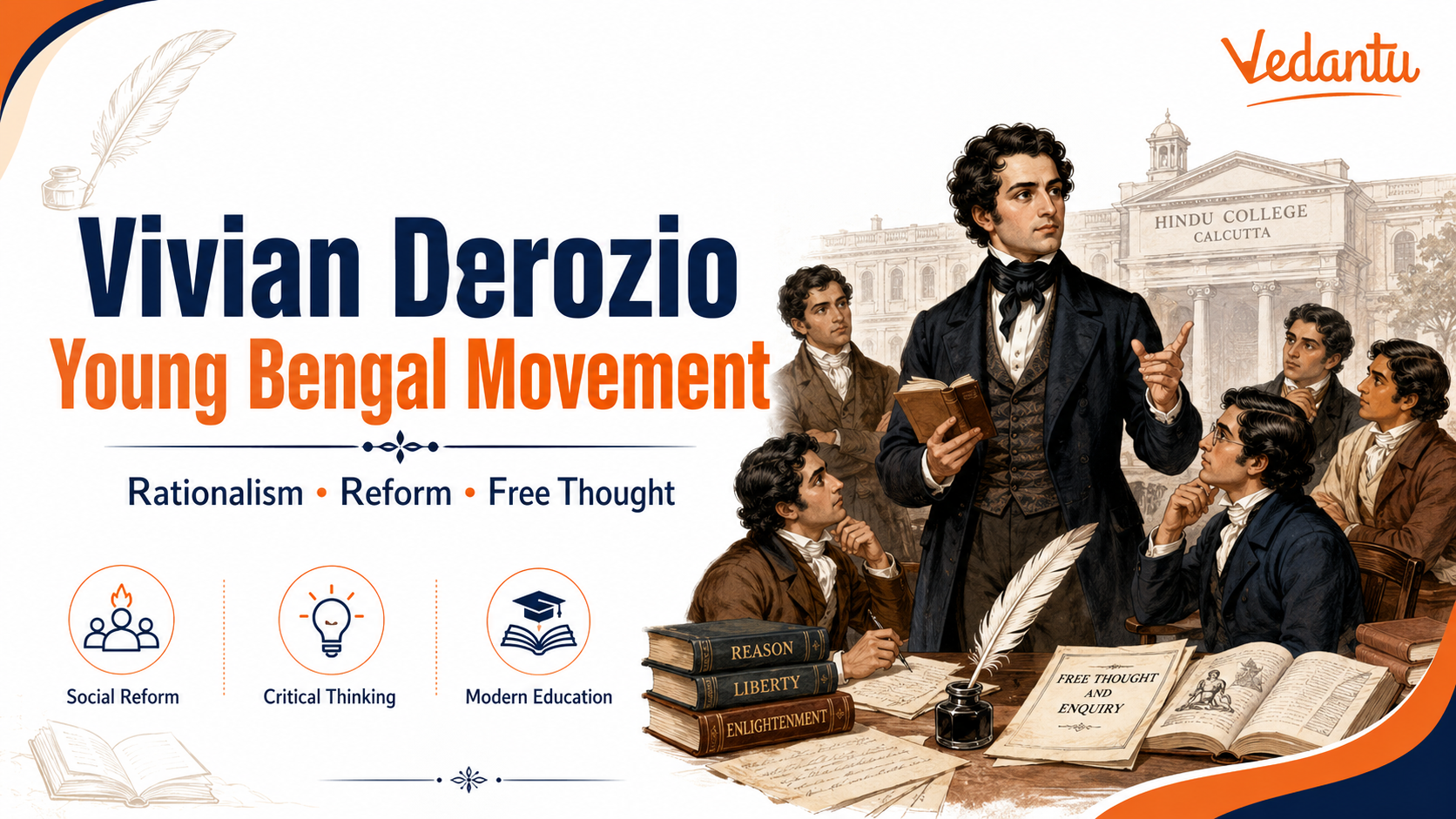
Henry Louis Vivian Derozio - An Overview
Henry Louis Vivian Derozio was born in 1809 in Calcutta. He was of mixed Portuguese and Indian descent and became one of the youngest teachers at Hindu College at the age of 17. Derozio was deeply influenced by Western liberal thought, the French Revolution, and the ideals of liberty, equality, and freedom. His teachings encouraged students to think independently and challenge orthodox Hindu customs.
Key Facts about Vivian Derozio
- Born in 1809 in Calcutta
- Appointed teacher at Hindu College in 1826
- Inspired students to adopt rationalism and free thinking
- Dismissed from Hindu College in 1831 due to controversial ideas
- Died in 1831 at the age of 22
Quick Facts Table - Vivian Derozio and Young Bengal Movement
| Aspect | Details | Year/Period |
|---|---|---|
| Birth of Derozio | Calcutta | 1809 |
| Teaching at Hindu College | Professor of English and History | 1826 to 1831 |
| Young Bengal Movement | Group of radical students | 1820s to 1830s |
The table highlights the key timeline and contributions associated with Derozio and the Young Bengal Movement. These facts are frequently asked in competitive examinations.
The Young Bengal Movement
The Young Bengal Movement was a group of Derozio’s students who were deeply influenced by his ideas. They came to be known as Derozians. The movement emphasized freedom of thought, equality, rationalism, and opposition to social evils. The members openly criticized traditional Hindu practices and campaigned for reforms in society.
Main Objectives of the Movement
- Promotion of rational thinking and scientific outlook
- Opposition to caste discrimination
- Advocacy of women’s rights and education
- Criticism of idol worship and orthodox rituals
- Encouragement of freedom of expression
Prominent Members of Young Bengal
- Krishna Mohan Banerjee
- Ramtanu Lahiri
- Rasik Krishna Mallick
- Peary Chand Mitra
Impact of the Young Bengal Movement
Although the Young Bengal Movement did not achieve immediate large scale reforms, it had a lasting intellectual impact. It played a crucial role in promoting modern education and liberal ideas in Bengal. The movement laid the foundation for later reformers and contributed to the growth of the Bengal Renaissance.
Positive Contributions
- Spread of Western education and liberal philosophy
- Encouragement of social and religious reforms
- Development of critical thinking among youth
- Contribution to early nationalist ideas
Limitations of the Movement
- Limited to urban educated middle class
- Lacked mass support
- Short lived due to Derozio’s early death
Role in the Bengal Renaissance
The Young Bengal Movement is often considered an early phase of the Bengal Renaissance. It encouraged questioning of blind faith and promoted progressive ideas. Though radical in approach, it prepared the ground for more organized reform movements led by figures like Raja Ram Mohan Roy and later social reformers.
Why Vivian Derozio and Young Bengal Movement are Important for Exams
This topic is frequently asked in General Knowledge and history sections of competitive examinations. Questions may focus on the founder, objectives, impact, and limitations of the movement. Understanding this topic helps in connecting early reform movements with the rise of nationalism in India.
- Remember the year 1809 for Derozio’s birth
- Associate Hindu College with the origin of the movement
- Focus on rationalism and reform as core themes
- Link the movement to the Bengal Renaissance
Conclusion
Vivian Derozio and the Young Bengal Movement marked a turning point in the intellectual history of India. Despite its short duration, the movement introduced modern, liberal, and rational ideas into Indian society. It encouraged youth to challenge social evils and laid the groundwork for future reform and nationalist movements. Understanding this topic provides valuable insight into the early development of modern Indian thought and social reform.
FAQs on Vivian Derozio and the Young Bengal Movement: Ideas and Impact
1. Who was Henry Vivian Derozio?
Henry Vivian Derozio was a radical teacher, poet, and reformer who inspired the Young Bengal Movement in early 19th-century India.
• Born in 1809 in Calcutta (Kolkata).
• Teacher at Hindu College at the age of 17.
• Promoted rationalism, free thought, and social reform.
• Influenced students to question orthodox Hindu practices.
• Considered a pioneer of the Bengal Renaissance and early Indian nationalism.
2. What was the Young Bengal Movement?
The Young Bengal Movement was a socio-intellectual reform movement led by Derozio that promoted modern thinking and social change.
• Started in the 1820s–1830s in Bengal.
• Followers were known as Derozians.
• Encouraged liberalism, women’s rights, and freedom of expression.
• Opposed social evils like caste discrimination and superstitions.
• Played a key role in shaping early Indian reform movements.
3. What were the main objectives of the Young Bengal Movement?
The main objective of the Young Bengal Movement was to promote rationalism and social reform in Indian society.
• Spread scientific temper and critical thinking.
• Oppose orthodox Hindu customs and blind faith.
• Advocate women’s education and equality.
• Support freedom of the press and individual liberty.
• Encourage debate, discussion, and intellectual awakening.
4. Who were the followers of Henry Vivian Derozio?
The followers of Derozio were known as Derozians and were mainly students of Hindu College.
• Included leaders like Krishna Mohan Banerjee and Ramtanu Lahiri.
• Formed debating societies and discussion groups.
• Actively criticized social orthodoxy.
• Contributed to the growth of modern education in India.
• Influenced later reformers during the Bengal Renaissance.
5. Why was Henry Vivian Derozio dismissed from Hindu College?
Henry Vivian Derozio was dismissed from Hindu College in 1831 due to accusations of spreading radical ideas.
• Criticized for promoting atheism and free thinking.
• Orthodox groups opposed his views on religion.
• Accused of influencing students against tradition.
• His dismissal shows resistance to early social reform movements in India.
6. What was the impact of the Young Bengal Movement?
The Young Bengal Movement had a significant intellectual impact despite limited mass support.
• Encouraged modern education and critical inquiry.
• Challenged caste system and social evils.
• Inspired later reformers like Raja Ram Mohan Roy (parallel reform context).
• Contributed to the broader Bengal Renaissance.
• Helped lay foundations for early Indian nationalism.
7. How did the Young Bengal Movement contribute to the Bengal Renaissance?
The Young Bengal Movement played a crucial role in stimulating intellectual awakening during the Bengal Renaissance.
• Promoted Western education and liberal philosophy.
• Encouraged social and religious reform debates.
• Fostered a spirit of scientific reasoning and humanism.
• Inspired future reformers and thinkers in 19th-century India.
8. What were the limitations of the Young Bengal Movement?
The Young Bengal Movement faced several limitations that reduced its broader social impact.
• Limited mainly to educated urban youth.
• Lacked mass participation and rural support.
• Overemphasis on theoretical debate rather than action.
• Short-lived due to Derozio’s early death in 1831.
• Faced strong opposition from orthodox communities.
9. What were the literary contributions of Henry Vivian Derozio?
Henry Vivian Derozio was also a notable poet of early Indian English literature.
• Wrote poems like "To India – My Native Land".
• Expressed patriotic and reformist ideas.
• Highlighted themes of national pride and social awakening.
• Considered one of the first modern Indian English poets.
10. Why is the Young Bengal Movement important for competitive exams?
The Young Bengal Movement is important for competitive exams as it marks an early phase of social and intellectual reform in India.
• Frequently asked in UPSC, SSC, State PSC, and school exams.
• Connected with topics like Bengal Renaissance, social reform movements, and Indian nationalism.
• Highlights key figures like Henry Vivian Derozio.
• Helps understand the evolution of modern Indian thought and reform.
