






Key Provisions and Objectives of the TRIPS Agreement in WTO
Trade Related Aspects of Intellectual Property Rights - TRIPS is an international agreement administered by the World Trade Organization - WTO. It sets minimum standards for the protection and enforcement of intellectual property rights across member countries. Adopted in 1994 as part of the Uruguay Round of the General Agreement on Tariffs and Trade - GATT, TRIPS plays a crucial role in global trade by linking intellectual property protection with international commerce. Understanding TRIPS is essential for students of English, General Knowledge, economics, law, and competitive exams because it connects innovation, trade, public health, and global development.
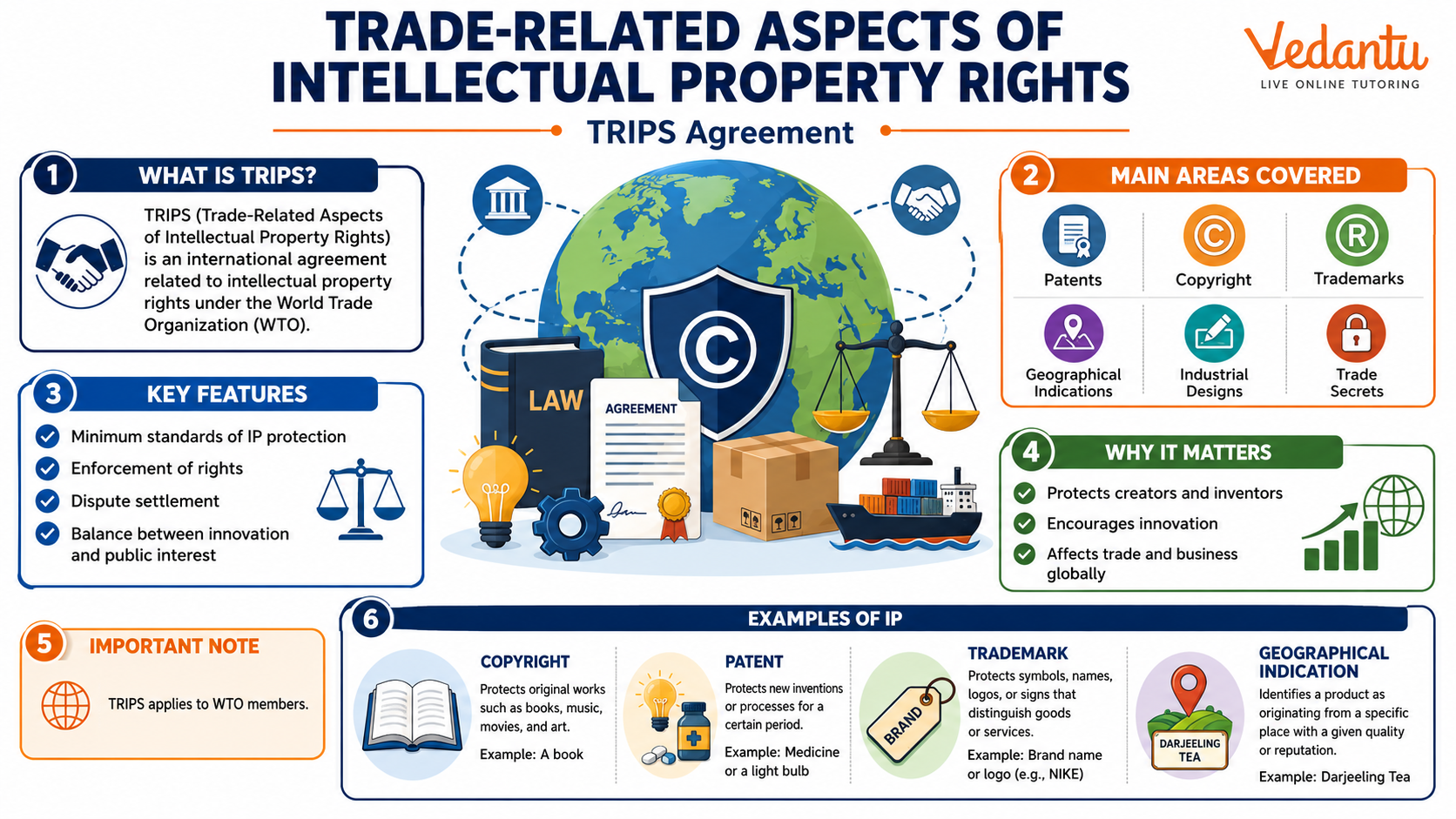
What is TRIPS?
TRIPS stands for Trade Related Aspects of Intellectual Property Rights. It is a comprehensive multilateral agreement that establishes uniform standards for intellectual property protection among WTO member nations. The agreement ensures that intellectual property laws in different countries follow a minimum level of protection while allowing some flexibility in implementation.
- Adopted in 1994
- Came into force on 1 January 1995
- Administered by the World Trade Organization - WTO
- Binding on all WTO member countries
Objectives of TRIPS
The main objective of TRIPS is to reduce distortions in international trade while promoting effective and adequate protection of intellectual property rights. It also aims to ensure that enforcement measures do not become barriers to legitimate trade.
- Establish minimum standards for IPR protection
- Promote technological innovation
- Encourage transfer and dissemination of technology
- Balance rights of innovators and public interest
Types of Intellectual Property Covered Under TRIPS
Intellectual Property Categories Under TRIPS
| Type of IPR | What It Protects | Minimum Protection Period |
|---|---|---|
| Patents | Inventions and technological innovations | 20 years |
| Copyright | Literary, artistic and musical works | Life of author plus 50 years |
| Trademarks | Brand names and logos | 7 years renewable |
In addition to the above, TRIPS also covers geographical indications, industrial designs, layout designs of integrated circuits, and protection of undisclosed information such as trade secrets.
Key Principles of TRIPS
1. National Treatment
A member country must treat foreign nationals no less favorably than its own citizens in matters of intellectual property protection.
2. Most Favoured Nation - MFN
Any advantage given by a member country to nationals of one country must be extended to nationals of all WTO members.
3. Minimum Standards
Countries must comply with minimum standards of protection but can provide stronger protection if they choose.
TRIPS and Public Health
One of the most debated aspects of TRIPS is its impact on access to medicines. The agreement initially raised concerns about high drug prices due to patent protection. To address this, the Doha Declaration on TRIPS and Public Health was adopted in 2001.
- Allows compulsory licensing in emergencies
- Permits parallel imports of medicines
- Supports access to affordable drugs in developing countries
Advantages of TRIPS
- Encourages innovation and research
- Provides legal certainty in international trade
- Promotes foreign direct investment
- Strengthens global intellectual property systems
Criticisms of TRIPS
- May increase cost of medicines
- Can limit access to technology in developing countries
- Favours developed nations with strong innovation sectors
TRIPS and India
India became a member of the WTO in 1995 and amended its intellectual property laws to comply with TRIPS. The Indian Patents Act was amended in 2005 to introduce product patents in pharmaceuticals and chemicals. India has also used TRIPS flexibilities such as compulsory licensing to ensure public health protection.
Important Points for Competitive Exams
- TRIPS is linked with WTO, not WIPO
- Minimum patent protection period is 20 years
- Doha Declaration was adopted in 2001
- Compulsory licensing is allowed under specific conditions
Conclusion
Trade Related Aspects of Intellectual Property Rights - TRIPS is a landmark international agreement that integrates intellectual property protection with global trade rules. It establishes uniform standards while allowing certain flexibilities to protect public interest. For students and competitive exam aspirants, understanding TRIPS is important to grasp the relationship between innovation, economic growth, public health, and international trade. A clear understanding of its objectives, principles, and impact helps in building strong conceptual knowledge in General Knowledge and global affairs.
FAQs on Trade-Related Aspects of Intellectual Property (TRIPS) Explained for Students
1. What is TRIPS in international trade?
TRIPS (Trade-Related Aspects of Intellectual Property Rights) is an international agreement that sets minimum standards for the protection of intellectual property rights among WTO member countries.
• It was established in 1995 under the World Trade Organization (WTO).
• It covers patents, copyrights, trademarks, geographical indications, industrial designs, and trade secrets.
• It ensures uniform IPR protection in global trade.
• It links intellectual property rights with international trade rules.
TRIPS is frequently asked in competitive exams under topics like WTO agreements, global trade law, and intellectual property protection.
2. What are the main objectives of the TRIPS Agreement?
The main objective of TRIPS is to promote innovation and ensure fair trade by protecting intellectual property rights globally.
• To provide minimum standards of IPR protection.
• To reduce trade distortions and disputes.
• To encourage technology transfer and innovation.
• To balance rights of inventors and public interest.
The agreement supports both economic development and global competitiveness through standardized IP laws.
3. What types of intellectual property are covered under TRIPS?
TRIPS covers almost all major forms of intellectual property rights (IPR) recognized internationally.
• Patents (20-year protection period)
• Copyrights and related rights
• Trademarks
• Geographical Indications (GI)
• Industrial Designs
• Trade Secrets (undisclosed information)
• Layout designs of integrated circuits
This comprehensive coverage makes TRIPS a key agreement in global intellectual property law.
4. How does TRIPS affect developing countries?
TRIPS impacts developing countries by requiring them to strengthen their intellectual property laws according to WTO standards.
• Provides a transition period for implementation.
• Encourages foreign investment and technology transfer.
• Raises concerns about access to medicines and public health.
• Requires legal reforms in patent and copyright laws.
It remains a debated topic in discussions on global inequality, pharmaceutical patents, and economic development.
5. What is the relationship between TRIPS and WTO?
TRIPS is one of the core agreements administered by the World Trade Organization (WTO).
• It came into force with the formation of the WTO in 1995.
• All WTO members must comply with TRIPS provisions.
• Disputes related to IPR are settled through the WTO Dispute Settlement Mechanism.
This relationship integrates intellectual property protection directly into the multilateral trading system.
6. What is compulsory licensing under TRIPS?
Compulsory licensing under TRIPS allows a government to permit the production of a patented product without the consent of the patent holder under specific conditions.
• Allowed in cases of public health emergencies.
• Recognized under the Doha Declaration (2001).
• Ensures access to essential medicines.
• Patent holders must receive adequate remuneration.
This provision balances patent rights with public interest and healthcare needs.
7. What is the Doha Declaration related to TRIPS?
The Doha Declaration (2001) clarified that TRIPS should not prevent members from protecting public health.
• Adopted at the WTO Doha Ministerial Conference.
• Emphasized access to affordable medicines.
• Reaffirmed rights to issue compulsory licenses.
• Supported developing countries in addressing health crises like HIV/AIDS.
It strengthened the flexibility of TRIPS Agreement provisions in favor of public welfare.
8. What are the minimum standards of patent protection under TRIPS?
TRIPS sets minimum global standards for patent protection that all WTO members must follow.
• Patent term must be at least 20 years.
• Patents must be granted for products and processes in all fields of technology.
• Protection applies to inventions that are new, involve inventive steps, and are industrially applicable.
• Limited exceptions are allowed under specific conditions.
These standards harmonize international patent laws across member countries.
9. Why is TRIPS important for competitive exams?
TRIPS is important for competitive exams because it is a key topic in international trade, economics, and current affairs.
• Frequently asked in exams like UPSC, SSC, Banking, and State PCS.
• Related to WTO agreements and global trade policies.
• Important for understanding intellectual property rights (IPR).
• Linked to debates on pharmaceutical patents and public health.
It forms a crucial part of General Knowledge (GK) and international relations studies.
10. What are the criticisms of the TRIPS Agreement?
The TRIPS Agreement has faced criticism for favoring developed nations and multinational corporations.
• May increase prices of medicines and essential drugs.
• Limits flexibility for developing and least developed countries (LDCs).
• Strengthens control of patent holders and big pharmaceutical companies.
• Raises concerns about biopiracy and traditional knowledge protection.
Despite criticism, TRIPS remains central to global intellectual property governance and trade regulation.
