






Why Has Krishnas Butterball Rock Remained Balanced for Centuries?
Krishna’s Butterball is one of the most fascinating natural rock formations in India. Located in Mahabalipuram, Tamil Nadu, this massive balancing rock has puzzled scientists, historians, and tourists for centuries. The huge granite boulder appears to defy gravity as it rests on a sloped surface without rolling down. Popularly associated with Lord Krishna, the rock is not only a geological wonder but also a cultural and historical attraction. Let us explore the mystery, history, scientific explanation, and interesting facts about Krishna’s Butterball.
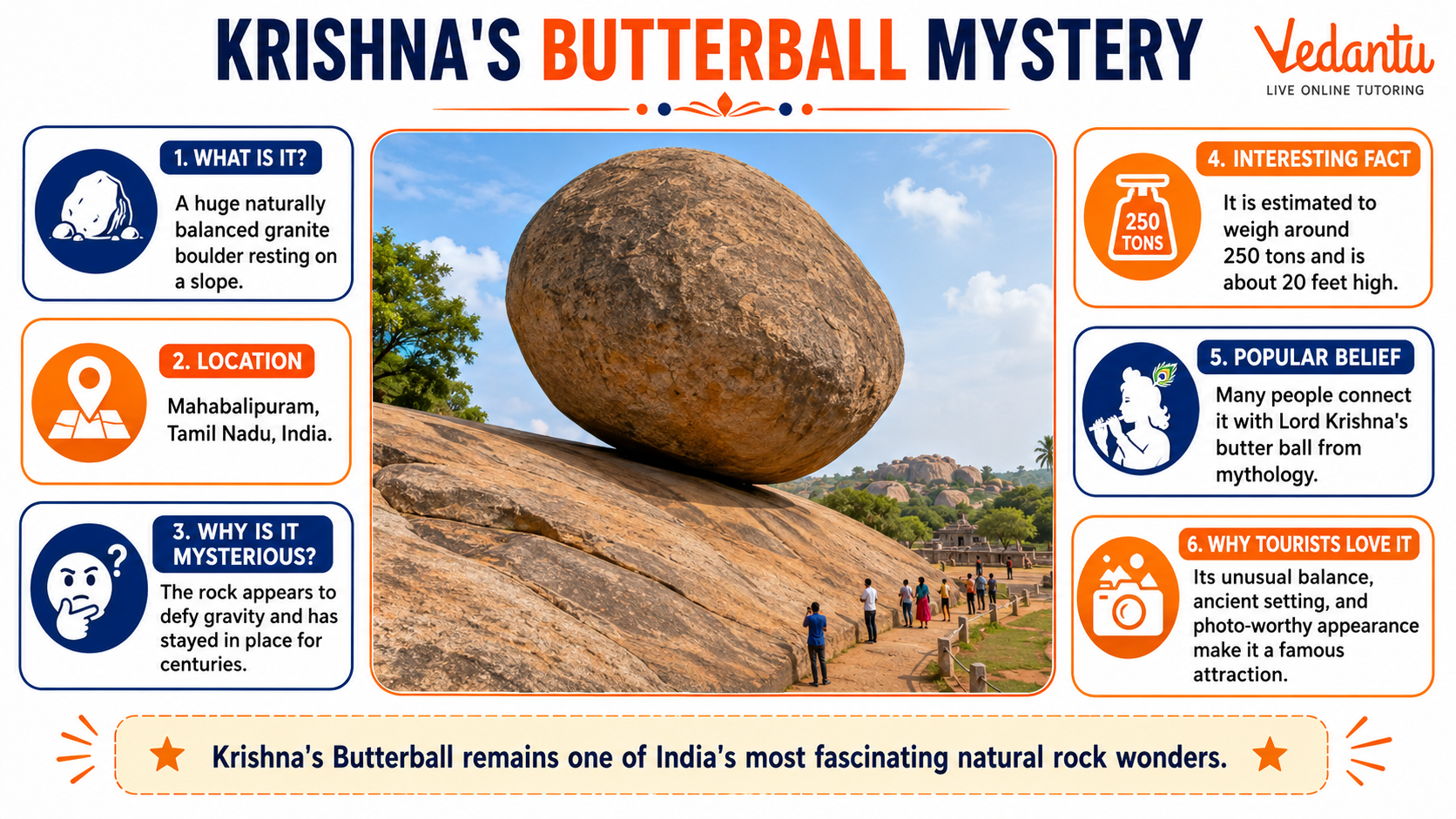
What Is Krishna’s Butterball?
Krishna’s Butterball is a giant granite boulder that sits on a small inclined rock surface in Mahabalipuram. It measures about 6 meters in height and 5 meters in width and is estimated to weigh around 250 tons. Despite its enormous weight, it has remained in the same position for over 1,200 years.
Why Is It Called Krishna’s Butterball?
According to Hindu mythology, Lord Krishna was fond of butter as a child and was often called "Makhan Chor" which means butter thief. The shape of the rock resembles a giant ball of butter, which is why locals named it Krishna’s Butterball. However, the original name of the rock in Tamil is "Vaan Irai Kal," which means Stone of the Sky God.
Location and Historical Background
Krishna’s Butterball is located in Mahabalipuram, also known as Mamallapuram, in Tamil Nadu. The town is famous for its UNESCO World Heritage Site monuments built during the Pallava dynasty in the 7th and 8th centuries.
- State - Tamil Nadu
- District - Chengalpattu
- Nearest City - Chennai (about 55 km away)
- Historical Period - Pallava Dynasty
Mahabalipuram is known for its rock-cut temples, sculptures, and monuments. Krishna’s Butterball adds a natural wonder to this historically rich location.
The Mystery Behind Krishna’s Butterball
The main mystery of Krishna’s Butterball is how such a massive rock can remain balanced on a steep slope without rolling down. The surface underneath appears smooth and slanted, yet the rock has not moved for centuries.
Attempt to Move the Rock
In 1908, the then Governor of Madras, Sir Arthur Lawley, ordered the rock to be removed because he thought it was dangerous. Seven elephants were used to pull the rock, but it did not move even slightly. This incident further increased the curiosity and mystery surrounding the boulder.
Scientific Explanation
Geologists explain that Krishna’s Butterball is a natural rock formation created by weathering and erosion over millions of years. The rock’s center of gravity and the friction between the rock and the ground help keep it stable. Despite appearing unstable, the weight distribution allows it to remain balanced.
- Formed due to natural geological processes
- Stable center of gravity
- Strong friction between surfaces
- Granite composition provides durability
Key Facts About Krishna’s Butterball
| Feature | Details | Significance |
|---|---|---|
| Height | Approximately 6 meters | Massive natural structure |
| Weight | Around 250 tons | Defies gravity appearance |
| Location | Mahabalipuram, Tamil Nadu | UNESCO Heritage region |
These facts highlight why Krishna’s Butterball is considered both a geological marvel and a tourist attraction. Its size, weight, and unusual position make it unique in the world.
Cultural and Tourist Importance
Krishna’s Butterball is one of the most photographed spots in Mahabalipuram. Tourists often pose as if they are holding or pushing the rock. It has become an iconic symbol of the town.
- Popular tourist attraction
- Associated with Hindu mythology
- Located near ancient rock-cut temples
- Part of UNESCO World Heritage surroundings
The rock also represents the blend of nature and culture that defines Mahabalipuram.
Interesting Facts for General Knowledge
- The rock has survived earthquakes and heavy rains.
- It has been in the same position for over 1,200 years.
- It is made of hard granite rock.
- Seven elephants failed to move it during British rule.
Conclusion
Krishna’s Butterball remains one of India’s most intriguing natural wonders. Its mysterious balance, mythological connection, and geological explanation make it a perfect example of how nature can surprise us. Whether viewed from a scientific or cultural perspective, this giant balancing rock continues to attract visitors and spark curiosity. Understanding such landmarks enhances our general knowledge and appreciation for India’s rich natural and historical heritage.
FAQs on Krishnas Butterball Mystery and the Secrets Behind It
1. What is Krishna’s Butterball?
Krishna’s Butterball is a massive natural balancing rock located in Mahabalipuram, Tamil Nadu.
• It is a giant granite boulder weighing around 250 tons.
• The rock stands on a small slope and appears to defy gravity.
• It is also known as Vaan Irai Kal (Stone of the Sky God).
• It is a popular tourist attraction and historical site near the Shore Temple.
This mysterious rock formation is often searched under terms like Krishna’s Butterball mystery, Mahabalipuram balancing rock, and gravity-defying stone in India.
2. Why is it called Krishna’s Butterball?
The rock is called Krishna’s Butterball because it resembles a ball of butter linked to Lord Krishna’s childhood stories.
• In Hindu mythology, Lord Krishna loved stealing and eating butter.
• The round shape of the boulder looks like a giant lump of butter.
• The name reflects India’s mythological and cultural heritage.
This connection between Hindu mythology and the rock increases curiosity among students and general readers.
3. Where is Krishna’s Butterball located?
Krishna’s Butterball is located in Mahabalipuram (Mamallapuram), in the state of Tamil Nadu, India.
• It lies near the famous Shore Temple.
• The site is part of the UNESCO World Heritage Site group of monuments.
• It is about 60 km from Chennai.
The location is frequently searched as Mahabalipuram balancing rock and Krishna’s Butterball UNESCO site.
4. How heavy is Krishna’s Butterball?
Krishna’s Butterball weighs approximately 250 tons, making it one of the heaviest balancing rocks in the world.
• It stands about 6 meters high.
• It has a width of nearly 5 meters.
• Despite its weight, it rests on a small sloped surface.
Its enormous size and weight contribute to the scientific mystery and curiosity around this natural wonder.
5. Why doesn’t Krishna’s Butterball fall?
Krishna’s Butterball does not fall due to a natural balance of gravity, friction, and rock formation.
• It has a unique center of gravity.
• The base provides enough friction to prevent slipping.
• It is believed to be a natural geological formation.
Scientists explain it through geology and physics, while many visitors view it as a divine or mysterious phenomenon.
6. Did anyone try to move Krishna’s Butterball?
Yes, attempts were made to move Krishna’s Butterball, but they failed.
• In 1908, the Governor of Madras, Arthur Lawley, tried to remove it.
• Seven elephants were used to push the rock.
• The boulder did not move at all.
This failed attempt strengthened its reputation as a mysterious and immovable rock in Indian history.
7. Is Krishna’s Butterball a natural or man-made structure?
Krishna’s Butterball is a natural rock formation, not man-made.
• It is formed from granite.
• It developed due to natural weathering and erosion over millions of years.
• It is not carved like other monuments in Mahabalipuram.
Geologists classify it as a natural balancing rock created by environmental processes.
8. Why is Krishna’s Butterball famous?
Krishna’s Butterball is famous for its mysterious balance and mythological connection.
• It appears to defy gravity.
• It is linked to Lord Krishna from Hindu mythology.
• It is part of the historic Pallava-era monuments.
• It attracts thousands of tourists and photographers every year.
The combination of science, history, and mythology makes it globally popular.
9. Which dynasty built the monuments near Krishna’s Butterball?
The monuments around Krishna’s Butterball were built by the Pallava Dynasty.
• The Pallavas ruled South India during the 7th–8th centuries CE.
• They constructed the famous Shore Temple and rock-cut temples.
• Mahabalipuram was an important port city under their rule.
This historical background adds cultural value to the site for students preparing for GK and competitive exams.
10. Is Krishna’s Butterball important for competitive exams?
Yes, Krishna’s Butterball is important for General Knowledge (GK) and competitive exams.
• It is linked to a UNESCO World Heritage Site.
• It relates to Indian history, geography, and culture.
• Questions may appear in exams like UPSC, SSC, Railways, and State PSC.
Understanding topics like Mahabalipuram monuments and Indian heritage sites helps students score better in static GK sections.
