






Major Events in India’s Freedom Struggle from 1885 to 1947
The Timeline of Indian Freedom Movement from 1885 to 1947 covers the major political events, movements, leaders, and turning points that led to India’s independence from British rule. This period witnessed the rise of nationalism, mass movements, revolutionary activities, constitutional reforms, and finally the achievement of independence on 15 August 1947. Understanding this timeline is essential for students and competitive exam aspirants as it provides a clear sequence of events and highlights the evolution of India’s struggle for freedom.
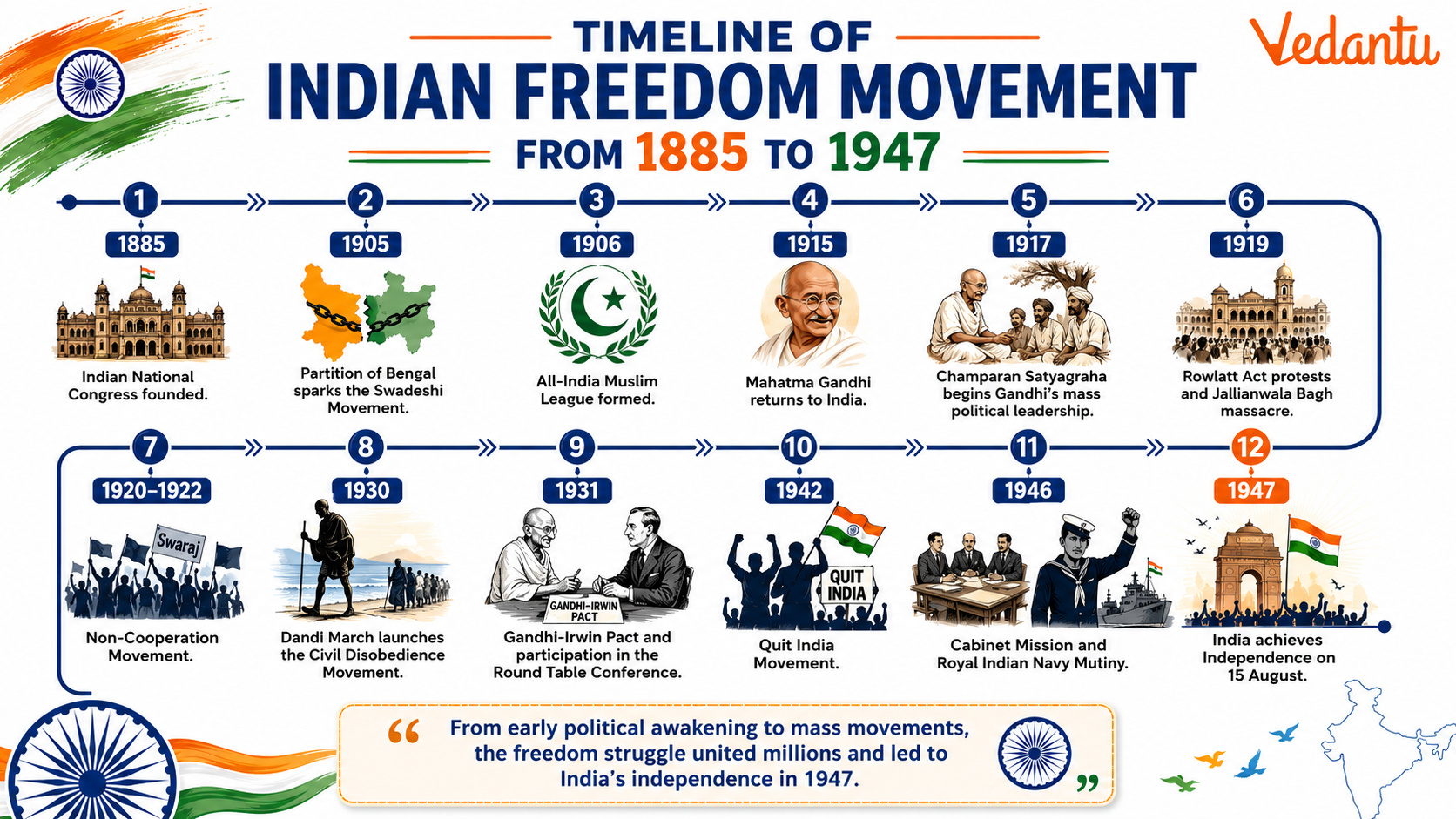
Overview of Indian Freedom Movement (1885 - 1947)
The organized national movement began with the formation of the Indian National Congress in 1885. Initially, leaders adopted moderate methods such as petitions and prayers. Over time, the movement became more assertive and mass based under leaders like Bal Gangadhar Tilak, Mahatma Gandhi, Subhas Chandra Bose, and others. The struggle went through several phases including moderate politics, extremist phase, revolutionary movements, Gandhian mass movements, and negotiations that finally resulted in independence and partition in 1947.
Major Phases of the Freedom Movement
1. Moderate Phase (1885 - 1905)
This phase was led by early leaders of the Indian National Congress who believed in constitutional methods and dialogue with the British government.
- Formation of Indian National Congress in 1885
- Demand for civil rights and greater representation in government
- Indian Councils Act of 1892
- Leaders like Dadabhai Naoroji, Gopal Krishna Gokhale, and Surendranath Banerjee
2. Extremist Phase and Swadeshi Movement (1905 - 1917)
The partition of Bengal in 1905 marked a turning point. Leaders adopted more aggressive methods and encouraged boycott of British goods.
- Partition of Bengal in 1905
- Swadeshi and Boycott movements
- Rise of leaders like Bal Gangadhar Tilak, Lala Lajpat Rai, Bipin Chandra Pal
- Formation of Muslim League in 1906
- Morley Minto Reforms of 1909
3. Gandhian Era (1917 - 1942)
Mahatma Gandhi transformed the freedom struggle into a mass movement based on non violence and civil disobedience.
- Champaran Satyagraha in 1917
- Non Cooperation Movement in 1920
- Civil Disobedience Movement and Dandi March in 1930
- Government of India Act 1935
- Quit India Movement in 1942
4. Final Phase and Independence (1942 - 1947)
After World War II, the British government decided to transfer power. However, communal tensions led to partition.
- Indian National Army activities under Subhas Chandra Bose
- Cabinet Mission Plan in 1946
- Mountbatten Plan in 1947
- Indian Independence Act 1947
- Independence on 15 August 1947
Important Events in Timeline (1885 - 1947)
| Year | Event | Significance |
|---|---|---|
| 1885 | Formation of INC | Beginning of organized national movement |
| 1905 | Partition of Bengal | Start of Swadeshi Movement |
| 1919 | Jallianwala Bagh Massacre | Nationwide outrage against British rule |
| 1920 | Non Cooperation Movement | First mass movement under Gandhi |
| 1930 | Dandi March | Beginning of Civil Disobedience Movement |
| 1942 | Quit India Movement | Demand for immediate independence |
| 1947 | Indian Independence Act | India became independent |
The above timeline highlights the most significant milestones that shaped India’s journey from colonial rule to independence. Each event contributed to strengthening national unity and political awareness among Indians.
Key Leaders of the Freedom Movement
- Mahatma Gandhi - Leader of non violent mass movements
- Jawaharlal Nehru - Prominent Congress leader and first Prime Minister
- Subhas Chandra Bose - Leader of Indian National Army
- Bal Gangadhar Tilak - Early extremist leader
- Sardar Vallabhbhai Patel - Key leader in final phase
- Bhagat Singh - Revolutionary freedom fighter
Why This Timeline Is Important for Exams
The timeline of the Indian Freedom Movement is frequently asked in competitive exams in the form of chronological ordering, match the following, and statement based questions. Understanding the sequence of events helps students connect reforms, movements, and leaders logically. It also builds conceptual clarity about how political awareness grew and how different strategies were used over time.
Conclusion
The Indian Freedom Movement from 1885 to 1947 was a long and determined struggle involving various phases, ideologies, and leaders. From the formation of the Indian National Congress to the final declaration of independence, each stage played a crucial role in shaping modern India. A clear understanding of this timeline not only strengthens general knowledge but also provides deep insight into India’s political and social transformation during the colonial period.
FAQs on Timeline of the Indian Freedom Movement from 1885 to 1947: Key Events Explained
1. What is the timeline of the Indian Freedom Movement from 1885 to 1947?
The Indian Freedom Movement (1885–1947) was a long struggle against British colonial rule marked by major political events and mass movements. Key milestones include:
• 1885 – Formation of the Indian National Congress (INC)
• 1905 – Partition of Bengal and Swadeshi Movement
• 1919 – Jallianwala Bagh Massacre and Rowlatt Act protests
• 1920–22 – Non-Cooperation Movement
• 1930 – Civil Disobedience Movement and Dandi March
• 1942 – Quit India Movement
• 15 August 1947 – India achieved Independence
This timeline covers major phases like moderate politics, extremist nationalism, Gandhian movements, and the final transfer of power.
2. Why was the Indian National Congress formed in 1885?
The Indian National Congress (INC) was formed in 1885 to represent Indian political interests under British rule. Its main objectives were:
• Promote political dialogue with the British government
• Demand civil rights and administrative reforms
• Unite educated Indians across regions
• Lay the foundation of the national movement
Founded by A.O. Hume, it later became the leading organization in India's freedom struggle.
3. What was the significance of the Partition of Bengal in 1905?
The Partition of Bengal (1905) marked the beginning of mass political resistance against British policies. Its significance includes:
• Triggered the Swadeshi and Boycott Movement
• Encouraged use of indigenous goods
• Strengthened nationalist feelings
• Led to rise of extremist leaders like Bal Gangadhar Tilak
The event intensified the Indian freedom movement and united people against colonial divide-and-rule policies.
4. What was the Non-Cooperation Movement (1920–1922)?
The Non-Cooperation Movement was a mass protest led by Mahatma Gandhi against British rule. Its key features were:
• Boycott of British goods, schools, and courts
• Promotion of Khadi and Swadeshi
• Resignation from government posts
• Peaceful resistance based on Satyagraha
It was withdrawn in 1922 after the Chauri Chaura incident, but it transformed the freedom struggle into a mass movement.
5. What was the importance of the Civil Disobedience Movement in 1930?
The Civil Disobedience Movement (1930) marked a new phase of direct action against British laws. Its importance lies in:
• Launch of the Dandi March to break the Salt Law
• Open defiance of unjust colonial laws
• Massive public participation including women
• Strengthening demand for Purna Swaraj (Complete Independence)
This movement gained international attention and intensified pressure on British authorities.
6. What happened during the Quit India Movement of 1942?
The Quit India Movement (1942) was a decisive mass uprising demanding immediate British withdrawal. Key highlights include:
• Launched by Mahatma Gandhi with the slogan “Do or Die”
• Nationwide protests and strikes
• Arrest of major leaders like Nehru and Patel
• Strong public resistance despite repression
This movement weakened British control and accelerated India's path to independence.
7. Who were the major leaders of the Indian Freedom Movement?
The Indian Freedom Movement was led by several prominent leaders who shaped different phases of the struggle. Important names include:
• Mahatma Gandhi – Leader of non-violent movements
• Jawaharlal Nehru – First Prime Minister of independent India
• Sardar Vallabhbhai Patel – Iron Man of India
• Subhas Chandra Bose – Leader of INA
• Bal Gangadhar Tilak – Extremist nationalist leader
Each contributed uniquely to India's fight against British colonial rule.
8. What was the role of Mahatma Gandhi in India’s independence?
Mahatma Gandhi played a central role in transforming the freedom struggle into a mass movement based on non-violence (Ahimsa). His contributions include:
• Leading Non-Cooperation, Civil Disobedience, and Quit India Movements
• Promoting Satyagraha and peaceful protest
• Encouraging rural participation and social reforms
• Uniting diverse communities under one national cause
He is rightly called the Father of the Nation for guiding India to independence.
9. What led to the Partition of India in 1947?
The Partition of India (1947) occurred due to political and communal tensions between Hindus and Muslims. Main causes were:
• Demand for a separate nation by the Muslim League
• Leadership of Mohammad Ali Jinnah
• Failure of power-sharing negotiations
• British decision under the Mountbatten Plan
This resulted in the creation of India and Pakistan on 15 August 1947.
10. Why is 15 August 1947 important in Indian history?
15 August 1947 marks the day India gained Independence from British rule after nearly 200 years of colonialism. Its significance includes:
• End of the British Raj
• Formation of a sovereign democratic nation
• Beginning of self-governance under Jawaharlal Nehru
• Adoption of national symbols and constitutional development
This date represents the successful culmination of the long Indian National Movement.
