






Major Features and Contributions of the Theosophical Movement in India
The Theosophical Society played an important role in the socio-religious and intellectual awakening of India during the late 19th and early 20th centuries. Founded in 1875 in the United States, the movement later shifted its headquarters to India and became closely associated with Indian religious revival and national consciousness. The Society aimed to promote universal brotherhood, comparative religion, and the study of ancient philosophies. Its activities significantly influenced social reform, education, and the Indian freedom movement.
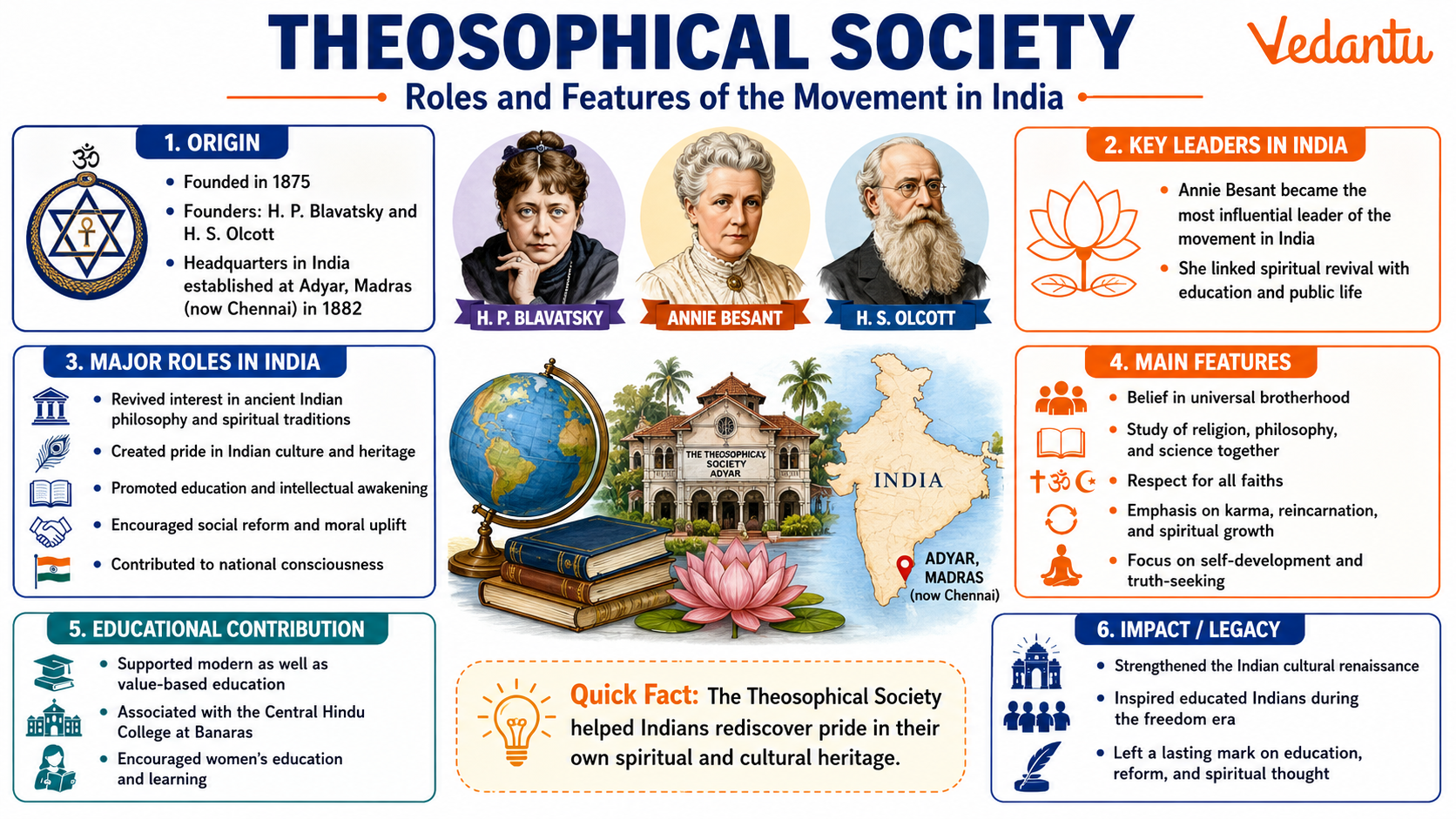
Origin and Establishment of the Theosophical Society
The Theosophical Society was founded in 1875 in New York by Helena Petrovna Blavatsky and Colonel Henry Steel Olcott. In 1879, they moved to India and established the headquarters at Adyar in Madras in 1882. India became the main center of the movement due to its rich spiritual and philosophical traditions.
- Founded in 1875 in New York
- Headquarters shifted to Adyar, Madras in 1882
- Major leaders included H.P. Blavatsky, H.S. Olcott, and Annie Besant
Objectives of the Theosophical Society
The Society had clear philosophical and spiritual goals that focused on unity and ancient wisdom. It did not aim to create a new religion but encouraged the study of comparative religion and universal truths.
- To promote universal brotherhood without distinction of race, creed, sex, caste, or color
- To encourage the study of comparative religion, philosophy, and science
- To investigate unexplained laws of nature and the powers latent in humans
Roles of the Theosophical Society in India
1. Revival of Ancient Indian Religions
The Society revived interest in Hinduism, Buddhism, and other ancient Indian philosophies at a time when Western education and Christian missionary activities were influencing Indian society. It encouraged Indians to take pride in their spiritual heritage.
2. Promotion of Education
Education was one of the major contributions of the Theosophical Society in India. Annie Besant played a key role in establishing educational institutions.
- Established the Central Hindu College in Varanasi in 1898
- The college later became the foundation of Banaras Hindu University
- Promoted modern education along with spiritual values
3. Contribution to Indian National Movement
Annie Besant became actively involved in Indian politics and launched the Home Rule Movement in 1916. The Society indirectly supported Indian nationalism by promoting self-respect and unity among Indians.
4. Social Reform and Equality
The Society opposed caste discrimination and social inequalities. It emphasized universal brotherhood and equal rights for all individuals, regardless of social background.
Features of the Theosophical Movement in India
- Emphasis on spiritual unity of all religions
- Strong support for ancient Indian scriptures like the Vedas and Upanishads
- Encouragement of women education and participation in public life
- Combination of Western and Eastern philosophical ideas
- Headquarters at Adyar became a global spiritual center
Key Leaders of the Theosophical Society in India
| Leader | Contribution | Period of Influence |
|---|---|---|
| H.P. Blavatsky | Co-founder and promoter of Theosophy | 1875 to 1891 |
| H.S. Olcott | Established headquarters at Adyar and promoted education | 1875 to 1907 |
| Annie Besant | Led Home Rule Movement and expanded educational reforms | 1893 onwards |
These leaders helped transform the Theosophical Society into a powerful socio-religious and educational movement in India. Annie Besant in particular linked spiritual revival with political awakening.
Impact and Significance
The Theosophical Society created a new sense of pride among Indians regarding their cultural and spiritual heritage. It encouraged reform without rejecting tradition. The movement also supported women's education and social equality, which were progressive ideas during that period.
- Strengthened Indian cultural identity
- Promoted national unity and self-confidence
- Contributed to educational and social reforms
- Inspired future reform movements
Conclusion
The Theosophical Society was a significant movement in modern Indian history. Through its emphasis on universal brotherhood, revival of ancient Indian wisdom, educational reforms, and support for nationalism, it played a crucial role in shaping India's intellectual and political landscape. Its contributions remain an important part of India's socio-religious reform movements and are frequently studied in General Knowledge and competitive examinations.
FAQs on Theosophical Society in India: Key Roles and Movement Features
1. What was the Theosophical Society and when was it founded?
The Theosophical Society was a spiritual and reformist movement founded in 1875 to promote universal brotherhood and ancient wisdom.
- Founded in New York by Madame H.P. Blavatsky and Colonel H.S. Olcott
- Headquarters shifted to Adyar, Madras (1882)
- Aimed to study comparative religion, philosophy, and science
- Promoted belief in karma, reincarnation, and universal brotherhood
It played a significant role in India’s socio-religious reform movement and cultural revival.
2. What were the main objectives of the Theosophical Society in India?
The main objective of the Theosophical Movement in India was to revive ancient spiritual values and promote unity.
- Establish universal brotherhood without discrimination
- Encourage study of Hinduism, Buddhism, and ancient scriptures
- Investigate unexplained laws of nature and psychic powers
- Promote education and social reform
These goals strengthened India’s cultural pride during British rule.
3. Who were the key leaders of the Theosophical Society in India?
The growth of the Theosophical Society in India was led by influential spiritual and political leaders.
- H.P. Blavatsky – Co-founder and spiritual philosopher
- Colonel H.S. Olcott – Organizational head and reform supporter
- Annie Besant – Prominent leader and Indian nationalist
- George Arundale – Later President of the Society
Among them, Annie Besant played a vital role in linking the movement with the Indian National Movement.
4. What role did Annie Besant play in the Theosophical Movement?
Annie Besant transformed the Theosophical Society into a force for Indian nationalism and education reform.
- Became President of the Society in 1907
- Founded the Central Hindu College (Varanasi)
- Launched the Home Rule Movement (1916)
- Promoted revival of Hindu philosophy and Vedic ideals
She connected spiritual revival with political awakening in colonial India.
5. How did the Theosophical Society contribute to Indian education?
The Theosophical Society significantly contributed to modern and spiritual education in India.
- Established the Central Hindu College (later part of BHU)
- Promoted education based on Indian culture and values
- Encouraged women’s education and social upliftment
- Supported national education free from colonial influence
Its efforts strengthened educational reform movements in India.
6. What were the main features of the Theosophical Movement in India?
The features of the Theosophical Movement combined spiritual philosophy with reformist ideals.
- Belief in karma and reincarnation
- Emphasis on ancient Hindu and Buddhist wisdom
- Promotion of religious tolerance and unity
- Opposition to social evils and caste discrimination
- Support for national awakening
These features made it an important part of the 19th-century reform movements in India.
7. How did the Theosophical Society influence the Indian National Movement?
The Theosophical Society indirectly supported the Indian freedom struggle by promoting self-respect and unity.
- Encouraged pride in Indian heritage
- Annie Besant started the Home Rule League
- Spread ideas of self-government and nationalism
- Inspired educated Indians toward political participation
It helped create an intellectual base for the Indian National Congress and reform movements.
8. Where is the headquarters of the Theosophical Society located in India?
The international headquarters of the Theosophical Society is located at Adyar, Chennai (Madras).
- Shifted to India in 1882
- Became the global center of Theosophical activities
- Hosts spiritual discussions, publications, and research
- Symbolizes India’s importance in the Theosophical Movement
Adyar remains a key landmark in India’s religious reform history.
9. What was the impact of the Theosophical Society on Indian society?
The impact of the Theosophical Society in India was cultural, educational, and political.
- Revived interest in ancient Indian philosophy
- Promoted social reform and women’s upliftment
- Encouraged interfaith harmony
- Strengthened the spirit of nationalism
Though limited in mass appeal, it deeply influenced the educated middle class.
10. Why is the Theosophical Society important for competitive exams?
The Theosophical Society is important for competitive exams because it is a key topic in Modern Indian History and GK.
- Frequently asked in UPSC, SSC, State PSC, and Railways exams
- Connected with Annie Besant and Home Rule Movement
- Part of the 19th-century socio-religious reform movements
- Linked with cultural revival and nationalism
Understanding its roles and features helps in mastering questions on Indian reform movements and national awakening.
