






Key Features of the Harshavardhana Period: Governance and Society
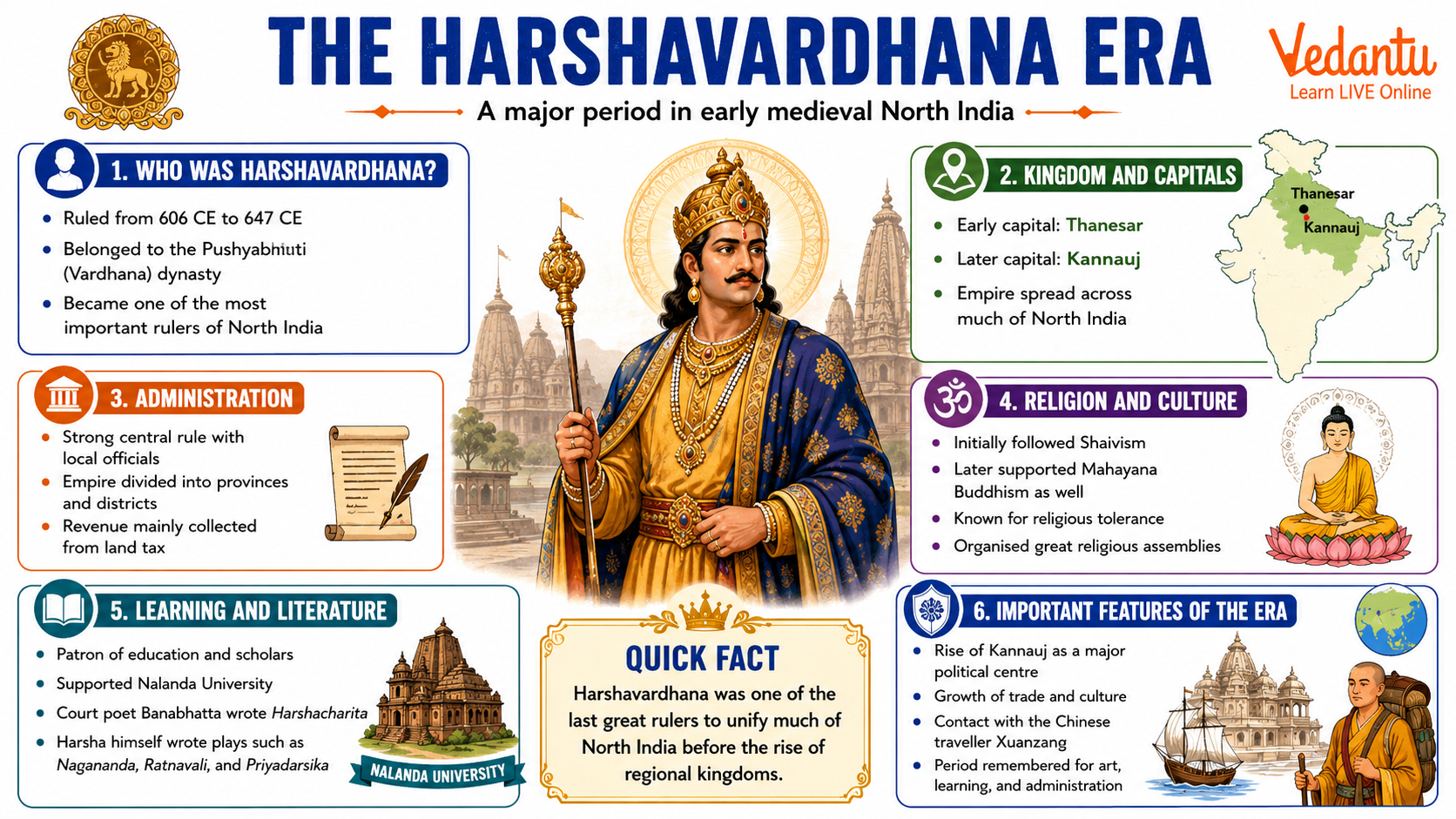
The Harshavardhana Era marks an important phase in early medieval Indian history. Harshavardhana, commonly known as Harsha, ruled North India from 606 CE to 647 CE. After the decline of the Gupta Empire, political fragmentation had spread across northern India. Harsha played a key role in reuniting large parts of North India under a single authority. His reign is known for political consolidation, administrative efficiency, patronage of religion, and cultural development. The period is also well documented due to the writings of the Chinese traveler Xuanzang and Harsha’s court poet Banabhatta.
Background of the Harshavardhana Era
After the fall of the Gupta Empire in the 6th century CE, northern India witnessed political instability. Several small kingdoms emerged, including the Pushyabhuti dynasty, to which Harsha belonged. Harsha ascended the throne at the age of 16 after the death of his brother Rajyavardhana. He gradually expanded his control and established a powerful empire with its capital at Kannauj.
- Founder of the dynasty - Prabhakaravardhana
- Capital city - Thanesar initially, later Kannauj
- Period of rule - 606 CE to 647 CE
- Dynasty - Pushyabhuti or Vardhana dynasty
Political Achievements of Harsha
Harsha expanded his empire through both military conquests and diplomatic alliances. He brought most of North India under his control, including Punjab, Kannauj, Bengal, Bihar, and Odisha. However, his attempt to expand into the Deccan was stopped by Pulakeshin II of the Chalukya dynasty.
Extent of the Empire
- Northern boundary - Himalayas
- Southern boundary - Narmada River
- Eastern boundary - Bengal
- Western boundary - Parts of Punjab
Although Harsha did not control the entire Indian subcontinent, he succeeded in creating political unity in northern India after a long period of fragmentation.
Administration During the Harshavardhana Era
Harsha followed a monarchical system of governance. The king was the supreme authority, but he was assisted by ministers and officials. The administrative system was similar to that of the Guptas, with certain regional adaptations.
- Empire divided into provinces called Bhuktis
- Provinces subdivided into districts called Vishayas
- Village was the basic administrative unit
- Revenue collected mainly from land tax
Harsha maintained a large army consisting of infantry, cavalry, elephants, and chariots. He also conducted regular tours to ensure proper administration and justice.
Religion and Cultural Contributions
Harsha was initially a follower of Shaivism but later became a patron of Mahayana Buddhism. However, he showed religious tolerance and supported different faiths, including Hinduism and Buddhism.
Religious Policy
- Organized religious assemblies at Kannauj
- Donated generously to monasteries and temples
- Held the famous Prayaga Assembly every five years
The Prayaga Assembly was a grand religious gathering where Harsha distributed wealth and charity to scholars, monks, and the poor.
Literary Contributions
Harsha himself was a scholar and playwright. He authored three Sanskrit plays which reflect the cultural richness of his period.
- Ratnavali
- Nagananda
- Priyadarshika
His court poet Banabhatta wrote Harshacharita and Kadambari, which provide valuable historical and literary information about the era.
Important Sources of the Harshavardhana Era
| Source | Author | Significance |
|---|---|---|
| Harshacharita | Banabhatta | Biography of Harsha and court life |
| Si Yu Ki | Xuanzang | Description of India and Harsha’s rule |
| Inscriptions | Various | Administrative and political details |
Xuanzang, the Chinese Buddhist pilgrim, visited India during Harsha’s reign and stayed at his court. His detailed accounts provide valuable insights into the political stability, religious atmosphere, and educational institutions like Nalanda University.
Economic Condition
The economy during the Harshavardhana Era was primarily agrarian. Agriculture formed the backbone of revenue. Trade and commerce were also practiced, though not as flourishing as during the Gupta period.
- Land revenue was the main source of income
- Taxes were moderate
- Internal trade existed between regions
- Support to education and monasteries through grants
Decline of the Harshavardhana Empire
Harsha died in 647 CE without a strong successor. After his death, the empire quickly disintegrated. Northern India once again experienced political fragmentation, leading to the rise of regional powers.
- No direct heir to the throne
- Weak central authority after his death
- Rise of regional kingdoms
Significance of the Harshavardhana Era
The Harshavardhana Era represents the last great Hindu empire in North India before the advent of Islamic invasions. It restored political unity after the Guptas and promoted religious harmony. The period is important for understanding the transition from ancient to early medieval India. Harsha’s patronage of literature, religion, and education contributed significantly to Indian cultural history.
For students and competitive exam aspirants, key areas to focus on include Harsha’s administration, religious policy, literary contributions, the role of Xuanzang, and the reasons for the empire’s decline. Understanding these aspects provides a clear picture of the political and cultural developments of 7th century India.
FAQs on Harshavardhana Era: Rise, Administration and Cultural Impact in Ancient India
1. Who was Harshavardhana and why is he important in Indian history?
Harshavardhana was a powerful North Indian ruler who established a vast empire in the 7th century CE.
• Harshavardhana (c. 606–647 CE) belonged to the Pushyabhuti dynasty.
• He ruled from his capital at Kannauj.
• United large parts of Northern India after the fall of the Gupta Empire.
• Known for religious tolerance, patronage of arts, and administrative efficiency.
He is often compared to great rulers like Samudragupta and is frequently asked in GK questions, UPSC, SSC, and state PCS exams.
2. When did Harshavardhana rule and what was the extent of his empire?
Harshavardhana ruled from 606 CE to 647 CE and controlled much of North India.
• Ascended the throne in 606 CE after his brother’s death.
• Empire extended from Punjab to Bengal and parts of Odisha.
• Southern expansion was stopped by Pulakeshin II of the Chalukya dynasty.
The Harsha Empire marked the last great Hindu empire in North India before medieval regional kingdoms emerged.
3. What were the main achievements of Harshavardhana?
Harshavardhana is remembered for his military conquests, administrative reforms, and cultural patronage.
• Consolidated North India under one ruler.
• Maintained a strong central administration with provincial governance.
• Promoted Buddhism, Hinduism, and Jainism equally.
• Encouraged education at Nalanda University.
• Organized grand religious assemblies at Prayag (Allahabad).
These achievements make the Harshavardhana Era significant in medieval Indian history.
4. Who was the Chinese traveler during Harshavardhana’s reign?
The famous Chinese traveler who visited Harsha’s court was Xuanzang (Hiuen Tsang).
• Visited India during the 7th century CE.
• Stayed at Nalanda University for several years.
• Described Harsha as a just and capable ruler.
• Provided detailed accounts of administration, society, and religion.
His writings are an important source for understanding the Harshavardhana period in Indian history.
5. What was Harshavardhana’s contribution to literature and culture?
Harshavardhana was not only a ruler but also a patron of literature and arts.
• Authored Sanskrit plays like Nagananda, Ratnavali, and Priyadarshika.
• Supported scholars such as Banabhatta, author of Harshacharita.
• Encouraged Sanskrit literature and classical learning.
The cultural achievements of Harsha are frequently highlighted in GK and history examinations.
6. What was the administrative system of Harshavardhana?
Harshavardhana followed a well-organized monarchical administrative system.
• King was the supreme authority.
• Empire divided into provinces (Bhuktis) and districts.
• Officials managed revenue, law, and military affairs.
• Maintained a strong army of infantry, cavalry, and elephants.
The administration under Harsha combined central control with local governance, similar to earlier Gupta practices.
7. What religion did Harshavardhana follow?
Harshavardhana initially followed Hinduism but later became a supporter of Buddhism.
• Began as a devotee of Lord Shiva.
• Later embraced Mahayana Buddhism.
• Practiced religious tolerance toward Hindus, Buddhists, and Jains.
• Organized religious assemblies promoting peace and charity.
This religious harmony was a key feature of the Harshavardhana Era.
8. Why did Harshavardhana fail to expand into South India?
Harshavardhana’s southern expansion failed due to his defeat by Pulakeshin II.
• Faced the powerful Chalukya ruler Pulakeshin II.
• Battle fought near the Narmada River.
• Harsha was prevented from expanding beyond North India.
This conflict is an important topic in ancient and medieval Indian history GK.
9. What is Harshacharita and who wrote it?
Harshacharita is a biographical account of Harshavardhana written by Banabhatta.
• Written in Sanskrit prose.
• Describes the life and achievements of King Harsha.
• Provides insights into the political and social conditions of the 7th century.
Banabhatta was the court poet of Harsha, and this text is a major source for studying the Harshavardhana period.
10. What led to the decline of Harshavardhana’s empire?
The decline of Harshavardhana’s empire began after his death in 647 CE due to lack of a strong successor.
• Harsha died without a capable heir.
• Empire fragmented into smaller regional kingdoms.
• Rise of new powers in North India.
The fall of the Harsha Empire marked the end of a unified North India until later medieval empires emerged.
