






How the Wealthiest Nations Rank by GDP Per Capita
The richest countries in the world are nations with the highest income levels, strong economies, and high standards of living. Wealth is usually measured using Gross Domestic Product - GDP per capita, which calculates the average income per person in a country. Many of the richest countries are small in size but have strong financial sectors, natural resources, or advanced industries. Understanding the richest countries is important for General Knowledge preparation, competitive exams, and awareness of global economic trends.
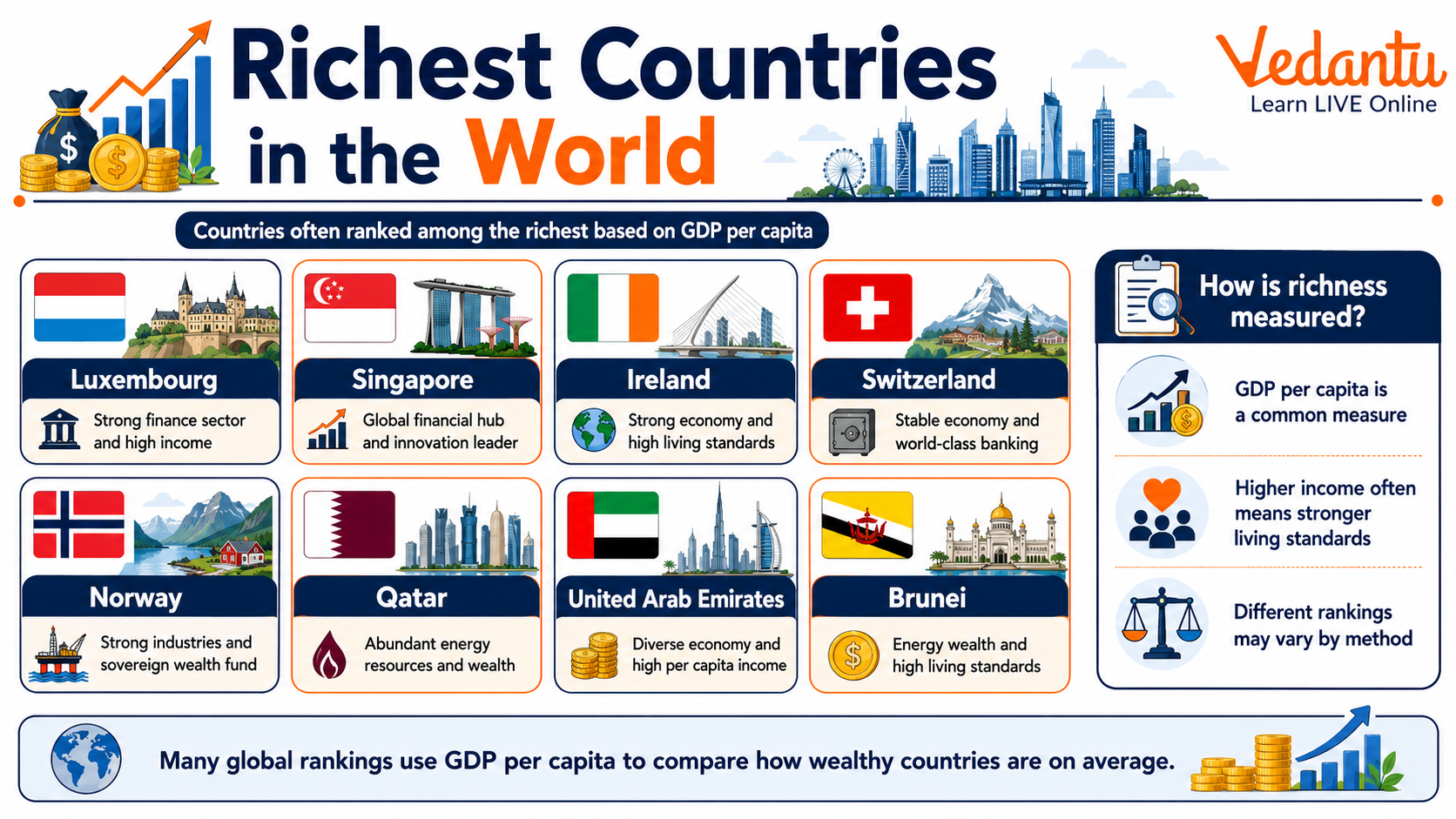
How Wealth of a Country is Measured
To identify the richest countries, economists use specific economic indicators. The most common and reliable measure is GDP per capita, especially when adjusted for Purchasing Power Parity - PPP. PPP considers the cost of living and inflation rates, giving a more accurate comparison between countries.
Key Indicators Used
- GDP per capita - Total economic output divided by population.
- GDP per capita PPP - Adjusted for purchasing power.
- Gross National Income - GNI per capita.
- Human Development Index - HDI.
- Standard of living and quality of infrastructure.
Top 10 Richest Countries In The World (By GDP Per Capita PPP)
| Rank | Country | Approx. GDP Per Capita (PPP) USD |
|---|---|---|
| 1 | Luxembourg | 140,000+ |
| 2 | Singapore | 130,000+ |
| 3 | Ireland | 120,000+ |
| 4 | Qatar | 110,000+ |
| 5 | Norway | 100,000+ |
| 6 | Switzerland | 95,000+ |
| 7 | United Arab Emirates | 90,000+ |
| 8 | United States | 85,000+ |
| 9 | Denmark | 80,000+ |
| 10 | Netherlands | 75,000+ |
The rankings may vary slightly depending on the source such as IMF, World Bank, or CIA World Factbook. Most of these countries have strong financial services, advanced technology sectors, oil and gas reserves, or global trade advantages.
Reasons Why These Countries Are So Rich
The wealth of these nations is not accidental. It is built on strong governance, economic planning, and strategic advantages.
Major Contributing Factors
- Strong financial and banking sectors - Example Luxembourg and Switzerland.
- Natural resource wealth - Example Qatar and Norway with oil and gas.
- Global trade hubs - Example Singapore and UAE.
- High-tech industries and innovation - Example United States and Ireland.
- Political stability and transparent governance.
Richest Countries By Continent
Different continents have their own leading wealthy nations based on GDP per capita.
- Europe - Luxembourg, Switzerland, Norway.
- Asia - Singapore, Qatar, United Arab Emirates.
- North America - United States.
- Oceania - Australia.
- Africa - Seychelles.
Difference Between Richest and Largest Economies
The richest countries are not always the largest economies. For example, the United States and China have the largest total GDP in the world. However, smaller countries like Luxembourg rank higher in GDP per capita because their population is small while income levels are very high.
- Largest economy - Measured by total GDP.
- Richest country - Measured by GDP per capita.
Importance of Studying Richest Countries
Learning about the richest countries helps students understand global economics, development patterns, and international trade systems. It is a common topic in competitive exams, quizzes, and interviews. Questions may ask about rankings, GDP measures, or economic indicators.
Preparation Tips for Competitive Exams
- Remember the top 5 richest countries by GDP per capita.
- Understand the difference between GDP and GDP per capita.
- Know the economic strengths of top countries.
- Follow updates from IMF and World Bank reports.
Conclusion
The richest countries in the world are defined by high GDP per capita, strong economies, and excellent living standards. Nations like Luxembourg, Singapore, and Ireland consistently rank at the top due to financial services, trade advantages, or natural resources. Understanding this topic enhances global awareness and strengthens General Knowledge preparation for exams and interviews.
FAQs on Richest Countries Around the World by Wealth
1. Which are the richest countries in the world in 2026?
The richest countries in the world in 2026 are ranked mainly by GDP per capita (PPP), which measures average income per person.
• Luxembourg – High financial services income
• Singapore – Strong trade and banking sector
• Ireland – Multinational corporate hub
• Qatar – Oil and natural gas wealth
• Switzerland – Banking and pharmaceuticals
These nations consistently rank high in world wealth rankings, per capita income, and global prosperity indexes.
2. How is a country’s wealth measured?
A country’s wealth is primarily measured using GDP per capita and Gross National Income (GNI).
• GDP per capita (PPP) – Adjusts income based on cost of living
• Nominal GDP per capita – Measures income without inflation adjustment
• Human Development Index (HDI) – Considers health, education, and income
• Natural resource wealth – Oil, gas, minerals
These indicators help compare economic prosperity, standard of living, and national income levels.
3. Why is Luxembourg considered the richest country in the world?
Luxembourg is considered the richest country due to its extremely high GDP per capita and strong financial sector.
• Major hub for international banking and investment funds
• Small population with high average income
• Stable political and economic system
• Strong service-based economy
This makes Luxembourg top global lists for richest nations, per capita income, and economic stability.
4. Is the United States the richest country in the world?
The United States has the largest overall GDP in the world, but not the highest GDP per capita.
• Ranked first in total economic output
• High income levels but large population
• Strong industries: technology, finance, defense
• GDP per capita lower than Luxembourg or Singapore
Thus, the USA is the biggest economy but not the richest per person.
5. Which country is the richest in Asia?
In Asia, Singapore and Qatar (West Asia) are among the richest countries by GDP per capita.
• Singapore – Global trade and financial hub
• Qatar – Oil and natural gas reserves
• United Arab Emirates (UAE) – Diversified economy
These countries lead Asia in per capita income, economic development, and living standards.
6. What is the difference between GDP and GDP per capita?
The key difference is that GDP measures total economic output, while GDP per capita measures average income per person.
• GDP – Total value of goods and services produced
• GDP per capita – GDP divided by population
• Used to compare standard of living between countries
• Important for ranking the richest countries in the world
GDP per capita gives a clearer picture of individual prosperity.
7. Why are small countries often among the richest nations?
Small countries often rank high because their wealth is distributed among fewer people, increasing GDP per capita.
• Smaller population size
• Strong banking or financial sectors
• Abundant natural resources (oil, gas)
• Business-friendly tax policies
Examples include Luxembourg, Singapore, and Qatar, which dominate global wealth rankings.
8. Which European countries are the richest?
The richest European countries based on GDP per capita include Luxembourg, Ireland, Switzerland, and Norway.
• Strong financial services
• Advanced industrial economies
• High living standards
• Strong social welfare systems
These nations consistently rank high in European economic prosperity and global income rankings.
9. Do natural resources make a country rich?
Yes, abundant natural resources like oil and gas can significantly increase a country’s wealth.
• Qatar – Natural gas reserves
• UAE – Oil exports
• Norway – Oil and sovereign wealth fund
• Higher export revenue boosts GDP per capita
However, economic diversification is essential for long-term sustainable growth and stability.
10. Which country has the highest GDP in the world?
The United States has the highest GDP in the world in terms of total economic output.
• Followed by China and Germany
• Measured in nominal GDP
• Reflects total production of goods and services
While the USA leads in total GDP, other countries lead in GDP per capita rankings.
