






Unique Culture, Traditions and Lifestyle of the Jarwa People in Andaman Islands
The Jarwa tribe is one of the most fascinating and ancient indigenous communities of India, living in the Andaman Islands. Known for their isolated lifestyle and deep connection with nature, the Jarwas have preserved their traditions for thousands of years. Studying interesting facts about the Andamans Jarwa Tribe helps students understand India's tribal diversity, human evolution, constitutional protection of tribes, and issues related to conservation and human rights. This topic is important for General Knowledge, competitive exams, and social studies.
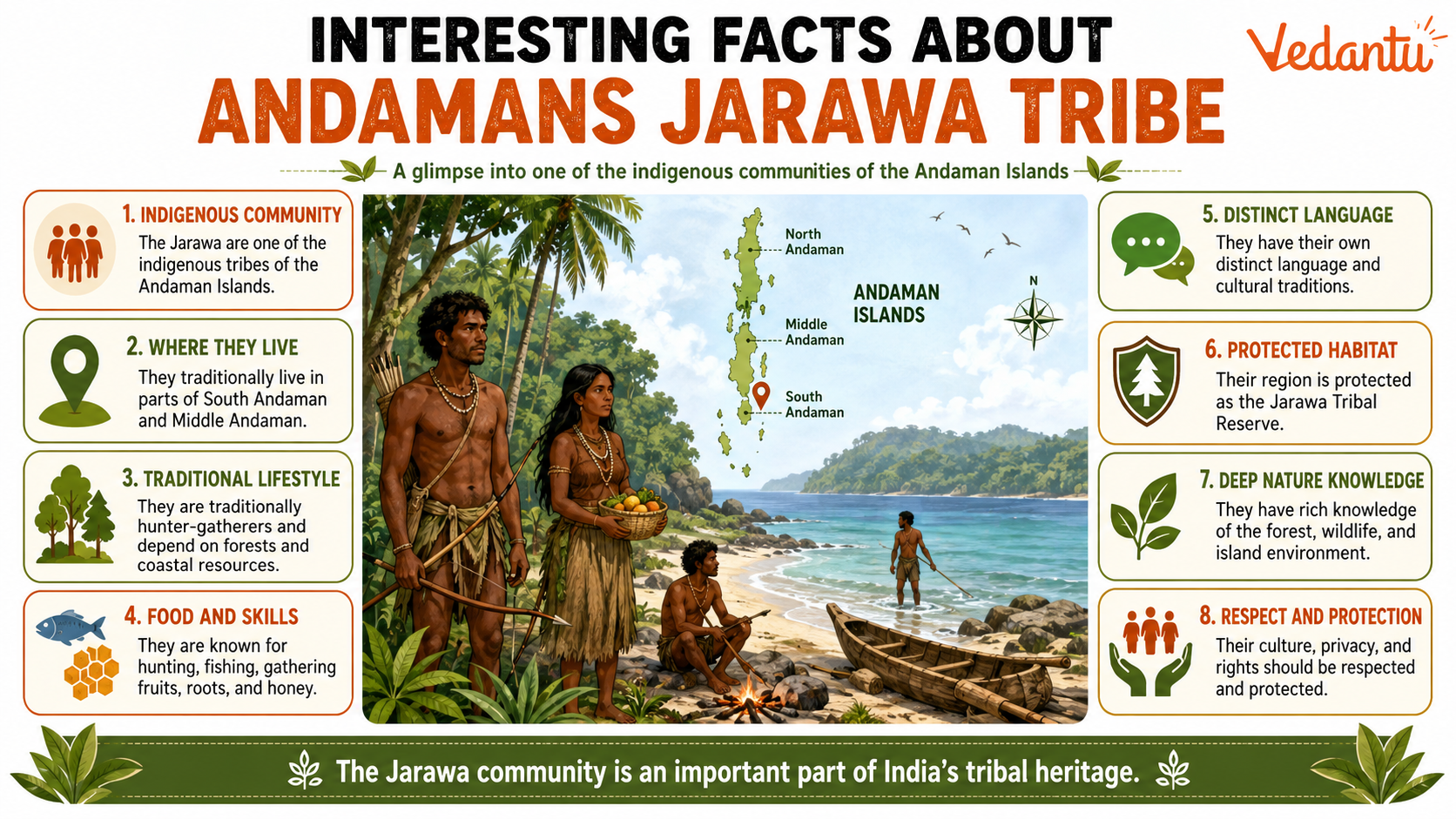
Who Are the Jarwa Tribe?
The Jarwa are one of the indigenous tribes of the Andaman and Nicobar Islands, located in the Bay of Bengal. They are considered among the original inhabitants of the islands and have lived there for thousands of years. The Jarwas traditionally lived as hunter-gatherers and remained isolated from the outside world for a long time.
- They mainly inhabit South Andaman and Middle Andaman Islands.
- They are part of the Negrito ethnic group.
- Their population is very small, estimated at around 400 to 500 individuals.
- They speak the Jarwa language, which has no written script.
Interesting Facts About Andamans Jarwa Tribe
1. One of the Oldest Surviving Tribes
The Jarwas are believed to have lived in the Andaman Islands for more than 50,000 years. They are among the oldest surviving human populations in the world and provide valuable insight into early human migration patterns.
2. Hunter-Gatherer Lifestyle
The Jarwas traditionally depend on hunting wild pigs, fishing, and collecting fruits, honey, and roots from forests. They do not practice agriculture and rely completely on natural resources.
3. Isolation from the Outside World
For centuries, the Jarwas resisted contact with outsiders. They were known to protect their territory strongly. In recent decades, limited contact has taken place, but the government restricts interaction to protect their culture and health.
4. Andaman Trunk Road Controversy
The Andaman Trunk Road passes through the Jarwa Reserve Area. This has raised concerns about illegal tourism, exploitation, and exposure of the tribe to diseases. The Supreme Court of India has issued strict guidelines to protect them.
5. Protected Tribal Reserve
The Jarwa territory has been declared a protected area under the Andaman and Nicobar Islands Protection of Aboriginal Tribes Regulation, 1956. Entry into the reserve without permission is strictly prohibited.
6. Unique Physical Features
The Jarwas have distinct physical features such as short stature, dark skin, and curly hair. These characteristics link them to other Negrito tribes of Southeast Asia.
7. Minimal Use of Modern Technology
Traditionally, the Jarwas use bows and arrows for hunting and make simple tools from natural materials. Although limited interaction has introduced some modern items, their lifestyle remains largely traditional.
Quick Facts About the Jarwa Tribe
| Feature | Details | Importance |
|---|---|---|
| Location | South and Middle Andaman Islands | Shows geographic isolation |
| Lifestyle | Hunter-gatherer | Represents early human survival methods |
| Legal Status | Protected Tribal Reserve | Ensures cultural and physical protection |
The table above summarizes the key aspects of the Jarwa tribe, including their location, lifestyle, and legal protection. These points are frequently asked in competitive examinations and General Knowledge tests.
Culture and Social Life
The Jarwas live in small groups and follow a simple social structure. Their society is based on cooperation and sharing of resources. They build temporary shelters using leaves and branches.
- Food is shared among group members.
- Traditional body decoration includes ornaments made of shells and bones.
- Music and dance are part of community celebrations.
Challenges Faced by the Jarwa Tribe
Despite legal protection, the Jarwas face several challenges due to increasing contact with outsiders and developmental activities in the region.
- Risk of diseases due to low immunity against common infections.
- Encroachment and habitat loss.
- Illegal tourism and exploitation.
- Cultural disruption due to external influence.
Importance of Studying the Jarwa Tribe
Learning about the Jarwa tribe is important for understanding tribal rights, biodiversity conservation, and human anthropology. It also highlights the need for balanced development that respects indigenous communities. Questions related to the Jarwa tribe often appear in UPSC, SSC, state PSC, and other competitive examinations under Indian Geography and Social Issues.
Conclusion
The Andamans Jarwa Tribe represents one of the oldest surviving human communities in the world. Their unique culture, hunter-gatherer lifestyle, and protected status make them an important part of India's tribal heritage. Understanding interesting facts about the Jarwa tribe not only enhances General Knowledge but also promotes awareness about the protection of indigenous communities and respect for cultural diversity.
FAQs on Interesting Facts About Andamans Jarwa Tribe for Students
1. Who are the Jarwa tribe of the Andaman Islands?
The Jarwa tribe is one of the oldest indigenous tribes living in the Andaman Islands of India.
• They are a Negrito tribe believed to have lived in the islands for over 50,000 years.
• They mainly inhabit the South and Middle Andaman Islands.
• The Jarwas traditionally live as hunter-gatherers.
• They are protected under the Andaman and Nicobar Islands Protection of Aboriginal Tribes Regulation, 1956.
This tribe is often discussed in GK, competitive exams, and topics related to indigenous people of India and isolated tribes.
2. Where do the Jarwa tribe live?
The Jarwa tribe lives in the dense forests of the Andaman Islands, mainly in South and Middle Andaman.
• Their territory is known as the Jarwa Tribal Reserve.
• It is located along the Andaman Trunk Road (ATR).
• The area is restricted to protect their traditional lifestyle.
• Entry without permission is strictly prohibited by the Indian government.
This region is frequently searched under terms like Jarwa habitat, Andaman tribal reserve, and tribes of Andaman and Nicobar Islands.
3. What is the lifestyle of the Jarwa tribe?
The Jarwa tribe follows a traditional hunter-gatherer lifestyle with minimal outside contact.
• They hunt wild pigs and monitor lizards.
• They gather fruits, honey, roots, and tubers.
• They use bows and arrows for hunting.
• They live in small temporary huts called lean-tos.
Their lifestyle is often studied in topics like primitive tribes of India, indigenous culture, and tribal traditions.
4. What language do the Jarwa people speak?
The Jarwa people speak the Jarwa language, which belongs to the Ongan language family.
• It is a unique and endangered tribal language.
• It is mainly spoken within the community.
• Very few outsiders understand it.
• The language has no widely used written script.
This topic is relevant under endangered languages of India and tribal dialects of Andaman.
5. Why are the Jarwa tribe protected by the government?
The Jarwa tribe is protected to preserve their culture and prevent exploitation.
• They are vulnerable to outside diseases.
• Contact with outsiders can disrupt their traditional life.
• The Jarwa Tribal Reserve restricts tourism and settlements.
• Laws prohibit photography, interaction, or exploitation.
Protection of the Jarwas is an important topic in tribal rights, human rights issues, and Indian polity GK.
6. How many Jarwa tribe members are there today?
The population of the Jarwa tribe is very small, estimated at around 400–500 individuals.
• They are classified as a Particularly Vulnerable Tribal Group (PVTG).
• Their population declined in the past due to diseases and conflicts.
• Government protection has helped stabilize their numbers.
This fact is commonly asked in exams under PVTGs in India and tribal population statistics.
7. What are some interesting facts about the Jarwa tribe?
The Jarwa tribe has several unique and fascinating characteristics that make them important in General Knowledge.
• They lived in isolation for thousands of years.
• They are skilled archers and hunters.
• They paint their bodies with natural pigments.
• They resisted outside contact for centuries.
• They survived the 2004 Indian Ocean tsunami using traditional knowledge.
These facts are often searched as interesting facts about Andaman tribes and Jarwa tribe GK questions.
8. How did the 2004 tsunami affect the Jarwa tribe?
The Jarwa tribe survived the 2004 tsunami with minimal loss due to their deep understanding of nature.
• They moved to higher ground after noticing unusual sea behavior.
• Their traditional ecological knowledge saved lives.
• Very few casualties were reported among them.
This event is often highlighted in discussions about indigenous knowledge systems and natural disaster survival.
9. What challenges does the Jarwa tribe face today?
The Jarwa tribe faces challenges from modernization and outside interference.
• Exposure to diseases from outsiders.
• Illegal tourism and exploitation.
• Encroachment due to the Andaman Trunk Road.
• Cultural erosion and dependency risks.
These concerns are frequently discussed under threats to indigenous tribes and tribal conservation issues in India.
10. Why is the Jarwa tribe important for General Knowledge and exams?
The Jarwa tribe is important for GK because they represent one of India’s oldest indigenous communities.
• Frequently asked in UPSC, SSC, and state PSC exams.
• Related to topics like PVTGs, tribes of India, and Andaman and Nicobar Islands.
• Important for understanding cultural diversity of India.
• Linked to current affairs on tribal rights and conservation.
This makes the Jarwa tribe a key topic in Indian Geography, Social Studies, and General Awareness.
