






List of Major Indigenous and Exotic Cow Breeds in India with Key Features
India is one of the largest producers of milk in the world, and cattle play a vital role in the country’s agriculture and rural economy. A common general knowledge question is - How many breeds of cows are found in India? According to the latest data recognized by the National Bureau of Animal Genetic Resources (NBAGR), India has more than 50 registered indigenous cattle breeds. These breeds are adapted to different climatic conditions and are known for their milk production, draught power, and disease resistance. Understanding Indian cow breeds is important for students, competitive exam aspirants, and agriculture-related studies.
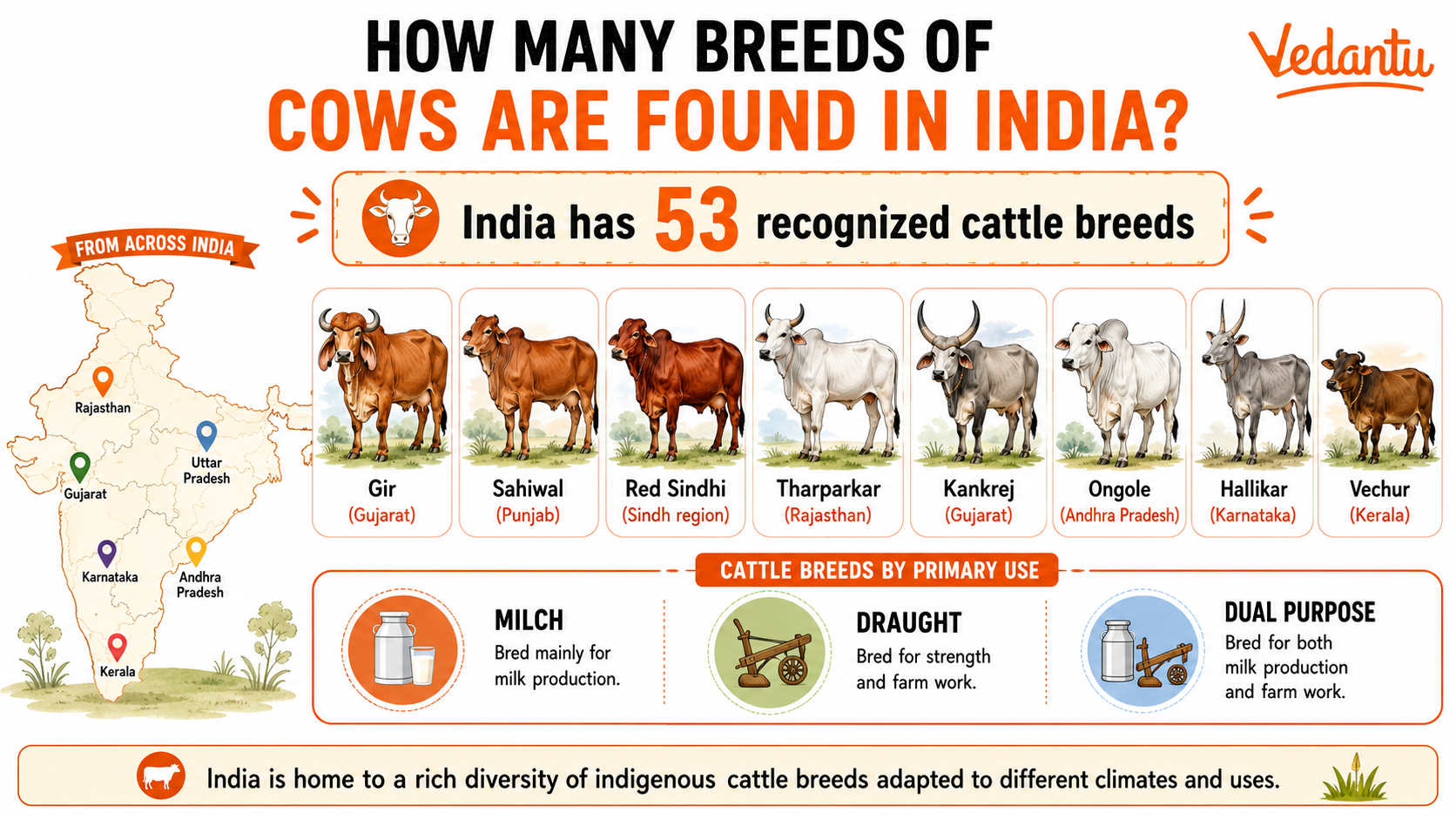
Total Number of Cow Breeds in India
India has 50+ registered indigenous cattle breeds. These breeds are officially recognized and documented by the National Bureau of Animal Genetic Resources. In addition to indigenous breeds, there are also several exotic and crossbred varieties found across the country.
- More than 50 indigenous cattle breeds are officially recognized.
- India ranks first in total cattle population globally.
- Indian breeds are well adapted to tropical and subtropical climates.
- They are known for heat tolerance and disease resistance.
Classification of Cow Breeds in India
Indian cattle breeds are generally classified based on their primary utility. This classification helps in understanding their economic importance.
1. Milch Breeds
These breeds are mainly reared for milk production. They produce a higher quantity of milk compared to other breeds.
- Gir
- Sahiwal
- Red Sindhi
- Rathi
2. Draught Breeds
These breeds are mainly used for agricultural work such as ploughing and cart pulling. Milk production is relatively low.
- Hallikar
- Amritmahal
- Kangayam
- Khillar
3. Dual Purpose Breeds
These breeds are useful for both milk production and agricultural work.
- Tharparkar
- Kankrej
- Ongole
- Hariana
Major Indigenous Cow Breeds of India
| Breed Name | State of Origin | Main Use |
|---|---|---|
| Gir | Gujarat | Milk |
| Sahiwal | Punjab | Milk |
| Tharparkar | Rajasthan | Dual Purpose |
| Kangayam | Tamil Nadu | Draught |
The above table highlights some of the most important indigenous cow breeds of India. Each breed is adapted to specific climatic conditions and plays a crucial role in regional agriculture and dairy farming.
Importance of Indigenous Cow Breeds
Indigenous cattle breeds are valuable due to their adaptability and sustainability. They require less maintenance compared to exotic breeds and are better suited to Indian environmental conditions.
- High resistance to tropical diseases.
- Better tolerance to heat and humidity.
- Lower feeding and management costs.
- Important for organic and sustainable farming.
Role of Cow Breeds in Indian Economy
Cattle contribute significantly to India's dairy sector, which supports millions of farmers. India is the largest milk producer in the world, and indigenous breeds form the backbone of rural livelihoods. Cow breeds also contribute to manure production, which enhances soil fertility.
Conclusion
To answer the question - How many breeds of cows are found in India? - there are more than 50 recognized indigenous cattle breeds in the country. These breeds are classified into milch, draught, and dual purpose categories based on their utility. They play a crucial role in agriculture, dairy production, and rural development. Knowledge of Indian cow breeds is important for general awareness, competitive exams, and understanding India's agricultural diversity.
FAQs on How Many Breeds of Cows Are Found in India and Why Are They Important?
1. How many breeds of cows are found in India?
India has over 50 recognized indigenous cattle breeds registered by the National Bureau of Animal Genetic Resources (NBAGR).
• More than 50 native (desi) cow breeds
• Includes milch, draught, and dual-purpose breeds
• India has the largest cattle population in the world
These Indian cow breeds are known for adaptability, disease resistance, and suitability to local climates.
2. What are some famous indigenous cow breeds of India?
Some of the most famous indigenous cow breeds of India are known for high milk yield and strong immunity.
• Gir (Gujarat)
• Sahiwal (Punjab)
• Red Sindhi
• Tharparkar
• Rathi
• Ongole
These breeds are commonly asked in GK questions, competitive exams, and agriculture studies.
3. Which Indian cow breed gives the highest milk?
The Gir cow is considered one of the highest milk-producing indigenous breeds in India.
• Average yield: 10–15 liters per day
• Known for high-quality A2 milk
• Native to Gujarat
Other high milk-yielding breeds include Sahiwal and Red Sindhi, important in dairy farming and livestock development.
4. What is the difference between indigenous and exotic cow breeds?
The main difference lies in origin, adaptability, and milk production capacity.
Indigenous (Desi) Breeds:
• Native to India
• Heat and disease resistant
• Produce A2 type milk
Exotic Breeds:
• Originated abroad (e.g., Jersey, Holstein Friesian)
• Higher milk yield
• Less tolerant to tropical climate
This distinction is important in animal husbandry and dairy science.
5. How are Indian cow breeds classified?
Indian cattle breeds are classified based on their utility and productivity.
• Milch breeds – High milk producers (Gir, Sahiwal)
• Draught breeds – Used for farming and transport (Hallikar, Kangayam)
• Dual-purpose breeds – Milk and work (Tharparkar, Rathi)
This classification is commonly covered in General Knowledge (GK) and agriculture exams.
6. Which state has the highest number of cow breeds in India?
States like Gujarat, Rajasthan, and Punjab are known for having several important indigenous cow breeds.
• Gujarat – Gir, Kankrej
• Rajasthan – Rathi, Tharparkar
• Punjab – Sahiwal
These states play a major role in India’s dairy industry and cattle diversity.
7. What is A2 milk and which Indian cows produce it?
A2 milk is a type of milk that contains the A2 beta-casein protein, believed to be easier to digest.
• Produced mainly by indigenous Indian cow breeds
• Examples: Gir, Sahiwal, Red Sindhi, Tharparkar
• Considered healthier compared to A1 milk
A2 milk is often discussed in health, dairy farming, and GK topics.
8. Why are indigenous cow breeds important in India?
Indigenous cow breeds are important for sustainable agriculture and rural economy.
• Adapted to Indian climate conditions
• Strong disease resistance
• Lower maintenance cost
• Produce A2 milk
They support dairy farming, organic agriculture, and livestock development programs in India.
9. Which organization registers cow breeds in India?
The National Bureau of Animal Genetic Resources (NBAGR) registers and recognizes cattle breeds in India.
• Located in Karnal, Haryana
• Maintains official breed records
• Works under ICAR (Indian Council of Agricultural Research)
This body ensures conservation of indigenous livestock breeds.
10. How many total cattle are there in India?
India has over 190 million cattle, making it the country with the largest cattle population globally.
• Data based on the Livestock Census
• Includes indigenous and crossbred cows
• Major contributor to world milk production
India ranks first in global milk production, supported by its diverse cow breeds.
