






State-wise Spread of Cement Plants in India and Major Location Factors
The geographical distribution of the cement industry in India is closely linked to the availability of raw materials, power supply, transportation facilities, and market demand. Cement is a key infrastructure material used in construction activities such as buildings, roads, bridges, dams, and industrial projects. India is one of the largest producers of cement in the world, and its cement plants are unevenly distributed across different states due to regional variations in limestone reserves and other essential resources. Understanding the spatial distribution of the cement industry helps students grasp the relationship between natural resources and industrial development in India.
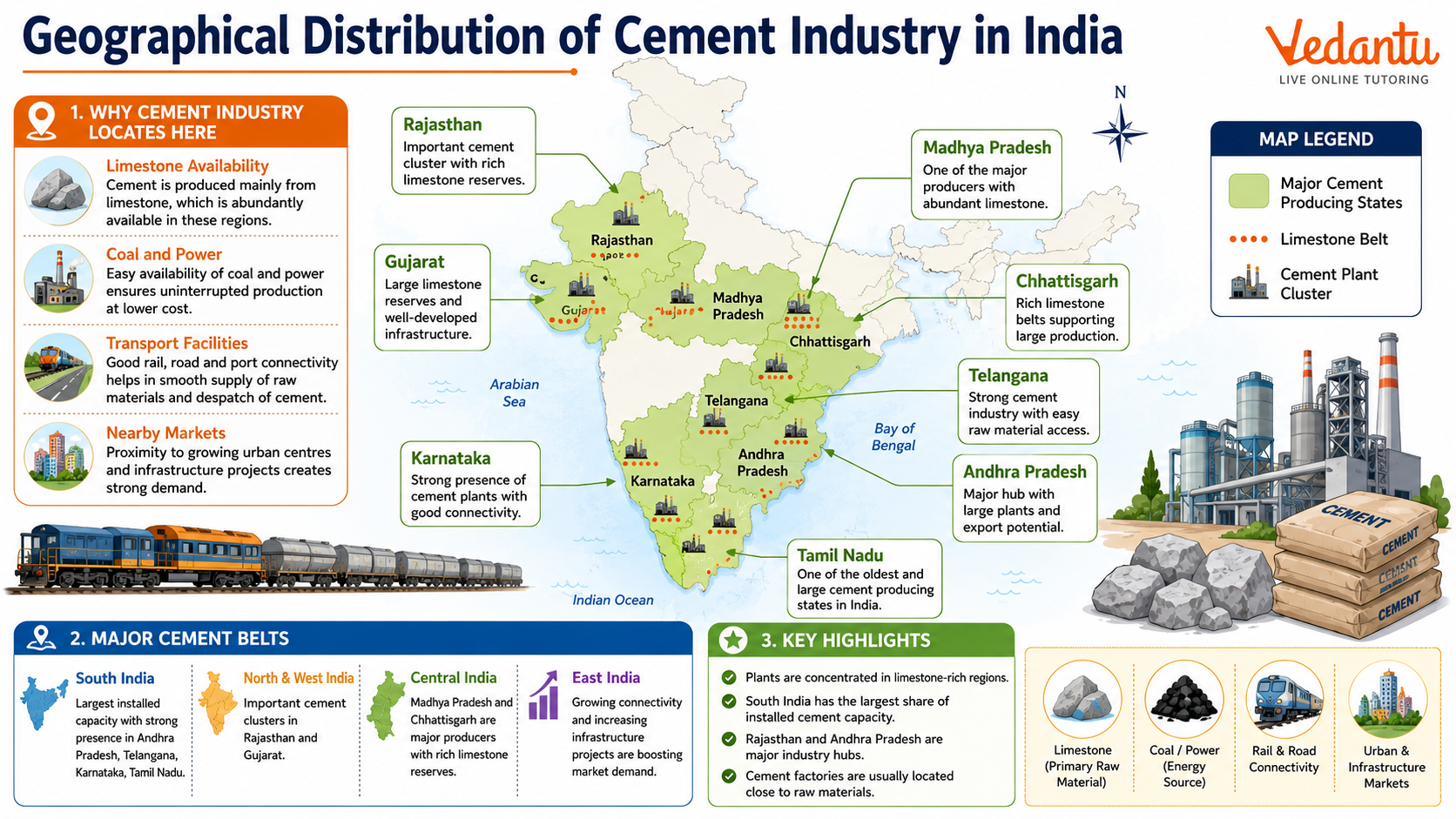
Factors Influencing the Location of Cement Industry
The cement industry is a raw material-oriented industry. It requires bulky raw materials, especially limestone, which determines its location. Several physical and economic factors influence the geographical distribution of cement plants in India.
1. Availability of Raw Materials
- Limestone is the chief raw material and accounts for about 60 to 70 percent of cement production.
- Other materials include clay, gypsum, silica, and iron ore.
- Regions rich in high-quality limestone attract cement plants.
2. Power and Fuel Supply
- Cement manufacturing is energy intensive.
- Coal, electricity, and petroleum are required for production.
- Plants are often located near coal fields or areas with reliable power supply.
3. Transportation Facilities
- Cement is a bulky and heavy commodity.
- Efficient rail and road networks reduce transportation costs.
- Proximity to ports supports export activities.
4. Market Demand
- Urbanization and infrastructure growth increase cement demand.
- Plants are often located near large construction markets.
Major Cement Producing Regions in India
The cement industry in India is mainly concentrated in states with abundant limestone reserves. The southern and western states dominate production, followed by central and northern regions.
State-wise Distribution of Cement Industry in India
| Region | Major States | Reasons for Concentration |
|---|---|---|
| Southern India | Andhra Pradesh, Tamil Nadu, Karnataka, Telangana | Abundant limestone, good infrastructure, high demand |
| Western India | Rajasthan, Gujarat, Maharashtra | Rich limestone deposits, proximity to ports |
| Central India | Madhya Pradesh, Chhattisgarh | Large limestone reserves, coal availability |
| Northern India | Uttar Pradesh, Himachal Pradesh | Availability of raw materials and growing market |
Rajasthan is one of the leading cement producing states due to its vast limestone reserves. Andhra Pradesh and Telangana also contribute significantly because of their high-quality raw materials and well-developed industrial infrastructure. Gujarat benefits from port facilities, which help in exporting cement to other countries.
Leading Cement Producing States
- Rajasthan - Largest producer with abundant limestone deposits.
- Andhra Pradesh - Major contributor due to large reserves and modern plants.
- Tamil Nadu - Strong industrial base and steady demand.
- Gujarat - Advantage of coastal location and export facilities.
- Madhya Pradesh - Centrally located with good connectivity.
Regional Pattern of Cement Industry
The southern region accounts for a significant share of India’s total cement production. The western and central regions also have a strong presence due to favorable geological conditions. The eastern region has fewer cement plants because of limited high-grade limestone reserves. Thus, the distribution pattern clearly reflects the importance of raw material availability.
Importance of Cement Industry in India
- Supports infrastructure development and housing projects.
- Generates employment in manufacturing and transportation sectors.
- Contributes significantly to industrial growth and GDP.
- Encourages development of allied industries.
Conclusion
The geographical distribution of the cement industry in India is mainly determined by the availability of limestone, power resources, transportation facilities, and market demand. The industry is highly concentrated in southern, western, and central India due to rich mineral reserves. Understanding this distribution highlights the strong link between natural resources and industrial location. For students and competitive exam aspirants, knowledge of state-wise concentration and locational factors is essential for geography and general knowledge preparation.
FAQs on Geographical Distribution Of Cement Industry In India and Key Producing States
1. What is the geographical distribution of the cement industry in India?
The cement industry in India is mainly concentrated in mineral-rich and limestone-abundant regions.
• Major cement-producing states include Rajasthan, Andhra Pradesh, Tamil Nadu, Gujarat, Karnataka, Madhya Pradesh, and Chhattisgarh.
• These areas have large deposits of limestone, the key raw material for cement manufacturing.
• Proximity to coal fields, transportation networks, and markets also influences the regional distribution of cement plants in India.
2. Why is the cement industry located near limestone deposits in India?
The cement industry is located near limestone deposits because limestone is the primary raw material for cement production.
• Limestone accounts for about 60–65% of cement composition.
• Transporting limestone is costly, so factories are set up close to mines.
• States like Rajasthan and Madhya Pradesh have abundant high-quality limestone reserves.
• This reduces production costs and ensures continuous supply for cement manufacturing units.
3. Which state is the largest producer of cement in India?
Rajasthan is the largest cement-producing state in India due to its vast limestone reserves.
• It contributes significantly to India's total cement output.
• Other major producers include Andhra Pradesh, Tamil Nadu, and Gujarat.
• Availability of raw materials and strong industrial infrastructure support high production levels.
• Rajasthan is often called the cement hub of India.
4. What factors affect the location of cement industries in India?
The location of the cement industry in India depends on several geographical and economic factors.
• Availability of limestone and gypsum.
• Access to coal and power supply.
• Efficient transportation facilities like railways and roads.
• Proximity to markets and urban construction centers.
• Government policies and industrial infrastructure.
5. Why is South India important for cement production?
South India plays a major role in cement production due to rich mineral resources and industrial growth.
• States like Andhra Pradesh, Tamil Nadu, and Karnataka have large limestone deposits.
• Availability of ports supports cement exports.
• Growing urbanization increases domestic demand.
• Well-developed infrastructure supports cement manufacturing plants.
6. How does transportation influence the distribution of cement plants in India?
Transportation plays a crucial role in the geographical distribution of cement industries in India.
• Cement is bulky and heavy, making transport costly.
• Plants are located near railways, highways, and ports.
• Easy transport ensures supply to major construction markets.
• Efficient logistics reduce overall production and distribution costs.
7. What is the importance of coal in the cement industry?
Coal is important for the cement manufacturing process as it provides the required energy.
• Coal is used in kilns to produce clinker, the main component of cement.
• Proximity to coal fields reduces fuel costs.
• States near coal mines like Chhattisgarh and Jharkhand benefit from lower energy expenses.
• Energy availability directly impacts cement production capacity.
8. How has urbanization affected the cement industry in India?
Rapid urbanization in India has significantly increased cement demand.
• Growth in housing, infrastructure, and smart cities projects boosts consumption.
• Expansion of highways, bridges, and metro networks increases production needs.
• Higher demand influences the expansion of cement plants across different states.
• The construction sector remains the primary consumer of cement.
9. Which raw materials are required for cement manufacturing in India?
Cement manufacturing in India requires specific raw materials for production.
• Limestone – main raw material.
• Clay and silica – for chemical composition balance.
• Gypsum – added to control setting time.
• Coal – used as fuel in kilns.
• These materials determine the location and growth of the cement industry in India.
10. Why is the cement industry important for India’s economy?
The cement industry is vital for India’s economic and infrastructure development.
• It supports the construction and real estate sector.
• Generates large-scale employment opportunities.
• Contributes to industrial growth and GDP.
• Plays a key role in national projects like roads, dams, bridges, and urban infrastructure.
• It is one of the core industries driving India’s development.
