






How Space Stations Work and Why They Matter in Space Exploration
Space stations are large artificial structures placed in orbit around the Earth or other celestial bodies where astronauts live and work for extended periods. They serve as research laboratories in space, helping scientists study microgravity, space science, Earth observation, and technology development. Space stations play a vital role in advancing human space exploration and are an important topic in General Knowledge, especially for competitive exams and science awareness.
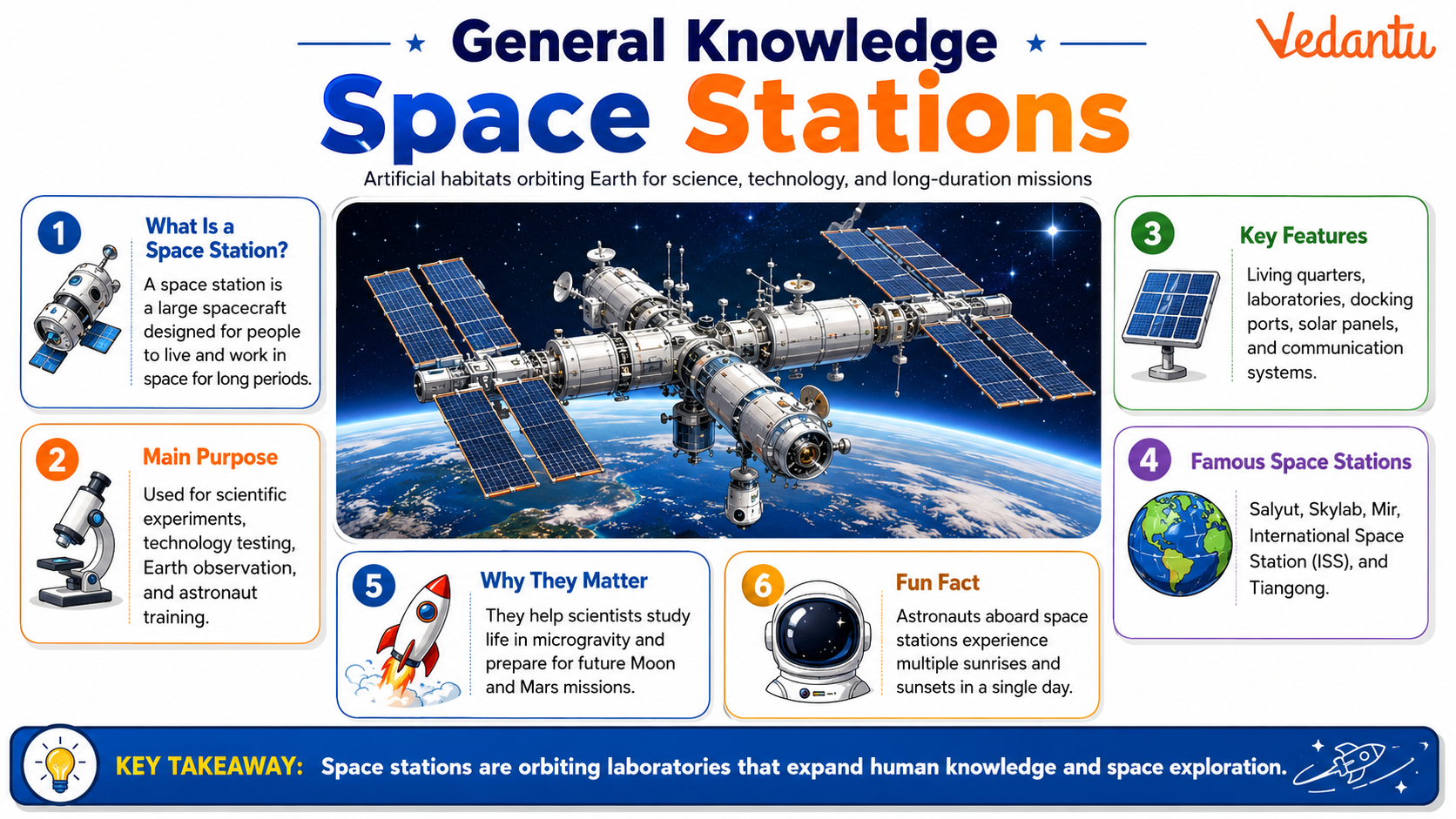
What is a Space Station?
A space station is a habitable artificial satellite designed for long-duration stays in space. Unlike spacecraft, which travel from one place to another, space stations remain in orbit and act as permanent or semi-permanent bases. Astronauts travel to and from space stations using spacecraft such as space shuttles or crew capsules.
Key Features of Space Stations
- Orbit around Earth at high speeds, usually in Low Earth Orbit - LEO.
- Provide living quarters, laboratories, and storage areas.
- Powered mainly by large solar panels.
- Equipped with life support systems that supply oxygen, water, and temperature control.
- Allow long-term scientific research in microgravity conditions.
Major Space Stations in History
Important Space Stations
| Space Station | Country or Agency | Operational Period |
|---|---|---|
| Salyut | Soviet Union | 1971 - 1986 |
| Skylab | United States | 1973 - 1979 |
| Mir | Soviet Union and Russia | 1986 - 2001 |
| International Space Station - ISS | NASA, Roscosmos, ESA, JAXA, CSA | 2000 - Present |
| Tiangong Space Station | China | 2021 - Present |
The International Space Station - ISS is currently the largest and most advanced space station. It is a joint project involving multiple countries and serves as a symbol of international cooperation in space exploration.
International Space Station - ISS
The ISS orbits Earth at an altitude of about 400 kilometers. It completes one orbit approximately every 90 minutes. The station supports a crew of astronauts and cosmonauts who conduct experiments in biology, physics, astronomy, and medicine.
Important Facts about ISS
- Launched in 1998 with the first module called Zarya.
- Continuously inhabited since November 2000.
- Travels at a speed of about 28,000 kilometers per hour.
- Visible from Earth with the naked eye at certain times.
- Supports research that benefits medicine, climate science, and technology.
Objectives of Space Stations
- Study the effects of long-term space travel on the human body.
- Conduct experiments in microgravity.
- Test new space technologies and equipment.
- Observe Earth for environmental and climate studies.
- Prepare for future missions to the Moon and Mars.
Importance of Space Stations in General Knowledge
Space stations are frequently asked topics in competitive exams due to their scientific, technological, and international significance. Questions may relate to the ISS, participating countries, historical stations, and current missions. Understanding space stations helps students grasp the progress of human space exploration and global cooperation in science.
Recent Developments
- China has completed its Tiangong modular space station.
- Private companies are planning commercial space stations.
- Research continues on long-duration missions for deep space exploration.
Quick Revision Points
- First space station - Salyut 1 in 1971.
- Largest space station - International Space Station.
- ISS orbit altitude - Approximately 400 km.
- China’s space station - Tiangong.
- Purpose - Scientific research and preparation for future space missions.
In conclusion, space stations are crucial milestones in humanity’s journey into space. They function as orbiting laboratories, foster international collaboration, and pave the way for deeper exploration of the solar system. A clear understanding of space stations strengthens general scientific awareness and enhances preparation for competitive examinations.
FAQs on General Knowledge About Space Stations and Life in Orbit
1. What is a space station?
A space station is a large spacecraft that stays in orbit around Earth and serves as a home and laboratory for astronauts.
• It functions as a space habitat where astronauts live and work.
• It is used for scientific research in microgravity.
• It orbits Earth at high speed, usually in Low Earth Orbit (LEO).
• Examples include the International Space Station (ISS) and China’s Tiangong Space Station.
Space stations help scientists study space, Earth, and the effects of zero gravity.
2. What is the International Space Station (ISS)?
The International Space Station (ISS) is the largest and most advanced space station orbiting Earth.
• Launched in 1998.
• A joint project of NASA (USA), Roscosmos (Russia), ESA (Europe), JAXA (Japan), and CSA (Canada).
• Orbits Earth every 90 minutes.
• Used for experiments in biology, physics, astronomy, and space medicine.
The ISS is often called a symbol of international cooperation in space exploration.
3. Why are space stations important?
Space stations are important because they allow long-term scientific research in space.
• Help study the effects of microgravity on the human body.
• Support experiments in space science and technology.
• Prepare astronauts for future missions to the Moon and Mars.
• Observe Earth’s climate and environmental changes.
They act as stepping stones for deep space exploration.
4. Who lives and works on a space station?
Highly trained astronauts and cosmonauts live and work on space stations.
• Selected by space agencies like NASA, ESA, and ISRO (future missions).
• Stay for about 6 months on average.
• Conduct scientific experiments and maintenance tasks.
• Perform spacewalks (EVA – Extravehicular Activity).
They follow strict schedules to live safely in space.
5. How do astronauts eat and sleep in space stations?
Astronauts eat specially packed food and sleep in small sleeping cabins in zero gravity.
• Food is dehydrated or vacuum-sealed.
• Drinks are consumed through sealed pouches.
• They sleep in sleeping bags attached to walls.
• There is no "up" or "down" due to microgravity.
Daily life on a space station is carefully planned to adjust to weightlessness.
6. What was the first space station in history?
The first space station was Salyut 1, launched by the Soviet Union in 1971.
• Marked the beginning of long-duration space missions.
• Followed by stations like Skylab (USA) and Mir.
• Helped scientists understand living in space.
Salyut 1 paved the way for modern stations like the ISS.
7. How does a space station stay in orbit?
A space station stays in orbit due to a balance between its speed and Earth’s gravity.
• It travels at about 28,000 km/h.
• Gravity pulls it toward Earth.
• Its forward motion keeps it from falling straight down.
• Occasional boosts from spacecraft maintain its orbit.
This constant free-fall creates the condition of weightlessness.
8. What experiments are conducted on space stations?
Space stations are used for a wide range of scientific experiments in space.
• Medical research on muscle and bone loss.
• Physics experiments in microgravity.
• Plant growth studies for space farming.
• Earth observation and climate monitoring.
These experiments improve life on Earth and support future space missions.
9. What is China’s Tiangong Space Station?
The Tiangong Space Station is China’s permanent space station in Low Earth Orbit.
• Operated by the China National Space Administration (CNSA).
• Became fully operational in 2022.
• Conducts scientific research and astronaut missions.
• Name "Tiangong" means "Heavenly Palace".
It represents China’s growing role in space exploration.
10. What is the future of space stations?
The future of space stations includes commercial stations and lunar orbit platforms.
• The ISS may retire after 2030.
• Private companies are developing commercial space stations.
• NASA plans the Lunar Gateway for Moon missions.
• Space stations will support missions to Mars and deep space.
Future space habitats will expand human presence beyond Earth.
