Class 9 English Kaveri Chapter 3 Poem Canvas of Soil Important Questions with Answers
The Class 9 English Kaveri Chapter 3 Poem Important Questions cover the poem's three stanzas, the significance of soil and seeds, the arrival of spring, and the comparison between a garden and an artist's canvas.
Students will also practise questions on metaphor, imagery, alliteration, personification, allegory, rhyme scheme, tone and mood, along with vocabulary related to painting and different shades of colour.
Class 9 English Chapter 3 Poem Canvas of Soil Multiple Choice Questions
Q1. Who is the poet of Canvas of Soil?
(a) Subramania Bharati
(b) Maya Anthony
(c) Temsula Ao
(d) Sarojini Naidu
Answer: (b) Maya Anthony.
Explanation: Maya Anthony uses the language of painting to celebrate gardening as a creative activity and nature as a source of beauty.
Q2. What does the poet compare the earth to in the opening stanza?
(a) A musical instrument
(b) A colourful palette
(c) A sheet of paper
(d) A flowing river
Answer: (b) A colourful palette.
Explanation: The earth is presented as a rich palette, suggesting that soil provides the foundation for the colours and beauty that appear when plants grow.
Q3. What do the 'brushstrokes of seeds' represent?
(a) Seeds arranged only for decoration
(b) The planting of seeds as a creative act
(c) A painter collecting brushes
(d) The removal of flowers from a garden
Answer: (b) The planting of seeds as a creative act.
Explanation: The poet compares sowing seeds to an artist making brushstrokes. Both activities involve planning and creativity and help produce something beautiful.
Q4. Which literary device is clearly used in 'Blossoms bloom'?
(a) Alliteration
(b) Irony
(c) Simile
(d) Onomatopoeia
Answer: (a) Alliteration.
Explanation: The repeated initial b sound in blossoms and bloom creates alliteration. It gives the phrase a pleasant musical quality.
Q5. Which rhyme scheme is used in the poem?
(a) ABAB
(b) ABCB
(c) AABB
(d) ABBA
Answer: (c) AABB.
Explanation: The poem uses rhyming pairs, such as deep–seep and true–hue. The remaining stanzas follow the same paired-rhyme pattern.
Q6. What is the main idea expressed in the final stanza?
(a) Gardens should contain only flowering plants.
(b) Painting is easier than growing plants.
(c) Gardening brings art and living nature together.
(d) Soil becomes less useful after spring.
Answer: (c) Gardening brings art and living nature together.
Explanation: The poet describes each garden plot as a canvas where natural growth and artistic creativity meet. Gardeners transform the land into something beautiful through their work.
Class 9 English Chapter 3 Poem Canvas of Soil Very Short Answer Questions
Q7. What is a palette, and how is it connected with the poem?
Answer:
A palette is a board on which a painter mixes colours. The poet compares the earth to a palette because gardens contain different natural colours.
Q8. What does the word 'hue' mean?
Answer:
Hue means a shade or variety of a colour. In the poem, it refers to the vibrant colours associated with spring.
Q9. Which three colours are mentioned in the poem?
Answer:
The poem specifically mentions green, red and blue to highlight the colourful beauty of nature.
Q10. What does the word 'till' mean in the final stanza?
Answer:
Till means to prepare and work the soil for growing plants. It refers to the effort gardeners put into cultivating their gardens.
Q11. What is the tone and mood of Canvas of Soil?
Answer:
The poem has an appreciative tone and creates a joyful mood. The poet admires the beauty of gardens and the creativity of gardeners.
Class 9 English Chapter 3 Poem Canvas of Soil Short Answer Questions
Q12. Why does the poet compare seeds to brushstrokes?
Answer:
The poet compares seeds to brushstrokes because planting seeds is presented as a creative activity, similar to painting.
A painter uses brushstrokes to create pictures on a canvas. Similarly, a gardener carefully plants seeds in the soil, deciding where different flowers and plants will grow.
Over time, the seeds develop into colourful plants, creating a garden that resembles a painting. The comparison shows that gardening requires imagination, care and patience.
Q13. How does the arrival of spring contribute to the poem's imagery?
Answer:
Spring represents the time when the gardener's efforts begin to show visible results. Seeds planted in the soil grow into flowers and fill the garden with colour.
The poet describes spring through the idea of vibrant hues, helping readers imagine a garden becoming more colourful.
Spring also suggests new beginnings and growth. Its arrival connects the gardener's earlier work with the beauty that develops later.
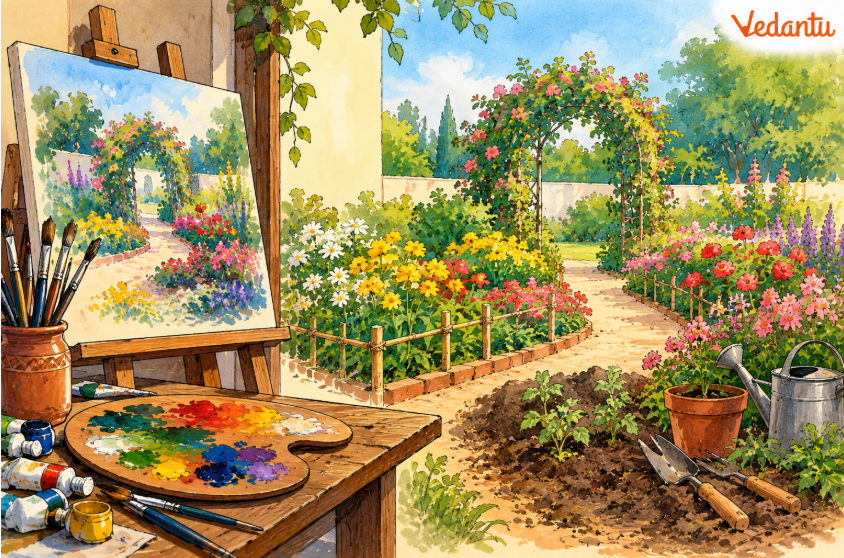
Q14. Observe the illustration comparing a painting with a garden. How does it help explain the central comparison in the poem?
Answer:
The illustration shows a painter's palette, a colourful painting and a garden, allowing students to compare the elements of art with those of nature.
The palette contains different colours that an artist can use. Similarly, a garden contains natural colours in its flowers, leaves and surroundings.
The painting represents an artist's creativity, while the garden represents the combined work of nature and a gardener.
Both are shaped through thoughtful arrangement, colours and imagination. The illustration supports the poem's idea that a garden can be viewed as a living painting.
Q15. Explain the effect of visual imagery in the second stanza of Canvas of Soil.
Answer:
The second stanza creates a vivid picture of a garden filled with blooming flowers and different colours.
The poet describes blossoms opening and moving in the morning light, helping readers imagine an active and beautiful natural scene.
The references to green, red and blue make the imagery colourful, while the morning light adds brightness.
This imagery encourages readers to see a garden as something visually artistic rather than merely as an area where plants grow.
Q16. How can the garden in Canvas of Soil represent growth and harmony beyond its literal meaning?
Answer:
The garden can be interpreted as a symbol of life's journey and personal growth.
Seeds develop gradually into plants, just as people develop through time, effort and experience. The changing seasons can also represent different stages of life.
The garden's many colours and plants suggest harmony in diversity. Different flowers grow together and contribute to the beauty of the whole garden.
This deeper interpretation makes the poem an example of possible allegory, where a simple description of nature communicates broader ideas about life.
Q17. What is the importance of the line 'Where art and life coincide' in the poem?
Answer:
The line suggests that gardening brings creativity and living nature together.
A garden contains real plants that grow and change, but its arrangement also reflects the gardener's imagination and care.
The gardener plans, sows and nurtures plants, while nature provides sunlight, water and the growth process.
The resulting garden is both a living space and an artistic creation. This line captures the central connection between nature and art in the poem.
Class 9 English Chapter 3 Poem Canvas of Soil Long Answer Questions
Q18. Read the following adapted extract based on Canvas of Soil and answer the questions.
The gardener places seeds carefully into rich soil, just as a painter adds brushstrokes to a canvas. The seeds wait for spring, when new plants and flowers will bring bright colours to the garden.
This is an adapted practice extract based on the first stanza, not a direct quotation from the poem.
(i) What does the rich soil represent in the extract?
Answer: The rich soil represents the foundation of the garden, where seeds can grow, and the gardener's ideas can take shape.
(ii) Why are seeds compared to an artist's brushstrokes?
Answer: Planting seeds is compared to making brushstrokes because both activities help create something beautiful through thoughtful effort.
(iii) What does spring suggest in this extract?
Answer: Spring suggests growth, fresh beginnings and the appearance of colourful flowers.
(iv) Identify the main poetic device used in comparing seeds with brushstrokes.
Answer: Metaphor.
(v) What does the extract suggest about a gardener's work?
Answer: It suggests that gardening involves creativity, patience and planning, just like painting.
(vi) Explain how the extract connects nature with artistic creativity.
Answer:
The extract presents the gardener as someone who creates beauty using natural materials.
A painter works with colours, brushes and a canvas, while a gardener works with soil, seeds and plants. Both begin with an idea and use their skills to transform ordinary materials into something attractive.
The gardener must also wait for the seeds to grow. Unlike a painting, the garden changes naturally over time.
This comparison highlights the partnership between human creativity and nature. The gardener plans and nurtures, while nature brings the plants to life.
Q19. Explain the three stanzas of Canvas of Soil and how the poem develops the comparison between gardening and painting.
Answer:
Maya Anthony develops the comparison between gardening and painting across three short stanzas.
First Stanza – Earth and Possibilities
The first stanza introduces the earth as a rich palette. Soil becomes the place where the gardener's ideas and dreams can develop.
Seeds are compared to brushstrokes because they are carefully placed to create a beautiful result.
The stanza also introduces the expectation of spring. The gardener has planted the seeds but must wait for nature to bring new colours.
This stanza focuses on preparation, creativity and hope.
Second Stanza – Nature's Work of Art
The second stanza presents the results of the gardener's efforts.
Flowers bloom, and the garden becomes bright with colours. The poet describes the movement of blossoms in the morning light.
The mention of green, red and blue creates visual imagery. These colours make the garden appear like a painting that changes and renews itself.
This stanza focuses on beauty, growth and the joy of nature.
Third Stanza – Gardens as Living Canvases
The final stanza brings together the ideas of gardening and painting.
Each plot of land becomes a canvas. The gardener's work transforms the soil into a living artwork.
The stanza highlights that a garden is shaped by both natural growth and the gardener's effort.
Conclusion:
The poem moves from planting seeds to watching flowers bloom and finally recognising the completed garden as a work of art. This progression shows how patience, creativity and nature combine to produce beauty.
Q20. Explain the important poetic devices used in Canvas of Soil with examples.
Answer:
Canvas of Soil uses poetic devices to show the beauty of gardening and its similarity to painting.
1. Metaphor
The poet compares the earth to a painter's palette and seeds to brushstrokes.
This shows that gardening is a form of creative expression. Just as a painter arranges colours, a gardener arranges plants to create a beautiful garden.
2. Visual Imagery
The poem includes vivid descriptions of blossoms, bright colours and morning light.
These images help readers imagine a garden as a colourful scene.
3. Personification
The blossoms are described as dancing in the morning light.
Flowers do not literally dance like people. The description suggests gentle movement and makes the garden appear lively.
4. Alliteration
The phrase blossoms bloom repeats the initial b sound.
This creates a musical effect and draws attention to the flowers coming into bloom.
5. Rhyme Scheme
The poem uses an AABB rhyme scheme, with words such as deep–seep and true–hue forming rhyming pairs.
The pattern makes the poem pleasant to read aloud.
6. Symbolism
Seeds can represent new beginnings and future possibilities. Spring suggests renewal, while the garden can represent growth and harmony.
These meanings add depth to the description of gardening.
7. Allegory
The garden may also represent the journey of life. Different plants and colours can suggest the importance of diversity and cooperation.
This is a possible deeper interpretation of the poem rather than its only meaning.
Conclusion:
The poetic devices make Canvas of Soil vivid, musical and meaningful. They help readers see gardening as a creative process that combines human effort with the beauty of nature.
Q21. Why is the title Canvas of Soil appropriate? Explain the poem's central message.
Answer:
The title Canvas of Soil is appropriate because the poem compares a garden plot to an artist's canvas.
In painting, an artist uses a canvas as the surface on which colours and designs are created. In gardening, soil becomes the surface where seeds are planted, and colourful plants grow.
1. Soil as a Creative Surface
The soil provides the foundation for the gardener's work. Without it, seeds cannot develop into plants.
2. Seeds as Brushstrokes
The seeds represent the gardener's creative choices. Their careful placement is compared to an artist's brushstrokes.
3. Spring and New Growth
Spring brings visible results through new leaves, flowers and colours. This reflects the rewards of patience and effort.
4. Flowers as Colours
The flowers and plants create colourful patterns that resemble the work of a painter.
5. The Gardener as an Artist
The gardener plans and nurtures the garden. These activities require care, imagination and practical knowledge.
6. Nature as a Creative Partner
The gardener cannot control every stage of growth. Sunlight, water, soil and the changing seasons contribute to the final result.
7. Beauty of Everyday Work
The poem encourages readers to appreciate gardening as an activity that produces beauty and supports life.
8. Deeper Meaning
The garden can also symbolise personal growth, hope, and the harmony created when different elements exist together.
9. Appreciative Tone
The poet expresses admiration for both the beauty of nature and the gardener's creativity.
Conclusion:
The title captures the poem's central idea that gardening is like painting with living materials. The poem celebrates creativity, patience, growth and the natural beauty that develops through the gardener's care.
Q22. Vocabulary and Descriptive Writing Practice – Based on Canvas of Soil
Part A. Match the painting-related words with their meanings.
Answer:
1 – (c) A board used for mixing colours
2 – (a) A shade of colour
3 – (e) A surface on which a painting is made
4 – (b) A picture of a person
5 – (d) A large painting made on a wall
Part B. Write a descriptive paragraph about a colourful garden you have visited, using the ideas of imagery from the poem.
Answer:
Last Sunday, I visited a beautiful garden near my home. Bright red roses, yellow marigolds and purple flowers added colour to the green surroundings. The morning sunlight fell gently on the petals, making them appear fresh and bright. Butterflies moved among the blossoms, and the leaves swayed in the cool breeze.
As I walked along the narrow path, I noticed how carefully the plants had been arranged. Different shades of green blended with the colourful flowers, making the garden look like a painting. The soft sounds of birds and the pleasant atmosphere made the visit memorable. It reminded me that nature can create wonderful beauty when people care for it.
This exercise follows the chapter's descriptive-writing activity and helps students practise imagery, vocabulary and observation.
Important Topics to Practise for Class 9 English Kaveri Chapter 3 Poem Exams
Students preparing for Canvas of Soil should focus on the poem's comparison between gardening and painting, its three stanzas and the poetic devices used to describe natural beauty.
Students should practise explaining the poet's comparisons with examples rather than simply memorising definitions of poetic devices.
Download Class 9 English Kaveri Chapter 3 Poem Important Questions PDF from Vedantu
Vedantu's Class 9 English Kaveri Chapter 3 Poem Important Questions and Answers cover Canvas of Soil through solved MCQs, short and long answers, extract-based questions and poetic-device explanations.
The Class 9 English Kaveri Chapter 3 Poem Important Questions PDF, when available, can help students:
Revise the meaning of all three stanzas.
Practise MCQs, short answers and extract-based questions.
Understand metaphors, imagery, alliteration and symbolism.
Learn painting-related vocabulary.
Improve descriptive writing and answer-writing skills.
Students can use these questions for revision and independent practice during the 2026–27 academic year.
Additional Study Material for Class 9 English (Kaveri) Chapter 3 Poem
Important Questions Class 9 English Kaveri (Poem)
Important Questions Class 9 English Kaveri (Prose)
Important Study Materials for Class 9 English
FAQs on Important Questions and Answers for Class 9 English (Kaveri) Chapter 3 Poem Canvas of Soil | 2026–27
1. Why does Maya Anthony compare a garden to a painting in Canvas of Soil?
The poet compares a garden to a painting because both involve colours, patterns and creativity. A painter uses a canvas and brushstrokes, while a gardener uses soil and seeds. As the plants grow, the garden becomes colourful and beautiful, resembling a living artwork.
2. What is the central message of Canvas of Soil in Class 9 English Kaveri?
The central message is that gardening is a creative activity that brings human effort and nature together. The poem celebrates the beauty of plants and flowers while recognising the patience and care involved in growing them. It also suggests deeper ideas about growth, hope and harmony.
3. How should students prepare for Class 9 English Kaveri Chapter 3 Poem Important Questions MCQ exercises?
Students should revise the poet's name, the meaning of the three stanzas and important comparisons such as soil as a palette and seeds as brushstrokes. They should also practise identifying metaphor, imagery, alliteration, personification, the AABB rhyme scheme and the poem's appreciative tone.
4. Where can students find Class 9 English Kaveri Chapter 3 Poem Important Questions PDF for revision?
Students can practise the solved questions on this Vedantu page, including MCQs, short answers, long answers and extract-based questions. The Class 9 English Kaveri Chapter 3 Poem Important Questions PDF can also support offline revision when the downloadable file becomes available.
5. Why are seeds described as brushstrokes in Canvas of Soil?
Seeds are compared to brushstrokes because the gardener uses them to create a beautiful result, just as an artist uses brushstrokes to create a painting. The metaphor highlights the planning, creativity and care involved in gardening.
6. What do the colours green, red and blue represent in the poem?
The colours create a vivid image of natural beauty. Green suggests leaves and plants, while red and blue contribute to the colourful appearance of the garden. Together, they help readers imagine nature as an artwork filled with different shades and patterns.
7. What is the rhyme scheme of Canvas of Soil by Maya Anthony?
The poem follows an AABB rhyme scheme. Words such as deep and seep, followed by true and hue, form rhyming pairs. The same pattern continues through the poem and gives it a pleasant rhythm.
8. How does Canvas of Soil use personification and alliteration?
The poet uses personification when blossoms are described as dancing in the morning light, giving flowers a human-like action. Alliteration appears in the phrase blossoms bloom, where the initial b sound is repeated. Both devices make the description lively and musical.
9. Why can Canvas of Soil be interpreted as an allegory?
The garden may represent more than a physical place. Seeds growing into plants can symbolise life's journey and personal development. Different flowers and colours growing together can suggest diversity and harmony. These deeper meanings allow the poem to be interpreted as an allegory.
10. How do Class 9 English Kaveri Chapter 3 Poem Important Questions and Answers help students prepare for exams?
These questions help students understand the poem's meaning, comparisons, poetic devices and central message. Practising different question types also improves interpretation, vocabulary and the ability to explain ideas using relevant examples from the poem.
11. What does the final stanza of Canvas of Soil teach us about creativity?
The final stanza shows that a garden is both a living space and an artistic creation. Gardeners use imagination and care to arrange plants, while nature helps them grow. The stanza highlights how human creativity and natural processes work together to produce beauty.
12. What vocabulary and writing topics should students revise from Canvas of Soil?
Students should revise painting-related words such as palette, hue, canvas, brushstrokes, portrait and mural. They should also practise describing a garden using colourful vocabulary and visual imagery, as suggested in the chapter's writing activity.