Class 9 English Kaveri Chapter 1 Poem Bharat Our Land Important Questions with Answers
The Class 9 English Kaveri Chapter 1 Poem Important Questions cover the poet's description of India's natural landmarks, spiritual traditions, cultural achievements and historical greatness. Students will practise questions on Himavant, Ganga, Upanishads, warriors, sages, Brahma-knowledge and Buddha's Dhamma.
The exercises also focus on personification, symbolism, imagery, hyperbole, allusion, the refrain and the characteristics of an ode. Understanding these elements will help students explain not only what the poem says but also how its language expresses admiration for Bharat.
Class 9 English Chapter 1 Poem Bharat Our Land Multiple Choice Questions
Q1. Who is the poet of Bharat Our Land?
(a) Rabindranath Tagore
(b) Subramania Bharati
(c) Sarojini Naidu
(d) Toru Dutt
Answer: (b) Subramania Bharati.
Explanation: Subramania Bharati celebrates India's natural features, spiritual heritage and cultural achievements in Bharat Our Land.
Q2. Which mountain range does the poet describe as mighty and unequalled?
(a) The Aravalli Range
(b) The Western Ghats
(c) The Himavant
(d) The Vindhya Range
Answer: (c) The Himavant.
Explanation: Himavant refers to the Himalayas. The poet uses this image to highlight India's natural strength, grandeur and uniqueness.
Q3. What does the description of Ganga as 'generous' mainly suggest?
(a) The river flows only during the rainy season.
(b) The river gives life and supports people and nature.
(c) The river is surrounded by mountains.
(d) The river is the longest in the world.
Answer: (b) The river gives life and supports people and nature.
Explanation: The word generous presents Ganga as a giving and nurturing presence. This is also an example of personification, as a human quality is attributed to a river.
Q4. What does the repeated phrase 'she's peerless, let's praise her!' express?
(a) Doubt about India's achievements
(b) Concern about India's geographical boundaries
(c) Admiration and pride in India's uniqueness
(d) A comparison between ancient and modern cities
Answer: (c) Admiration and pride in India's uniqueness.
Explanation: The poet repeatedly praises Bharat as incomparable. The refrain reinforces the poem's patriotic tone and encourages readers to appreciate India's heritage.
Q5. Which literary device is most clearly used in the expression 'this sunny golden land'?
(a) Metaphor
(b) Pun
(c) Onomatopoeia
(d) Irony
Answer: (a) Metaphor.
Explanation: The poet describes India as a sunny, golden land to suggest its beauty, richness and glory. The description is figurative rather than a literal statement about the colour of the land.
Q6. Why can Bharat Our Land be described as an ode?
(a) It tells a humorous story about a traveller.
(b) It expresses deep admiration and praise for India.
(c) It gives directions for visiting different states.
(d) It presents an argument against ancient traditions.
Answer: (b) It expresses deep admiration and praise for India.
Explanation: An ode is a lyrical poem that praises a person, place, object or idea. Bharat Our Land is an ode because it celebrates India's natural beauty, cultural heritage and spiritual achievements.
Class 9 English Chapter 1 Poem Bharat Our Land Very Short Answer Questions
Q7. What does the word 'peerless' mean in the poem?
Answer:
Peerless means incomparable or unmatched. The poet uses it to suggest that Bharat possesses qualities worthy of special admiration.
Q8. Which ancient Indian scriptures are mentioned in Bharat Our Land?
Answer:
The poem mentions the Upanishads, which represent India's ancient philosophical and spiritual knowledge.
Q9. What does the expression 'hoary antiquity' suggest about Bharat?
Answer:
Hoary antiquity refers to a very ancient past. It highlights India's long history and the age of its cultural traditions.
Q10. Which two groups of people does the poet honour for their contributions to India?
Answer:
The poet honours gallant warriors and sages. The warriors represent bravery, while the sages represent wisdom and spiritual knowledge.
Q11. What is a refrain, and which refrain appears in Bharat Our Land?
Answer:
A refrain is a line or phrase repeated in a poem. The refrain in Bharat Our Land is “she's peerless, let's praise her!” It emphasises admiration and national pride.
Class 9 English Chapter 1 Poem Bharat Our Land Short Answer Questions
Q12. Why does the poet describe Himavant as mighty? What does it symbolise?
Answer:
The poet describes Himavant, or the Himalayas, as mighty because of its great height, strength and impressive presence.
The Himalayas represent India's natural grandeur and are presented as a source of national pride. They also symbolise strength, stability and permanence.
By suggesting that there is no mountain range equal to Himavant, the poet emphasises his admiration for India's natural beauty.
Q13. How does the poet use personification to describe the River Ganga?
Answer:
The poet describes the Ganga as generous and refers to its movement as graceful.
These are qualities usually associated with living beings. By giving the river human characteristics, the poet uses personification.
The description suggests that Ganga nourishes the land and supports life. It also conveys the poet's affection and respect for this important river.
Q14. Look at the illustration of the mountains, flowing river and sage. How does this image reflect the poem's main ideas?
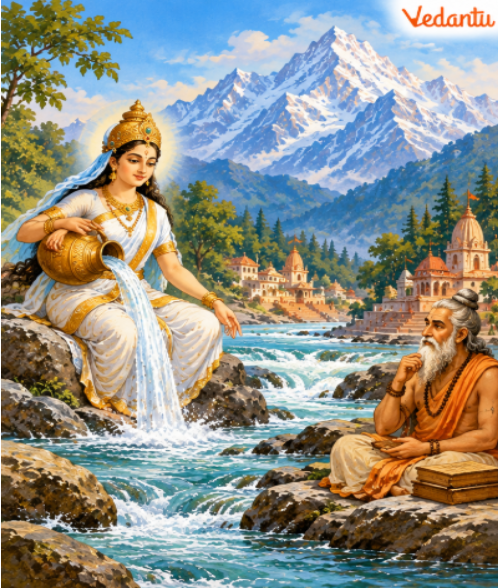
Answer:
The illustration brings together three important ideas from the poem: natural beauty, spiritual knowledge and India's ancient heritage.
The mountain scenery represents Himavant and suggests strength and grandeur.
The flowing river represents Ganga, which the poet praises for its generosity and grace.
The sage and reference to the Upanishads highlight India's traditions of learning and spiritual wisdom.
Together, these images show why the poet admires Bharat. They help readers understand that the poem celebrates both the physical beauty of the country and its cultural achievements.
Q15. What is the significance of the Upanishads and Brahma-knowledge in the poem?
Answer:
The Upanishads represent India's ancient spiritual and philosophical traditions. By describing them as sacred, the poet expresses respect for the wisdom contained in these scriptures.
Brahma-knowledge refers to a deeper understanding of ultimate reality and spiritual truth.
Together, these references suggest that India has made important contributions to philosophical thought and the search for knowledge.
The poet considers this intellectual and spiritual heritage an important part of Bharat's greatness.
Q16. How do the references to warriors, sages and music contribute to the poem's praise of India?
Answer:
The poet praises India's warriors for their bravery and the sages for their wisdom.
The reference to warriors highlights the country's history of courage and sacrifice. The sages represent spiritual learning and moral guidance.
The poet also celebrates the music that has flourished in India, showing his admiration for the country's artistic traditions.
These references demonstrate that India's greatness is not limited to its geography. It also comes from the achievements of its people in different fields.
Q17. What effect do the hyphens and rhetorical questions create in the first stanza?
Answer:
The hyphens introduce deliberate pauses between the poet's statements about India's remarkable features and his expressions of admiration.
They give the lines a measured, emphatic rhythm and allow readers to reflect on each example.
The rhetorical questions about the Ganga and the Upanishads do not seek actual answers. Instead, they strongly suggest that the poet considers these features unmatched.
Together, the pauses and rhetorical questions create an enthusiastic and celebratory tone.
Class 9 English Chapter 1 Poem Bharat Our Land Long Answer Questions
Q18. Read the following extract from Bharat Our Land and answer the questions.
The mighty Himavant is ours-
There's no equal anywhere on earth.
The generous Ganga is ours-
Which other river can match her grace?
The sacred Upanishads are ours-
What scriptures else to name with them?
(i) What does the word 'mighty' suggest about Himavant?
Answer: The word mighty highlights the great strength, height and grandeur of the Himalayas.
(ii) Why does the poet call Ganga generous?
Answer: The poet describes Ganga as generous because the river nourishes the land and supports life. The description presents the river as a valuable and giving part of India's natural heritage.
(iii) Identify the literary device used in 'generous Ganga'.
Answer: Personification is used because a human quality, generosity, is attributed to a river.
(iv) What is the purpose of the questions in the extract?
Answer: These are rhetorical questions. The poet uses them to emphasise his belief that India's rivers and ancient scriptures are extraordinary.
(v) What does the reference to the Upanishads reveal about the poet's attitude?
Answer: It reveals the poet's admiration for India's ancient spiritual and philosophical knowledge.
(vi) Explain the overall message of the extract.
Answer:
The extract celebrates India's natural beauty and intellectual heritage. The poet praises the Himalayas for their grandeur, the Ganga for its generosity and the Upanishads for their wisdom.
Through these examples, the poet presents Bharat as a country of remarkable natural and cultural wealth. The repeated references to things belonging to the country create a feeling of shared identity.
The extract encourages readers to recognise and appreciate the richness of India's heritage.
Q19. Explain the symbolism used in Bharat Our Land. How do different symbols represent India's greatness?
Answer:
Subramania Bharati uses symbols throughout Bharat Our Land to express admiration for India's natural, historical and spiritual achievements.
A symbol is a person, place, object or idea that represents a deeper meaning.
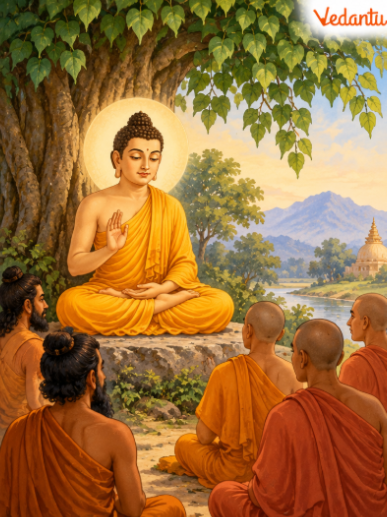
The poem's important symbols include the following:
1. Symbols of Natural Beauty
The Himalayas and Ganga represent the country's impressive natural environment. They are not simply geographical features; they also contribute to the poet's sense of national pride.
2. Symbols of Wisdom
The Upanishads and Brahma-knowledge represent India's traditions of philosophical enquiry and spiritual understanding.
3. Symbols of Courage and Knowledge
The warriors and sages represent different kinds of achievement. The former are associated with bravery, while the latter are associated with learning and wisdom.
4. Symbol of Cultural Greatness
The sunny golden land represents India's richness and glory. It combines the poet's admiration for the country's natural and cultural qualities.
Conclusion:
The symbols help the poet communicate a broad understanding of Bharat's greatness. Through them, he celebrates the country's geography, history, knowledge and traditions.
Q20. Explain the important poetic devices used in Bharat Our Land with examples.
Answer:
Subramania Bharati uses several poetic devices to make Bharat Our Land expressive and memorable.
1. Personification
Personification gives human qualities to non-human things.
Example: “The generous Ganga”
The river is described as generous, suggesting that it nourishes and supports life.
2. Imagery
Imagery uses descriptive language to create pictures in the reader's mind.
Example: “The mighty Himavant”
The phrase helps readers imagine the grandeur of the Himalayas.
Example: “This sunny golden land”
This description creates a bright and rich image of Bharat.
3. Metaphor
A metaphor describes something in terms of another idea without using like or as.
Example: “This sunny golden land”
The description presents India as a land of beauty, richness and glory.
4. Hyperbole
Hyperbole is deliberate exaggeration used for emphasis.
Example: “there's no equal anywhere on earth.”
The statement emphasises the poet's admiration for Himavant rather than presenting a measurable comparison.
5. Refrain
A refrain is a repeated line or phrase that reinforces an important idea.
Example: “she's peerless, let's praise her!”
This line repeatedly expresses the poet's pride and admiration for Bharat.
6. Allusion
An allusion refers to a well-known person, text, tradition or idea.
Examples: The Upanishads, Brahma-knowledge and Buddha's Dhamma.
These references remind readers of India's ancient philosophical and spiritual traditions.
7. Rhetorical Question
A rhetorical question is asked to emphasise a point rather than obtain an answer.
Example: “Which other river can match her grace?”
The question expresses the poet's belief that Ganga is extraordinary.
8. Personification of Bharat
The poet refers to the country as she, presenting Bharat as a beloved figure deserving admiration.
Conclusion:
These poetic devices make the poem vivid and celebratory. They also help communicate the poet's strong connection to India's natural features and cultural heritage.
Q21. Why is Bharat Our Land considered an ode? Explain how its tone, mood and structure support this classification.
Answer:
Bharat Our Land can be described as an ode because it expresses deep admiration and praise for India.
An ode is a lyrical poem that celebrates a person, place, object or idea in an elevated and expressive manner.
1. Subject of Praise
The central subject of the poem is Bharat. The poet celebrates its mountains, rivers, scriptures, history, music and spiritual traditions.
2. Admiring Tone
The poet speaks with enthusiasm and pride. His words communicate affection and respect for the country.
3. Positive Mood
The poem creates an uplifting and inspiring feeling. Readers are encouraged to recognise the achievements and distinctive features of their country.
4. Celebratory Language
The poem uses expressions such as mighty, generous, sacred and peerless. These words help create an elevated tone.
5. Repeated Refrain
The refrain strengthens the sense of admiration and gives the poem a lyrical quality.
6. Rhetorical Questions
The questions about India's natural and cultural features make the poet's praise more emphatic.
7. Literary Devices
Personification, symbolism, metaphor and imagery make the description expressive and memorable.
8. Structure and Rhythm
The poem does not follow a consistent end-rhyme pattern. Instead, it relies on repetition, pauses and the arrangement of ideas to create rhythm.
Conclusion:
The poem is an ode because its main purpose is to praise Bharat. Its admiring tone, vivid language and repeated refrain encourage readers to appreciate India's natural beauty, history and spiritual heritage.
Q22. Why is the title Bharat Our Land appropriate? Explain the central theme of the poem.
Answer:
The title Bharat Our Land is appropriate because the poem expresses the poet's pride in India and celebrates the country's remarkable qualities.
The word Bharat identifies the country being praised, while Our Land creates a sense of belonging and shared identity.
The poem develops this idea through several important references.
Natural Beauty
The poet praises Himavant for its greatness and Ganga for its generosity and graceful movement.
Spiritual Heritage
The Upanishads, Brahma-knowledge and Buddha's teachings represent India's traditions of wisdom and philosophical thought.
Historical Achievements
The references to gallant warriors and sages highlight courage, knowledge and the contributions of earlier generations.
Cultural Richness
The poet also celebrates India's music and describes the country as a sunny golden land.
National Pride
The repeated refrain encourages readers to admire the country and recognise its special qualities.
The Central Theme
The central theme of the poem is admiration for India's natural beauty, cultural identity, historical achievements and spiritual heritage.
The poet presents Bharat as a land whose greatness comes from many different sources.
Conclusion:
The title is appropriate because it captures both the subject of the poem and the feeling behind it. Bharat Our Land celebrates the country while encouraging readers to value its rich and diverse heritage.
Important Topics to Practise for Class 9 English Kaveri Chapter 1 Poem Exams
Students preparing for Bharat Our Land should focus on the poem's central message, India's natural beauty, cultural heritage and important poetic devices. Understanding these topics will help students answer both direct and interpretation-based questions.
Students should practise explaining the meaning of important lines and identifying poetic devices with examples.
Download Class 9 English Kaveri Chapter 1 Poem Important Questions PDF from Vedantu
Vedantu's Class 9 English Kaveri Chapter 1 Poem Important Questions and Answers cover Bharat Our Land through solved MCQs, short and long answers, extract-based questions and poetic devices.
The Class 9 English Kaveri Chapter 1 Poem Important Questions PDF Download, when available, can help students:
Revise important lines, themes and symbols offline.
Practise MCQs and extract-based questions.
Identify poetic devices and their effects.
Improve vocabulary and word formation.
Check answers and strengthen exam preparation.
Students can use these questions for quick revision and independent practice during the 2026–27 academic year.
Additional Study Material for Class 9 English (Kaveri) Chapter 1 Poem
Important Questions Class 9 English Kaveri (Prose)
Important Questions Class 9 English Kaveri (Poem)
Important Study Materials for Class 9 English
FAQs on Important Questions and Answers for Class 9 English (Kaveri) Chapter 1 Poem Bharat Our Land | 2026–27
1. Why does Subramania Bharati mention Buddha's Dhamma in Bharat Our Land?
The poet refers to Buddha's Dhamma to highlight India's contribution to spiritual and philosophical thought. Buddha's teachings are associated with compassion, non-violence and the search for enlightenment. By including this reference, Subramania Bharati shows that India's greatness lies not only in its natural beauty and history but also in the wisdom and values that developed on its land.
2. What is the central theme of Bharat Our Land in Class 9 English Kaveri?
The central theme is admiration for India's natural, cultural, historical and spiritual heritage. Subramania Bharati celebrates the country's mountains, rivers, scriptures, music and traditions. The poem encourages readers to appreciate these aspects of Bharat's identity.
3. How should students prepare for Class 9 English Kaveri Chapter 1 Poem Important Questions MCQ exercises?
Students should revise the poet's name, the natural features mentioned in the poem and the significance of the Upanishads, warriors and sages. They should also practise identifying personification, symbolism, hyperbole, imagery and the refrain. Understanding the meaning of the lines will help students answer interpretation-based MCQs.
4. Where can students find Class 9 English Kaveri Chapter 1 Poem Important Questions PDF Download for revision?
Students can practise the solved questions on this Vedantu page, including MCQs, extract-based questions and detailed explanations of poetic devices. The Class 9 English Kaveri Chapter 1 Poem Important Questions PDF Download can support offline revision once the file is available.
5. Why does the poet describe the River Ganga as generous and graceful?
The description suggests that Ganga supports life and contributes to the richness of the land. Words such as generous and graceful also create a positive image of the river. By attributing human qualities to it, the poet uses personification to express admiration.
6. What does the phrase 'she's peerless, let's praise her!' mean in Bharat Our Land?
The phrase means that Bharat is incomparable and deserves admiration. Its repetition creates a refrain that reinforces the poet's sense of pride and encourages readers to appreciate the country's achievements and heritage.
7. What is the significance of the Upanishads in Bharat Our Land?
The Upanishads represent India's ancient spiritual and philosophical traditions. The poet refers to them as sacred because they are associated with deep philosophical thought and wisdom. Their inclusion highlights the country's intellectual heritage.
8. Which poetic devices are important in Bharat Our Land?
Important poetic devices include personification, metaphor, imagery, symbolism, hyperbole, allusion and rhetorical questions. For example, the description of Ganga as generous uses personification, while the references to the Upanishads and Buddha's Dhamma connect the poem with India's philosophical traditions.
9. Why is Bharat Our Land called an ode?
An ode is a lyrical poem expressing admiration or praise. Bharat Our Land celebrates India's natural beauty, cultural richness and spiritual achievements. Its elevated language, admiring tone, and repeated refrain make it an example of an ode.
10. How do Class 9 English Kaveri Chapter 1 Poem Important Questions and Answers help students prepare for exams?
These questions help students understand the poem's meaning, important symbols, poetic devices and overall message. Practising MCQs, short answers, extract-based questions and descriptive responses can improve comprehension and answer-writing skills.
11. What do the references to warriors, sages and music suggest about India's heritage?
The references highlight different areas of India's achievements. Warriors represent bravery, sages represent wisdom, and music represents artistic expression. Together, they show that the poet admires India's history, knowledge and cultural traditions.
12. What vocabulary and literary appreciation topics should students revise from Bharat Our Land?
Students should revise words such as peerless, gallant, sanctified, auspicious and hoary antiquity. They should also practise explaining the poem's mood, tone, symbolism, imagery, allusions and the effect of its repeated refrain.